
Chef Juliette
Bouillabaisse à la Marseillaise
Marseille's great fish stew, saffron-gold and garlic-scented, proves that a hard boil can be the careful choice: it binds olive oil into broth before the whole pot meets bread.
A cooking platform built around craft, culture, and the stories behind what we eat.
Created by Chef Juliette
Based on No. 636, Purée de Flageolets, otherwise Musard, from Le Guide Culinaire (1907) by Auguste Escoffier
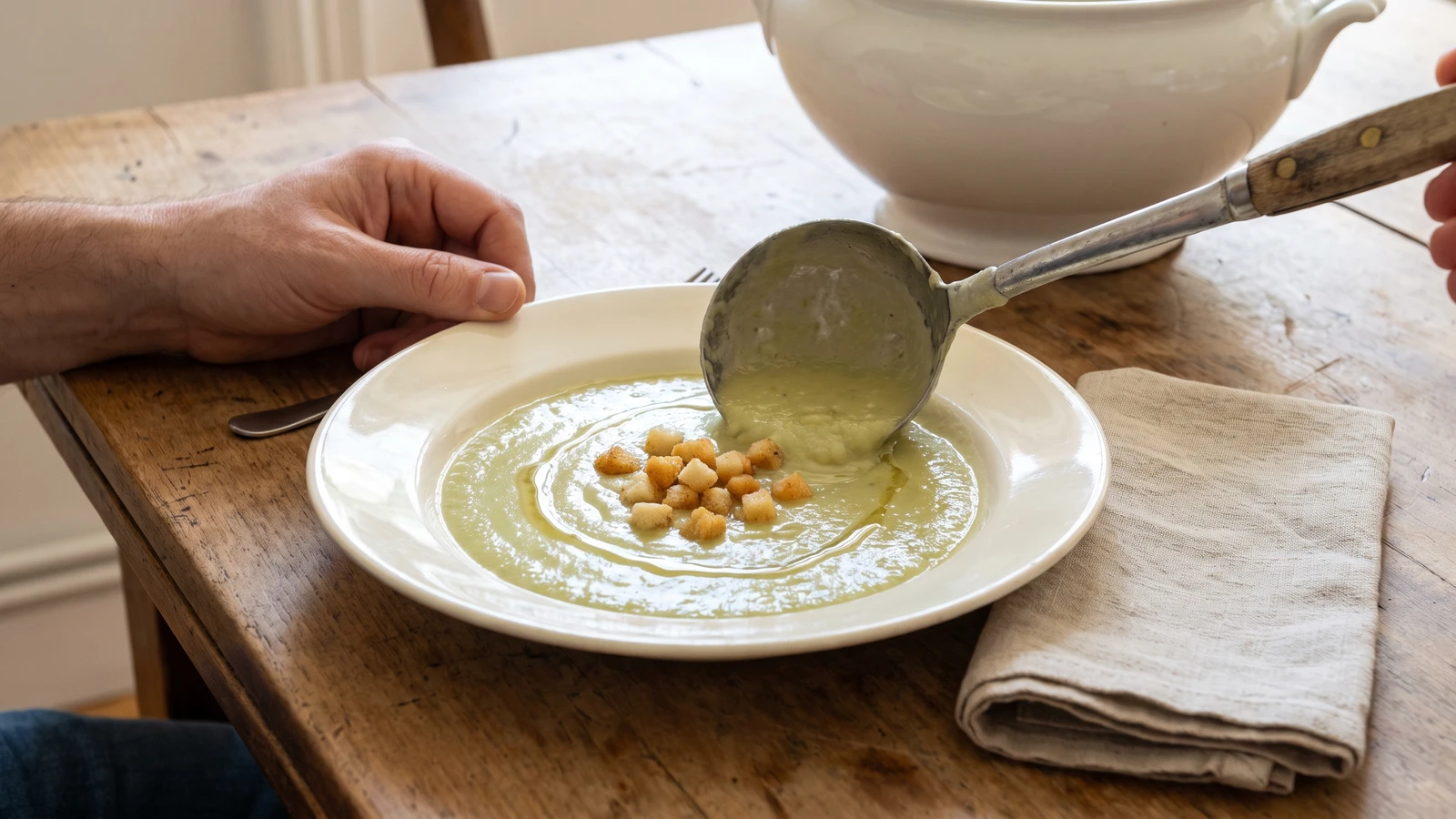
Musard teaches the central discipline of every legume purée: cook the bean until utterly tender, pass it fine, then loosen it carefully until the bowl is satin-smooth, pale green, and bright with butter.
Purée de Flageolets, dite Musard (silken flageolet soup), teaches one severe little truth: a bean purée can only be as smooth as the bean is tender. Let the flageolets cook past salad tenderness, until one collapses under the tongue; then their starch gives body without roux, and the passed soup settles in the bowl with a pale green gloss.
The original kitchen assumed a cook watching the soup pot, white consommé never off the fire, a mortar for pounding, a tammy for passing, and enough hands to boil milk while someone else skimmed. This two-quart translation gives one cook a food processor in place of the mortar, a fine-mesh sieve in place of the tammy, and good unsalted pale chicken stock when finished consommé isn't waiting. Those tools and brigade hands are scaffolding. The gentle cooking, true passing, boiled milk, and final butter are the dish, so they stay. One cook, one stove, one evening.
Fresh flageolets, used at twice the dry volume just as the source directs, make the sweeter, greener bowl; dried beans make the sound pantry version. Before you touch the pan, remember the point that cannot be bargained away: cook the beans completely before you pass them. Grit cannot be sieved into silk.
Musard belongs to the classical Parisian soup course, where the household practice of simmering dried legumes was refined into named purées by passing them through a tammy and adjusting them with stock, milk, and butter. Its identity is technical rather than regional: the cooking aromatics are removed, the skins are passed away, and butter-fried bread dice provide the only garnish. The canon also permits a velouté or cream treatment, preferably made with fresh flageolets and finished with tiny beans and chervil pluches.
Quantity
1¾ cups (425 ml / 340 g) dried, or 3½ cups (850 ml / 600 g) fresh
dried beans soaked and drained; fresh beans left unsoaked
Quantity
10 cups (2.4 L / 2.4 kg), plus more if needed
Quantity
1 (about 115 g)
peeled, halved, and studded with the clove
Quantity
1 (about 70 g)
peeled and halved lengthwise
Quantity
1
Quantity
1
Quantity
2 teaspoons (10 ml / 12 g), divided, plus more as needed
Quantity
½ to 1 cup (120 to 240 ml / 120 to 240 g)
reserved after draining the beans
Quantity
2 cups (475 ml / 475 g)
Quantity
2 cups (475 ml / 490 g), plus a little more if needed
Quantity
4 tablespoons (60 ml / 57 g)
1 tablespoon for the bread dice; 3 tablespoons chilled and cubed for finishing
Quantity
2 tablespoons (30 ml / 12 g)
cut into ¼-inch (6 mm) dice
| Ingredient | Quantity |
|---|---|
| dried flageolets, or fresh shelled flageoletsdried beans soaked and drained; fresh beans left unsoaked | 1¾ cups (425 ml / 340 g) dried, or 3½ cups (850 ml / 600 g) fresh |
| cold water | 10 cups (2.4 L / 2.4 kg), plus more if needed |
| small onionpeeled, halved, and studded with the clove | 1 (about 115 g) |
| small carrotpeeled and halved lengthwise | 1 (about 70 g) |
| whole clove | 1 |
| bouquet garni of parsley stems, thyme, and bay leaf | 1 |
| fine salt | 2 teaspoons (10 ml / 12 g), divided, plus more as needed |
| reserved flageolet cooking liquorreserved after draining the beans | ½ to 1 cup (120 to 240 ml / 120 to 240 g) |
| white consommé, or unsalted pale chicken stock | 2 cups (475 ml / 475 g) |
| whole milk | 2 cups (475 ml / 490 g), plus a little more if needed |
| unsalted butter1 tablespoon for the bread dice; 3 tablespoons chilled and cubed for finishing | 4 tablespoons (60 ml / 57 g) |
| day-old white breadcut into ¼-inch (6 mm) dice | 2 tablespoons (30 ml / 12 g) |
For the overnight method, cover the dried flageolets generously with cold water and soak them for 8 to 12 hours, then drain. For one-evening cooking, cover the unsoaked beans with water, boil for 2 minutes, cover, and leave off the heat for 1 hour before draining. Fresh flageolets need no soaking; their quantity is twice the dry volume, preserving the source's proportion.
Put the flageolets in a heavy saucepan with the 10 cups of water, onion and clove, carrot, bouquet garni, and 1 teaspoon of the salt. Bring slowly to a boil and skim away the first froth, then lower the heat, partially cover, and maintain a quiet simmer. Fresh beans may need 30 to 40 minutes; soaked dried beans usually need 60 to 90 minutes. Add boiling water whenever the beans threaten to rise above the liquid. They are ready only when one crushes into cream between your tongue and palate, with no firm or chalky centre.
Set a sieve over a heatproof bowl and drain the flageolets, reserving at least 1 cup of their cooking liquor. Remove and discard the onion, clove, carrot, and bouquet garni; they have given what the soup needs and should not be ground into it. Keep the beans hot, because warm starch passes more willingly than cold starch.
Transfer the hot beans to a food processor and add ½ cup of the reserved cooking liquor. Process to a thick, even paste, adding more liquor a tablespoon at a time only if the blades struggle. Force the paste through a fine-mesh sieve with a flexible scraper while it is still warm. Do not skip this passing; removing the skins is what separates Musard from an ordinary blended bean soup. If the paste feels gritty or refuses to pass, stop. Return it to the pot with another splash of cooking liquor, simmer for 10 to 15 minutes, then process and pass it again. Ça se rattrape. Forcing harder cannot cook an unripe starch.
Bring the milk just to a boil in a small saucepan, then remove it from the heat; this is the boiled milk specified by the source. Warm the white consommé or pale chicken stock separately. Put the passed flageolet paste in a clean saucepan and whisk in the hot consommé a little at a time, followed by the hot milk, stopping to judge the texture between additions. The finished purée should coat a spoon lightly, then slide from it in a broad sheet. If it is too thick after the measured liquids are added, loosen it with a little more hot milk; if it is too thin, correct it during the gentle simmer that follows.
Bring the purée only to a bare simmer and hold it there for 10 to 12 minutes, stirring across the bottom often. As foam or a thin skin gathers, lift it away with a shallow spoon; this despumating gives the soup its clean finish and lets the bean taste sweet rather than dusty. An overly thin purée can reduce here until it lightly coats the spoon. If the bottom catches, do not scrape the scorched layer into the soup. Pour the clean upper portion into another pan and continue gently.
Melt 1 tablespoon of the butter in a small skillet over medium heat. When the foam subsides, add the tiny bread dice and toss them until every side is crisp and evenly golden. Lift them onto a small plate and keep them separate from the soup until serving, or they will surrender their crisp edges.
Remove the purée from the heat. Montez au beurre, finish by whisking in the remaining 3 tablespoons of cold butter one small piece at a time, allowing each piece to disappear before adding the next. Taste and correct the salt. Do not boil the soup after the butter goes in; if butter beads appear on the surface, pull the pan fully off the heat and whisk in a spoonful of hot milk until the sheen returns. Ladle into warm bowls and scatter the butter-fried bread dice over each serving at the last moment. À table!
1 serving (about 240g)
Culinary guides, cultural storytelling, and the editorial depth that makes cooking meaningful.
Discover Culinary ExplorerChef Juliette
Marseille's great fish stew, saffron-gold and garlic-scented, proves that a hard boil can be the careful choice: it binds olive oil into broth before the whole pot meets bread.

Chef Juliette
Waterzoi asks fresh, bone-in river fish to thicken its own buttery broth, with parsley root and pepper for company. No flour, no stockpot, just a brisk simmer watched closely.
Chef Juliette
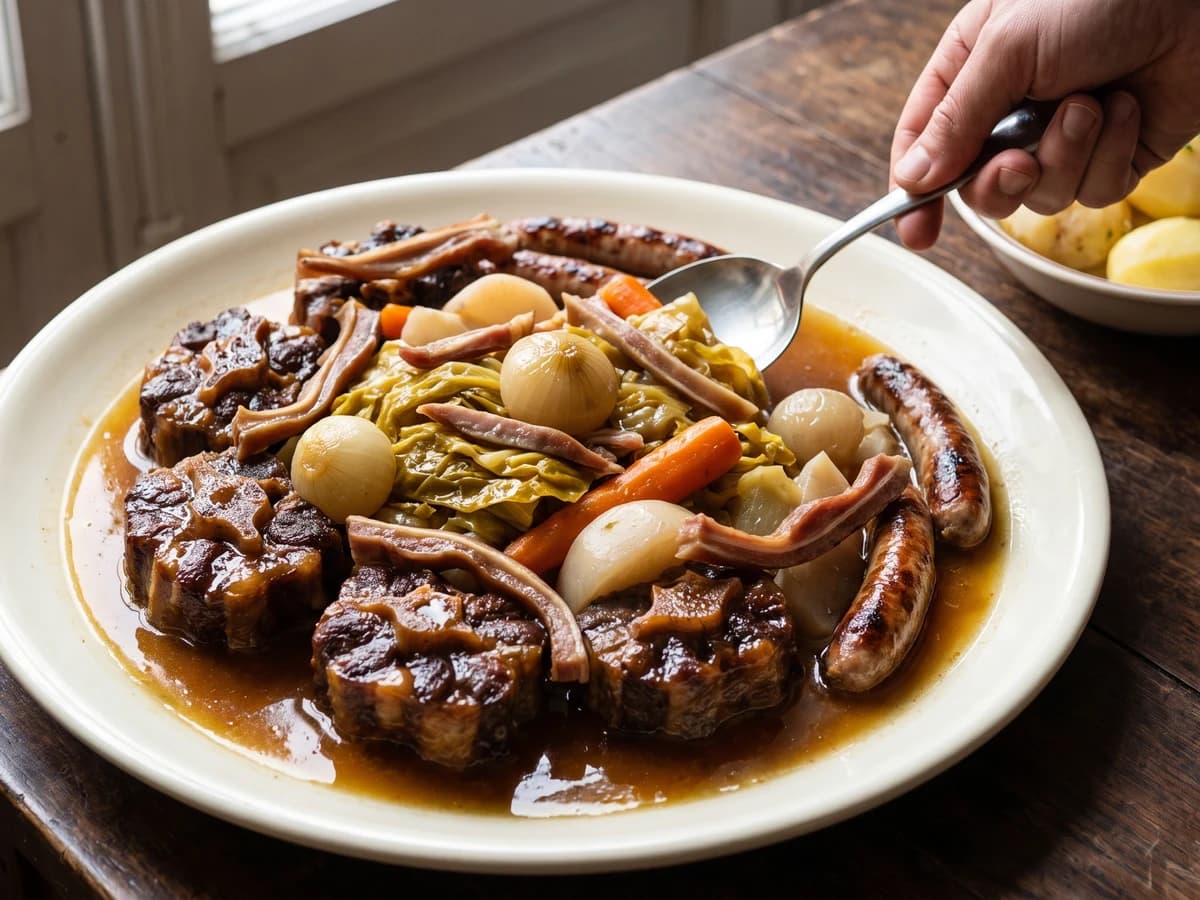
Queue de Bœuf en Hochepot gathers oxtail, pig's trotter and ear, cabbage, roots, and grilled chipolatas around a clear, gelatin-rich broth whose quiet simmer keeps every piece tender and distinct.

Chef Juliette
Beef shoulder larded with bacon, sharpened by red wine and vinegar, then sealed with garlic, vegetables, and dry lemon peel until the low oven turns it yielding and the gravy darkly glossy.