
Chef Juliette
Bouillabaisse à la Marseillaise
Marseille's great fish stew, saffron-gold and garlic-scented, proves that a hard boil can be the careful choice: it binds olive oil into broth before the whole pot meets bread.
A cooking platform built around craft, culture, and the stories behind what we eat.

Created by Chef Juliette
Based on No. 604, Consommé Rachel, from Le Guide Culinaire (1907) by Auguste Escoffier
Clear chicken consommé gains a silken body from tapioca, then meets crisp butter-fried croûtes crowned with tender marrow and fine artichoke julienne, a formal tureen made entirely manageable at home.
Consommé Rachel (clarified chicken broth with tapioca, marrow-topped fried bread rounds, and artichoke) teaches one true thing: refinement depends on control, not complication. The consommé must keep its clarity while gaining the faintest silken body, the marrow must poach without melting, and the croûtes must reach the tureen while their butter-browned edges are still crisp.
The old entry assumed a stockpot never off the fire and spare brigade hands to sieve tapioca, poach marrow, fry bread, and assemble the tureen at the last breath. Here, two of its one-quart service units make one home tureen for eight first courses. A fine nylon sieve replaces linen, a 1¼-inch cutter replaces the ambiguous penny-sized stamp, and two saucepans with one skillet replace the extra hands. Constant holding is brigade scaffolding and can go. The clarified consommé, exact measure of tapioca, marrow, artichoke julienne, and last-minute frying are the dish and must stay. One cook, one stove, one evening.
When it is right, the broth is amber and limpid, the artichoke lies in pale matchsticks beneath it, and each little croûte carries a trembling coin of marrow. The decisive step is the tapioca: press it smooth while warm, incorporate it gently, and never let the finished consommé boil.
Consommé Rachel belongs to the formal Parisian table rather than to a regional French larder, and its name is generally linked to the celebrated tragedienne known simply as Rachel, following the grand-kitchen custom of dedicating composed dishes to figures of the stage. Its construction is rigorously classical: clarified chicken broth for purity, tapioca for nearly invisible body, marrow croûtes for richness, and artichoke for a mild vegetal counterpoint. Tureen service carried preparations like this from grand kitchens into bourgeois dinner-party cooking, where every element could be prepared ahead and united in the final minutes.
Quantity
10 cups (2.4 L / 2.4 kg)
cold and divided: 8 cups for the soup and up to 2 cups for poaching and adjustment
Quantity
¼ cup (60 ml / 40 g)
to yield 6 tablespoons of poached tapioca paste
Quantity
4 cups (960 ml / 960 g)
for poaching the tapioca
Quantity
8 slices
cut ½ inch thick, enough for twenty-four 1¼-inch roundels
Quantity
½ cup (120 ml / 110 g)
for frying
Quantity
¾ cup (180 ml / 170 g)
removed from center-cut bones in intact cylinders and thoroughly chilled
Quantity
6 tablespoons (90 ml / 75 g)
cut julienne-fashion
| Ingredient | Quantity |
|---|---|
| finished chicken consommécold and divided: 8 cups for the soup and up to 2 cups for poaching and adjustment | 10 cups (2.4 L / 2.4 kg) |
| fine small-pearl tapiocato yield 6 tablespoons of poached tapioca paste | ¼ cup (60 ml / 40 g) |
| cold waterfor poaching the tapioca | 4 cups (960 ml / 960 g) |
| day-old pain de miecut ½ inch thick, enough for twenty-four 1¼-inch roundels | 8 slices |
| clarified butterfor frying | ½ cup (120 ml / 110 g) |
| very fresh beef marrowremoved from center-cut bones in intact cylinders and thoroughly chilled | ¾ cup (180 ml / 170 g) |
| cooked artichoke bottomscut julienne-fashion | 6 tablespoons (90 ml / 75 g) |
Bring the water to a quiet simmer in a medium saucepan. Rain in the tapioca while stirring, then poach it gently for 20 to 25 minutes, stirring often, until every pearl is translucent and collapses readily under a spoon. Drain without rinsing. While it is still warm, press the tapioca through a sturdy fine-mesh nylon sieve with a flexible scraper until you have a smooth paste, then measure exactly 6 tablespoons (90 ml / about 90 g). If the tapioca cools and turns stubborn before it passes through, warm it with a spoonful of water. Ça se rattrape. Forcing cold pellets through the sieve only leaves lumps.
Pour 8 cups of cold chicken consommé into a clean saucepan. In a bowl, loosen the measured tapioca paste with 1 cup of the consommé, whisking until perfectly smooth, then stir this mixture back into the pan. Heat slowly to about 180°F (82°C), below a simmer, and hold it there for 8 to 10 minutes. The consommé should remain clear enough to see through, with only a slight satin weight on the spoon. If small lumps appear, remove the pan from the heat and pass the liquid through damp cheesecloth without squeezing. If it tightens beyond that faint body, loosen it with a little reserved consommé.
Cut the cooked artichoke bottoms julienne-fashion, meaning into fine match-shaped rods, and measure 6 tablespoons. Stamp twenty-four 1¼-inch roundels from the crumb of the pain de mie, keeping each one a full ½ inch thick. Slice the very cold marrow into twenty-four coins and trim each just smaller than a bread round. Chilling makes clean slices possible; warm marrow smears under the knife.
Heat 1½ cups of the reserved consommé in a small saucepan to 170 to 175°F (77 to 79°C), where the surface barely moves. Lower in the marrow coins in two batches and poach for 1½ to 2 minutes, until their edges turn opaque, the centers remain supple, and the marrow reaches 145°F (63°C). Lift each coin carefully with a small slotted spoon and hold it on a warm plate. If the marrow begins dissolving into the liquid, pull the pan off the heat at once and remove the slices. Broken pieces can be fitted into the hollowed croûtes, and no one at the table will know.
Begin exactly six minutes before serving. Heat the clarified butter in a skillet until it shimmers, then fry the bread roundels in batches for 45 to 60 seconds per side, until evenly butter-gold and crisp at the edges. Drain briefly. While they are warm, use a ¾-inch cutter or the tip of a paring knife to hollow a shallow well in each center without piercing the bottom. Crown every croûte with one poached marrow coin. If the bread drinks butter instead of browning, the fat is too cool; lift the pieces out, restore the heat, and fry them briefly once more.
Bring the thickened consommé back to 180°F (82°C), still without boiling. Warm the soupière with hot water, empty it, and dry it well. Scatter the artichoke julienne across the bottom, pour over the consommé, and set the twenty-four marrow croûtes on the surface. Carry the tureen straight to the table, because the contrast between crisp bread, yielding marrow, and silken broth waits for no speech. À table!
1 serving (about 290g)
Culinary guides, cultural storytelling, and the editorial depth that makes cooking meaningful.
Discover Culinary ExplorerChef Juliette
Marseille's great fish stew, saffron-gold and garlic-scented, proves that a hard boil can be the careful choice: it binds olive oil into broth before the whole pot meets bread.

Chef Juliette
Waterzoi asks fresh, bone-in river fish to thicken its own buttery broth, with parsley root and pepper for company. No flour, no stockpot, just a brisk simmer watched closely.
Chef Juliette
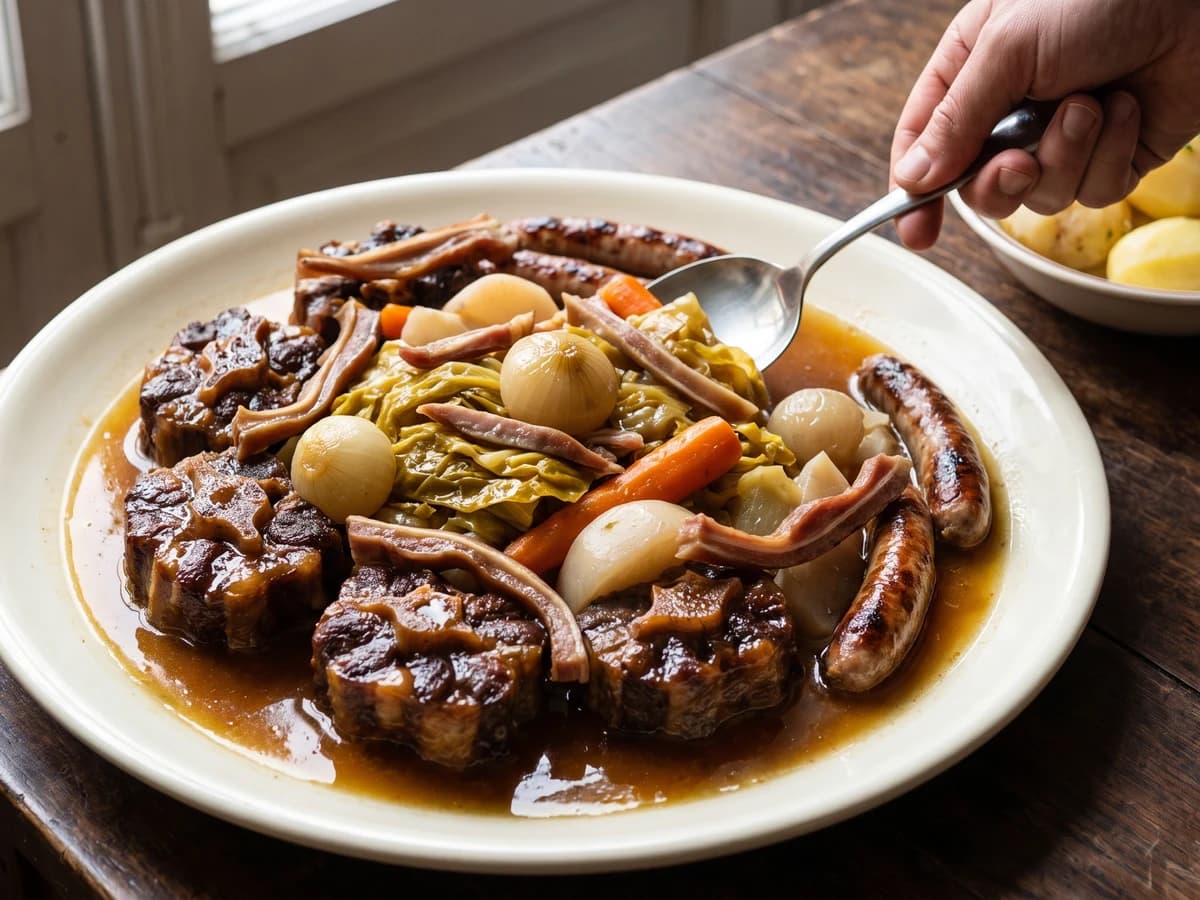
Queue de Bœuf en Hochepot gathers oxtail, pig's trotter and ear, cabbage, roots, and grilled chipolatas around a clear, gelatin-rich broth whose quiet simmer keeps every piece tender and distinct.

Chef Juliette
Beef shoulder larded with bacon, sharpened by red wine and vinegar, then sealed with garlic, vegetables, and dry lemon peel until the low oven turns it yielding and the gravy darkly glossy.