
Chef Juliette
Bouillabaisse à la Marseillaise
Marseille's great fish stew, saffron-gold and garlic-scented, proves that a hard boil can be the careful choice: it binds olive oil into broth before the whole pot meets bread.
A cooking platform built around craft, culture, and the stories behind what we eat.

Created by Chef Juliette
Based on No. 603, Consommé aux Profiterolles, from Le Guide Culinaire (1907) by Auguste Escoffier
Forty tiny, bone-dry choux meet a limpid chicken consommé only as the bowls leave the kitchen, preserving the lovely argument between a crisp shell and deeply savory broth.
Consommé aux Profiterolles (clear chicken consommé with tiny savory choux) teaches one true thing: components that depend on contrast must remain apart until the last possible moment. The broth should be perfectly clear and deeply flavored, the profiterolles dry enough to feel almost weightless. Bring them together too soon and the dish loses its reason for being.
The source assumed the brigade's stockpot never left the fire, a pastry station produced trays of choux, and a saucier, the sauce cook, kept service moving. At home, you begin with a finished two-quart batch of excellent chicken consommé and forty Profiterolles for Soups (No. 218), refreshing the shells in an ordinary oven only if storage has softened them. No salamander enters this preparation; the moderate, even oven heat named by the source is exactly right. Perpetual hot holding and brigade quantities are scaffolding, so they go. Clear broth, very dry shells, and last-second service are the dish, so they stay. One cook, one stove, one evening.
When it is right, the amber broth gleams around forty pale-gold shells, and the first spoonful meets a crisp crust before the consommé reaches it. Test the dryness before anyone sits down. If a cooled shell dents instead of holding firm, return the batch to the low oven and cool it again. Ça se rattrape.
Consommé aux Profiterolles belongs to the formal Parisian table, where a consommé took its name from the garnish placed in its perfectly clear broth and the cook's precision remained visible at a glance. These profiterolles are not sweet cream puffs misplaced in soup: in the classical savory register, the word also names tiny unsweetened choux shells, sometimes served plain and sometimes made walnut-sized and filled with chicken or foie gras purée. Because the broth and shells could be prepared separately, the dish traveled neatly from grand service to the bourgeois dinner table, with their last-second meeting preserving the essential contrast.
Quantity
2 quarts (1.9 L / about 1.9 kg)
clarified, completely degreased, and fully seasoned
Quantity
40 Profiterolles for Soups (No. 218)
baked very dry, fully cooled, and about the size of large hazelnuts
| Ingredient | Quantity |
|---|---|
| excellent chicken consomméclarified, completely degreased, and fully seasoned | 2 quarts (1.9 L / about 1.9 kg) |
| Profiterolles for Soupsbaked very dry, fully cooled, and about the size of large hazelnuts | 40 Profiterolles for Soups (No. 218) |
Heat the oven to 300°F (150°C). Spread the 40 Profiterolles for Soups (No. 218) on a baking sheet without crowding them. Freshly baked, fully cooled shells need only be checked; stored shells should return to the oven for 8 to 10 minutes, until their surfaces are firm and they sound hollow when tapped. Cool them completely on a wire rack. Warm shells can seem crisp while remaining damp inside, so judge them only after cooling. If one dents or feels leathery, bake the batch for another 5 minutes and cool again. Ça se rattrape.
While the shells cool, warm ten shallow soup bowls and a 2½-quart soupière, the covered soup tureen, with hot water. Drain and dry them thoroughly just before service. Warm porcelain protects the consommé's temperature, but every bowl must be dry before the profiterolles enter it.
Pour the chicken consommé into a clean 3-quart saucepan and heat it gently until the surface shimmers and tiny bubbles gather at the rim, about 180 to 185°F (82 to 85°C). Do not reduce it or let it roll at a boil; the broth is already finished, and rough heat can disturb its fat and dull its clarity. Skim the surface quietly if necessary. If it boils, remove it from the heat at once, leave it untouched for 2 minutes, then skim and pass it slowly through damp muslin if disturbed fat remains.
Transfer the hot consommé to the warmed soupière and cover it. Once everyone is seated, place exactly four dry profiterolles in each warm bowl. Ladle about 6½ fluid ounces (190 ml) of consommé around them, letting the broth rise rather than striking the shells directly. Serve each bowl immediately, with no garnish and no waiting. The moment broth touches choux, the clock begins. À table!
1 serving (about 200g)
Culinary guides, cultural storytelling, and the editorial depth that makes cooking meaningful.
Discover Culinary ExplorerChef Juliette
Marseille's great fish stew, saffron-gold and garlic-scented, proves that a hard boil can be the careful choice: it binds olive oil into broth before the whole pot meets bread.

Chef Juliette
Waterzoi asks fresh, bone-in river fish to thicken its own buttery broth, with parsley root and pepper for company. No flour, no stockpot, just a brisk simmer watched closely.
Chef Juliette
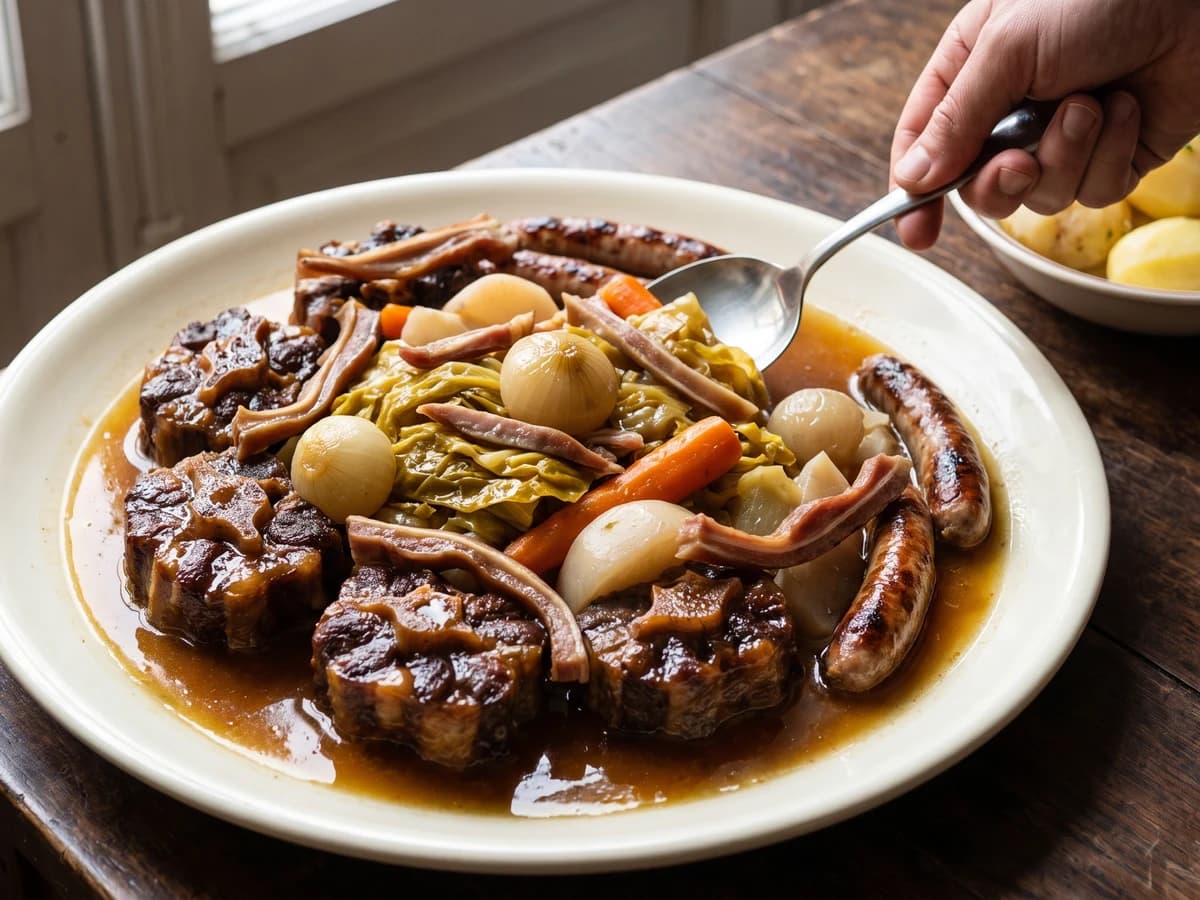
Queue de Bœuf en Hochepot gathers oxtail, pig's trotter and ear, cabbage, roots, and grilled chipolatas around a clear, gelatin-rich broth whose quiet simmer keeps every piece tender and distinct.

Chef Juliette
Beef shoulder larded with bacon, sharpened by red wine and vinegar, then sealed with garlic, vegetables, and dry lemon peel until the low oven turns it yielding and the gravy darkly glossy.