
Chef Juliette
Bouillabaisse à la Marseillaise
Marseille's great fish stew, saffron-gold and garlic-scented, proves that a hard boil can be the careful choice: it binds olive oil into broth before the whole pot meets bread.
A cooking platform built around craft, culture, and the stories behind what we eat.
Created by Chef Juliette
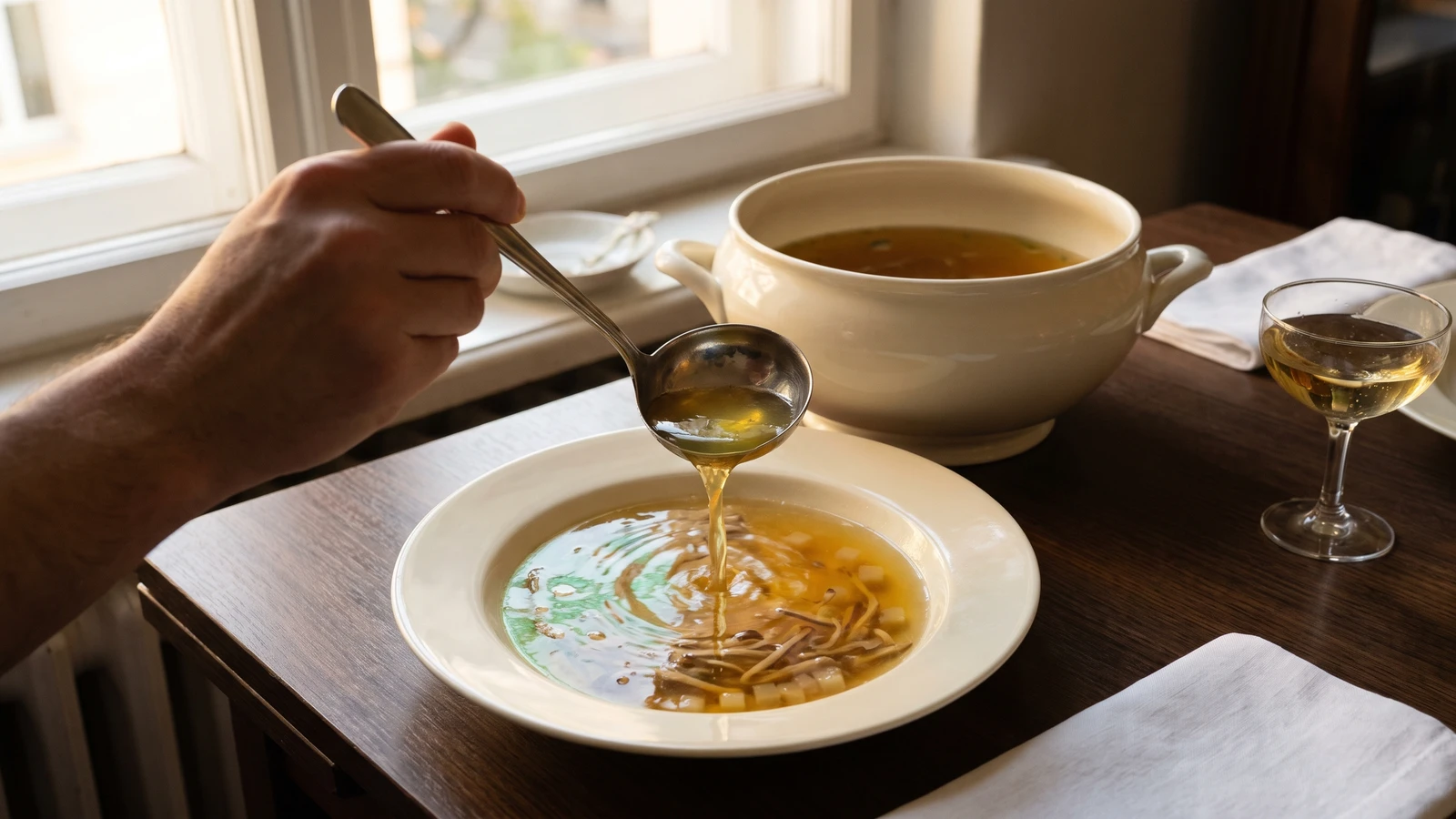
Based on No. 589, Consommé à la Moscovite, from Le Guide Culinaire (1907) by Auguste Escoffier
Crystal-clear sturgeon consommé, sharpened with fresh cucumber essence and poured over salted-mushroom julienne and tender vesiga: a Franco-Russian lesson in clarity, restraint, and keeping the pot below a boil.
Consommé à la Moscovite (Moscow-style clarified sturgeon broth) teaches one uncompromising thing: clarity is settled before the broth gets hot. Begin with cold stock, bring the clarification raft up slowly, and never let a rolling boil tear it apart. The reward is an amber-gold consommé that tastes distinctly of sturgeon, then turns cool and green at the finish from cucumber essence.
The classical formula assumed a saucier on staff, sturgeon stock never off the fire, linen ready for straining, and vesiga already soaking in the larder. The salamander can stay dark, because this dish lives entirely in the stockpot. At home, cold unsalted fish stock is strengthened and clarified with minced sturgeon and egg whites, tightly woven linen replaces the professional filter, and the quart formula is multiplied only to two quarts, enough for eight first-course bowls. One cook, one stove, one evening.
Holding several stocks all day was brigade scaffolding, so it goes. The sturgeon clarification, cucumber essence, salted-mushroom julienne, and well-soaked vesiga are the dish itself, so every one stays. Bring the raft up slowly and hold it at the barest tremble. That is the step that decides the consommé.
Consommé à la Moscovite belongs to the Franco-Russian grand table, where French consommé technique met the sturgeon, salted mushrooms, and cucumber of the Russian larder. Sterlet and sturgeon traveled from the Volga and Caspian trade into formal dining rooms, while French cooks organized those flavors inside a brilliantly clear broth and named the garnish à la Moscovite. Vesiga is often glossed as sturgeon spine-marrow, but it is the dried notochord, valued for the tender, faintly gelatinous bite it gains after soaking and cooking.
Quantity
12 cups (2.8 liters / 2.8 kilograms)
divided
Quantity
3 cups (710 ml / 450 g)
very finely chopped
Quantity
5 large (about 2/3 cup / 160 ml / 150 g)
Quantity
3/4 cup (180 ml / 110 g)
cut into small dice
Quantity
1/2 cup (120 ml / 70 g)
cut into small dice
Quantity
1/2 cup (120 ml / 60 g)
thinly sliced and washed
Quantity
1/3 cup (80 ml / 45 g)
thinly sliced
Quantity
8
Quantity
1
Quantity
8
lightly crushed
Quantity
2 large (about 1/4 cup / 60 ml / 60 g)
Quantity
1 ounce (28 g), yielding about 1/4 cup (60 ml / 55 g) cooked
soaked, diced, and cooked
Quantity
3 quarts (2.8 liters / 2.8 kilograms), plus more as needed
Quantity
1/4 cup (60 ml / 50 g)
drained and cut julienne-fashion
Quantity
1 large, about 2 cups (475 ml / 300 g) prepared
peeled, halved, and cored
Quantity
as needed
| Ingredient | Quantity |
|---|---|
| very cold unsalted clear white fish stock, preferably made with sturgeon framesdivided | 12 cups (2.8 liters / 2.8 kilograms) |
| skinless farmed sturgeon fillet or trimvery finely chopped | 3 cups (710 ml / 450 g) |
| large egg whites | 5 large (about 2/3 cup / 160 ml / 150 g) |
| yellow onioncut into small dice | 3/4 cup (180 ml / 110 g) |
| carrotcut into small dice | 1/2 cup (120 ml / 70 g) |
| leek, white part onlythinly sliced and washed | 1/2 cup (120 ml / 60 g) |
| celerythinly sliced | 1/3 cup (80 ml / 45 g) |
| parsley stems | 8 |
| bay leaf | 1 |
| white peppercornslightly crushed | 8 |
| additional large egg whites for reclarifying (optional) | 2 large (about 1/4 cup / 60 ml / 60 g) |
| dried vesigasoaked, diced, and cooked | 1 ounce (28 g), yielding about 1/4 cup (60 ml / 55 g) cooked |
| cold water for soaking the vesiga | 3 quarts (2.8 liters / 2.8 kilograms), plus more as needed |
| fermented salted mushroomsdrained and cut julienne-fashion | 1/4 cup (60 ml / 50 g) |
| cucumberpeeled, halved, and cored | 1 large, about 2 cups (475 ml / 300 g) prepared |
| fine sea salt | as needed |
Cover the dried vesiga generously with cold water and refrigerate it for four hours, changing the water twice. It should swell, soften, and bend without a hard core. If the centre still resists the knife, give it another hour in fresh cold water rather than forcing it; vesiga that isn't fully soaked stays leathery after cooking.
Reserve 1 1/2 cups (360 ml / 360 g) of the fish stock for cooking the vesiga and adjusting the finished consommé. In a tall stockpot, combine the remaining cold stock with the chopped sturgeon, five egg whites, onion, carrot, leek, celery, parsley stems, bay leaf, and peppercorns. Stir thoroughly while everything is cold so the proteins are dispersed through the stock; clumps now leave cloudy pockets later.
Set the pot over medium-low heat and scrape the floor gently and continuously with a flat wooden spoon as the stock warms. After 15 to 25 minutes, the egg whites and sturgeon will gather into a pale raft and rise to the surface. Stop stirring as soon as that raft seals, cut a small chimney through its centre, and hold the liquid at the barest tremble for 35 minutes, ladling a little broth through the chimney now and then. Never let it roll. If the raft fractures and the broth clouds, remove the pot from the heat, let the curds settle for 10 minutes, strain without pressing, and cool until no longer hot. Whisk in the two optional egg whites and repeat a gentle 20-minute clarification. Ça se rattrape.
Wet a piece of tightly woven clean linen with cold water, wring it out, and lay it inside a fine sieve over a clean pot. Ladle the consommé through the chimney and then through the linen, disturbing the raft as little as possible. Let gravity work. Pressing the raft forces its captured particles back into the broth. Measure 8 cups (1.9 liters / 1.9 kilograms) of clear consommé; if slightly short, add enough reserved hot stock to reach the measure, and if slightly over, hold the excess for another soup.
Drain the softened vesiga and cut it into neat 1/4-inch dice. Simmer it gently in 1 cup (240 ml / 240 g) of the reserved fish stock for 25 to 40 minutes, until tender and faintly gelatinous but still distinct under the teeth. Drain well. Save the cooking broth for another fish soup, but don't return it to this pot because the released gelatin can dull the consommé's clarity. Taste a salted mushroom; if fiercely salty, rinse it briefly and pat it dry, then cut it julienne-fashion into fine match-shaped rods.
Grate the peeled and cored cucumber finely, then pound or crush the pulp until wet and loose. Place it in a fresh piece of damp linen and let the clear essence drip into a bowl, pressing only gently at the end. A hard squeeze pushes fine pulp through and clouds the consommé. Aim for about 1/3 cup (80 ml / 80 g); if a little pulp escapes, pass the essence through clean linen once more.
Warm a 2 1/2-quart soup tureen and the serving bowls with hot water, then dry them. Put the salted-mushroom julienne and cooked vesiga in the tureen. Stir the cucumber essence into the consommé, taste, and season lightly, remembering that the mushrooms will bring more salt. Bring the consommé just to a boil and pour it immediately over the garnish. Ladle at the table while the broth remains brilliantly clear and the cucumber still tastes fresh. À table!
1 serving (about 240g)
Culinary guides, cultural storytelling, and the editorial depth that makes cooking meaningful.
Discover Culinary ExplorerChef Juliette
Marseille's great fish stew, saffron-gold and garlic-scented, proves that a hard boil can be the careful choice: it binds olive oil into broth before the whole pot meets bread.

Chef Juliette
Waterzoi asks fresh, bone-in river fish to thicken its own buttery broth, with parsley root and pepper for company. No flour, no stockpot, just a brisk simmer watched closely.
Chef Juliette
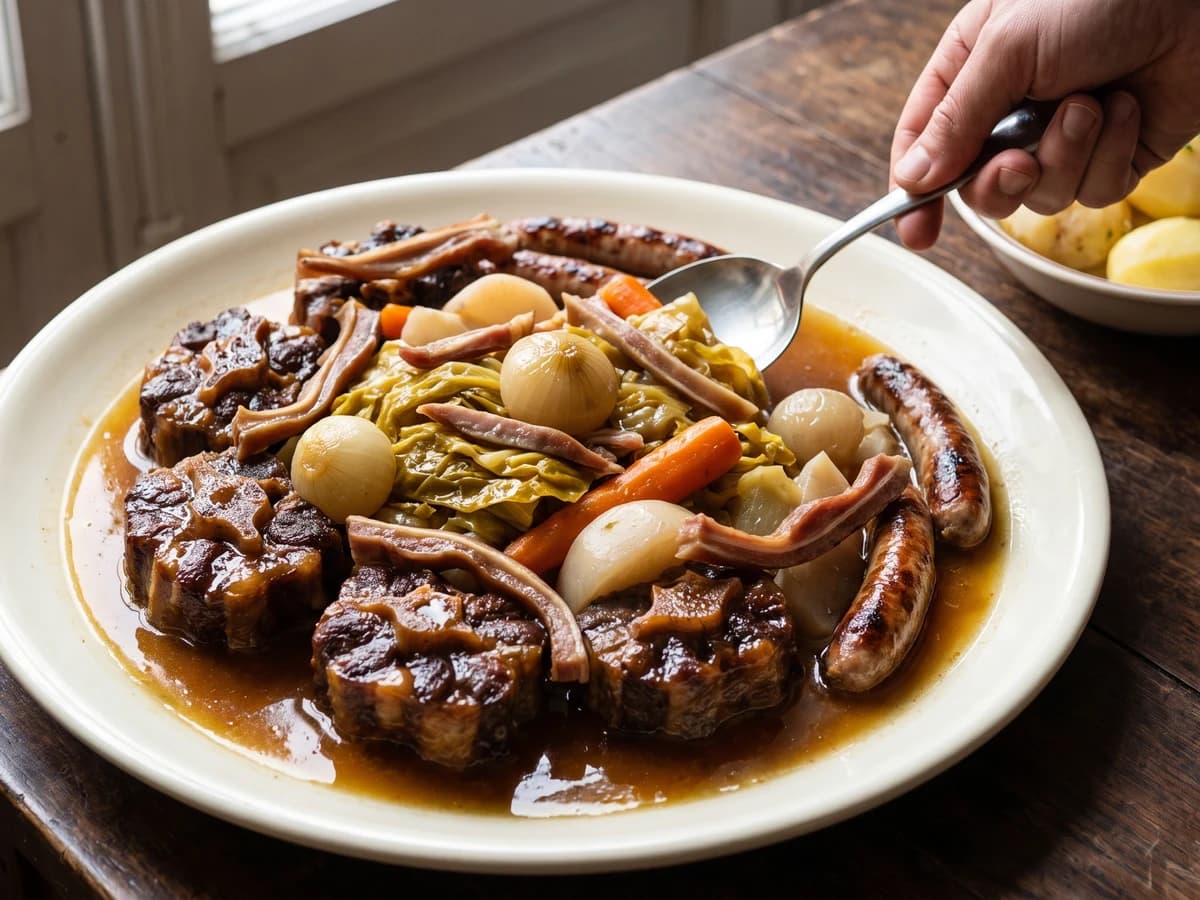
Queue de Bœuf en Hochepot gathers oxtail, pig's trotter and ear, cabbage, roots, and grilled chipolatas around a clear, gelatin-rich broth whose quiet simmer keeps every piece tender and distinct.

Chef Juliette
Beef shoulder larded with bacon, sharpened by red wine and vinegar, then sealed with garlic, vegetables, and dry lemon peel until the low oven turns it yielding and the gravy darkly glossy.