
Chef Juliette
Bouillabaisse à la Marseillaise
Marseille's great fish stew, saffron-gold and garlic-scented, proves that a hard boil can be the careful choice: it binds olive oil into broth before the whole pot meets bread.
A cooking platform built around craft, culture, and the stories behind what we eat.

Created by Chef Juliette
Based on No. 570, Consommé Germaine, from Le Guide Culinaire (1907) by Auguste Escoffier
Clear chicken consommé poured over emerald pea royale and tender chicken-cream pastilles, a study in contrast that brings the disciplined grand-kitchen soup to one home table.
Consommé Germaine (clear chicken broth garnished with green-pea custard and chicken-cream quenelles) teaches one severe, useful principle: clarity comes from keeping every garnish out of the broth until service. The emerald royale and ivory pastilles must be cooked separately, cooled or drained cleanly, then covered with brilliant consommé at the table. The contrast is the dish.
The original entry assumed a saucier on staff, chicken consommé never off the fire, two dariole moulds, small flared moulds, for each quart, and hands practiced at shaping eighteen identical quenelles. A home kitchen gets four buttered ramekins, a food processor, a shallow pan, and consommé prepared ahead. The quart formula is doubled to about two quarts for eight first courses, so its proportions remain intact: four royales and thirty-six pastilles. Hand-pounding and a separate cook for each component are brigade scaffolding and can go. The cold forcemeat, gentle bain-marie (water bath), separate poach, and last-minute pour must stay. One cook, one stove, one evening.
Before touching a pan, remember the one true thing: the consommé is for serving, never for cooking the garnish. Keep the custard water below a simmer and the quenelle water at a bare tremble. That discipline gives clean rounds, tender quenelles, and broth clear enough to show them.
Consommé Germaine belongs to the formal Parisian dining-room repertoire, where clear consommés were identified by their garnishes as carefully as classical sauces were identified by their derivatives. Germaine names the composition, not a pea-flavoured broth: clear chicken consommé receives rounds of green-pea royale scented with buttered Mirepoix (No. 228) and chervil, plus chicken-cream quenelles shaped as pastilles. The dish moved easily from brigade service to private dinner tables because every garnish can be prepared ahead, while the final act remains a simple pour from a hot soup pot.
Quantity
8 cups (1.9 L / 1.9 kg)
preferably gelatin-rich and well seasoned
Quantity
2 cups (475 ml / 290 g)
Quantity
2 tablespoons (30 ml / 30 g) Mirepoix (No. 228)
very finely diced and stewed in butter
Quantity
2
Quantity
2
Quantity
2 tablespoons loosely packed (30 ml / 4 g)
Quantity
1 teaspoon (5 ml / 5 g)
softened
Quantity
8 ounces (225 g)
sinew removed and meat diced
Quantity
1
Quantity
1/2 cup (120 ml / 120 g)
thoroughly chilled
Quantity
1 teaspoon (5 ml / 6 g)
divided
Quantity
1/4 teaspoon (1 ml / 0.6 g)
divided
| Ingredient | Quantity |
|---|---|
| clarified chicken consommépreferably gelatin-rich and well seasoned | 8 cups (1.9 L / 1.9 kg) |
| frozen petits pois | 2 cups (475 ml / 290 g) |
| Mirepoix (No. 228)very finely diced and stewed in butter | 2 tablespoons (30 ml / 30 g) Mirepoix (No. 228) |
| large eggs | 2 |
| large egg yolks | 2 |
| small chervil pluches | 2 tablespoons loosely packed (30 ml / 4 g) |
| unsalted buttersoftened | 1 teaspoon (5 ml / 5 g) |
| boneless, skinless chicken breastsinew removed and meat diced | 8 ounces (225 g) |
| large egg white | 1 |
| heavy creamthoroughly chilled | 1/2 cup (120 ml / 120 g) |
| fine sea saltdivided | 1 teaspoon (5 ml / 6 g) |
| ground white pepperdivided | 1/4 teaspoon (1 ml / 0.6 g) |
Chill the food-processor bowl and blade, the diced chicken, egg white, and cream for at least 20 minutes. Heat the oven to 300°F (150°C), butter four 4-ounce (120 ml) dariole, timbale, or straight-sided ramekin moulds, and arrange them on a folded towel in a small roasting pan. The towel keeps the moulds steady and softens the heat reaching the custard.
Blanch the petits pois in boiling water for 90 seconds, just until tender and brilliantly green. Drain them, cool them immediately under very cold running water, then drain again and press away excess moisture. Blend the peas with the whole eggs, yolks, 1/4 teaspoon of the salt, and a small pinch of white pepper until smooth. Press the mixture through a fine sieve, let it stand for 5 minutes, and skim away any froth. Fold in the Mirepoix (No. 228) and the chervil pluches, the small picked leaves, without beating air back into the mixture.
Divide the pea mixture among the buttered moulds. Pour hot water into the roasting pan until it reaches halfway up their sides, then cover the pan loosely with foil. Bake for 20 to 25 minutes, until the edges are set and the centres give one soft tremble; an instant-read thermometer should register about 160°F (71°C). If the surrounding water starts bubbling, add a little cold water and lower the oven heat at once. A boiling bain-marie makes holes and curdles the custard. Lift out the moulds, cool them, cover, and chill for at least 2 hours.
Reserve 1 tablespoon of the measured cream in the cold. Process the chilled chicken with the remaining salt and white pepper until it becomes a fine, sticky paste, scraping the bowl as needed. Add the egg white and process until absorbed. With the machine pulsing, add the remaining cream gradually, stopping as soon as the forcemeat is smooth and softly glossy. If it turns grainy or shows free liquid, stop immediately. Ça se rattrape: set the bowl over ice until thoroughly cold, then pulse in the reserved cream a teaspoon at a time. Scrape the finished forcemeat through a fine sieve and chill it for 20 minutes.
Bring 2 inches (5 cm) of water to 175°F to 180°F (79°C to 82°C) in a wide pan. Poach one teaspoon of forcemeat as a test until its centre reaches 165°F (74°C), then taste and correct the seasoning. Using two damp teaspoons, shape 36 short, flattened oval quenelles of about 2 teaspoons each, closer to pastilles than pointed dinner-course quenelles. Poach them in batches for 4 to 5 minutes, turning once. The water should barely move. If a tester frays, chill the forcemeat for another 15 minutes before trying again; if it swells and turns coarse, cool the poaching water before continuing. Lift the cooked quenelles onto a clean tray with a slotted spoon. Never poach them in the consommé, because their proteins would cloud it.
Run a thin knife around each cold royale and unmould it onto a chilled board. Slice it crosswise into rounds about 1/4 inch (6 mm) thick. If ramekins have produced wide slices, stamp regular 1 1/2-inch (4 cm) roundels with a plain cutter. Work while the royale is thoroughly cold. If it cracks, return it to the cold for 20 minutes; intact rounds can still be cut from the larger pieces.
Pass the chicken consommé through damp cheesecloth into a perfectly clean saucepan, leaving any sediment behind. Taste it cold enough to judge the seasoning, then bring it to a decisive boil only when the table is ready. Skim away any fat at the surface. If loose particles disturb its clarity, remove the pan from the heat, let them settle for a minute, and pass the broth through fresh damp cheesecloth once more.
Warm a soup tureen and the serving bowls with hot water, then dry them. Arrange the pea-royale roundels and poached chicken quenelles in the tureen, distributing them gently so the rounds remain whole. Pour the boiling chicken consommé over the garnish at the last possible moment and serve immediately. The hot broth warms the small garnishes without another cooking. À table!
1 serving (about 340g)
Culinary guides, cultural storytelling, and the editorial depth that makes cooking meaningful.
Discover Culinary ExplorerChef Juliette
Marseille's great fish stew, saffron-gold and garlic-scented, proves that a hard boil can be the careful choice: it binds olive oil into broth before the whole pot meets bread.

Chef Juliette
Waterzoi asks fresh, bone-in river fish to thicken its own buttery broth, with parsley root and pepper for company. No flour, no stockpot, just a brisk simmer watched closely.
Chef Juliette
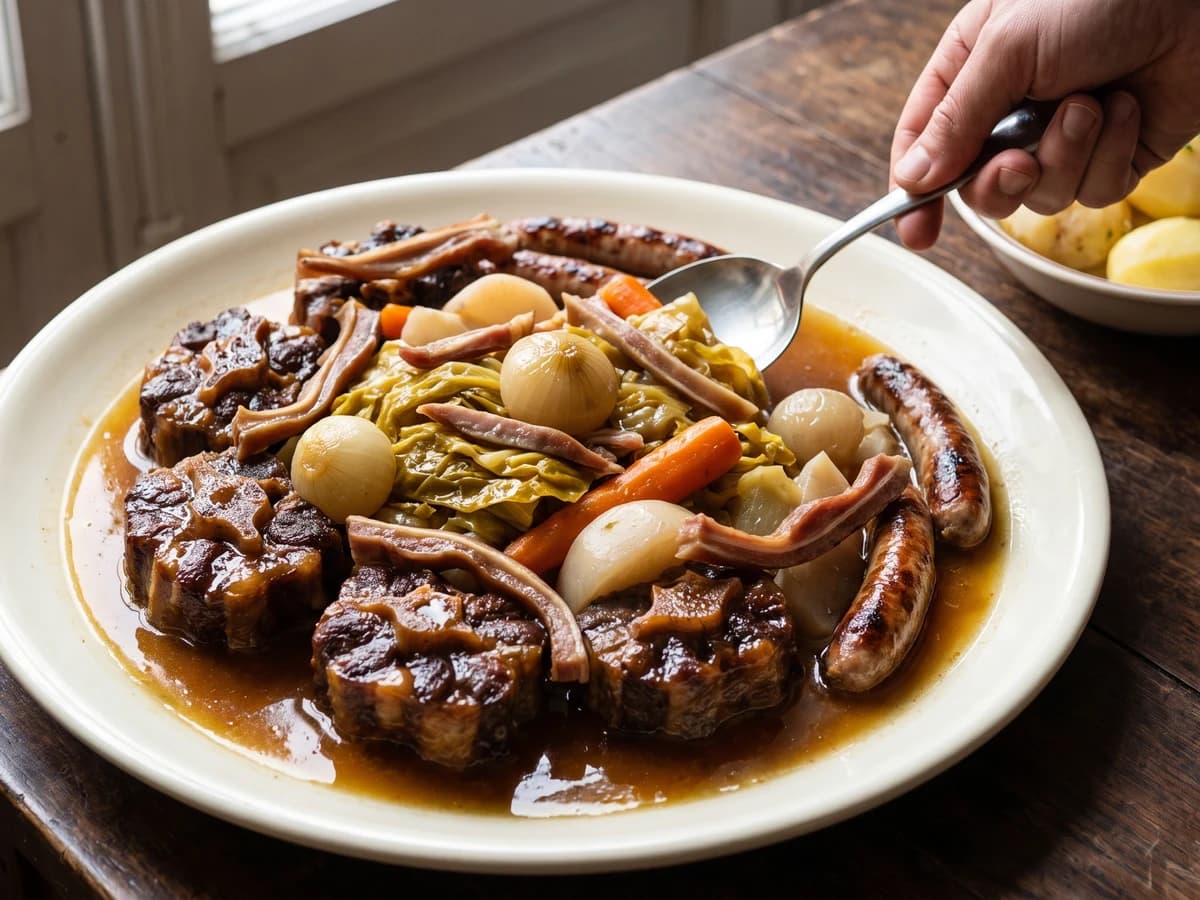
Queue de Bœuf en Hochepot gathers oxtail, pig's trotter and ear, cabbage, roots, and grilled chipolatas around a clear, gelatin-rich broth whose quiet simmer keeps every piece tender and distinct.

Chef Juliette
Beef shoulder larded with bacon, sharpened by red wine and vinegar, then sealed with garlic, vegetables, and dry lemon peel until the low oven turns it yielding and the gravy darkly glossy.