
Chef Juliette
Bouillabaisse à la Marseillaise
Marseille's great fish stew, saffron-gold and garlic-scented, proves that a hard boil can be the careful choice: it binds olive oil into broth before the whole pot meets bread.
A cooking platform built around craft, culture, and the stories behind what we eat.

Created by Chef Juliette
Based on No. 564, Consommé Douglas, from Le Guide Culinaire (1907) by Auguste Escoffier
A brilliant, highly seasoned consommé carrying neat penny rounds of cooled braised sweetbread and artichoke bottom, with green asparagus tips: refinement built on clarity, precise cutting, and a broth served fiercely hot.
Consommé Douglas (clear consommé with sweetbread, artichoke, and asparagus) teaches that clarity belongs to the garnish as much as to the broth. The one true thing to know before touching a pan is this: the sweetbread must be fully cooked, lightly pressed, and cold before the cutter meets it. Warm sweetbread smears and tears; cold sweetbread gives the clean penny roundels that make the tureen look composed rather than cluttered.
The original entry assumes a saucier with ordinary consommé never off the fire, a cold station handing over braised sweetbread and cooked artichoke bottoms, and another pair of hands keeping asparagus very green. It needs no salamander, and neither do you. One saucepan used in sequence, two plates and a weight for pressing, and a 1-inch plain round cutter in place of the old even cutter give the same result. The book gives one quart; this version doubles every garnish exactly for the requested two-quart home batch, with the ratio untouched.
Separate holding pots were brigade scaffolding and can go. The pressed sweetbread, matching artichoke rounds, green asparagus heads, and final pour of boiling, highly seasoned consommé are the dish and must stay. One cook, one stove, one evening. Chill the sweetbread until the knife leaves a dry edge; that is the step that decides Douglas.
Consommé Douglas belongs to the named garnished consommés of the Franco-British grand-kitchen table, where French service gave a clear base broth its distinct identity through what was placed in the tureen. Douglas is an honorific title, not a French regional soup, and the surviving formula defines it by three exact garnishes: braised sweetbread, artichoke bottoms, and green asparagus heads. It passed naturally to the domestic dinner party because the garnishes could wait, cut and cooled, while the consommé was brought to a boil at the last moment.
Quantity
1 lb (454 g)
Quantity
1 tablespoon (15 ml / 14 g)
Quantity
1/2 cup (120 ml / 70 g)
sliced
Quantity
1/3 cup (80 ml / 45 g)
sliced
Quantity
1 1/2 cups (360 ml / 360 g)
Quantity
2 teaspoons (10 ml / 12 g), divided, plus more as needed
Quantity
8 large (12 oz / 340 g)
Quantity
4 tablespoons, loosely filled (60 ml / 40 g)
cut 1 inch (2.5 cm) long
Quantity
2 quarts (1.9 L / about 1.9 kg)
preferably beef or veal based
| Ingredient | Quantity |
|---|---|
| raw veal heart sweetbread | 1 lb (454 g) |
| unsalted butter | 1 tablespoon (15 ml / 14 g) |
| yellow onionsliced | 1/2 cup (120 ml / 70 g) |
| carrotsliced | 1/3 cup (80 ml / 45 g) |
| light unsalted veal or chicken stock | 1 1/2 cups (360 ml / 360 g) |
| fine salt | 2 teaspoons (10 ml / 12 g), divided, plus more as needed |
| frozen artichoke bottoms | 8 large (12 oz / 340 g) |
| green asparagus headscut 1 inch (2.5 cm) long | 4 tablespoons, loosely filled (60 ml / 40 g) |
| finished, clear ordinary consommépreferably beef or veal based | 2 quarts (1.9 L / about 1.9 kg) |
Rinse the sweetbread and soak it in a bowl of very cold water for 1 hour, changing the water twice, until the last water remains nearly clear. Bring fresh water and 1 teaspoon of the salt to a bare simmer in a wide saucepan. Lower in the sweetbread and blanch it for 5 minutes, keeping the water gentle, then transfer it immediately to ice water. Once cool enough to handle, peel away the thick outer membrane and remove the obvious cords without picking so fiercely that the lobes fall apart.
Dry the saucepan and melt the butter over gentle heat. Add the onion and carrot with a pinch of salt, then cook for 5 minutes without browning. Set the sweetbread on top and add the stock, which should come about halfway up its sides. Cover and hold at a bare simmer for 20 to 25 minutes, turning once, until the sweetbread feels firm and reaches 160°F (71°C) at its thickest point. Lift it onto a parchment-lined plate, cover with a second sheet and plate, then add a 1 to 2 lb (450 to 900 g) weight. Let excess heat escape for 15 minutes and refrigerate under the weight for at least 2 hours.
Rinse the saucepan, fill it with fresh water, add the remaining teaspoon of salt, and bring it to a simmer. Cook the frozen artichoke bottoms until a small knife enters with slight resistance, 8 to 12 minutes; they must be tender but firm enough to cut. Drain them flat on a towel and cool. Bring fresh salted water to a boil, blanch the asparagus heads for 60 to 90 seconds until vivid green, then cool them in ice water and dry them thoroughly.
Slice the cold, pressed sweetbread into sections exactly 1/3 inch (8 mm) thick. With a smooth 1-inch (2.5 cm) round cutter, punch out 24 sweetbread roundels. Trim the artichoke bottoms to the same thickness and cut 24 matching roundels with the same cutter. If the sweetbread smears or tears, it isn't cold enough. Stop, rewrap the uncut pieces, press them lightly, and chill them for 20 minutes in the freezer or 45 minutes in the refrigerator before continuing. Ça se rattrape. Keep the finished garnish covered and cool, then remove it from the refrigerator 15 minutes before service.
Pour the finished ordinary consommé into the clean saucepan and bring it quickly to a full boil. Skim away any surface fat without disturbing the broth, then taste from a warm spoon and season with salt until the flavor is clear and emphatic. Highly seasoned does not mean peppery; ground pepper would mark the consommé with specks. If sediment rises, don't whisk it through. Let it settle for 2 minutes, pass the broth gently through damp double cheesecloth into the cleaned pan, and return it to a boil.
Warm a 3-quart soup tureen with boiling water, then empty and dry it. Put in all 24 sweetbread roundels, all 24 artichoke roundels, and the 4 tablespoonfuls of green asparagus heads, preserving the book's sequence and proportion. Pour the boiling consommé directly over the garnish and serve immediately, giving each bowl three rounds of sweetbread, three of artichoke, and an equal share of asparagus. Don't hold the filled tureen; waiting dulls the asparagus and cools the consommé. À table!
1 serving (about 325g)
Culinary guides, cultural storytelling, and the editorial depth that makes cooking meaningful.
Discover Culinary ExplorerChef Juliette
Marseille's great fish stew, saffron-gold and garlic-scented, proves that a hard boil can be the careful choice: it binds olive oil into broth before the whole pot meets bread.

Chef Juliette
Waterzoi asks fresh, bone-in river fish to thicken its own buttery broth, with parsley root and pepper for company. No flour, no stockpot, just a brisk simmer watched closely.
Chef Juliette
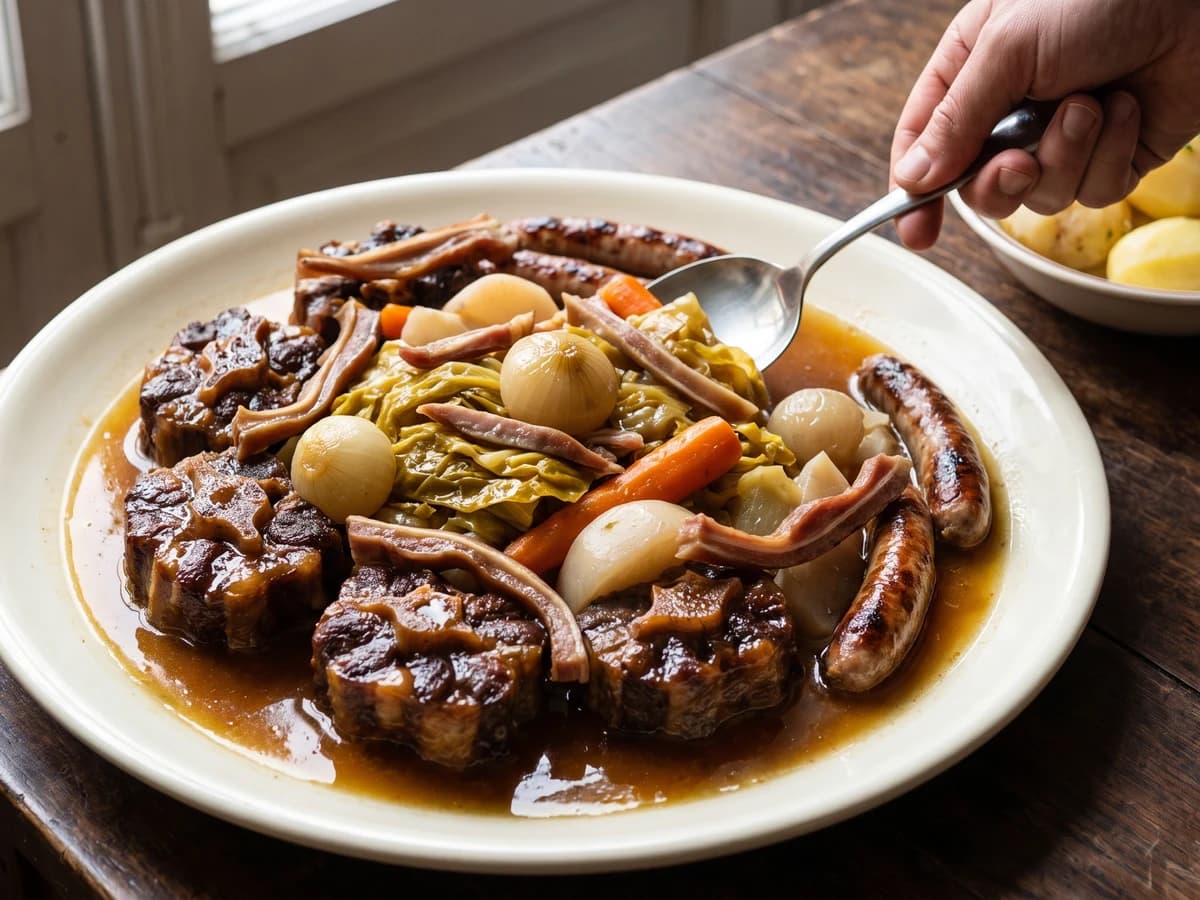
Queue de Bœuf en Hochepot gathers oxtail, pig's trotter and ear, cabbage, roots, and grilled chipolatas around a clear, gelatin-rich broth whose quiet simmer keeps every piece tender and distinct.

Chef Juliette
Beef shoulder larded with bacon, sharpened by red wine and vinegar, then sealed with garlic, vegetables, and dry lemon peel until the low oven turns it yielding and the gravy darkly glossy.