
Chef Juliette
Bouillabaisse à la Marseillaise
Marseille's great fish stew, saffron-gold and garlic-scented, proves that a hard boil can be the careful choice: it binds olive oil into broth before the whole pot meets bread.
A cooking platform built around craft, culture, and the stories behind what we eat.
Created by Chef Juliette
Based on No. 541, Consommé Andalouse, from Le Guide Culinaire (1907) by Auguste Escoffier
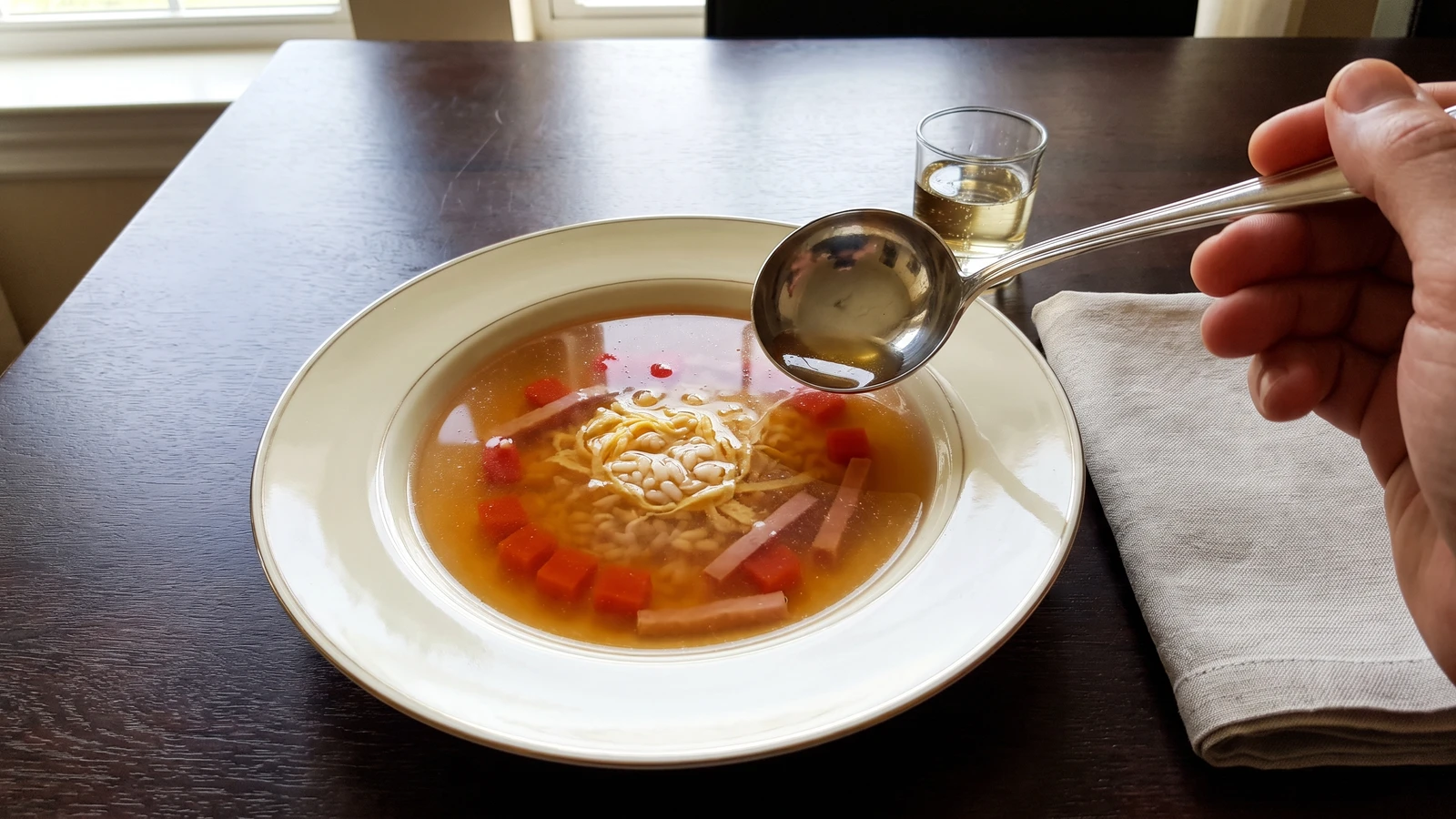
Consommé Andalouse sets a jewel-clear chicken broth around tomato royale, ham julienne, separate grains of rice, and fragile egg threads, a lesson in precision whose final pour must be swift and gentle.
Consommé Andalouse teaches the discipline of garnish. The broth can be brilliant and the royale tender, but if the rice clumps or the egg threads break, the whole bowl looks muddled. The one true thing before you touch a pan is this: clarity must be protected at every handoff, because it cannot be stirred back into the soup.
The original recipe assumed a stockpot of clarified chicken consommé never off the range, a separate cook to prepare Threaded Eggs (No. 217), and a small baba mould ready for the tomato royale. At home, one well-made consommé prepared ahead, one six-ounce ramekin, and the finished egg preparation do the same work. The quart formula is doubled here to about two quarts for eight first-course servings, keeping the measured ham, rice, and egg ratios intact. The separate stations were brigade scaffolding and can go; the clear broth, well-chilled royale, distinct rice grains, and unbroken threads are the dish. One cook, one stove, one evening.
When it lands, the broth is amber and transparent, red tomato dice hold sharp edges, and pale egg threads drift among pink ham and white grains of rice. The final pour decides it: the tureen must be warm, the consommé boiling, and your hand gentle. No stirring afterward.
Consommé Andalouse belongs to the Parisian classical dining-room repertoire, where a family of named consommés was distinguished by exact garnishes set against a common clear broth. Andalouse is the French kitchen's title for this combination of tomato royale, rice, ham, and egg, an evocation of Spain rather than an Andalusian household soup. Its move to the home table changed the scale and the mould, not the grammar: a lucid consommé and neatly distinct garnishes still carry the name.
Quantity
½ teaspoon (2.5 ml / 3 g)
softened, for the mould
Quantity
¼ cup (60 ml / 65 g)
preferably canned and passed through a fine sieve
Quantity
1
Quantity
1
Quantity
⅛ teaspoon (0.6 ml / 0.75 g)
Quantity
1⁄16 teaspoon (0.3 ml / 0.15 g)
Quantity
2 tablespoons (30 ml / 25 g)
cut en julienne (matchsticks)
Quantity
2 tablespoons (30 ml / 30 g)
with every grain distinct
Quantity
8 cups (2 L / 2 kg)
well skimmed and correctly seasoned
| Ingredient | Quantity |
|---|---|
| unsalted buttersoftened, for the mould | ½ teaspoon (2.5 ml / 3 g) |
| smooth tomato puréepreferably canned and passed through a fine sieve | ¼ cup (60 ml / 65 g) |
| large egg | 1 |
| large egg yolk | 1 |
| fine salt | ⅛ teaspoon (0.6 ml / 0.75 g) |
| ground white pepper | 1⁄16 teaspoon (0.3 ml / 0.15 g) |
| cooked hamcut en julienne (matchsticks) | 2 tablespoons (30 ml / 25 g) |
| cooked long-grain white ricewith every grain distinct | 2 tablespoons (30 ml / 30 g) |
| Threaded Eggswell drained | ¼ cup (60 ml / 35 g) Threaded Eggs (No. 217) |
| very clear chicken consomméwell skimmed and correctly seasoned | 8 cups (2 L / 2 kg) |
Heat the oven to 300°F (150°C) and butter a 6-ounce (180 ml) straight-sided ramekin. Stir the whole egg and yolk just enough to loosen them, then mix in the strained tomato purée, salt, and white pepper without beating in air. Pass the mixture through a fine sieve into the ramekin. If bubbles collect on top, let it stand for five minutes and lift them away with the corner of a paper towel; bubbles become holes in the finished royale.
Set the ramekin in a small roasting pan and add hot water to come halfway up its sides. Bake in this bain-marie, the hot-water bath, for 20 to 25 minutes, until the edges are set and the centre gives only a small tremble, or reaches 160°F (71°C). The water must never boil. If the royale begins to puff or shows pinholes, lift the ramekin from the bath at once and lower the oven heat; chill it, trim away the porous surface, and use the smooth custard beneath. Ça se rattrape.
Cool the royale, cover it, and chill for at least one hour until completely firm. Run a thin knife around the edge, dip the base of the ramekin in warm water for five seconds, and invert it onto a board. Cut it into neat ¼-inch (6 mm) dice. If a corner clings or breaks, trim the pieces into smaller even dice. Cut the ham en julienne, meaning fine matchsticks. If the cooked rice has clumped, rinse it briefly with hot water, drain thoroughly, and spread it on a cloth until the grains separate.
Warm a 2½-quart soup tureen with boiling water, then empty and dry it thoroughly. Add the tomato royale dice, ham julienne, and rice. Lay the well-drained Threaded Eggs (No. 217) over them last, loosening the threads gently with two forks if needed. Do not squeeze, rinse, or compact them; their delicacy is part of the garnish.
Bring the chicken consommé to a clean boil only when everyone is ready for the soup. Skim away any beads of fat or foam without stirring the pot. If sediment rises and clouds the broth, stop the heat, leave it undisturbed for two minutes, then ladle the clear portion through damp muslin or a damp lint-free cloth. Do not press the sediment through.
Carry the warm tureen to the table and pour in the boiling consommé in one broad, steady stream, aiming against the inside wall rather than directly onto the egg threads. Ladle into warm bowls without stirring, making certain each serving receives tomato royale, ham, rice, and egg. Serve at once. À table!
1 serving (about 275g)
Culinary guides, cultural storytelling, and the editorial depth that makes cooking meaningful.
Discover Culinary ExplorerChef Juliette
Marseille's great fish stew, saffron-gold and garlic-scented, proves that a hard boil can be the careful choice: it binds olive oil into broth before the whole pot meets bread.

Chef Juliette
Waterzoi asks fresh, bone-in river fish to thicken its own buttery broth, with parsley root and pepper for company. No flour, no stockpot, just a brisk simmer watched closely.
Chef Juliette
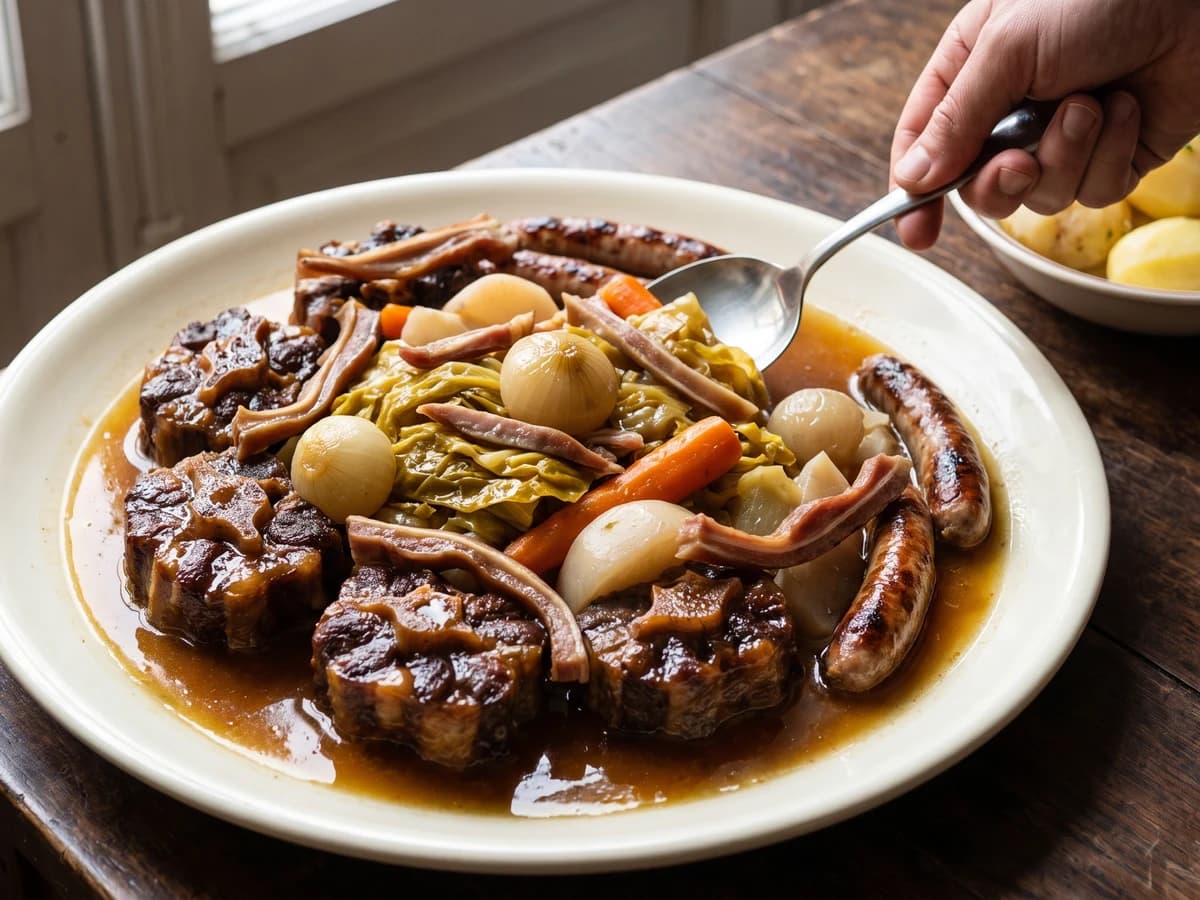
Queue de Bœuf en Hochepot gathers oxtail, pig's trotter and ear, cabbage, roots, and grilled chipolatas around a clear, gelatin-rich broth whose quiet simmer keeps every piece tender and distinct.

Chef Juliette
Beef shoulder larded with bacon, sharpened by red wine and vinegar, then sealed with garlic, vegetables, and dry lemon peel until the low oven turns it yielding and the gravy darkly glossy.