
Chef Juliette
Bouillabaisse à la Marseillaise
Marseille's great fish stew, saffron-gold and garlic-scented, proves that a hard boil can be the careful choice: it binds olive oil into broth before the whole pot meets bread.
A cooking platform built around craft, culture, and the stories behind what we eat.

Created by Chef Juliette
Based on No. 539, Consommé Alexandra, from Le Guide Culinaire (1907) by Auguste Escoffier
A clear chicken consommé gains the faintest body from tapioca, then carries fine chicken julienne, long grooved quenelles, and lettuce chiffonade, each garnish distinct beneath the shimmering golden broth.
Consommé Alexandra (clarified chicken broth with tapioca, chicken, quenelles, and lettuce) teaches the discipline of clarity. The broth must remain brilliant enough to show every garnish beneath it, while the tapioca gives only the faintest body. One true thing before you touch a pan: if the consommé is not excellent and clear, nothing added later can disguise it.
The original assumed a saucier with chicken consommé always ready, a garnish station holding poached tapioca and quenelles, and muslin close at hand. Your honest equivalent is one saucepan, a fine sieve lined with damp cheesecloth, a warmed tureen, and the garnishes prepared in small quantities. The station is brigade scaffolding and can go; the clear consommé, separate poaching, precise ratio, and final boiling pour are the dish, so they stay. The book's quart formula is doubled here to about two quarts for eight first-course bowls, every proportion kept intact. One cook, one stove, one evening.
Done well, the broth is golden and lightly silken, with transparent tapioca, white chicken matchsticks, long grooved quenelles, and tender green ribbons holding their identities in each spoonful. Rinse the poached tapioca until the runoff is perfectly clear before it touches the consommé; that is the step that decides whether Alexandra gleams or goes murky.
Consommé Alexandra belongs to the formal Parisian dining room, where named consommés distinguished themselves through garnishes arranged with almost heraldic precision. Its title is generally linked to Queen Alexandra and to the classical custom of dedicating refined preparations to royal figures. Tapioca here is not a creamy pudding ingredient: poached until transparent, it gives the broth scarcely perceptible body while the chicken, quenelles, and lettuce remain visible and distinct.
Quantity
8 cups (1.9 L / 1.9 kg)
crystal clear and fully defatted
Quantity
3 tablespoons (45 ml / 30 g), yielding exactly 6 tablespoons (90 ml / 85 g) once poached
Quantity
6 cups (1.4 L / 1.4 kg)
for poaching and rinsing the tapioca
Quantity
2 tablespoons (30 ml / 25 g)
cut julienne-fashion into fine matchstick rods
Quantity
2 tablespoons (30 ml / 30 g)
poached, grooved, and long in shape
Quantity
2 tablespoons (30 ml / 8 g) Chiffonade (No. 215)
made with very tender lettuce
| Ingredient | Quantity |
|---|---|
| excellent chicken consommécrystal clear and fully defatted | 8 cups (1.9 L / 1.9 kg) |
| dry small pearl tapioca | 3 tablespoons (45 ml / 30 g), yielding exactly 6 tablespoons (90 ml / 85 g) once poached |
| waterfor poaching and rinsing the tapioca | 6 cups (1.4 L / 1.4 kg) |
| cooked white chicken meatcut julienne-fashion into fine matchstick rods | 2 tablespoons (30 ml / 25 g) |
| prepared small chicken quenellespoached, grooved, and long in shape | 2 tablespoons (30 ml / 30 g) |
| prepared Chiffonademade with very tender lettuce | 2 tablespoons (30 ml / 8 g) Chiffonade (No. 215) |
Set the chicken consommé over gentle heat in a large saucepan. Ladle 1 cup into a smaller pan for poaching the lettuce, then fill the soup tureen and serving bowls with hot water so they lose their chill. Keep the remaining consommé below a simmer while the garnishes are prepared; prolonged boiling dulls its flavour and agitates the particles that careful clarification removed.
Bring the water to an active simmer and rain in the dry tapioca, stirring gently so the pearls don't gather on the bottom. Poach for 18 to 25 minutes, or until every pearl is transparent with no chalky white centre. Drain through a fine sieve lined with damp cheesecloth, then rinse under a thin stream of very hot water until the runoff is perfectly clear. If the pearls remain white or shed milky starch, return them to fresh simmering water for 3 to 5 minutes and rinse again. Measure exactly 6 tablespoons of cooked tapioca; the ratio is deliberate.
Bring the reserved cup of consommé to the barest tremble. Add the prepared Chiffonade (No. 215), made with tender lettuce, and poach it gently for 30 minutes without allowing the liquid to boil. Lift out the softened ribbons with a small sieve and keep them warm. Pass their poaching liquid through damp cheesecloth into the main saucepan without pressing on the leaves.
Warm the chicken julienne and prepared quenelles in a ladleful of consommé for 2 to 3 minutes at a bare tremble. This is warming, not a second cooking. A hard boil roughens the chicken and can split the quenelles; if one opens, lower the heat at once and leave that piece behind. Drain the garnishes, returning their liquid through the fine sieve to the main saucepan.
Add the measured 6 tablespoons of poached tapioca to the main saucepan and raise the heat until the consommé reaches one quiet boil. Taste for seasoning without stirring aggressively. If the tapioca clouds the broth, don't whisk it. Ça se rattrape: lift out the pearls, let the liquid settle for 2 minutes, pass it through fresh damp cheesecloth without pressing, rinse the tapioca once more in hot water, and reunite the two.
Empty and dry the warmed tureen. Arrange the chicken julienne, grooved quenelles, and poached Chiffonade (No. 215) across its bottom, keeping the three garnishes distinct. Pour the boiling tapioca-bound consommé over them in one steady stream and carry it directly to the table. This soup waits for no one. À table!
1 serving (about 255g)
Culinary guides, cultural storytelling, and the editorial depth that makes cooking meaningful.
Discover Culinary ExplorerChef Juliette
Marseille's great fish stew, saffron-gold and garlic-scented, proves that a hard boil can be the careful choice: it binds olive oil into broth before the whole pot meets bread.

Chef Juliette
Waterzoi asks fresh, bone-in river fish to thicken its own buttery broth, with parsley root and pepper for company. No flour, no stockpot, just a brisk simmer watched closely.
Chef Juliette
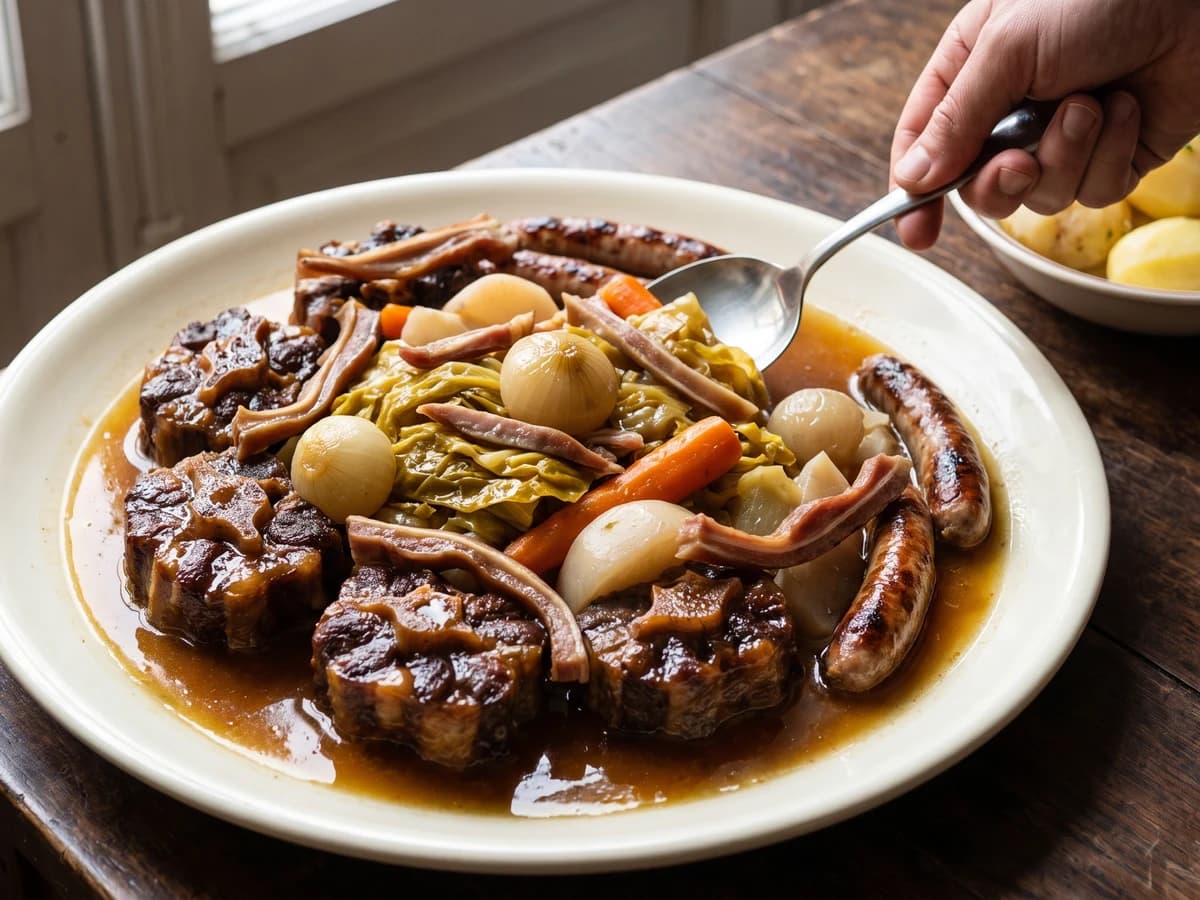
Queue de Bœuf en Hochepot gathers oxtail, pig's trotter and ear, cabbage, roots, and grilled chipolatas around a clear, gelatin-rich broth whose quiet simmer keeps every piece tender and distinct.

Chef Juliette
Beef shoulder larded with bacon, sharpened by red wine and vinegar, then sealed with garlic, vegetables, and dry lemon peel until the low oven turns it yielding and the gravy darkly glossy.