
Chef Juliette
Omelette à l’Écossaise
A creamy omelette aux fines herbes closes around smoked-salmon-wrapped herring milts, gently poached in butter. Have the filling ready, then roll the eggs while they still shine.
A cooking platform built around craft, culture, and the stories behind what we eat.
Created by Chef Juliette
Based on No. 485, Harvesters’ Fried Eggs, from Le Guide Culinaire (1907) by Auguste Escoffier
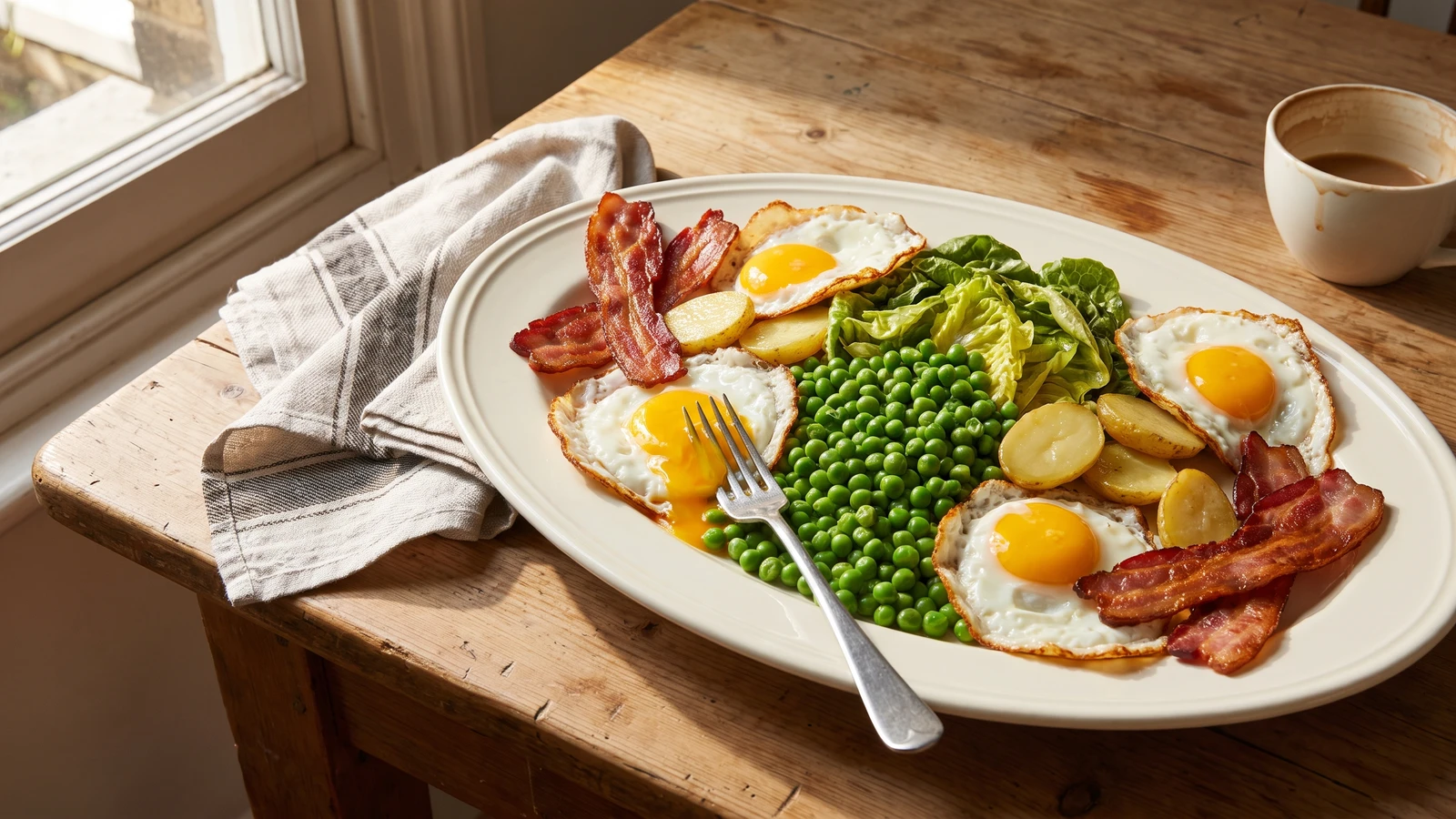
Crisp bacon and lacy fried eggs circle a buttery heap of peas, ciseled lettuce, and tender potato: a thrifty harvester’s plate whose whole lesson is timing three humble elements to finish together.
Œufs frits des moissonneurs (Harvesters’ Fried Eggs) teaches timing, not complication. The eggs and bacon form a hot, crisp ring around peas, ciseled lettuce, and sliced potato, so the one true thing to know before touching a pan is this: the vegetable garnish must be tender and ready to hold before the eggs begin. Eggs wait for nobody.
The formula assumes several pans moving at once and a platter assembled the instant each cook sends a component. At home, a covered sauté pan takes the vegetables, one skillet handles the bacon and then the eggs, and a warmed platter buys the few minutes a lone pair of hands needs. The rashers arrive already prepared through Blanchings (No. 273), exactly as the cross-reference intends; four eggs and four rashers preserve the book’s equal count. No saucier, stockpot held on the fire, or salamander is needed. One cook, one stove, one evening.
What must stay is the architecture: bacon and eggs alternating around the rim, with large peas, lettuce, and finely sliced potatoes piled in the middle. Simultaneous brigade service is scaffolding and can go. Cisel means to cut crosswise into fine ribbons; here it lets the lettuce soften among the peas instead of lying in ropes. Finish the vegetables first, keep them glossy under a lid, and only then fry the eggs. That sequence decides the dish.
Œufs frits des moissonneurs belongs to the French agricultural table rather than to one province, especially wherever grain harvests demanded filling food assembled quickly from bacon, eggs, potatoes, and garden vegetables. Classical kitchens carried that farm formula into their repertory and formalized its circular service, alternating one rasher with one egg around the platter. The peas, lettuce, and potato in the center are not decorative garnish; they are the substance that turns fried eggs into a complete workers’ meal.
Quantity
4 thick rashers (about 5½ oz / 160 g), already prepared according to Blanchings (No. 273)
Quantity
4
Quantity
3 cups (710 ml / 450 g)
Quantity
2 cups (475 ml / 285 g)
peeled and finely sliced about ⅛ inch (3 mm) thick
Quantity
1 small head (about 6 oz / 170 g)
cored and ciseled
Quantity
3 tablespoons (45 ml / 42 g)
divided
Quantity
½ cup (120 ml / 120 g)
divided
Quantity
¾ teaspoon (4 ml / 4 g)
divided
Quantity
¼ teaspoon (1 ml / 0.5 g)
| Ingredient | Quantity |
|---|---|
| breast bacon | 4 thick rashers (about 5½ oz / 160 g), already prepared according to Blanchings (No. 273) |
| large eggs | 4 |
| large green peas, fresh or frozen | 3 cups (710 ml / 450 g) |
| waxy potatoespeeled and finely sliced about ⅛ inch (3 mm) thick | 2 cups (475 ml / 285 g) |
| butter lettucecored and ciseled | 1 small head (about 6 oz / 170 g) |
| unsalted butterdivided | 3 tablespoons (45 ml / 42 g) |
| waterdivided | ½ cup (120 ml / 120 g) |
| fine saltdivided | ¾ teaspoon (4 ml / 4 g) |
| freshly ground black pepper | ¼ teaspoon (1 ml / 0.5 g) |
Warm the serving platter in a very low oven, about 200°F (95°C), then turn the oven off. Slice the potatoes evenly about ⅛ inch (3 mm) thick. Cisel the lettuce by cutting it crosswise into fine ribbons. Crack each egg into its own small cup so all four can enter the skillet quickly. Have everything ready before heating the pans; once the eggs begin, there is no useful pause.
Melt 2 tablespoons (30 ml / 28 g) of the butter in the lidded sauté pan over medium heat. Add the potatoes, ½ teaspoon (2.5 ml / 3 g) of the salt, half the pepper, and ⅓ cup (80 ml / 80 g) of the water. Turn the slices through the butter, bring the liquid to a gentle simmer, then cover and lower the heat. Cook for 7 to 9 minutes, turning once, until the potatoes are beginning to soften but still hold their shape.
Add the peas, ciseled lettuce, and remaining 3 tablespoons (40 ml / 40 g) water to the potatoes. Fold gently, cover, and cook at a quiet simmer for 5 to 7 minutes, until the peas are tender, the lettuce has collapsed, and a potato slice bends easily over the spoon. Uncover and toss over medium heat until the loose water disappears and the butter gives everything a light gloss. If the pan dries before the potatoes are tender, add water one tablespoon at a time and cover again; if the vegetables are soupy when tender, boil uncovered for a minute. Ça se rattrape. Cover and set off the heat.
Take the breast bacon already prepared according to Blanchings (No. 273) and dry it thoroughly. Lay the rashers in a cold skillet, set it over medium heat, and fry until their edges are crisp and their broad surfaces are well bronzed, turning as needed, about 6 to 8 minutes. Transfer them to the warmed platter. Pour the rendered fat into a heatproof cup, then return about 2 tablespoons (30 ml) to the skillet.
Set the skillet over medium heat and add enough of the remaining butter to keep a generous film of fat in the pan. When the butter foams, slide in the eggs one by one, leaving room between them. Season with the remaining salt and pepper. Fry for 2 to 3 minutes, spooning hot fat over any unset white while keeping it off the yolks, until the edges are crisp, the whites are opaque, and the yolks remain glossy and soft. If the edges color before the tops set, lower the heat, add a teaspoon of water to an empty patch of pan, and cover for 20 seconds. The trapped moisture finishes the whites without hardening the yolks.
If the vegetables have cooled, turn them over gentle heat for one minute; loosen them with a spoonful of water if they have tightened. Mound the peas, lettuce, and potatoes generously in the center of the warmed platter. Arrange the four bacon rashers and four fried eggs alternately around the mound, keeping each yolk intact and facing upward. Bring the platter straight to the table, because the runny yolks become part of the buttery vegetable dressing as people serve themselves. À table!
1 serving (about 320g)
Culinary guides, cultural storytelling, and the editorial depth that makes cooking meaningful.
Discover Culinary ExplorerChef Juliette
A creamy omelette aux fines herbes closes around smoked-salmon-wrapped herring milts, gently poached in butter. Have the filling ready, then roll the eggs while they still shine.

Chef Juliette
Four tender herbs, hot butter, and two eggs per pan: this rolled omelette teaches the quick hand and good judgment that keep the outside pale and the center creamy.

Chef Juliette
Four batters, one lesson: let the flour drink deeply before cooking, then spread the batter thinly in butter for crêpes and pannequets that bend without becoming tough.

Chef Juliette
Crêpes au Couvent trap ripe Williams pear dice between two thin pours of sweet batter, then turn in one clean toss and reach the table butter-gold, powdered, and burning hot.