Culinary Explorer

A cooking platform built around craft, culture, and the stories behind what we eat.
Discover Culinary Explorer
Omelette aux Fines Herbes

Omelette aux Fines Herbes

Created by Chef Juliette

Based on No. 2320, Omelette aux Fines Herbes, from Le Guide Culinaire (1907) by Auguste Escoffier

Four tender herbs, hot butter, and two eggs per pan: this rolled omelette teaches the quick hand and good judgment that keep the outside pale and the center creamy.

Breakfast & Brunch
French
Weeknight
Quick Meal
Comfort Food
12 min
Active Time
12 min cook24 min total
Yield4 servings

Omelette aux fines herbes (soft French omelet with fine herbs) teaches the speed and judgment beneath the whole family of French omelets. The one true thing to know before touching the pan is this: the omelette finishes cooking after it leaves the heat, so roll it while the center is still baveuse (soft and creamy). Wait until it looks done in the pan and it will be overdone on the plate.

The old entry is brief because it points to Omelet aux Fines Herbes (No. 502) and assumes that “the usual way” already lives in the cook’s hands. It calls for one tablespoon of a nearly equal mixture of parsley, chervil, chives, and tarragon per omelet. Here that becomes four individual two-egg omelets, each cooked in an 8-inch skillet. There is no saucier, stockpot, or salamander to replace, because none belongs here; what the old kitchen assumed was a practiced cook turning pan after pan. The repeated service is brigade scaffolding. The hot pan, foaming butter, herb ratio, and creamy roll are the dish, and they stay.

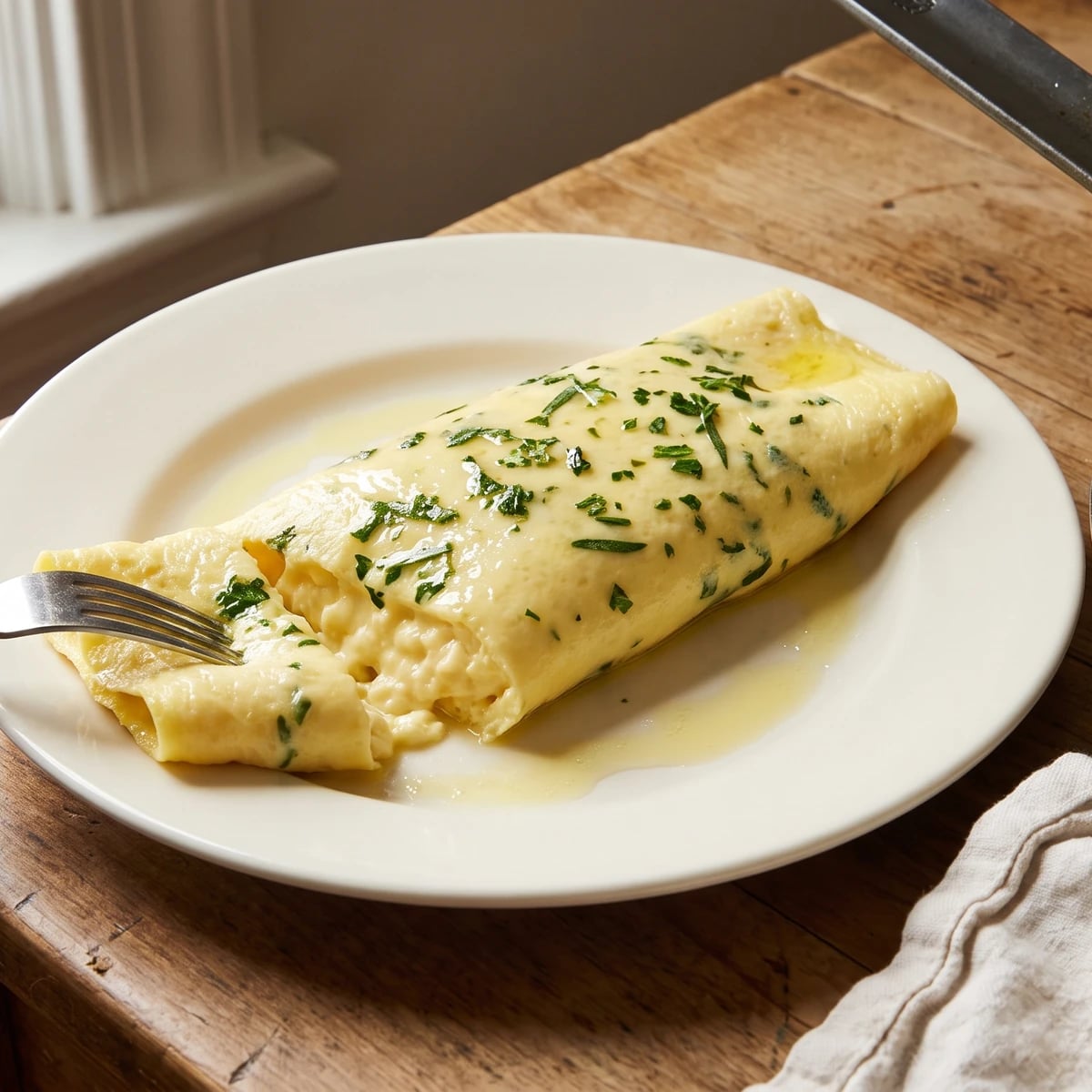
The finished omelette should be pale butter-gold, smooth outside, and generously flecked with green, with a center that yields under the fork rather than bouncing back. Chop the herbs just before cooking, have everyone ready to eat, and work one omelette at a time. The step that matters most is the roll: begin while the surface still glistens.

Omelette aux fines herbes belongs less to one province than to the Parisian bourgeois and bistro table, where the plain rolled omelet became a quiet test of a cook’s hand. Fines herbes names the tender quartet of parsley, chervil, chives, and tarragon, chopped fresh and added at the last moment; it is neither a catch-all for any green herb nor the long-cooked bouquet garni. Grand kitchens fixed its concise formula, but the dish remained quick home food, moving between household stove and café range without losing its essential simplicity.

The technique, the tradition, and the story behind every dish.

Discover Culinary Explorer

Ingredients

Omelet aux Fines Herbes

Quantity

4 individual omelets (No. 502)

the referenced preparation, scaled and made from the ingredients below

large eggs

Quantity

8

flat-leaf parsley leaves

Quantity

1 tablespoon (15 ml / 4 g)

very finely chopped

chervil leaves

Quantity

1 tablespoon (15 ml / 2 g)

very finely chopped

fresh chives

Quantity

1 tablespoon (15 ml / 3 g)

very finely chopped

French tarragon leaves

Quantity

1 tablespoon (15 ml / 2 g)

very finely chopped

unsalted butter

Quantity

4 tablespoons (60 ml / 56 g)

divided into four portions

fine sea salt

Quantity

1/2 teaspoon (2.5 ml / 3 g)

divided

finely ground white pepper

Quantity

1/4 teaspoon (1.25 ml / 0.6 g)

divided

Equipment Needed

  • 8-inch (20 cm) nonstick or well-seasoned carbon-steel skillet
  • Flexible silicone spatula or table fork
  • Small mixing bowl
  • Warm serving plates

Instructions

  1. 1

    Prepare the herbs

    Wash the parsley, chervil, chives, and tarragon only if needed, then dry them completely. Chop each very finely and combine them in equal spoonfuls, giving you 4 tablespoons of fines herbes. Wet herbs cling in dark clumps and throw water into the eggs, so they must be dry, loose, and freshly cut.

    Measure the four herbs equally by volume, not weight. Their leaves have different densities, and the source asks for an almost equal share of each.
  2. 2

    Beat one portion

    For each Omelet aux Fines Herbes (No. 502), crack 2 eggs into a small bowl and add 1 tablespoon of the fines herbes, one-quarter of the salt, and one-quarter of the white pepper. Beat briskly with a fork just until yolks and whites become one fluid yellow mixture. Don’t whip in a cap of foam; large bubbles leave the cooked surface pocked rather than smooth. Beat each portion immediately before it meets the pan.

  3. 3

    Foam the butter

    Heat an 8-inch skillet over medium-high heat until a drop of egg begins to set on contact without snapping or browning. Add 1 tablespoon of the butter and swirl it over the base as it melts and foams. Pour in the eggs while the foam is still pale. If the butter races toward brown, lift the pan off the heat for several seconds before adding the eggs; the omelette wants butter’s sweetness and sheen, not a browned crust.

  4. 4

    Form fine curds

    Stir the eggs immediately in small, rapid circles while shaking the pan back and forth. Scrape across the whole base so the eggs gather into fine, moist curds rather than one firm sheet. After about 20 seconds, stop stirring and spread the curds evenly; the underside should just hold together while the top remains glossy and softly unset. If the edges seize before the center thickens, pull the pan off the heat and fold those firmer edges into the wet egg. Ça se rattrape while the mixture still glistens.

    Use a table fork in a well-seasoned carbon-steel pan or a flexible silicone spatula in nonstick. Protect the pan, but keep the motion quick.
  5. 5

    Roll and serve

    Tilt the pan away from you and fold the near third of the omelette over its creamy center. Nudge it toward the far rim, allowing the lower edge to curl over itself, then turn it onto a warm plate so the final fold and seam land underneath. If the roll tears, bring the edges together and place the seam down; the omelette will settle into shape, and a touch of butter from the pan will gloss the surface. Serve immediately, then wipe out the skillet and repeat with the remaining portions. Omelets wait for no one. À table!

Chef Tips

  • The herb quartet is the recipe: parsley, chervil, chives, and French tarragon in equal spoonfuls. Dried herbs cannot do this work, and Russian tarragon lacks the clear anise note of the French variety.
  • Use an 8-inch skillet for each two-egg omelette. In a larger pan the eggs spread too thin and dry before you can roll them; in a smaller one they remain too deep to set evenly.
  • No cream, milk, cheese, or separate garnish goes into this formula. The source adds the chopped herbs directly to the eggs, nothing else. Cooking well is not cooking fancy.
  • Have the diners seated before the first egg reaches the pan. Serve each omelette as it is finished, even if that means the table eats in sequence; the creamy center matters more than ceremony.

Advance Preparation

  • The herbs can be washed up to 6 hours ahead, dried thoroughly, wrapped loosely in a clean towel, and chilled. Chop them shortly before cooking so their fragrance and green color remain lively.
  • Measure the butter, salt, and pepper and set the plates before heating the skillet. Don’t beat all eight eggs in advance; mix each two-egg portion just before cooking so the herbs remain evenly suspended and the eggs stay fluid.

Frequently Asked Questions

Nutrition Information

1 serving (about 110g)

Calories
250 calories
Total Fat
21 g
Saturated Fat
10 g
Trans Fat
0.5 g
Unsaturated Fat
9 g
Cholesterol
400 mg
Sodium
440 mg
Total Carbohydrates
1 g
Dietary Fiber
0 g
Sugars
0 g
Protein
13 g

Note: Chef personas and recipes are created with AI assistance. Cook with care: follow safe food-handling practices, check doneness with a thermometer when needed, and adapt for allergies and your kitchen.

Where cooking meets culture.

Culinary guides, cultural storytelling, and the editorial depth that makes cooking meaningful.

Discover Culinary Explorer

More from Savouries

Browse the full collection