
Chef Juliette
Flan aux Carottes
A pale short-paste shell holds silken, lightly sweet carrot purée beneath neat glazed half-discs, their butter syrup catching the light: a classical tart poised between vegetable course and sweet.
A cooking platform built around craft, culture, and the stories behind what we eat.

Created by Chef Juliette
Based on No. 2451, Chestnut Croquettes, from Le Guide Culinaire (1907) by Auguste Escoffier
Croquettes de marrons hide a whole chestnut inside vanilla-scented purée, bound with yolks and butter, then take their crisp à l’anglaise coat and a warm apricot sauce.
Croquettes de marrons (chestnut croquettes) teach one severe but useful lesson: the filling must be dry before the crust can protect it. A wet chestnut purée turns to pressure in hot fat and bursts; a properly dried one fries into a bronze shell around a tender vanilla center and one whole marron. Dryness, not frying bravado, decides the dish.
The original recipe assumed a pastry cook free to stir over a fierce range, a fine tamis, a vat of fat kept ready, and enough hands to shape a service tray. Your home equivalents are a wide saucepan for fast evaporation, a fine-mesh sieve or food mill, and a deep saucepan with a thermometer. This batch makes twenty croquettes for four people. The old napkin used for draining can go because a wire rack preserves the crust better; that is brigade scaffolding. The fierce drying, the exact ratio of five yolks and one and a half ounces of butter to each pound of purée, the whole chestnut center, and the à l’anglaise coat must stay. They are the dish.
Before you touch the frying oil, press a spoonful of the finished paste onto a cold plate. It must hold a firm mound without spreading or showing a wet sheen. If it slumps, return it to gentle heat and dry it again. Ça se rattrape now; once it enters the fat, it cannot. One cook, one stove, one evening.
Croquettes de marrons belong to the classical French sweet entremets rather than to one province, though their defining ingredient points toward the chestnut country of Ardèche and the Cévennes. In grand dining rooms, a sustaining regional staple became a refined sweet through vanilla syrup, sieving, and panure à l’anglaise. Marron in French pastry vocabulary denotes a prized edible chestnut suited to remaining whole, and the nut hidden at the center preserves that identity beneath the crumb.
Quantity
1 lb 2 oz (about 4 cups / 510 g) Chestnuts (Marrons) (No. 2172), plus 20 small whole Chestnuts (Marrons) (No. 2172) (about 6 oz / 170 g)
Quantity
3 cups (720 ml / 720 g)
Quantity
1½ cups (360 ml / 300 g)
Quantity
1
split lengthwise
Quantity
3 tablespoons (45 ml / 42 g)
Quantity
5
Quantity
½ cup (120 ml / 60 g)
Quantity
½ cup (120 ml / 120 g) Anglaise (for Egg-and-bread-crumbing) (No. 174)
prepared and chilled
Quantity
2 cups (480 ml / 200 g)
Quantity
6 cups (1.4 L / 1.3 kg)
for frying
Quantity
¾ cup (180 ml / 240 g)
| Ingredient | Quantity |
|---|---|
| Chestnuts (Marrons), prepared and peeled, for the purée and centers | 1 lb 2 oz (about 4 cups / 510 g) Chestnuts (Marrons) (No. 2172), plus 20 small whole Chestnuts (Marrons) (No. 2172) (about 6 oz / 170 g) |
| water | 3 cups (720 ml / 720 g) |
| granulated sugar | 1½ cups (360 ml / 300 g) |
| vanilla beansplit lengthwise | 1 |
| unsalted butter | 3 tablespoons (45 ml / 42 g) |
| large egg yolks | 5 |
| all-purpose flour | ½ cup (120 ml / 60 g) |
| Anglaise (for Egg-and-bread-crumbing)prepared and chilled | ½ cup (120 ml / 120 g) Anglaise (for Egg-and-bread-crumbing) (No. 174) |
| very fine dry breadcrumbs | 2 cups (480 ml / 200 g) |
| refined peanut or sunflower oilfor frying | 6 cups (1.4 L / 1.3 kg) |
| smooth apricot preserves | ¾ cup (180 ml / 240 g) |
Combine the water, sugar, vanilla seeds, and pod in a wide saucepan. Bring to a boil, stirring only until the sugar dissolves, then lower the heat so the thin syrup barely trembles. Add the prepared and peeled Chestnuts (Marrons) (No. 2172), including the twenty intended for the centers. Cover the surface with a round of parchment and cook gently for 20 to 25 minutes, until the nuts are tender and vanilla-scented but the center pieces remain intact. A hard boil breaks them into rubble. Lift out twenty small whole nuts and drain them on a rack, then drain the remainder for 10 minutes. Reserve at least ⅓ cup (80 ml / 80 g) of the vanilla syrup for the sauce.
While the drained chestnuts are still warm, force them through a fine-mesh sieve or the finest plate of a food mill. Do not use a blender, which can turn their starch gummy. Weigh exactly 1 lb (454 g) of smooth purée for the croquettes; set any excess aside. The proportion matters because this amount takes precisely five yolks and 1½ oz (42 g) butter.
Put the purée in a wide, heavy saucepan over medium-high heat and work it constantly with a firm wooden spoon for 7 to 10 minutes. Scrape the floor and corners as you stir. It is dry enough when it gathers into one mass, leaves a clean track across the pan, and loses its wet surface shine. Take the pan off the heat for 30 seconds, beat in the yolks one at a time, then beat in the butter. Return it to medium-low heat and stir for another 2 to 3 minutes, until the paste again draws cleanly from the pan and reaches 165°F (74°C). Press a spoonful onto a cold plate. If it spreads, continue drying over low heat for 2 minutes and test again. Ça se rattrape, but do not accept a loose paste.
Spread the chestnut paste about ¾ inch (2 cm) thick on a parchment-lined tray so it cools evenly. Press parchment directly against its surface and let it lose its heat for 15 minutes, then refrigerate for 45 minutes. It should be cold, firm, and easy to lift without sticking. If it is still soft, give it another 15 minutes in the cold rather than adding crumbs to the filling.
Divide the paste into twenty portions of about 1 oz (28 g), the size of small pigeons’ eggs. Flatten one portion into a thick disc in your palm, set a drained whole chestnut in the center, and close the paste around it. Roll gently into a smooth ball with no seam or exposed nut. If the paste sticks, chill it briefly; if a fine crack appears, pinch it closed with cold fingertips. Every opening is a path for the filling to escape.
Paner à l’anglaise means coating first with flour, then egg preparation, then fine crumbs. Roll each ball lightly in flour and knock off every excess. Coat it completely in the prepared Anglaise (for Egg-and-bread-crumbing) (No. 174), let the surplus drain, then roll it in the very fine breadcrumbs, pressing just enough to close the coat. Set the breaded croquettes on a clean tray and refrigerate uncovered for 30 minutes. If you spot a bare patch or crack, touch it with a little Anglaise and crumbs before chilling.
Combine the apricot preserves with ⅓ cup (80 ml / 80 g) of the reserved vanilla syrup in a small saucepan. Bring it to a gentle simmer and cook for 4 to 5 minutes, stirring until glossy and fluid enough to pour from a spoon. Pass the sauce through a fine sieve, taste, and loosen it with another spoonful of syrup if it has tightened too far. Keep it warm and serve it separately, as the original directs.
Pour the oil into a deep, heavy saucepan, leaving the pan no more than half full, and heat it to 355°F (180°C). Fry one test croquette first. It should seal at once, rise, and turn deep chestnut-gold in about 2 minutes. If it splits, stop before sacrificing the rest: chill the remaining croquettes for 20 minutes, patch any seams with Anglaise and crumbs, then test again. Fry the croquettes four at a time, returning the oil to temperature between batches. Lift them to a wire rack, not a pile of paper where their undersides soften, and serve at once with the warm vanilla-apricot sauce in a separate jug. À table!
1 serving (about 505g)
Culinary guides, cultural storytelling, and the editorial depth that makes cooking meaningful.
Discover Culinary ExplorerChef Juliette
A pale short-paste shell holds silken, lightly sweet carrot purée beneath neat glazed half-discs, their butter syrup catching the light: a classical tart poised between vegetable course and sweet.
Chef Juliette
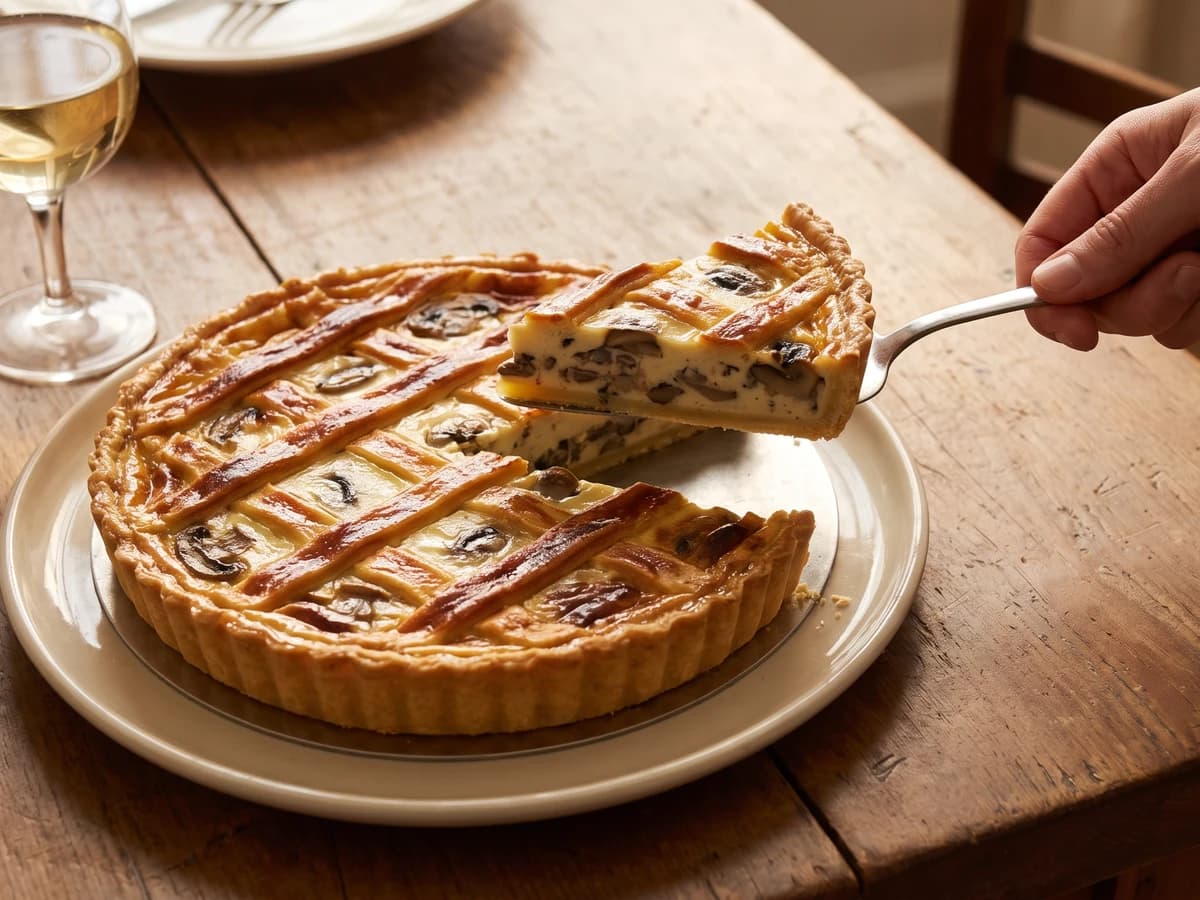
A hot mushroom flan under a butter-gold lattice, with cream reduced close around barely opened caps and a crisp short-paste base protected by one discipline: cool the filling completely.
Chef Juliette
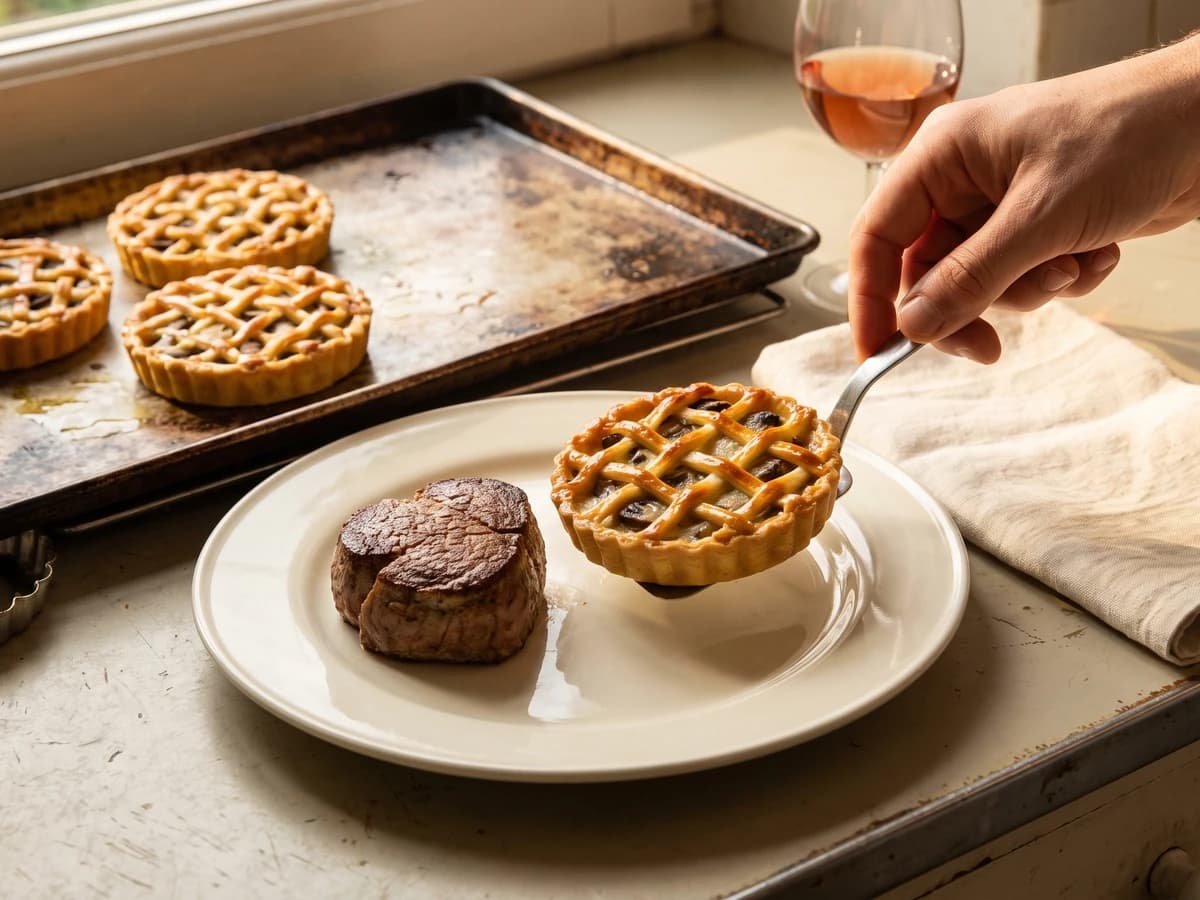
Four little mushroom flans, latticed and gilded, baked hard and fast until butter-gold: a classical garnish scaled to the meat it accompanies and served before its crispness has time to fade.

Chef Juliette
Morels surrender their liquor, then take it back as a glossy cream-and-butter sauce inside burnished puff pastry. The lesson is simple and absolute: reduce with patience, then heat gently and never boil.