
Chef Juliette
Flan aux Carottes
A pale short-paste shell holds silken, lightly sweet carrot purée beneath neat glazed half-discs, their butter syrup catching the light: a classical tart poised between vegetable course and sweet.
A cooking platform built around craft, culture, and the stories behind what we eat.
Created by Chef Juliette
Based on No. 2423, Custard Fritters or Fried Cream, from Le Guide Culinaire (1907) by Auguste Escoffier
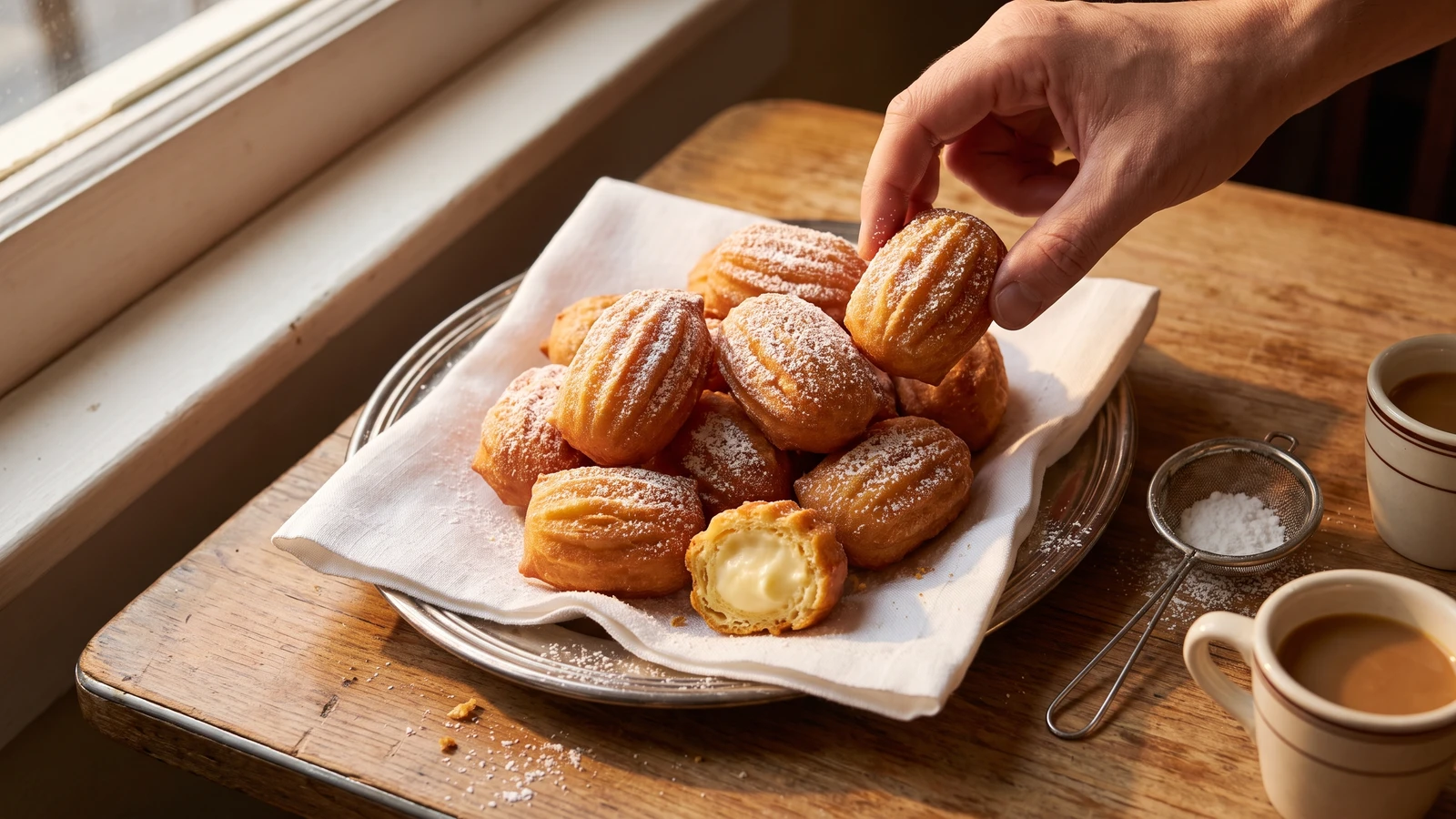
Stone-cold frangipan, two close coats à l'anglaise, and fierce fat give these golden custard fritters a creamy centre beneath fine crumbs and icing sugar.
Beignets de crème (custard fritters) teach the discipline of containment. A yielding cream survives fierce fat only when it is stone cold and sealed twice à l'anglaise, with egg and fine crumbs. Warm cream or timid fat opens the coat; cold cream and properly heated fat give you a crisp golden shell around a soft, rich centre.
The original assumed a pastry station with a marble slab, trays of prepared Frangipan and Anglaise, a deep fryer held at service heat, and a fierce oven waiting for the alternate glazed method. Your honest equivalents are an 18 cm square pan, a refrigerator, a heavy pot with a thermometer, and the broiler already in your oven. The brigade quantity becomes twelve lozenges, enough for four. Only the volume and equipment change; the proportions inside each referenced preparation remain its own. The marble and fryer station were scaffolding. The cold set and double coat are the dish, so they stay.
Cut one open and the fine crumb crust gives beneath the fork, revealing ivory cream just soft enough to settle onto the plate. Before you touch the frying pot, make certain every breaded lozenge is firm, cold, and completely enclosed. That is the step that decides them.
Beignets de crème belong to the classical Parisian entremets repertoire rather than to one provincial larder, and their defining act is frying a set cream behind an instantly formed crust. The canon keeps three quite different preparations under the title: firm Frangipan cut and crumbed, whole-egg moulded custard dipped in batter, and filled dry meringue breaded at the last moment. Here Frangipan means a firm flour-and-egg cream made for frying, not the almond filling many bakers expect from the name.
Quantity
about 3 cups (720 ml / 800 g) Frangipan for Fried Cream (No. 2400)
prepared in an 18 cm square pan and thoroughly chilled
Quantity
3/4 cup (180 ml / 90 g)
Quantity
1 cup (240 ml / 230 g) Anglaise (for Egg-and-bread-crumbing) (No. 174)
Quantity
4 cups (950 ml / 240 g)
Quantity
6 cups (1.4 litres / 1.3 kg)
sunflower or peanut oil
Quantity
1/2 cup (120 ml / 60 g)
Quantity
about 3 cups (720 ml / 800 g) Crème à la Vanille, Moulée (No. 2639)
made with whole eggs in a shallow square vessel and chilled for the second method
Quantity
2 cups (480 ml / 500 g) Batter for Oven-glazed Fruit Fritters (No. 234)
Quantity
12 small Ordinary Meringue (No. 2382)
baked until very dry and cooled for the third method
Quantity
1 1/2 cups (360 ml / about 300 to 400 g)
if using fruit salpicon, bind it with stewed apricot or plum
Quantity
3/4 cup (180 ml / 170 g) Anglaise (for Egg-and-bread-crumbing) (No. 174)
Quantity
2 cups (475 ml / 120 g)
| Ingredient | Quantity |
|---|---|
| Frangipan for Fried Creamprepared in an 18 cm square pan and thoroughly chilled | about 3 cups (720 ml / 800 g) Frangipan for Fried Cream (No. 2400) |
| plain flour | 3/4 cup (180 ml / 90 g) |
| Anglaise for egg-and-bread-crumbing | 1 cup (240 ml / 230 g) Anglaise (for Egg-and-bread-crumbing) (No. 174) |
| very fine fresh white breadcrumbs | 4 cups (950 ml / 240 g) |
| neutral high-heat frying oilsunflower or peanut oil | 6 cups (1.4 litres / 1.3 kg) |
| icing sugar | 1/2 cup (120 ml / 60 g) |
| Crème à la Vanille, Moulée (optional)made with whole eggs in a shallow square vessel and chilled for the second method | about 3 cups (720 ml / 800 g) Crème à la Vanille, Moulée (No. 2639) |
| Batter for Oven-glazed Fruit Fritters (optional) | 2 cups (480 ml / 500 g) Batter for Oven-glazed Fruit Fritters (No. 234) |
| Ordinary Meringue (optional)baked until very dry and cooled for the third method | 12 small Ordinary Meringue (No. 2382) |
| cold Bavarois, firm ice cream, or fruit salpicon (optional)if using fruit salpicon, bind it with stewed apricot or plum | 1 1/2 cups (360 ml / about 300 to 400 g) |
| Anglaise for the third method (optional) | 3/4 cup (180 ml / 170 g) Anglaise (for Egg-and-bread-crumbing) (No. 174) |
| very fine fresh white breadcrumbs for the third method (optional) | 2 cups (475 ml / 120 g) |
Prepare the Frangipan for Fried Cream (No. 2400) according to its own entry, scaling out about 800 g for an 18 cm square pan so it sets close to 2.5 cm thick. Chill it for at least 4 hours, preferably overnight, until the slab feels firm from edge to centre and lifts without bending. If it slumps when raised, don't add flour or force the cutting. Ça se rattrape: return it to the refrigerator for another hour, or give it 15 minutes in the freezer, then try again.
Turn the cold slab onto a board and wipe a thin knife between cuts. Trim the edges, then divide the cream into 12 neat lozenges about 6 cm long, 3 cm wide, and 2.5 cm thick. Keep the pieces cold while you arrange three shallow dishes containing the flour, the Anglaise (for Egg-and-bread-crumbing) (No. 174), and the fine breadcrumbs.
Coat each lozenge lightly in flour and tap away the excess. Immerse it completely in the Anglaise (for Egg-and-bread-crumbing) (No. 174), drain for a moment, then bury it in fine breadcrumbs. Press gently with the flat of a knife so the crumbs adhere without crushing the cream. Dip it into the Anglaise once more and apply a second coat of crumbs. The second coat is not brigade fuss; it is the resisting crust that keeps the cream inside. If you see a bare spot or crack, dab it with Anglaise and press on more crumbs. Chill the breaded pieces for 20 minutes so the coat sets.
Pour the oil into a heavy pot, leaving at least 8 cm of empty space above it, and heat it to 190°C. The fat must be fierce without smoking. Drop in a pinch of crumbs: they should fizz at once and turn golden within about 20 seconds. If they sink quietly, wait. Timid fat lets the coating drink oil before it can seal.
Lower three lozenges into the oil and fry for 90 seconds to 2 minutes, turning once, until evenly deep gold. Keep the oil between 185°C and 190°C and let it recover before each batch. If one coat opens, lift that fritter out immediately, return the remaining pieces to the refrigerator, patch any visible cracks with Anglaise and crumbs, and restore the oil to temperature. The escaped one is the cook's share; dust it and eat it from a small bowl. Drain the intact fritters on a rack, dust generously with icing sugar while warm, and serve at once. À table!
For the whole-egg version, prepare the Crème à la Vanille, Moulée (No. 2639) according to its own entry, using only whole eggs as this method directs and poaching it in a shallow square vessel that permits clean cutting. Chill completely, cut into 12 pieces, immerse them in the Batter for Oven-glazed Fruit Fritters (No. 234), and fry at 190°C until golden. Drain, dust with icing sugar, then set them beneath a fully heated broiler just until the sugar glazes. Watch without blinking; pale sugar becomes bitter sugar quickly.
For the filled version, prepare 12 small Ordinary Meringue (No. 2382) according to its own entry and dry them thoroughly. Cut a small lid from each, fill with cold Bavarois, firm ice cream, or fruit salpicon, meaning small diced fruit bound with stewed apricot or plum, then replace the lids. Chill Bavarois or fruit fillings for 1 hour; freeze ice-cream fillings until solid. Quickly coat each meringue with the Anglaise (for Egg-and-bread-crumbing) (No. 174) and fine breadcrumbs, stand them lid-side up in a frying basket, and immerse them in oil at 195°C for only a few seconds, just until gold. Drain, dust with icing sugar, and carry them straight to the table.
1 serving (about 380g)
Culinary guides, cultural storytelling, and the editorial depth that makes cooking meaningful.
Discover Culinary ExplorerChef Juliette
A pale short-paste shell holds silken, lightly sweet carrot purée beneath neat glazed half-discs, their butter syrup catching the light: a classical tart poised between vegetable course and sweet.
Chef Juliette
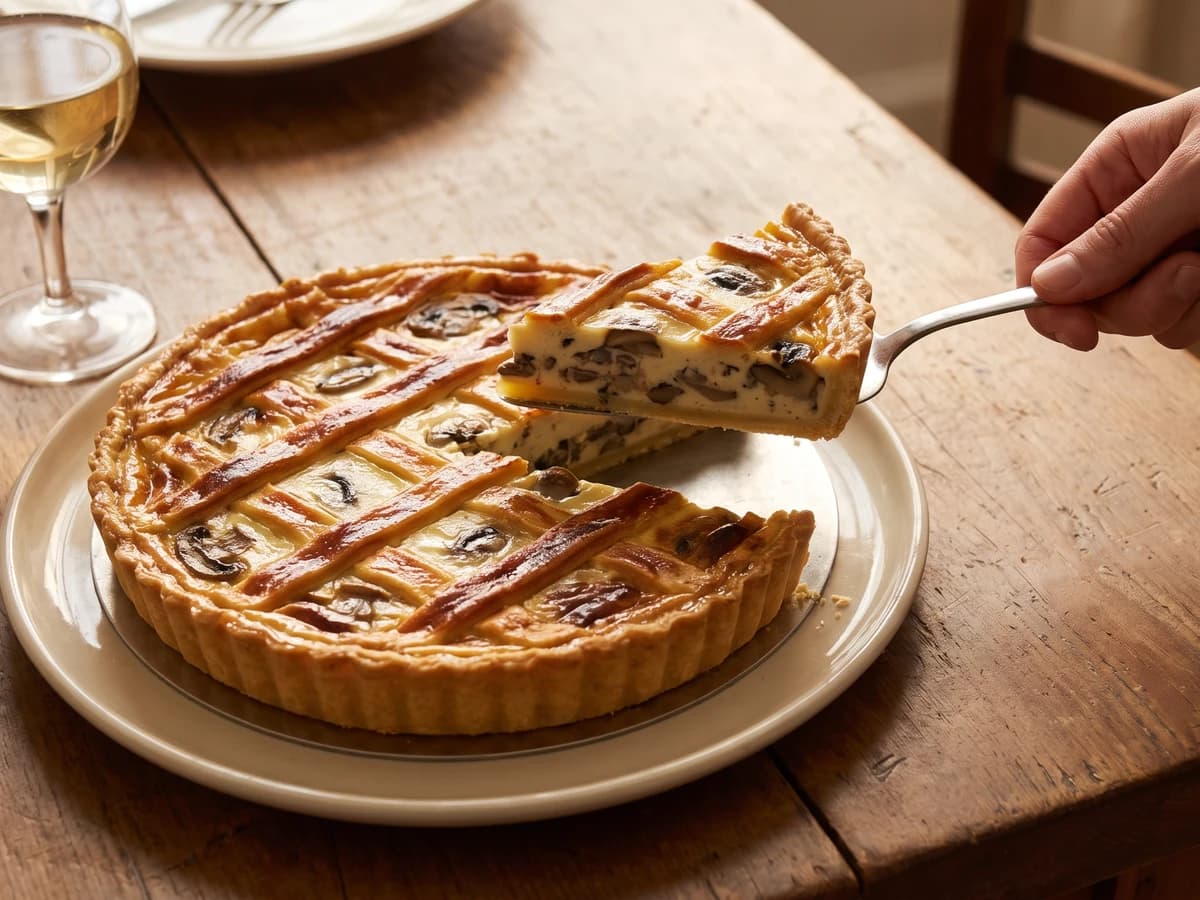
A hot mushroom flan under a butter-gold lattice, with cream reduced close around barely opened caps and a crisp short-paste base protected by one discipline: cool the filling completely.
Chef Juliette
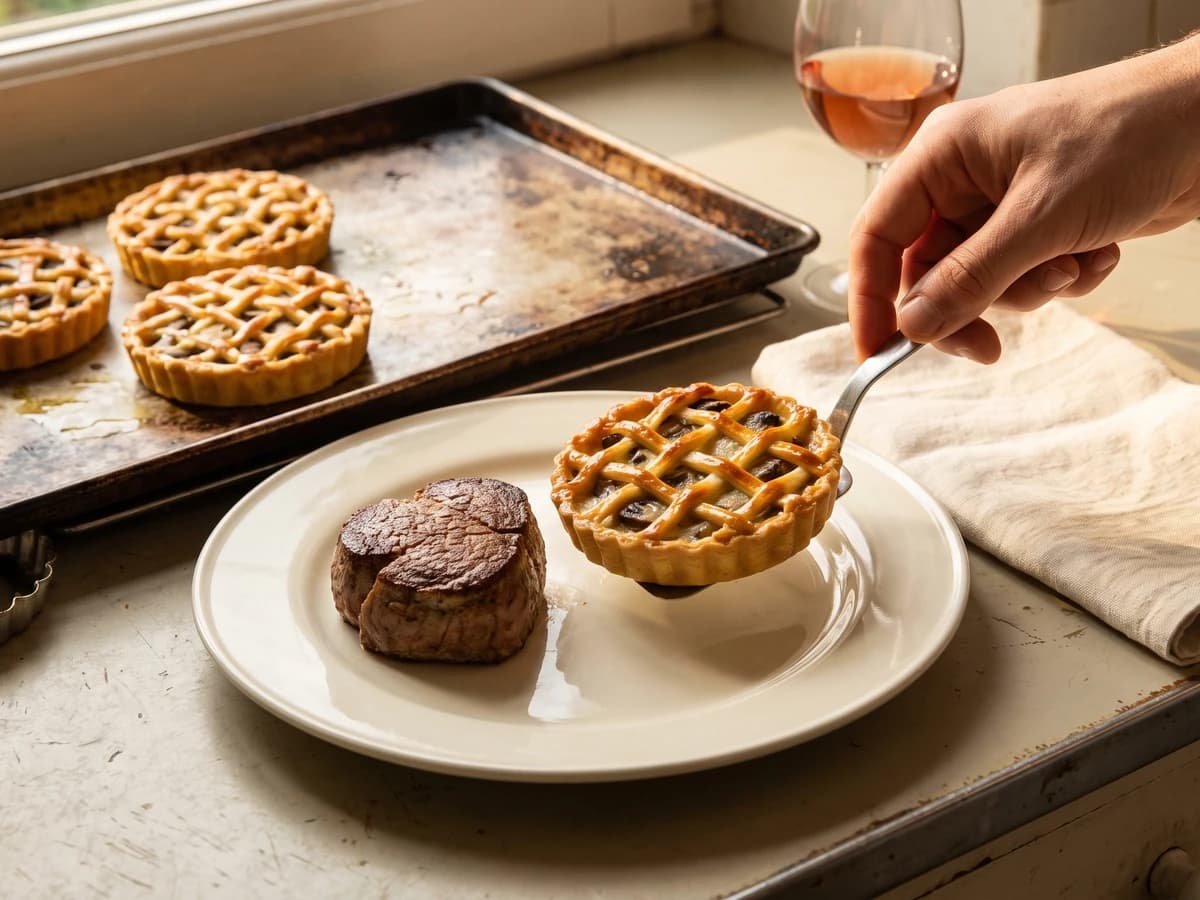
Four little mushroom flans, latticed and gilded, baked hard and fast until butter-gold: a classical garnish scaled to the meat it accompanies and served before its crispness has time to fade.

Chef Juliette
Morels surrender their liquor, then take it back as a glossy cream-and-butter sauce inside burnished puff pastry. The lesson is simple and absolute: reduce with patience, then heat gently and never boil.