
Chef Juliette
John Dory (St. Pierre)
John Dory has the delicacy of sole and the firmness of turbot. A light flouring, a quick butter sauté, and nut-brown beurre noisette show exactly why looks never mattered.
A cooking platform built around craft, culture, and the stories behind what we eat.
Created by Chef Juliette
Based on No. 2291, Noodles (Nouilles), from Le Guide Culinaire (1907) by Auguste Escoffier
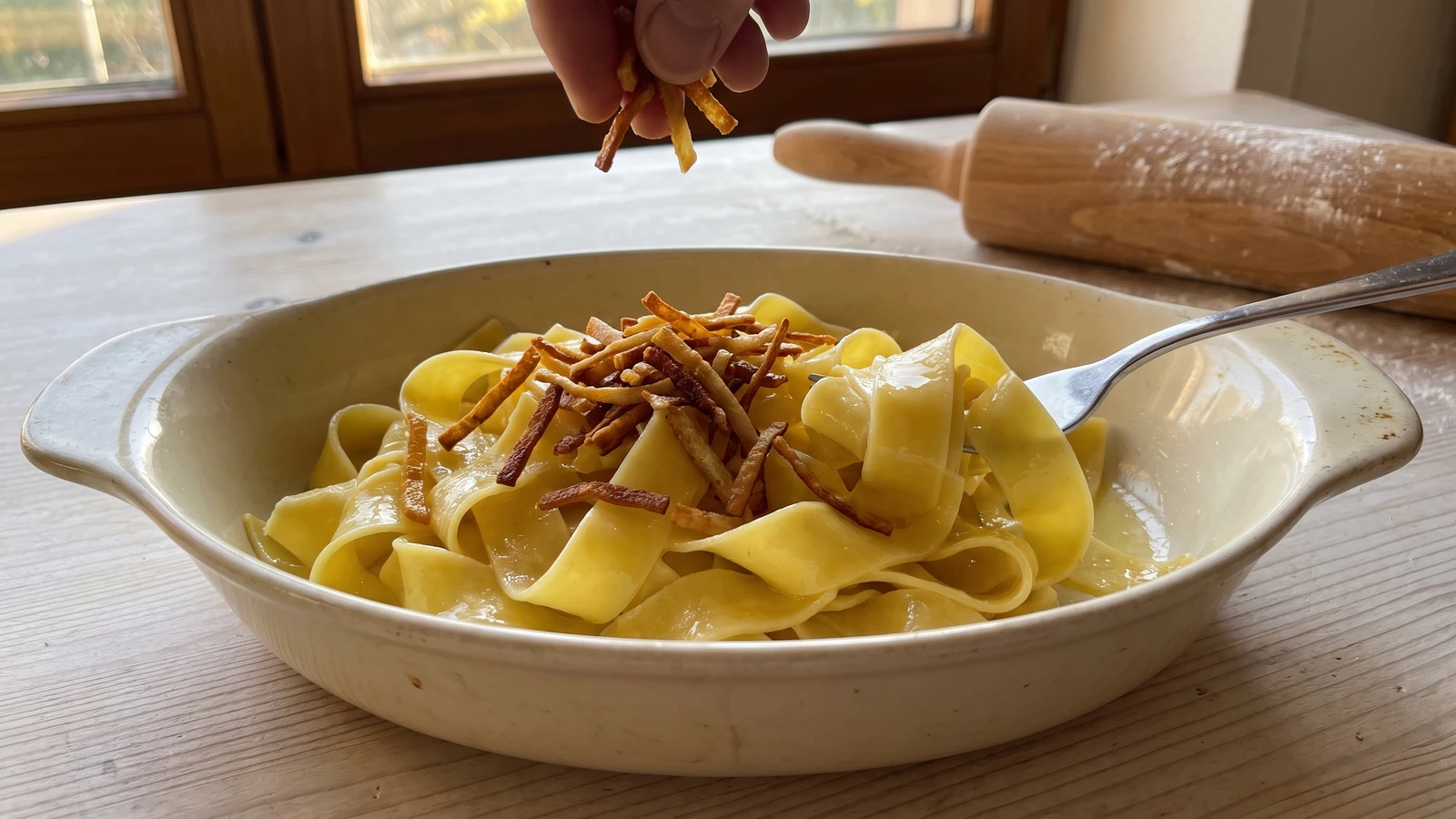
Egg-rich nouilles rolled twice, rested until supple, and cut by hand, then served butter-glossed beneath an Alsatian crown of raw noodles sautéed crisp for a weeknight lesson in patience and contrast.
Nouilles à l’Alsacienne (Alsatian egg noodles) teach the value of rest. This paste is rich with whole eggs and yolks, but it is deliberately firm, and the one true thing to know before touching the rolling pin is this: rest is not delay, it is the technique. Roll twice, wait until the sheets are dry at the surface but supple within, and they cut cleanly instead of gripping the pin or collapsing into a sticky tangle.
The old entry asks for none of the usual brigade scaffolding, no saucier on staff, no stock kept simmering, no salamander. What it assumes is a broad pastry board, practiced arms, and room to dry one great sheet. At home, divide the paste into four manageable sheets and use an ordinary rolling pin. That division is the modernization; the flour, salt, eggs, two rollings, and full rest remain untouched because they are the dish. The source’s one-pound flour formula already makes four generous main portions, so I have kept its ratios intact rather than asking you to divide eggs into absurd fractions.
Sauté, cooking quickly in a shallow pan with butter and constant movement, supplies the Alsatian finish: a few raw noodle ribbons become deeply golden and crisp before they are scattered over the tender buttered nouilles. Make that crown only after the serving bowl is ready. Above all, do not cut the sheets before their surfaces have turned matte and calm.
Nouilles belong across French domestic cooking, but the à l’Alsacienne finish places this version in Alsace, where egg-rich rolled noodles share the table with, but are distinct from, hand-cut Spätzle. The classical entry begins by admitting that nouilles are generally bought ready-made, then gives a house paste and permits macaroni preparations to be applied to it, showing how readily the noodle moved between the household pantry and the formal kitchen. Its Alsatian distinction is precise: a timbale of tender noodles receives a crown of raw strands sautéed crisp in butter, not a generic addition of cream, cheese, or choucroute.
Quantity
3¾ cups (890 ml / 454 g)
Quantity
2⅓ teaspoons (11.5 ml / 14 g)
Quantity
3 (about 150 g without shells)
at room temperature
Quantity
5 (about 90 g)
at room temperature
Quantity
6 tablespoons (90 ml / 85 g)
divided
Quantity
4 quarts (3.8 L / 3.8 kg)
for boiling
| Ingredient | Quantity |
|---|---|
| unbleached all-purpose flour | 3¾ cups (890 ml / 454 g) |
| fine salt | 2⅓ teaspoons (11.5 ml / 14 g) |
| large eggsat room temperature | 3 (about 150 g without shells) |
| large egg yolksat room temperature | 5 (about 90 g) |
| unsalted butterdivided | 6 tablespoons (90 ml / 85 g) |
| waterfor boiling | 4 quarts (3.8 L / 3.8 kg) |
Mix the flour and 14 g salt thoroughly, then mound them on the board and open a broad well in the centre. Whisk the whole eggs and yolks together, pour them into the well, and draw in the flour gradually with a fork until a rough paste forms. Knead firmly for 12 to 15 minutes, using a bench scraper to gather every crumb, until the paste is smooth, dense, and slightly satiny. It should feel much firmer than bread dough. If loose crumbs remain after several minutes, cover the paste and crumbs with an inverted bowl for 10 minutes, then knead again; the weighed eggs contain the moisture, but the flour needs time to drink it.
Divide the paste into four equal pieces so it fits a home board, shaping each into a flat rectangle and keeping the others covered. Roll one piece at a time from the centre outward, turning it frequently, until it forms an even sheet about 3 mm thick. Keep the board clean and scrape away any tacky patches instead of burying the paste in extra flour. If a sheet contracts as quickly as you roll it, cover it for 10 minutes and begin again; the gluten is tense, not ruined.
Give each sheet its second complete rolling, thinning it evenly to about 1 mm. Work from the centre toward the edges and turn the sheet often so no damp patch fastens itself to the board. You should be able to see the shadow of your fingers through the paste without finding holes. Stop after this second rolling. Repeatedly worrying the dough with the pin only toughens and dries it.
Lay the sheets flat on clean, dry kitchen towels and leave them for 1 to 2 hours, turning them once halfway through. Begin checking at 1 hour: they are ready when the surfaces feel matte and no longer tacky, while the sheets still bend without cracking. This rest is the step that matters. Cut too early and the ribbons stick together; wait until they become brittle and they splinter. If the edges have dried too far, cover the sheet with a barely damp towel for 5 minutes. Ça se rattrape.
Roll each rested sheet into a very loose cylinder without pressing it, then cut crosswise into ribbons about ¼ inch (6 mm) wide. Uncoil them immediately with your fingers. Reserve about 1½ ounces (40 g) of the shortest raw ribbons for the crisp crown, trimming them to roughly 2 to 3 inches (5 to 8 cm) so they sauté evenly. Spread the reserved noodles in a single layer and gather the rest into loose nests.
Bring the water to a strong boil in a large pot. Do not add more salt; the paste already carries the full measure specified in the original formula. Cook the noodles in two batches for 3 to 5 minutes, stirring as soon as they enter the water, until tender but still resilient and free of any floury core. Lift them out, drain thoroughly without rinsing, and transfer them to a warmed deep serving bowl, dividing 3 tablespoons (45 ml / 43 g) of the butter between the batches. If the ribbons begin clinging before they are buttered, dip them back into the boiling water for 10 seconds, drain again, and toss immediately.
Melt the remaining 3 tablespoons (45 ml / 42 g) butter in a wide skillet over medium heat. When the foam subsides, add the reserved raw noodles in one loose layer and sauté for 4 to 6 minutes, turning constantly, until they are deep butter-gold, rigid, and crisp all the way through. If the butter darkens before the noodles snap cleanly, slide the pan off the heat, lower the burner, and continue more gently. Scatter the crisp noodles over the buttered nouilles only at the last moment, then carry the bowl straight to the table. À table!
1 serving (about 300g)
Culinary guides, cultural storytelling, and the editorial depth that makes cooking meaningful.
Discover Culinary ExplorerChef Juliette
John Dory has the delicacy of sole and the firmness of turbot. A light flouring, a quick butter sauté, and nut-brown beurre noisette show exactly why looks never mattered.

Chef Juliette
Fresh haddock proves its delicacy in the meunière pan: a fine flour crust, moist pearly flakes, and beurre noisette sharpened with lemon and parsley, ready from one skillet in half an hour.
Chef Juliette
Éperlans à l’Anglaise turns small fish into a lesson in disciplined coating: boned smelts under a close, crisp crumb, pan-fried in clarified butter and finished with bright, half-melted maître d’hôtel butter.

Chef Juliette
Tiny smelts, shallot, mushrooms, white wine, gratin sauce, and fine bread raspings meet a fierce oven, where the fish must turn tender in the same breath the buttered crust bronzes.