
Chef Juliette
John Dory (St. Pierre)
John Dory has the delicacy of sole and the firmness of turbot. A light flouring, a quick butter sauté, and nut-brown beurre noisette show exactly why looks never mattered.
A cooking platform built around craft, culture, and the stories behind what we eat.
Created by Chef Juliette
Based on No. 2288, Macaroni à la Nantua, from Le Guide Culinaire (1907) by Auguste Escoffier
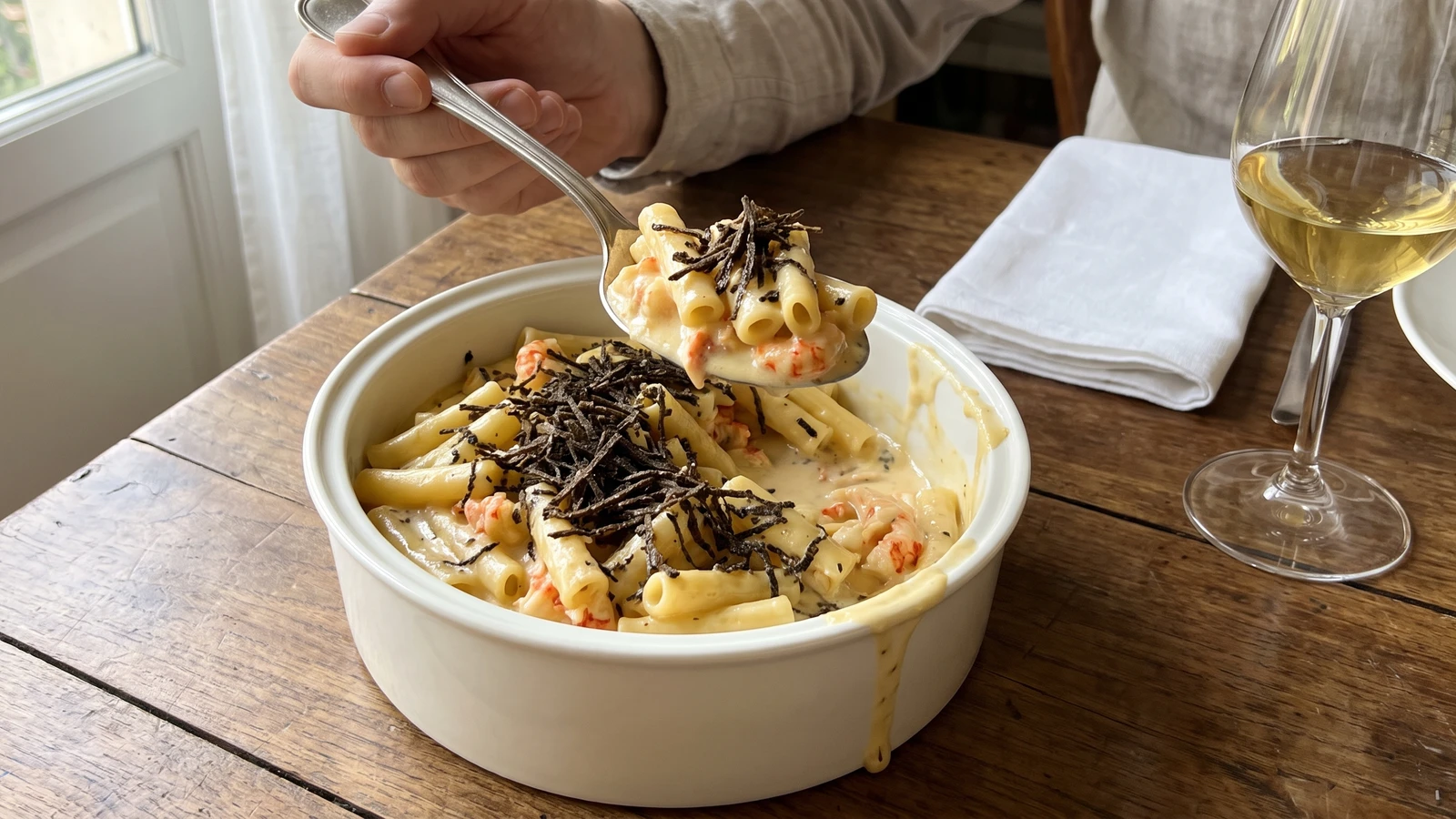
Crayfish is the point: macaroni bound in a shell-deep cream, folded with eighteen tender tails, and brought to the table beneath a very black julienne of truffle, generous, glossy, and unmistakably Nantua.
Macaroni à la Nantua (macaroni with crayfish cream) teaches one thing before you touch a pan: the crayfish is the point. The cream must taste distinctly of its shells, not merely look rich, and the tender tails must stay whole enough to announce themselves in every serving. The truffle is a dark, fragrant crown, but it never gets to steal the dish.
The source entry is brief because it assumes what its kitchen already had: a saucier keeping crayfish cream ready, stock never off the fire, another hand to drain and dry the macaroni, and a warm timbale waiting at service. Your honest equivalent is simpler. Infuse the reserved shells directly in cream, reduce it in the same saucepan, dry the pasta briefly in its hot pot, and serve from a warmed deep porcelain dish. A salamander has no work here because the macaroni is bound, not gratinéed. The source ratio stays exact: twenty-four tails per pound becomes eighteen tails for twelve ounces of macaroni, enough for four. One cook, one stove, one evening.
The separate sauce station and service silver are scaffolding, so they go. The shell-deep cream, the draining and drying, the full measure of tails, and the julienne of very black truffle are the dish, so they stay. The moment that decides everything is the liaison, the binding: the macaroni must be dry enough to take the cream, and the cream reduced enough to cling without turning pasty. If it tightens, the reserved infused cream brings it back. Ça se rattrape.
Macaroni à la Nantua belongs to Nantua in the Bugey, east of Lyon, where crayfish from the surrounding lakes and streams gave the town's name to a whole family of shellfish-rich preparations. Grand kitchens carried that crayfish signature into sauces and garnishes, but this entry keeps the identity unusually direct: cream drawn from the shells, a lavish count of tails, and black truffle over macaroni. The common mistake is to treat Nantua as a generic pink cream sauce; here there is no tomato and no ornamental shellfish, because the crayfish itself is the foundation and the point.
Quantity
12 ounces (about 3 cups dry / 340 g)
Quantity
18
unseasoned; tails removed and shells reserved
Quantity
2 cups (480 ml / 480 g)
divided
Quantity
3 tablespoons (45 ml / 42 g)
divided, with 1 tablespoon kept cold
Quantity
1 ounce (about 1/4 cup julienned / 28 g)
fresh or whole-preserved
Quantity
1 tablespoon (15 ml / 18 g), plus more to taste
| Ingredient | Quantity |
|---|---|
| dried small smooth macaroni tubes | 12 ounces (about 3 cups dry / 340 g) |
| plain-cooked whole freshwater crayfishunseasoned; tails removed and shells reserved | 18 |
| heavy creamdivided | 2 cups (480 ml / 480 g) |
| unsalted butterdivided, with 1 tablespoon kept cold | 3 tablespoons (45 ml / 42 g) |
| very black trufflefresh or whole-preserved | 1 ounce (about 1/4 cup julienned / 28 g) |
| fine sea salt | 1 tablespoon (15 ml / 18 g), plus more to taste |
Twist the tail from each crayfish, peel it carefully, and draw out the dark intestinal vein without breaking the meat. Reserve all eighteen tails under cover in the refrigerator. Keep the head, body, and tail shells together, then crack them lightly with the base of a small saucepan. You want fractured shells that will surrender their flavour, not a paste that will cloud the cream.
Melt 2 tablespoons of the butter in a heavy saucepan over medium heat. Add the cracked shells and cook for 4 minutes, turning and pressing them until the butter smells deeply of crayfish, but do not let the butter darken. Pour in the cream and bring only to a bare tremble. Partially cover and infuse over the gentlest heat for 15 minutes, stirring along the bottom twice so the cream cannot catch. Strain through a fine-mesh sieve into a measuring jug, pressing the shells lightly. Do not grind them through the mesh, which makes the cream muddy and bitter. Reserve 1/4 cup of the infused cream for adjusting the liaison.
Brush a fresh truffle clean, or drain and dry a whole-preserved one. Cut the truffle julienne-fashion, into fine match-shaped rods, keeping every trimming with the finished julienne. Fill a deep 2-quart porcelain timbale or serving bowl with hot water and leave it to warm while you finish the dish. A cold vessel seizes cream sauce before the first serving reaches the plate.
Return the unreserved infused cream to the clean saucepan and simmer gently for 6 to 10 minutes, whisking often, until it is nappant, coating the back of a spoon in an even ivory layer. Take the pan from the heat and monter au beurre, whisk in the remaining cold tablespoon of butter, until the cream gleams. Season with a small pinch of salt. If beads of butter appear around the edge, stop heating and whisk in reserved infused cream one spoonful at a time until the sauce is smooth again. Ça se rattrape.
Bring a large pot of water to a full boil, add the measured salt, and cook the macaroni until tender through but still holding its shape. Drain it thoroughly, shake the colander twice, and return the macaroni to the empty pot over low heat for 30 to 60 seconds, folding continuously until the surface looks matte and no water beads remain. Do not brown it. This drying is the step the source names plainly, and it must stay: wet macaroni dilutes the crayfish cream instead of taking hold of it.
Set the crayfish cream over low heat and add the dried macaroni. Fold steadily for 1 to 2 minutes, reaching across the bottom, until every tube is glossy and the cream clings rather than pooling beneath it. If the sauce still runs to the pan floor, keep folding over low heat; if it tightens into paste, loosen it with the reserved infused cream, a tablespoon at a time. Fold in all eighteen crayfish tails and warm them gently for about 2 minutes, just until hot at the centre. Do not boil them, or their sweetness turns to rubber.
Empty and dry the warmed timbale. Spoon in the macaroni at once, bringing the crayfish tails visibly through the cream rather than burying them at the bottom. Cover the full surface with the truffle julienne, including every trimming, and carry the timbale straight to the table. The truffle opens against the warm cream while the sauce is still loose and gleaming. À table!
1 serving (about 350g)
Culinary guides, cultural storytelling, and the editorial depth that makes cooking meaningful.
Discover Culinary ExplorerChef Juliette
John Dory has the delicacy of sole and the firmness of turbot. A light flouring, a quick butter sauté, and nut-brown beurre noisette show exactly why looks never mattered.

Chef Juliette
Fresh haddock proves its delicacy in the meunière pan: a fine flour crust, moist pearly flakes, and beurre noisette sharpened with lemon and parsley, ready from one skillet in half an hour.
Chef Juliette
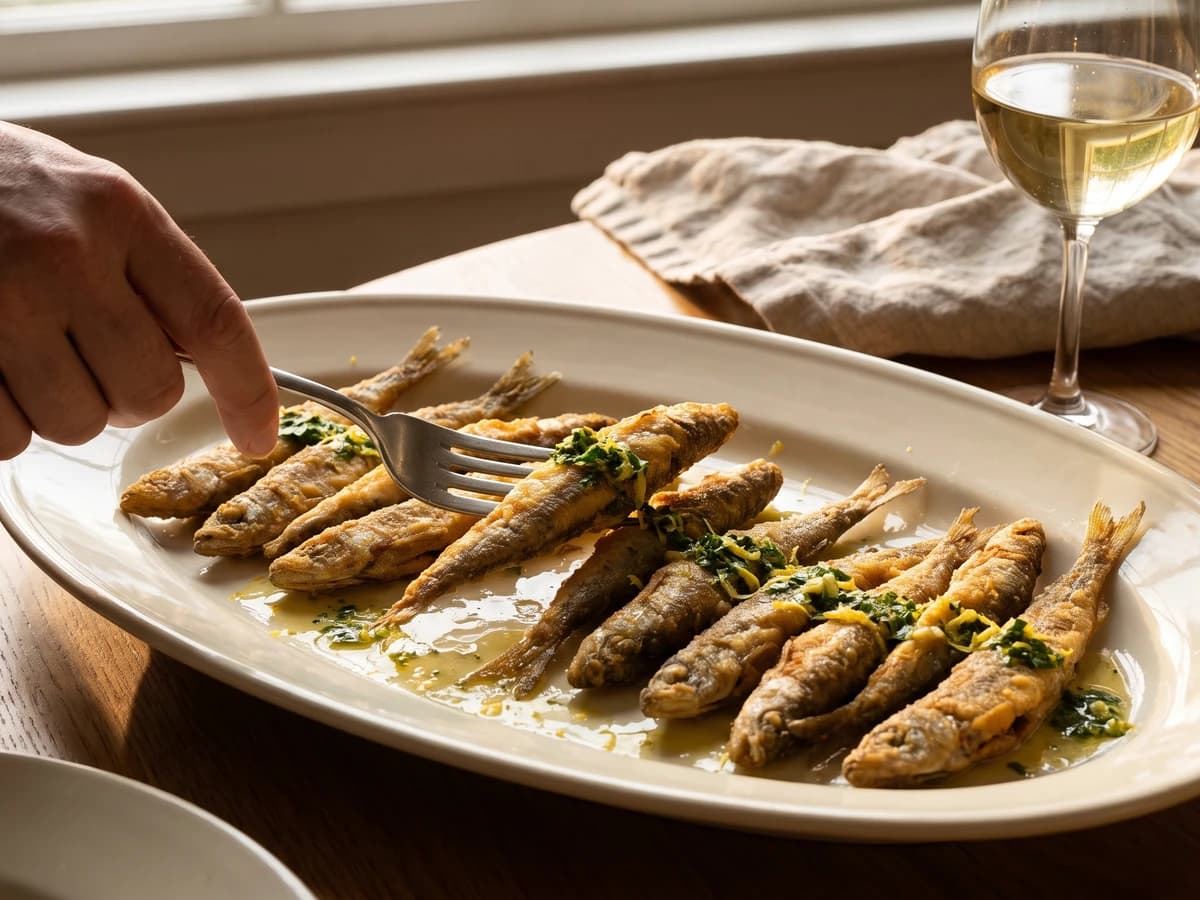
Éperlans à l’Anglaise turns small fish into a lesson in disciplined coating: boned smelts under a close, crisp crumb, pan-fried in clarified butter and finished with bright, half-melted maître d’hôtel butter.

Chef Juliette
Tiny smelts, shallot, mushrooms, white wine, gratin sauce, and fine bread raspings meet a fierce oven, where the fish must turn tender in the same breath the buttered crust bronzes.