
Chef Juliette
John Dory (St. Pierre)
John Dory has the delicacy of sole and the firmness of turbot. A light flouring, a quick butter sauté, and nut-brown beurre noisette show exactly why looks never mattered.
A cooking platform built around craft, culture, and the stories behind what we eat.

Created by Chef Juliette
Based on No. 2258, Rizotto à la Piémontaise, from Le Guide Culinaire (1907) by Auguste Escoffier
Rizotto à la Piémontaise teaches the patient addition that makes rice creamy: hot consommé in eight measures, saffron, butter, Parmesan, then white truffle or diced ham at the generous finish.
Rizotto à la Piémontaise (Piedmont-style rice) teaches the one discipline every absorption-cooked rice demands: the grain must drink before it is fed again. Hot consommé goes in seven or eight installments, never in a flood. Each addition draws starch from the rice while its center cooks, so the finished rizotto is creamy without cream and every grain still holds itself.
The source assumed a saucier stationed at the pan and a consommé pot never off the fire. At home, use one heavy saucepan, one small pan of consommé held at a bare murmur, and eight measured additions. I keep its half-pound of Piedmont rice and half-quart of consommé, exactly the book's proportion, which gives four home servings. What disappears is the brigade's constant stock service, not the measured feeding, covered cooking, or final butter and Parmesan, because those are the dish. No salamander enters here; the original never needed one. This is the honest translation for one cook, one stove, one evening.
The saffron stains the butter gold, Parmesan gives savory depth, and fresh butter leaves the rice loose enough to settle softly in the bowl. If an addition goes in too quickly, don't panic; ça se rattrape, and the rescue waits in the method. Before you touch the pan, remember the step that decides everything: wait until the spoon leaves a brief clean path across the bottom before adding the next measure.
Rizotto à la Piémontaise takes its real home from Piedmont, particularly the rice-growing plains around Vercelli and Novara, where short-grain rice is cooked by gradual absorption and enriched with butter and aged cheese. French classical kitchens carried the method across the Alps, retaining saffron, Parmesan, and the choice of white truffle or diced ham. It is often mistaken for a generic saffron rice, but the white-truffle finish ties this formula directly to Piedmont, while its installment-fed consommé and covered cooking identify the precise classical preparation.
Quantity
4 tablespoons (60 ml / 57 g)
divided, with the final half kept cold
Quantity
1 medium (about 1 cup / 240 ml / 150 g)
finely chopped
Quantity
8 ounces (1¼ cups / 300 ml / 227 g)
Quantity
2 cups (475 ml / 475 g)
kept hot
Quantity
⅛ teaspoon (0.6 ml / 0.1 g)
Quantity
½ cup (120 ml / 45 g)
finely grated
Quantity
1 small (about 0.7 ounce / 20 g)
thinly shaved; choose this or the ham
Quantity
⅔ cup (160 ml / 100 g)
cut into small dice; choose this or the truffle
Quantity
Up to ¼ teaspoon (1.25 ml / 1.5 g)
use only if the finished rizotto needs it
| Ingredient | Quantity |
|---|---|
| unsalted butterdivided, with the final half kept cold | 4 tablespoons (60 ml / 57 g) |
| medium yellow onionfinely chopped | 1 medium (about 1 cup / 240 ml / 150 g) |
| Piedmont rice, preferably Carnaroli or Arborio | 8 ounces (1¼ cups / 300 ml / 227 g) |
| clear consommékept hot | 2 cups (475 ml / 475 g) |
| saffron threads | ⅛ teaspoon (0.6 ml / 0.1 g) |
| Parmesanfinely grated | ½ cup (120 ml / 45 g) |
| fresh white truffle (optional)thinly shaved; choose this or the ham | 1 small (about 0.7 ounce / 20 g) |
| good cooked ham (optional)cut into small dice; choose this or the truffle | ⅔ cup (160 ml / 100 g) |
| fine salt (optional)use only if the finished rizotto needs it | Up to ¼ teaspoon (1.25 ml / 1.5 g) |
Bring the consommé to a bare simmer in a small saucepan, then hold it on the lowest heat. It must remain hot but should not boil away or grow saltier through reduction. Plan eight roughly equal additions of about ¼ cup (60 ml) each, keeping the final portion available to judge the texture. The source says about one quart per pound because rice and stovetop heat decide the last spoonful.
Melt 2 tablespoons (30 ml / 28 g) of the butter in a heavy saucepan over medium-low heat. Add the onion and fry gently for 5 to 7 minutes, stirring often, until soft and translucent with only the faintest gold. Add the rice, lower the heat, and turn it through the onion for 2 minutes. Sprinkle in the saffron and continue stirring until every grain is glossy, warmly golden, and thoroughly saturated with butter. If the onion begins to brown, lift the pan from the heat for half a minute before continuing; dark onion would cover the saffron rather than support it.
Add the first ¼ cup (60 ml) of hot consommé and stir slowly with a wooden spoon until it is evenly distributed. Cover the pan and hold the rice at a gentle simmer. When the liquid is nearly absorbed and the spoon leaves a clean path across the pan floor for a second, add the next measure, stir, and cover again. Continue in seven or eight installments for 18 to 22 minutes, tasting after the sixth. The rice is ready when it is tender with slight resistance at its center, never chalky, and the preparation is loose and creamy. If two measures go in at once and the rice swims, uncover it and keep the simmer gentle until the spoon's path returns. Don't attack it with fierce heat or constant beating. Ça se rattrape.
Take the saucepan fully off the heat while the rizotto is still a little looser than you want to serve it. Montez au beurre (mount with butter): add the remaining cold butter in several pieces, followed by the grated Parmesan, and stir firmly for 30 seconds until both disappear into a glossy, cohesive cream around the grains. Cover and rest for 2 minutes. If butter pools on the surface, the pan was too hot. Stop, beat in a tablespoon of the reserved hot consommé, and continue off the heat until the mixture comes together. Taste before adding any salt.
Choose one finish, never both. For ham, fold the small dice through the finished rizotto and cover for 1 minute, just long enough to warm them. For white truffle, spoon the rizotto into warmed shallow bowls first, then shave the truffle generously over the surface so its perfume is not dulled by the pan. The rizotto should relax outward when served, not stand in a stiff mound; if it has tightened during its brief rest, loosen it with the remaining hot consommé. Serve at once. À table!
1 serving (about 240g)
Culinary guides, cultural storytelling, and the editorial depth that makes cooking meaningful.
Discover Culinary ExplorerChef Juliette
John Dory has the delicacy of sole and the firmness of turbot. A light flouring, a quick butter sauté, and nut-brown beurre noisette show exactly why looks never mattered.

Chef Juliette
Fresh haddock proves its delicacy in the meunière pan: a fine flour crust, moist pearly flakes, and beurre noisette sharpened with lemon and parsley, ready from one skillet in half an hour.
Chef Juliette
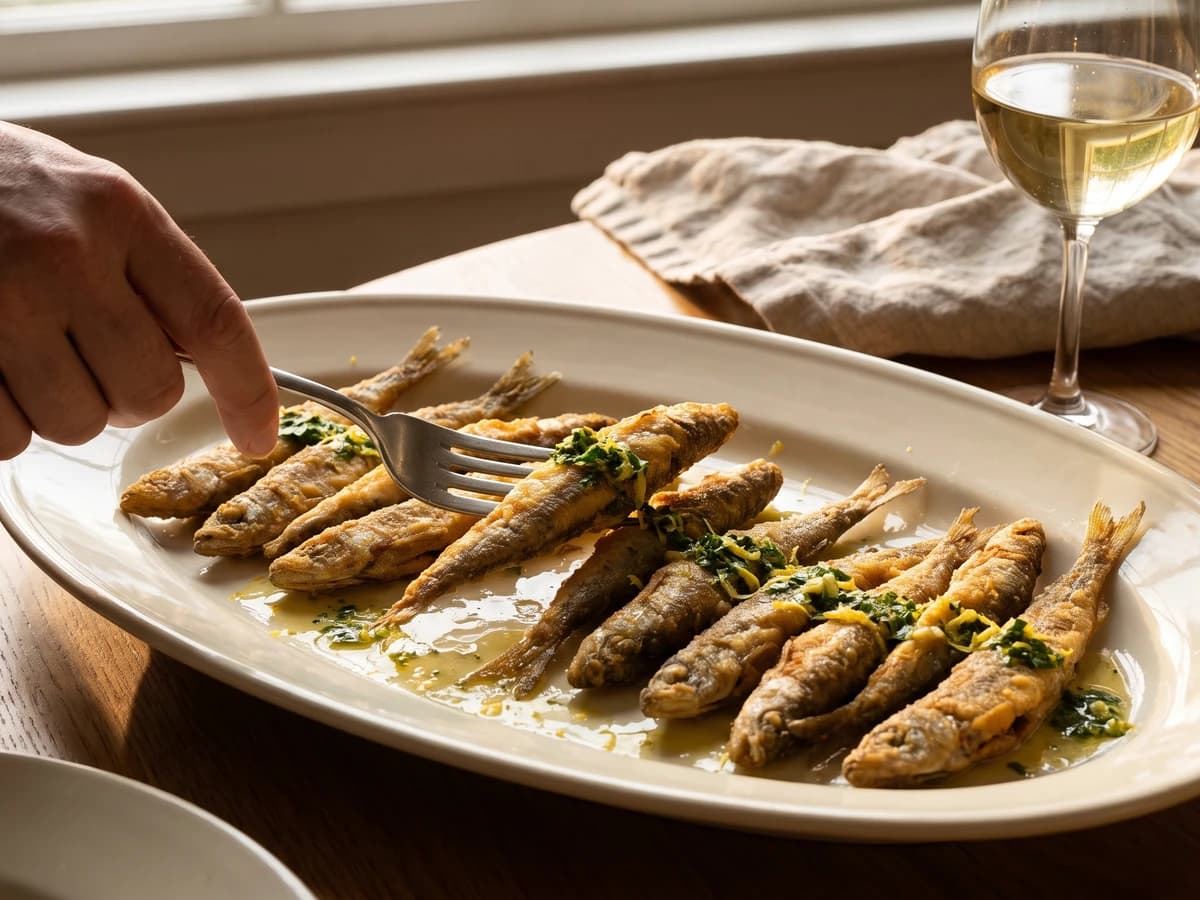
Éperlans à l’Anglaise turns small fish into a lesson in disciplined coating: boned smelts under a close, crisp crumb, pan-fried in clarified butter and finished with bright, half-melted maître d’hôtel butter.

Chef Juliette
Tiny smelts, shallot, mushrooms, white wine, gratin sauce, and fine bread raspings meet a fierce oven, where the fish must turn tender in the same breath the buttered crust bronzes.