Chef Juliette
Suet Dumpling
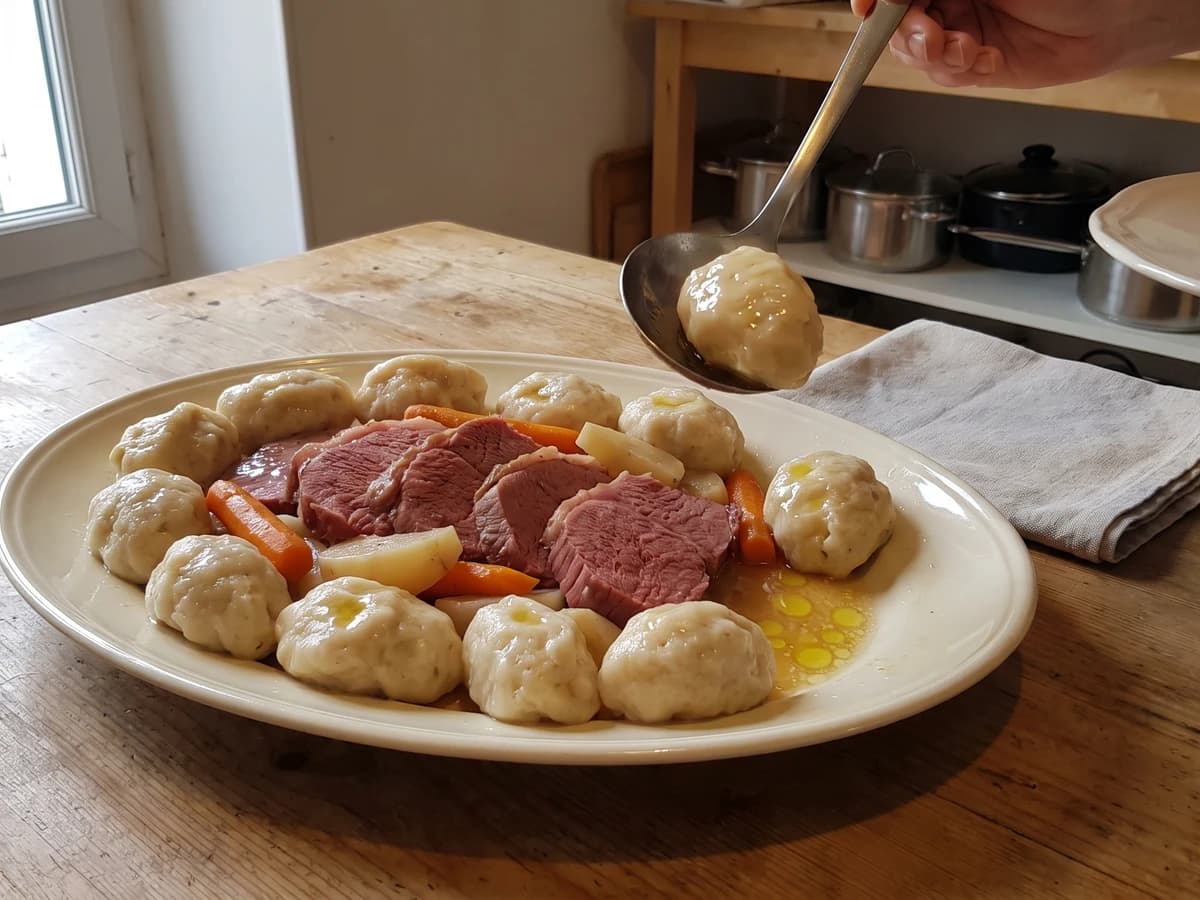
Boulettes au suif, poached beside salt beef, turn equal weights of flour and finely chopped suet into tender, rich dumplings. Keep the beef liquor at a bare tremble and the old garnish works beautifully at home.
A cooking platform built around craft, culture, and the stories behind what we eat.

Created by Chef Juliette
Based on No. 2033, Fonds d’Artichauts Farcis, from Le Guide Culinaire (1907) by Auguste Escoffier
Firm, pale artichoke bottoms hold savory duxelles beneath a buttered crumb, then meet fierce heat just long enough to gratinée, with glossy Madeira sauce passed at the table.
Fonds d’Artichauts Farcis (stuffed artichoke bottoms) teach restraint in two directions: the blanc protects their pale color, while an early exit from the pan protects their shape. The one true thing to know is this: cook the bottoms only until a knife enters with slight resistance. The oven finishes them.
The original assumed a saucier on staff, a stock never off the fire, and a salamander waiting for the final gratin. At home, the prepared Special Court-bouillon, or Blanc (No. 167), Duxelle for Stuffed Vegetables (Tomatoes, Mushrooms, &c.) (No. 224), and sauce Madère do the component work; a wide saucepan and an ordinary broiler handle the service. This version cuts the brigade quantity to eight bottoms for four people. Gallons of blanc and pans held for service are scaffolding and can go. The firm poach, concentrated duxelle, buttered crumb, and fierce final heat are the dish, and they stay.
Done properly, each pale artichoke cup carries a dark, savory mound beneath a butter-gold crust, with the Madeira sauce glossy beside it rather than soaking the crumb. Watch the texture in the blanc above everything else. Pull the bottoms while they still have backbone.
Fonds d’artichauts farcis belong to the Parisian classical table, where cooks pared globe artichokes to their tender bottoms and used those neat cups as garnishes or as a separate vegetable course. The preparation moved naturally into cuisine bourgeoise because the bottoms, duxelles, sauce, and crumb could be readied apart, then assembled when guests sat down. A blanc does not bleach an artichoke; it checks darkening while the vegetable cooks, a practical piece of kitchen chemistry absorbed into the canon.
Quantity
8 medium globe artichokes (about 3¼ to 4 pounds / 1.5 to 1.8 kg total)
Quantity
2 lemons (about 8 ounces / 230 g total)
halved
Quantity
10 cups (2.4 L / 2.4 kg) Special Court-bouillon, or Blanc (No. 167)
Quantity
1 cup (240 ml / 240 g) Duxelle for Stuffed Vegetables (Tomatoes, Mushrooms, &c.) (No. 224)
Quantity
2 tablespoons (30 ml / 28 g)
divided
Quantity
¼ cup (60 ml / 25 g)
Quantity
1 application of Gratins (No. 268)
Quantity
1 cup (240 ml / 250 g)
| Ingredient | Quantity |
|---|---|
| medium globe artichokes | 8 medium globe artichokes (about 3¼ to 4 pounds / 1.5 to 1.8 kg total) |
| lemonshalved | 2 lemons (about 8 ounces / 230 g total) |
| prepared Special Court-bouillon, or Blanc | 10 cups (2.4 L / 2.4 kg) Special Court-bouillon, or Blanc (No. 167) |
| prepared Duxelle for Stuffed Vegetables | 1 cup (240 ml / 240 g) Duxelle for Stuffed Vegetables (Tomatoes, Mushrooms, &c.) (No. 224) |
| unsalted butterdivided | 2 tablespoons (30 ml / 28 g) |
| fine fresh breadcrumbs | ¼ cup (60 ml / 25 g) |
| Gratins finishing treatment | 1 application of Gratins (No. 268) |
| prepared sauce Madère (Madeira sauce) | 1 cup (240 ml / 250 g) |
Work on one artichoke at a time. Snap the stem away close to the base, pulling rather than slicing so some of its tough fibers come with it. Cut across the leaf cone about 1 inch above the base, then use a sharp paring knife to remove the remaining green leaf bases and round the sides into a neat, thick cup. Pull out the small purple leaves and scoop away every thread of fuzzy choke without gouging the tender flesh beneath. Rub all exposed surfaces firmly with a lemon half and keep the finished bottom beneath a damp clean towel while you prepare the rest.
Bring the prepared Special Court-bouillon, or Blanc (No. 167) to a boil in a wide nonreactive saucepan, stirring as it heats because its flour can settle. Lower in the artichoke bottoms, place a parchment cartouche directly over them to keep them submerged, and return the liquid to a bare simmer. Cook for 12 to 16 minutes, checking early, until a paring knife enters the thick edge with distinct but gentle resistance. If they become fully tender, lift them out at once, chill them, and plan to gratinée them under the broiler without the preliminary oven heating. Ça se rattrape, but softness cannot be cooked backward.
Lift the bottoms from the blanc and drain them hollow-side down on a clean towel or rack for 10 minutes. Turn them over and blot the cups and rims thoroughly. Trapped liquid thins the filling and softens the crumb, so give it somewhere to go now. Use about 1 teaspoon of the butter to coat a shallow broiler-safe gratin dish, then arrange the bottoms hollow-side up.
Divide the prepared Duxelle for Stuffed Vegetables (Tomatoes, Mushrooms, &c.) (No. 224) among the artichoke bottoms, allowing about 2 tablespoons for each. Mound it neatly without packing it hard; the filling should sit inside the rim rather than spilling down the sides. If the duxelle has loosened during storage, warm it separately and reduce it just until it holds a mound before filling. Ça se rattrape. A wet filling buried under crumbs does not.
Heat the oven to 425°F (220°C) with a rack in the upper third. Sprinkle the fine fresh breadcrumbs evenly over the duxelle without pressing them down. Melt the remaining butter and spoon it across the crumbs so every top receives a little. Butter, not cheese, makes this crust; adding cheese would cover the artichoke and mushroom flavors the gratin is meant to concentrate.
Bake for 8 to 10 minutes, just until the filling is hot and melted butter bubbles around the bottoms. Finish with the Rapid Gratin treatment from Gratins (No. 268): move the dish beneath a fully heated broiler for 30 seconds to 2 minutes, watching without leaving the stove, until the crumbs are evenly butter-gold. If one patch colors early, rotate the dish and shield that spot loosely with foil. Do not wait for the artichokes to soften further; the color on top is your signal.
While the gratin finishes, warm the sauce Madère over the lowest heat until it is fluid, glossy, and hot. If a skin forms, whisk gently until smooth. Pour it into a warmed sauceboat and serve it at the same time as the artichokes, allowing each guest to spoon the sauce beside the bottoms rather than over their crisp tops. Two bottoms make a generous serving. À table!
1 serving (about 235g)
Culinary guides, cultural storytelling, and the editorial depth that makes cooking meaningful.
Discover Culinary ExplorerChef Juliette
Boulettes au suif, poached beside salt beef, turn equal weights of flour and finely chopped suet into tender, rich dumplings. Keep the beef liquor at a bare tremble and the old garnish works beautifully at home.

Chef Juliette
Bread, flour, frangipane, and rice become four cool, supple panades for binding forcemeats, each changing body and flavor while preserving tenderness. The finest Mousselines need none, and knowing that distinction is the lesson.

Chef Juliette
Panade au pain is bread, milk, salt, heat, and attention: stir until the paste releases cleanly, butter it against a skin, and you have the quiet binder behind tender French farces.

Chef Juliette
Panade de farine teaches the drying stroke behind pâte à choux: flour meets boiling buttered water, then stays over the fire until the paste gathers, smooths, and quits the pan cleanly.