
Chef Juliette
Ordinary or White Consommé
Beef shin, lean beef, and fowl begin in cold water and rise slowly toward a tremble. Skim before the boil, and you learn the quiet discipline that gives every clear French broth its backbone.
A cooking platform built around craft, culture, and the stories behind what we eat.
Created by Chef Juliette
Based on No. 167, Special Court-bouillon, or Blanc, from Le Guide Culinaire (1907) by Auguste Escoffier
The blanc that protects pale meats and vegetables: flour suspended in lemoned salted water, stirred without pause to the first boil, then used at once for clean colour and gentle cooking.
Court-bouillon spécial, ou blanc (special white cooking liquor) teaches a quiet discipline: flour must remain suspended as salted, acidulated water reaches the boil. This is not a thickened sauce, and it should remain fluid and only lightly cloudy. Its purpose is to keep calf's head, trotters, salsify, cardoon, and other pale ingredients from turning grey as they cook.
The original formula assumed five quarts for professional service and a cook free to stand over the saucepan while the next ingredient was made ready. Here it becomes about two quarts in a four-quart pan, with the book's proportions of flour, grey salt, lemon, and water kept intact. One cook, one stove, one evening.
The five-quart quantity was brigade scaffolding, so it goes. Gradual mixing, straining, and uninterrupted stirring to the first boil are the dish itself, so they stay. Have the ingredient ready beside the stove before you begin heating, then stir from cold water to the first boil without leaving the pan.
Le blanc belongs to the classical kitchens of Paris and to bourgeois households that adopted their working methods; it is a preparatory cooking medium, not a regional sauce. Its flour is not meant to thicken a finished dish but to remain suspended with acid and salt, helping pale offal and oxidation-prone vegetables such as salsify and cardoon retain their colour. Despite the name court-bouillon, it is not the aromatic fish liquor most cooks expect, and fish is expressly outside its work.
Quantity
2 quarts (1.9 liters / 1.9 kilograms)
Quantity
Scant 3 tablespoons (45 milliliters / 22 grams)
Quantity
1 tablespoon (15 milliliters / 17 grams)
Quantity
Juice of 1¼ medium lemons, about 3 tablespoons (45 milliliters / 45 grams), or 2 tablespoons (30 milliliters / 30 grams) vinegar
lemon juiced and strained
Quantity
1 batch, prepared through Blanchings (No. 273)
| Ingredient | Quantity |
|---|---|
| cold water | 2 quarts (1.9 liters / 1.9 kilograms) |
| all-purpose flour | Scant 3 tablespoons (45 milliliters / 22 grams) |
| coarse grey sea salt | 1 tablespoon (15 milliliters / 17 grams) |
| fresh lemon juice or good wine vinegarlemon juiced and strained | Juice of 1¼ medium lemons, about 3 tablespoons (45 milliliters / 45 grams), or 2 tablespoons (30 milliliters / 30 grams) vinegar |
| calf's head or foot, sheep's trotters, cocks' kidneys or combs, salsify, or cardoon | 1 batch, prepared through Blanchings (No. 273) |
Put the flour in a wide mixing bowl. Add about 1 cup of the measured cold water in a thin stream while whisking, beginning with only a splash so the whisk has enough resistance to crush every lump. Once the mixture is perfectly smooth, gradually whisk in the remaining water. Cold water matters here; warm water catches the flour into little dumplings before it can disperse.
Whisk in the grey salt and either the lemon juice or wine vinegar until the salt dissolves. Pass the mixture through a fine-mesh strainer into a four-quart stainless-steel or enamelled saucepan. Straining is not ceremony; it catches the one small flour lump that would otherwise settle, stick, and scorch.
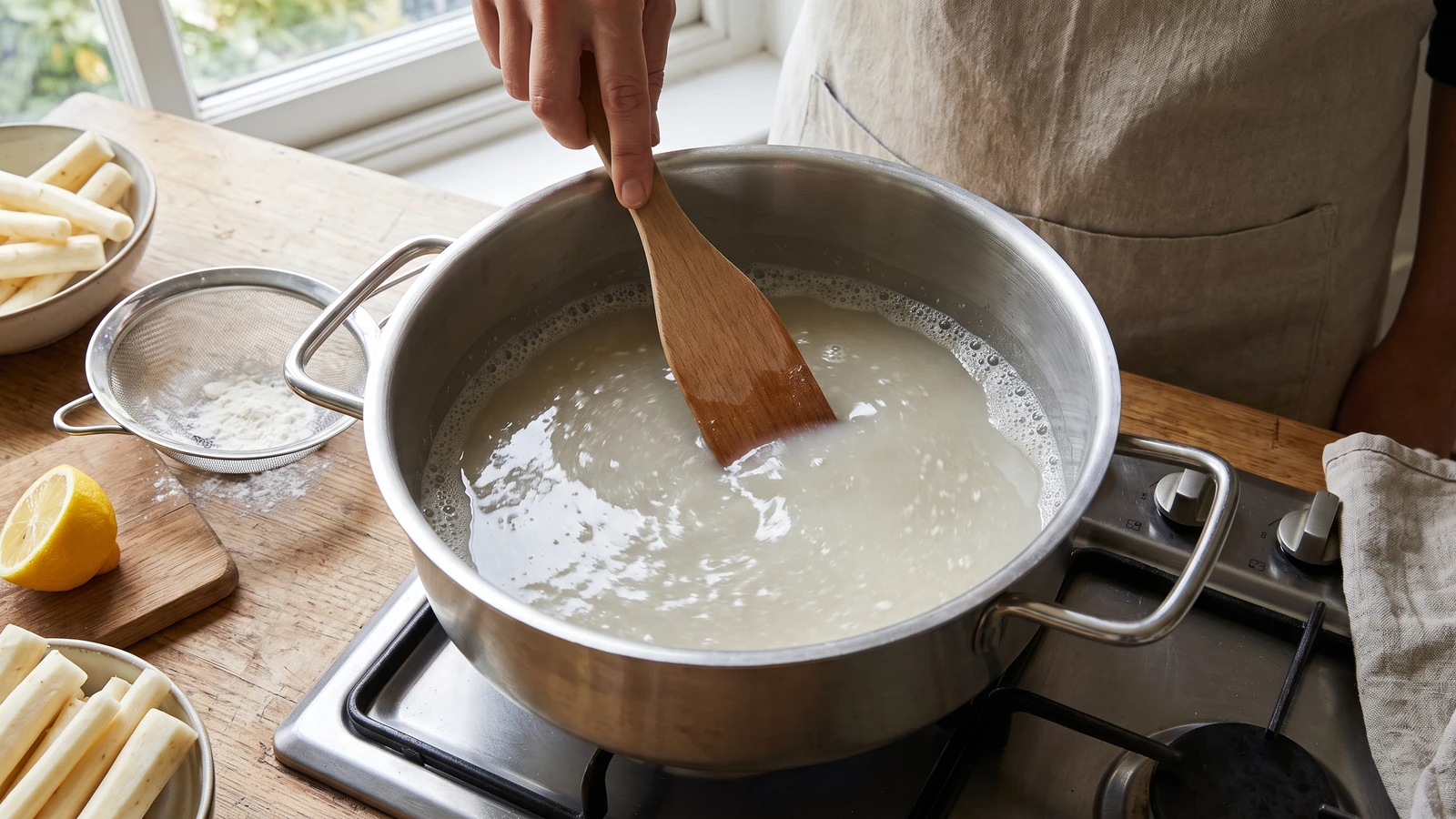
Set the saucepan over medium heat and stir continuously with a flat-edged wooden spatula, sweeping the entire base and reaching into the corners. The blanc must stay lightly cloudy and evenly fluid as it heats. If flour begins gathering on the bottom, lift the pan off the heat immediately and whisk until it disperses, then continue more gently. Ça se rattrape. If you see brown specks or smell toasted flour, do not scrape them up; decant the liquid into a clean pan and taste it, restarting if the scorched flavour has entered the blanc.
At the first full boil, immediately lower in the chosen ingredient, already prepared and ready according to Blanchings (No. 273). The blanc must cover it completely. If it does not, use a narrower pan or make more blanc in the same proportions; plain water would weaken the balance that preserves the colour. A parchment circle or small heatproof plate can hold floating pieces beneath the surface.
Let the liquid return to a gentle simmer, then cook for the time and doneness required by the ingredient's final recipe. Sweep the spatula carefully around the ingredient and across the pan floor every few minutes so the flour remains suspended. Blanching is a preliminary treatment, not proof of doneness, so meats and offal must complete their prescribed cooking before serving.
Lift the cooked ingredient from the blanc with a skimmer, drain it, and proceed immediately with its final preparation. Do not serve this liquid as broth and do not reuse it for another batch, particularly after meat or offal; it has done its work when the ingredient comes out pale, clean-tasting, and properly cooked.
1 serving (about 240g)
Culinary guides, cultural storytelling, and the editorial depth that makes cooking meaningful.
Discover Culinary ExplorerChef Juliette
Beef shin, lean beef, and fowl begin in cold water and rise slowly toward a tremble. Skim before the boil, and you learn the quiet discipline that gives every clear French broth its backbone.

Chef Juliette
Break the veal bones small, then give them eight hours at a bare tremble. This pale, gelatinous fond becomes the quiet foundation beneath velouté, blanquette, and every sauce that must stay light.

Chef Juliette
Sauce Orientale concentrates lobster-rich American Sauce with curry, then folds in cream away from the fire: a glossy, gently spiced derivative made for lobster, crayfish, and firm fish.

Chef Juliette
An old lesson in sauce families: Sauce Allemande takes mushroom liquor, then butter, lemon, and parsley, becoming a glossy Poulette for sheep's trotters, leeks, cauliflower, and anything needing gentle richness with a bright edge.