
Chef Juliette
John Dory (St. Pierre)
John Dory has the delicacy of sole and the firmness of turbot. A light flouring, a quick butter sauté, and nut-brown beurre noisette show exactly why looks never mattered.
A cooking platform built around craft, culture, and the stories behind what we eat.

Created by Chef Juliette
Based on No. 1974, Roast Ortolans, from Le Guide Culinaire (1907) by Auguste Escoffier
Tiny farmed quail, vine leaves, salted water, and fierce heat preserve the spare logic of ortolans rôtis: hold the bird’s fat close, roast swiftly, and serve it without butter, bacon, sauce, or ornament.
Ortolans rôtis (roast ortolans) teach the hardest form of classical cooking: restraint. The entry’s one true thing is that the bird is sufficient in itself, so the vine leaf, shallow salted water, and fierce heat must preserve its own fat rather than bury it under bacon, butter, gravy, truffle, or foie gras.
That original assumes access to a tiny wild ortolan bunting. A home cook must not make that assumption: the species is protected under French and European law, and trapping, buying, possessing, or cooking one is unlawful. The honest equivalent is inspected, farm-raised quail, one vine leaf per bird, scaled to eight small birds for four people. Quail are larger and leaner, so the four to five minutes in the entry becomes a thermometer-led 10 to 14 minutes. Changing the clock is necessary to preserve the method’s intent and serve poultry safely.
The old recipe needs no saucier, stockpot, or salamander. Its only brigade advantage was a fiercely heated oven on command; a fully preheated home oven and a compact metal tray provide that concentrated blast for one cook, one stove, one evening. The salted water and vine-leaf wrapping are the dish and must stay. Ornamental luxuries are scaffolding and go. Watch the water and the internal temperature. Those two readings decide everything.
Ortolans rôtis belong to Landes and the wider Gascon table in southwest France, where ortolan buntings taken during migration became a private ceremonial delicacy before grand kitchens codified their service. The classical preparation is unusually severe about luxury: the bird is roasted in a vine leaf over salted water, while bacon, butter, gravy, truffles, and foie gras are rejected because they obscure its delicacy. The ortolan bunting is protected under French and European law, so this lawful home rendering uses farmed quail and changes only the roasting time demanded by the larger bird.
Quantity
8, each 4 to 5 ounces (115 to 140 g)
fully thawed with giblets removed
Quantity
8, about 7 inches (18 cm) wide
untreated fresh leaves or brined leaves thoroughly rinsed
Quantity
¾ cup (180 ml / 180 g)
Quantity
½ teaspoon (2.5 ml / 3 g)
| Ingredient | Quantity |
|---|---|
| small farm-raised quailfully thawed with giblets removed | 8, each 4 to 5 ounces (115 to 140 g) |
| very large edible vine leavesuntreated fresh leaves or brined leaves thoroughly rinsed | 8, about 7 inches (18 cm) wide |
| water | ¾ cup (180 ml / 180 g) |
| fine sea salt | ½ teaspoon (2.5 ml / 3 g) |
Use only inspected, farm-raised quail. Wild ortolan buntings are protected and must never be trapped, purchased, possessed, or cooked. Take the quail from the cold 20 minutes before roasting, check that every cavity is empty, and pat the birds thoroughly dry inside and out. A wet surface dilutes the little fat the bird carries and prevents the vine leaf from holding closely.
If the vine leaves are fresh, cut away the thick stems and blanch the leaves in boiling water for 15 seconds, just until supple, then drain and dry them. If they came from brine, rinse them well and dry them instead. Lay each leaf vein-side up, set one quail breast-side down near its centre, and fold the sides and tip snugly around the body. Turn the parcel seam-side down. The leaf should embrace the bird, not swaddle it in several heavy layers.
Heat the oven to 500°F (260°C), with a rack in the upper third, and give it a full 30 minutes to reach its fierce heat. Dissolve the salt in the water. Pour ½ cup (120 ml / 120 g) into a heavy 13 by 9-inch (33 by 23 cm) metal roasting tray and keep the remaining ¼ cup (60 ml / 60 g) hot. You want a shallow film across the tray floor, not a bath. Arrange the wrapped quail seam-side down with a little air between them.
Roast without basting for 8 minutes, then begin checking. The leaves should be darkened and blistered at their edges, with burnished skin visible where each wrapping opens. Continue roasting for 2 to 6 minutes, until an instant-read thermometer inserted through the leaf into the deepest part of the breast, without touching bone, registers 165°F (74°C). The original four to five minutes belonged to a much smaller bird and cannot be transferred safely to quail. If the leaves blacken before the quail are ready, cover them loosely with foil. If the tray dries, pour the reserved hot salted water down one side without wetting the birds. Ça se rattrape.
Lift the tray from the oven and leave the quail in their vine leaves for 3 minutes. Serve two birds to each person on warm plain plates, either still wrapped or with the leaves folded back to reveal the burnished skin. Do not spoon over the tray liquid, and add no bacon, butter, gravy, truffle, foie gras, garnish, or side dish. The austerity is deliberate. À table!
1 serving (about 155g)
Culinary guides, cultural storytelling, and the editorial depth that makes cooking meaningful.
Discover Culinary ExplorerChef Juliette
John Dory has the delicacy of sole and the firmness of turbot. A light flouring, a quick butter sauté, and nut-brown beurre noisette show exactly why looks never mattered.

Chef Juliette
Fresh haddock proves its delicacy in the meunière pan: a fine flour crust, moist pearly flakes, and beurre noisette sharpened with lemon and parsley, ready from one skillet in half an hour.
Chef Juliette
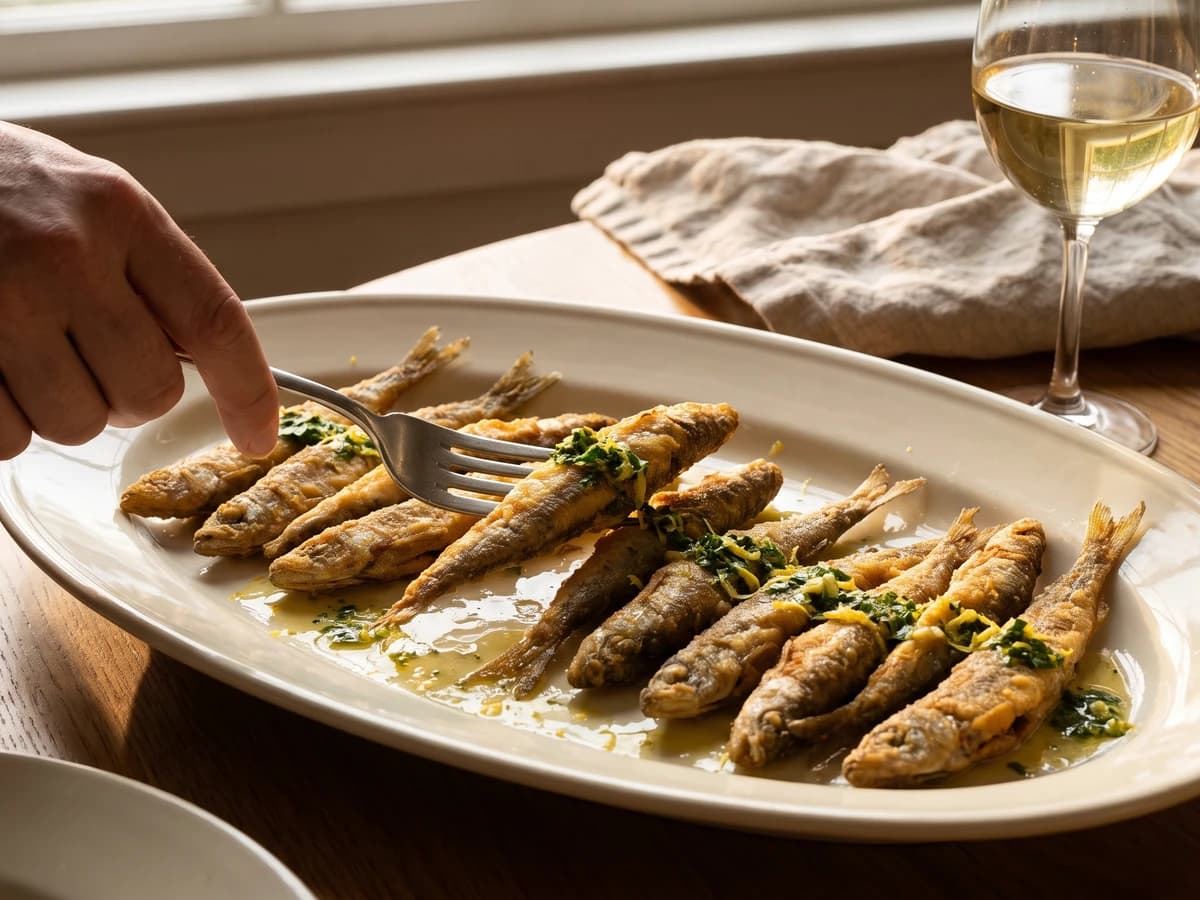
Éperlans à l’Anglaise turns small fish into a lesson in disciplined coating: boned smelts under a close, crisp crumb, pan-fried in clarified butter and finished with bright, half-melted maître d’hôtel butter.

Chef Juliette
Tiny smelts, shallot, mushrooms, white wine, gratin sauce, and fine bread raspings meet a fierce oven, where the fish must turn tender in the same breath the buttered crust bronzes.