
Chef Juliette
John Dory (St. Pierre)
John Dory has the delicacy of sole and the firmness of turbot. A light flouring, a quick butter sauté, and nut-brown beurre noisette show exactly why looks never mattered.
A cooking platform built around craft, culture, and the stories behind what we eat.
Created by Chef Juliette
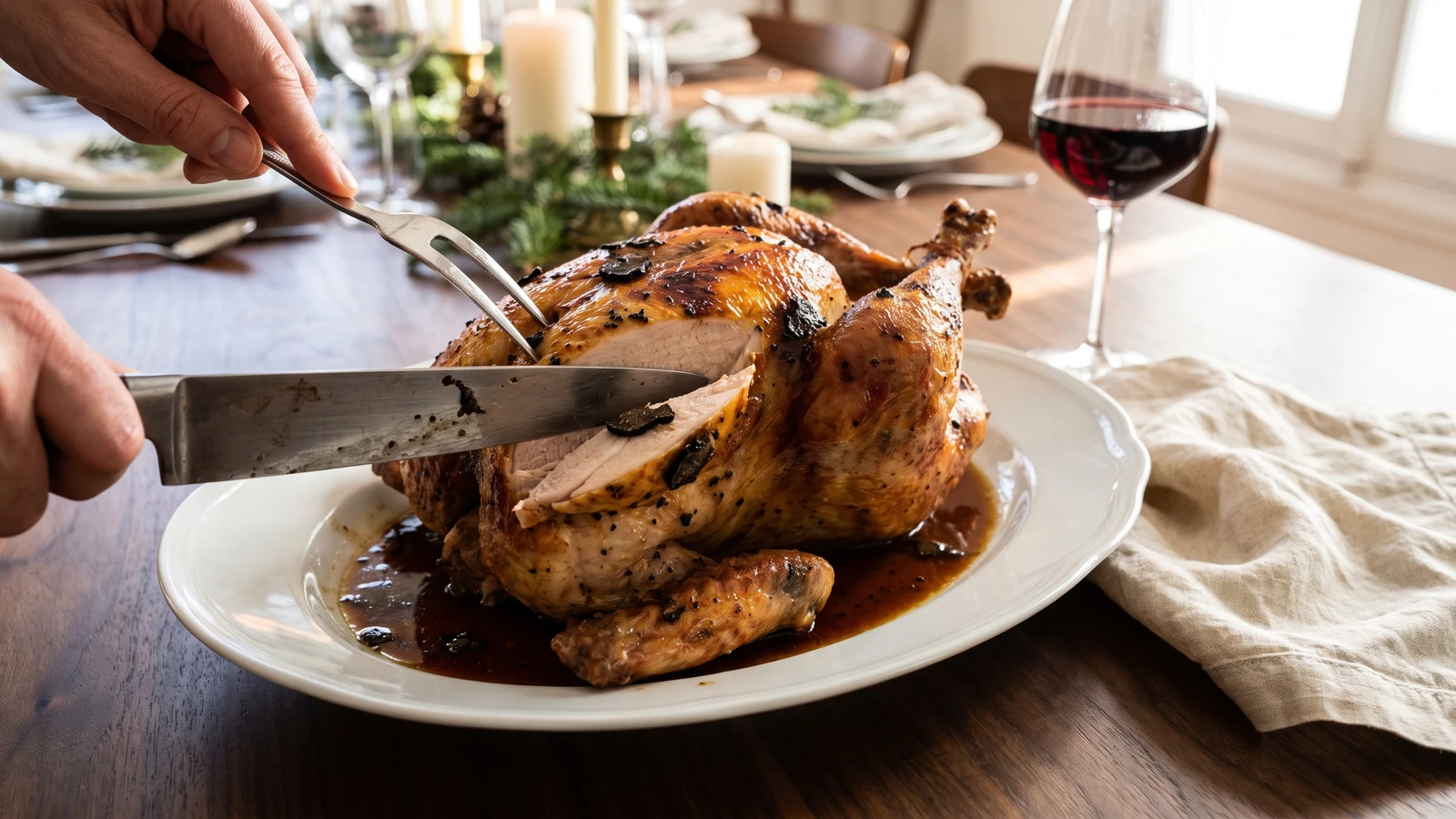
Based on No. 1961, Truffled Young Turkey, from Le Guide Culinaire (1907) by Auguste Escoffier
Dindonneau truffé turns a small celebration bird into a lesson in perfume and protection: black truffle carried by pounded fat, skin sewn tight, parchment lifted only for the final burnished colour.
Dindonneau truffé (truffled young turkey) teaches one thing above all: keep the truffle's perfume inside the bird until the final browning. Black truffle is not a garnish here. It is folded through pounded fresh fat, enclosed in the cavity, and carried into the flesh by a long, steady roast. Open the bird too soon and the kitchen gets the aroma instead of the meat.
The source is deliberately spare because it sends the cook back to the truffled pullet and asks only for more truffle, more fat, and more time. A grand kitchen could give the turkey to a rôtisseur (roast cook), keep a saucier beside a stock never off the fire, pound fat at the mortar, and correct the colour under a salamander. At home, a small processor, a roasting rack, good poultry stock, and a hotter final oven do the same work. I have scaled the bird to four generous servings. The brigade's extra hands are scaffolding, but the generous truffle, the pounded fat, the sewn opening, the buttered paper, and the steady fire are the dish. One cook, one stove, one evening.
Do not pack the cavity hard. The fat must melt around the truffles without forming a dense plug. Sew the skin snugly, wrap the breast and sides in buttered parchment, then leave the paper alone until the last stretch. That seal is the step that decides the dish.
Dindonneau truffé belongs to the French celebration table, where grand Parisian kitchens brought young poultry together with black truffles arriving from Périgord and Quercy. The preparation moved the truffle from garnish to seasoning: mixed with fat and enclosed inside the bird, its perfume traveled through the flesh during roasting. The turkey is not simply a larger pullet, because its broader cavity and longer fire demand more truffle, more protective fat, and a paper covering kept on until the final colouring.
Quantity
1, 6 to 7 lb (2.7 to 3.2 kg)
giblets removed
Quantity
12 oz (340 g / about 2½ cups)
brushed clean and coarsely chopped
Quantity
8 oz (225 g / about 1¼ cups)
very cold and finely diced
Quantity
1 tbsp (15 ml / 18 g)
divided
Quantity
1 tsp (5 ml / 2 g)
divided
Quantity
5 tbsp (75 ml / 71 g)
4 tablespoons softened and 1 tablespoon cold
Quantity
2 cups (480 ml / 480 g)
divided
| Ingredient | Quantity |
|---|---|
| small whole young turkeygiblets removed | 1, 6 to 7 lb (2.7 to 3.2 kg) |
| fresh black trufflesbrushed clean and coarsely chopped | 12 oz (340 g / about 2½ cups) |
| fresh unsmoked pork fatbackvery cold and finely diced | 8 oz (225 g / about 1¼ cups) |
| fine sea saltdivided | 1 tbsp (15 ml / 18 g) |
| finely ground white pepperdivided | 1 tsp (5 ml / 2 g) |
| unsalted butter4 tablespoons softened and 1 tablespoon cold | 5 tbsp (75 ml / 71 g) |
| unsalted poultry stockdivided | 2 cups (480 ml / 480 g) |
Set an oven rack in the lower third and heat the oven to 325°F (165°C). Remove the neck and gizzard from the turkey and reserve them for the roasting pan; save the liver for another use, since it can make the jus bitter. Trim any loose lumps of cavity fat, pat the bird thoroughly dry, and leave it out for no more than 30 minutes while you prepare the filling.
Pulse the cold fatback in a small processor with 1 teaspoon of the salt and ½ teaspoon of the white pepper until it becomes a fine, cohesive paste, stopping often so it stays cold. A mortar did this work in the brigade kitchen; the processor is its honest home equivalent. Fold in the chopped truffles without crushing them. If the fat turns shiny and begins releasing oil, stop and chill it for 10 minutes before continuing. Ça se rattrape. The fat must be soft enough to carry the truffle perfume, not warm enough to melt.
Season the turkey inside and out with the remaining salt and white pepper. Spoon the truffle and fatback mixture into the cavity, filling it generously but never compacting it into a hard mass. Pull the tail flap over the opening and sew the skin closed with a large trussing needle and unwaxed cotton twine, taking stitches about ½ inch (1 cm) apart. If the skin tears, ça se rattrape: bridge the opening with two or three metal skewers and lace the twine around them. Fold the wing tips underneath and tie the legs together without squeezing the bird out of shape.
Set the reserved neck and gizzard beneath a rack in a sturdy metal roasting pan, then pour 1 cup (240 ml / 240 g) of the stock around them. Rub the turkey with 1 tablespoon of the softened butter. Coat a sheet of baking parchment generously with the remaining 3 tablespoons of softened butter, lay the buttered face against the breast and sides, and tie it in place with kitchen twine. Cover the bird well but leave the bottom open to the heat of the pan.
Roast the papered turkey for 1 hour 45 minutes, turning the pan once for even cooking. Check the pan after the first hour; it should hold a shallow layer of golden juices and a brown fond, not a dry black crust. If it is drying, add a little of the remaining stock. If the fond begins to scorch, add ¼ cup (60 ml / 60 g) stock immediately and move the pan one rack higher. The steady fire perfumes and tenderizes the bird. The final high heat is only for colour.
Remove the pan, cut away the parchment, and raise the oven to 425°F (220°C). Spoon a little clear pan fat over the skin, then return the turkey uncovered for 30 to 50 minutes, turning the pan once, until the breast is deeply golden and the thigh juices run clear. Check with a thermometer in three places: the thickest breast should reach at least 160°F (71°C) and rise as it rests, the inner thigh should reach 170°F (77°C), and the centre of the truffle mixture must reach 165°F (74°C). If the skin colours before the centre is ready, cover only the dark areas with clean parchment, lower the oven to 350°F (180°C), and continue cooking.
Transfer the turkey to a warm platter and rest it for 25 to 30 minutes, loosely covered with a clean sheet of parchment. Do not seal it tightly or the burnished skin will soften. Resting is part of roasting, not empty time: the juices settle through the meat while the truffle filling finishes distributing its perfume.
Make the jus de rôti (roasting jus) while the turkey rests. Remove the neck and gizzard, pour the pan liquid into a heatproof jug, and let the fat rise before spooning most of it away. Set the metal roasting pan over medium heat, add the remaining stock and the defatted juices, and scrape up every brown trace of fond. Simmer until reduced to about 1 cup (240 ml / 240 g), then strain. Off the heat, monter au beurre by whisking in the reserved tablespoon of cold butter until the jus gleams. If it looks greasy, put a teaspoon of cold stock in a clean saucepan and whisk in the split jus a little at a time. Ça se rattrape.
Cut and remove every stitch before opening the cavity. Tip the bird slightly over a warm bowl and spoon out the truffles, leaving behind any pool of rendered fat. Carve the breast in broad slices, separate the legs at their joints, and arrange everything generously on the platter. Scatter the hot truffle pieces over the meat and spoon on just enough glossy jus to moisten it, passing the rest at the table. À table!
1 serving (about 510g)
Culinary guides, cultural storytelling, and the editorial depth that makes cooking meaningful.
Discover Culinary ExplorerChef Juliette
John Dory has the delicacy of sole and the firmness of turbot. A light flouring, a quick butter sauté, and nut-brown beurre noisette show exactly why looks never mattered.

Chef Juliette
Fresh haddock proves its delicacy in the meunière pan: a fine flour crust, moist pearly flakes, and beurre noisette sharpened with lemon and parsley, ready from one skillet in half an hour.
Chef Juliette
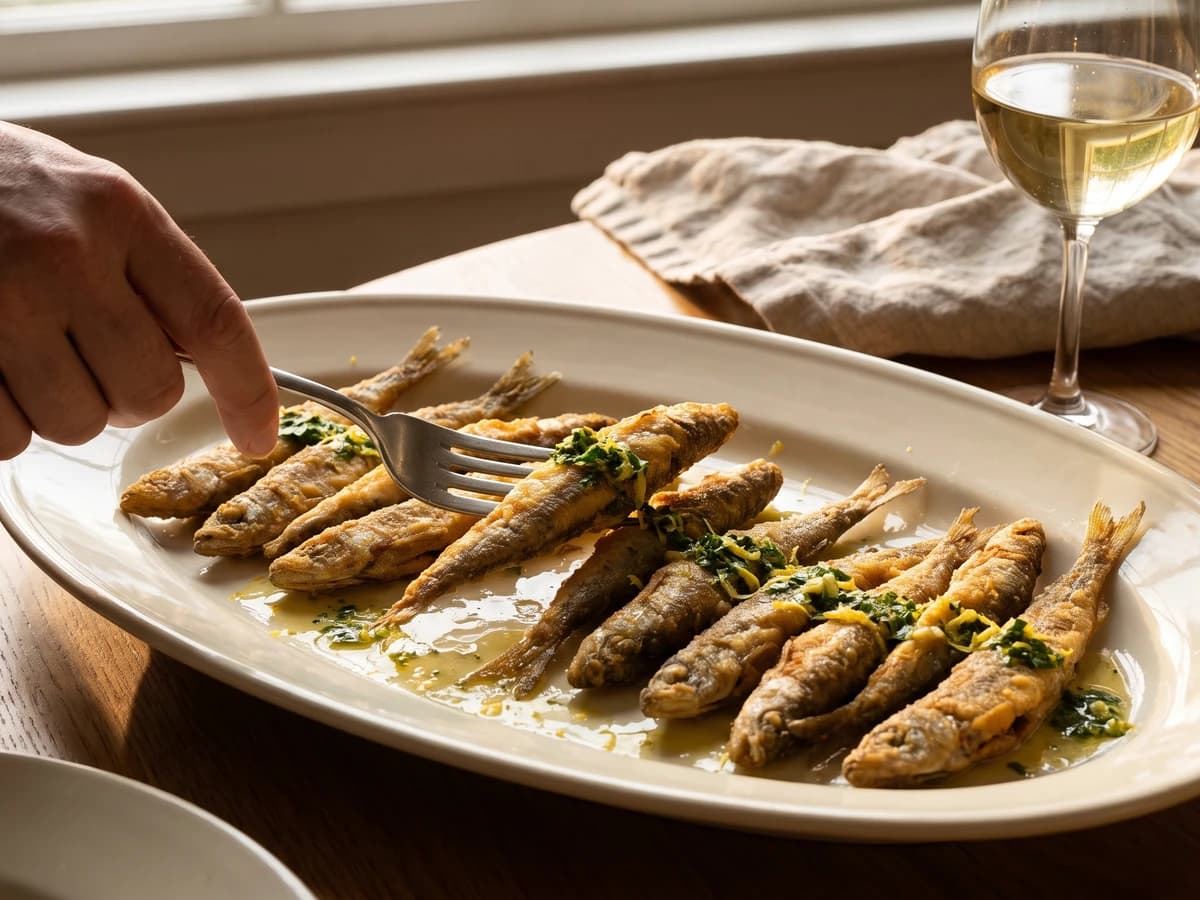
Éperlans à l’Anglaise turns small fish into a lesson in disciplined coating: boned smelts under a close, crisp crumb, pan-fried in clarified butter and finished with bright, half-melted maître d’hôtel butter.

Chef Juliette
Tiny smelts, shallot, mushrooms, white wine, gratin sauce, and fine bread raspings meet a fierce oven, where the fish must turn tender in the same breath the buttered crust bronzes.