
Chef Juliette
John Dory (St. Pierre)
John Dory has the delicacy of sole and the firmness of turbot. A light flouring, a quick butter sauté, and nut-brown beurre noisette show exactly why looks never mattered.
A cooking platform built around craft, culture, and the stories behind what we eat.

Created by Chef Juliette
Based on No. 1958, Spring Chickens à la Russe, from Le Guide Culinaire (1907) by Auguste Escoffier
Two young chickens, bacon and anchovy threaded through their breasts, truffled sausage meat inside, and a final pour of hot bacon fat that turns the skin crisp before sharp Rémoulade meets it.
Poulets de Grain à la Russe (spring chickens in the Russian manner) teaches larder, to thread fat and seasoning through lean meat so it bastes from within. The one true thing to know before touching a pan is that the bacon and anchovy strips must be very cold and the scalded breasts completely dry. Soft bacon smears instead of passing through the flesh; wet skin will not frizzle.
This entry asks for neither a saucier nor a stockpot kept simmering. It assumed a turning spit, a larding needle, a paper horn for pouring fiercely hot bacon fat, and enough hands to manage them without breaking stride. At home, two small chickens feed four, a rack in a roasting tin replaces the spit, a narrow metal skewer opens the channels, and a small saucepan gives you a controlled stream of fat. The spit, needle, paper horn, and brigade quantity are scaffolding. The five-minute scald, bacon-and-anchovy larding, truffled sausage meat, roasting, final frizzle, and separate Rémoulade are the dish, so they stay. One cook, one stove, one evening.
The source's burning bacon fat means fiercely hot, never alight. Pour it low over a dry bird inside a deep roasting tin, and the skin crackles and tightens under the stream. If a lardon softens before it passes through the breast, stop and chill it again. Ça se rattrape. Before you begin, clear space for a cold tray and a dry roasting tin; taut skin and firm lardons decide this dish.
Poulets de Grain à la Russe belongs to the cosmopolitan Parisian grand-kitchen table rather than to a particular French province. In classical French menu language, à la Russe identified a French interpretation of tastes associated with the Russian table, not one fixed Russian household recipe. Truffle, anchovy, sausage forcemeat, a spit-roasted young bird, and cold Rémoulade show the French canon translating that idea through its own exacting grammar.
Quantity
2, 1½ to 1¾ pounds (680 to 800 g) each
giblets removed and birds well chilled
Quantity
3 quarts plus 1 tablespoon (2.85 liters / 2.85 kg)
divided
Quantity
12 thin chilled batons (3 ounces / 85 g)
each about ⅛ inch thick and 2½ inches long
Quantity
7 fillets (1 ounce / 28 g)
drained; 6 halved lengthwise and 1 mashed
Quantity
1¼ cups (300 ml / 300 g)
Quantity
2 tablespoons (30 ml / 20 g)
drained and finely chopped
Quantity
1 tablespoon (15 ml / 15 g)
Quantity
½ cup (120 ml / 105 g)
divided
Quantity
1
at room temperature
Quantity
1½ tablespoons (22 ml / 22 g)
Quantity
2 teaspoons (10 ml / 10 g)
Quantity
¾ cup (180 ml / 165 g)
Quantity
2 tablespoons (30 ml / 18 g)
rinsed, drained, and finely chopped
Quantity
2 tablespoons (30 ml / 28 g)
finely chopped
Quantity
2 tablespoons (30 ml / 6 g)
Quantity
½ teaspoon (2.5 ml / 3 g)
divided
Quantity
½ teaspoon (2.5 ml / 1 g)
divided
| Ingredient | Quantity |
|---|---|
| spring chickens or poussinsgiblets removed and birds well chilled | 2, 1½ to 1¾ pounds (680 to 800 g) each |
| waterdivided | 3 quarts plus 1 tablespoon (2.85 liters / 2.85 kg) |
| unsmoked streaky baconeach about ⅛ inch thick and 2½ inches long | 12 thin chilled batons (3 ounces / 85 g) |
| oil-packed anchovy filletsdrained; 6 halved lengthwise and 1 mashed | 7 fillets (1 ounce / 28 g) |
| plain finely ground fresh pork sausage meat | 1¼ cups (300 ml / 300 g) |
| preserved black truffledrained and finely chopped | 2 tablespoons (30 ml / 20 g) |
| truffle preserving juice | 1 tablespoon (15 ml / 15 g) |
| rendered unsmoked bacon fatdivided | ½ cup (120 ml / 105 g) |
| pasteurized large egg yolkat room temperature | 1 |
| Dijon mustard | 1½ tablespoons (22 ml / 22 g) |
| white wine vinegar | 2 teaspoons (10 ml / 10 g) |
| neutral oil, such as sunflower or grapeseed | ¾ cup (180 ml / 165 g) |
| capersrinsed, drained, and finely chopped | 2 tablespoons (30 ml / 18 g) |
| cornichonsfinely chopped | 2 tablespoons (30 ml / 28 g) |
| fines herbes, finely chopped parsley, chervil, and tarragon | 2 tablespoons (30 ml / 6 g) |
| fine sea saltdivided | ½ teaspoon (2.5 ml / 3 g) |
| ground white pepperdivided | ½ teaspoon (2.5 ml / 1 g) |
Whisk the egg yolk with the Dijon mustard, vinegar, a pinch of salt, and a pinch of white pepper until perfectly smooth. Add the neutral oil drop by drop until the emulsion catches and thickens, then continue in a thin steady stream, whisking without pause. If it splits, don't discard it. Ça se rattrape: put 1 teaspoon of the measured cold water in a clean bowl and whisk in the broken sauce one spoonful at a time until it comes together. Fold in the capers, cornichons, fines herbes, and the single mashed anchovy. Taste before adding more salt, then cover and refrigerate.
Lay each halved anchovy fillet against a chilled bacon baton, making 12 paired lardons. Set them on a small tray and chill them in the freezer for 10 to 15 minutes, only until firm enough to thread without bending. Mix the sausage meat with the chopped truffle, truffle juice, and ¼ teaspoon of the white pepper until tacky and smooth. Fry a teaspoonful in a small pan and taste it. Sausage, anchovy, and bacon already carry salt, so add only what the cooked sample truly needs. Keep the forcemeat cold.
Bring 3 quarts of the measured water to a full boil in a wide pot. Tuck each chicken's wing tips behind its shoulders and truss the legs and body into a compact shape, leaving the cavity opening accessible. Working with one bird at a time, lower it breast-down into the boiling water with long tongs so the breast and its skin are immersed. Hold the water at an active simmer for exactly 5 minutes. Lift the bird carefully, drain the cavity, and repeat with the second chicken. Pat every surface completely dry and let the birds cool for 10 minutes. The breasts should feel taut and slightly firm. Discard the scalding water and clean the pot and surrounding work surface.
Use a larding needle or narrow metal skewer to open three shallow channels lengthwise through each breast half, passing from the thick end toward the thin end and staying about ½ inch beneath the skin. Thread one firm bacon-and-anchovy lardon through each channel. The strips belong inside the flesh, not laid beneath the skin; this internal basting is the principle of the dish. If a strip softens or begins to smear, stop. Chill it for another 10 minutes and reopen the same channel with the skewer. Ça se rattrape. Divide the truffled sausage meat between the two cavities, filling them loosely rather than packing them tight, then close each opening with a small metal skewer and tighten the trussing string.
Heat the oven to 425°F (220°C) with a rack in the middle. Set the chickens breast-up on a wire rack inside a roasting tin, brush them with 1 tablespoon of the bacon fat, and season the skin lightly with the remaining salt and white pepper. Roast for 15 minutes, then lower the oven to 375°F (190°C), rotate the tin, and continue for 35 to 50 minutes. The skin should be deeply golden, the thickest part of each thigh must reach 165°F (74°C), and the centre of the sausage filling must also reach 165°F (74°C). If the breast browns before the filling is safe, cover only the breast with a loose patch of foil and continue roasting. Colour can wait; raw forcemeat cannot.
Rest the cooked chickens uncovered on their rack for 10 minutes. Meanwhile, heat the remaining bacon fat in a small saucepan to about 350°F (175°C), when it is fluid and shimmering but not alight. Set the rack over a completely dry, deep roasting tin on a stable heatproof surface, away from water and any open flame. Wearing oven gloves, pour the fat from close above the birds in a thin controlled stream, moving across the breasts and legs. It should crackle immediately and tighten the skin. If one damp patch stays soft, don't keep pouring fat over it. The broiler is your home salamander: place the bird beneath it for 30 to 60 seconds, watching continuously, until that patch crisps.
Transfer the chickens to a warm oval platter and remove the string and cavity skewers. Halve each small bird through the breastbone and backbone so every serving receives crisp skin, breast, leg, and truffled stuffing. Stir the chilled Rémoulade and serve it in a bowl alongside, never poured over the skin you worked to crisp. Its mustard and vinegar cut through the bacon, sausage, and truffle with exactly the required sharpness. À table!
1 serving (about 350g)
Culinary guides, cultural storytelling, and the editorial depth that makes cooking meaningful.
Discover Culinary ExplorerChef Juliette
John Dory has the delicacy of sole and the firmness of turbot. A light flouring, a quick butter sauté, and nut-brown beurre noisette show exactly why looks never mattered.

Chef Juliette
Fresh haddock proves its delicacy in the meunière pan: a fine flour crust, moist pearly flakes, and beurre noisette sharpened with lemon and parsley, ready from one skillet in half an hour.
Chef Juliette
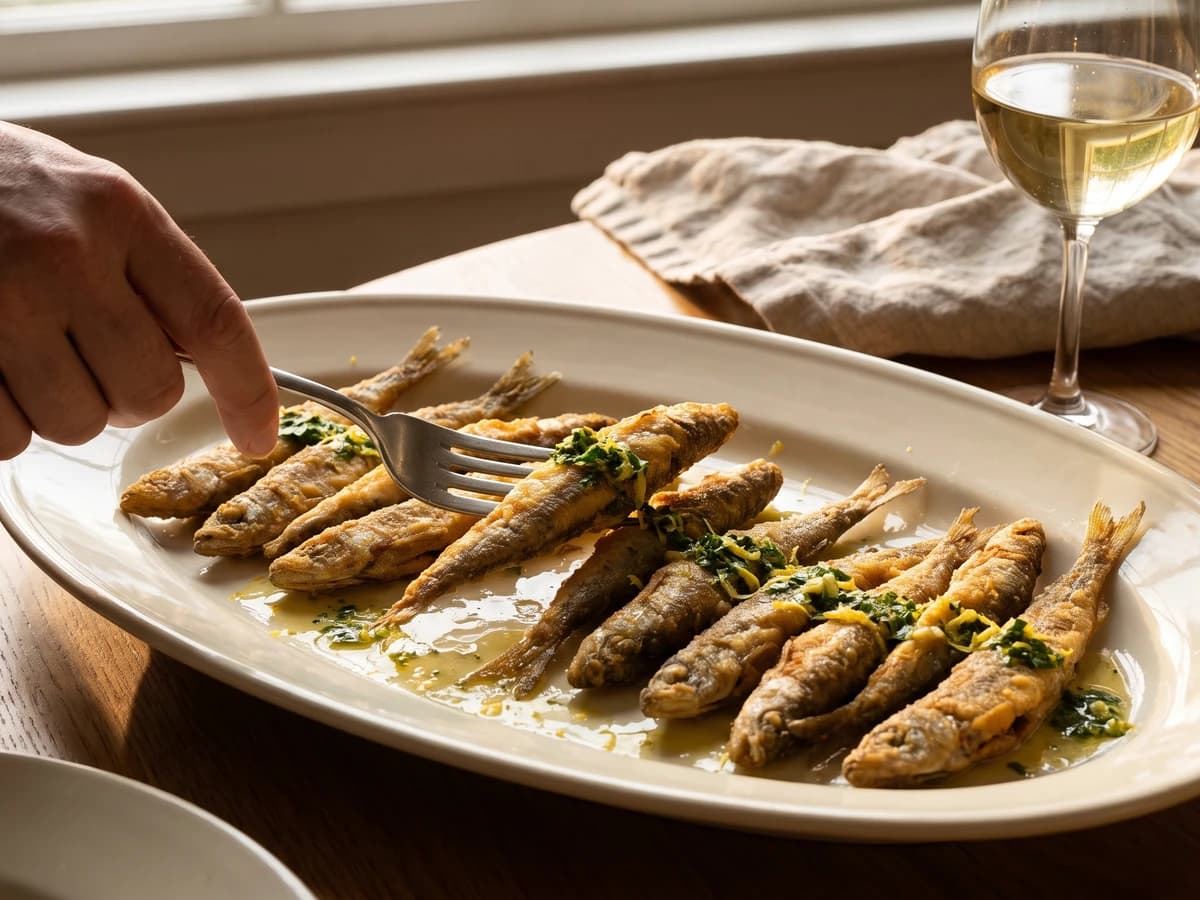
Éperlans à l’Anglaise turns small fish into a lesson in disciplined coating: boned smelts under a close, crisp crumb, pan-fried in clarified butter and finished with bright, half-melted maître d’hôtel butter.

Chef Juliette
Tiny smelts, shallot, mushrooms, white wine, gratin sauce, and fine bread raspings meet a fierce oven, where the fish must turn tender in the same breath the buttered crust bronzes.