
Chef Juliette
John Dory (St. Pierre)
John Dory has the delicacy of sole and the firmness of turbot. A light flouring, a quick butter sauté, and nut-brown beurre noisette show exactly why looks never mattered.
A cooking platform built around craft, culture, and the stories behind what we eat.
Created by Chef Juliette
Based on No. 1957, Chicken à la Reine and Spring Chickens, from Le Guide Culinaire (1907) by Auguste Escoffier
A small pullet and spring chickens share one classical roasting grammar: real butter, steady basting, and turns through the oven, with doneness judged by pale juices and the thigh, never minutes alone.
Poulet à la Reine et Poussins Rôtis (roasted small chicken and spring chickens) teaches one true thing before you touch the pan: changing the size of the bird changes the cooking time, not the roasting method. Butter it, turn it, baste it, and read the juices at the thigh. C'est la même grammaire.
The book's entry is a cross-reference, not a new garnish or sauce. It assumes the pullet method is already known, with a turning spit and a cook free to baste while the bird revolves. Your honest equivalent is a shallow roasting pan, three deliberate turns, and an oven hot enough to bronze the skin. Formal trussing and separate hot holding are brigade scaffolding, so they go; turning, basting, resting, and judging doneness stay. One cook, one stove, one evening.
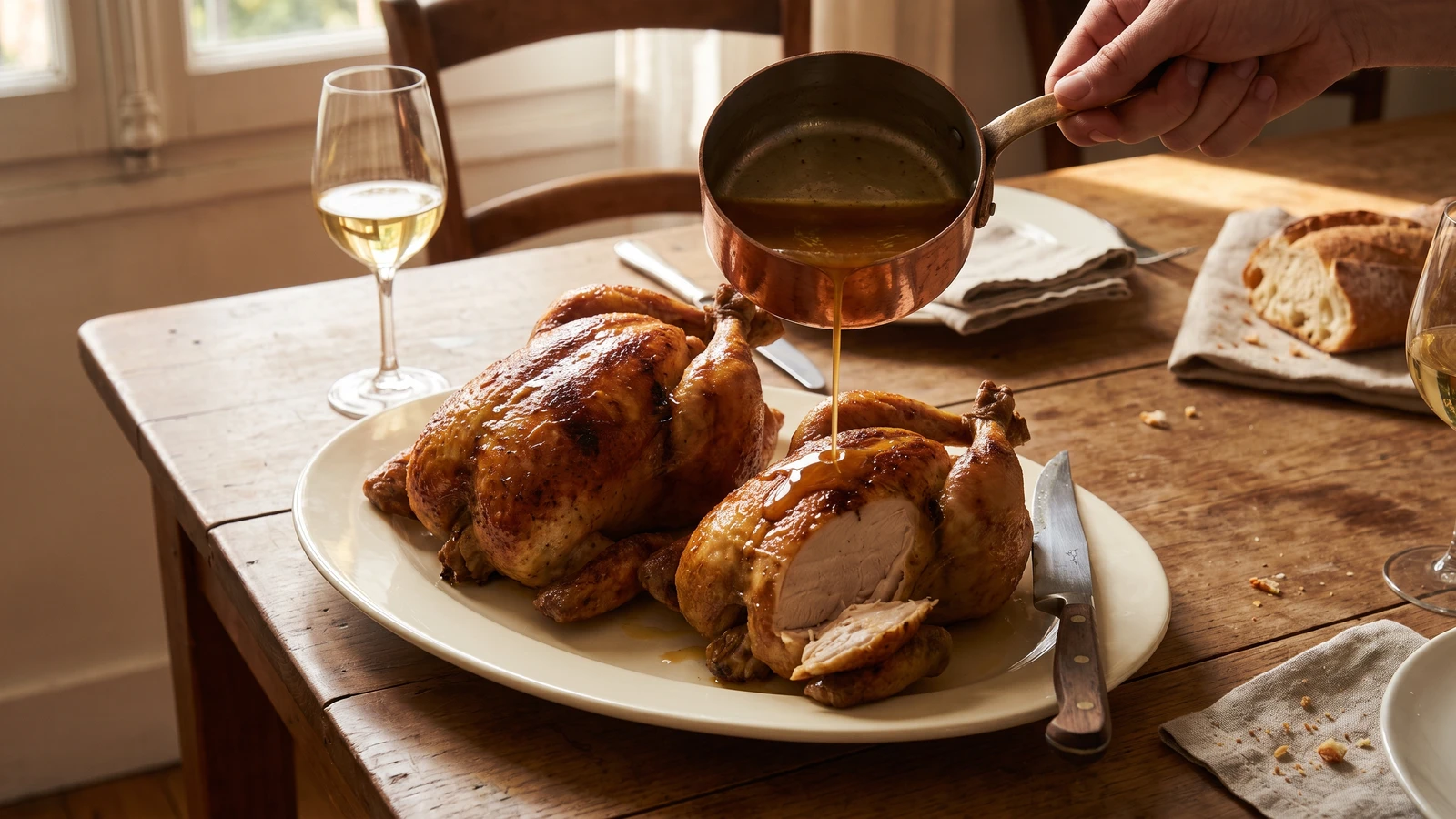
What comes to the table is beautifully plain: taut bronze skin, juicy meat, and a jus de rôti, the natural roasting jus, made from the brown film in the pan. A pullet feeds four when carved; two poussins are halved so each guest receives a generous piece. The decisive step is the last turn: pierce the deepest part of the thigh and look for clear to pale-white juice with no rose, then confirm the centre is safely cooked. Judge the thigh, not the clock.
Poulet à la reine and the smaller market birds belong to the precise poultry vocabulary of Parisian merchants and classical French kitchens, where chickens were distinguished by size, age, tenderness, and the cooking each could bear. In this entry, à la reine identifies a fine small chicken rather than a queenly sauce or garnish, while spring chickens occupy the still-smaller end of the same roasting family. The terminology traveled from the poultry market into dining-room menus, but the governing practice remained domestic and direct: roast the bird in proportion to its size and trust its juices before any timetable.
Quantity
1 pullet, 3 to 3½ lb (1.35 to 1.6 kg), or 2 spring chickens, 1¼ to 1½ lb (570 to 680 g) each
giblets removed
Quantity
4 tablespoons (60 ml / 57 g)
softened and divided
Quantity
2 teaspoons (10 ml / 12 g)
Quantity
1 teaspoon (5 ml / 2 g)
Quantity
½ to ¾ cup (120 to 180 ml / 120 to 180 g)
| Ingredient | Quantity |
|---|---|
| small whole pullet or spring chickensgiblets removed | 1 pullet, 3 to 3½ lb (1.35 to 1.6 kg), or 2 spring chickens, 1¼ to 1½ lb (570 to 680 g) each |
| unsalted buttersoftened and divided | 4 tablespoons (60 ml / 57 g) |
| fine sea salt | 2 teaspoons (10 ml / 12 g) |
| freshly ground black pepper | 1 teaspoon (5 ml / 2 g) |
| water | ½ to ¾ cup (120 to 180 ml / 120 to 180 g) |
Heat the oven to 425°F (220°C). Take the bird from the cold about 30 minutes before roasting, remove any giblets, and dry the skin and cavity thoroughly. Tuck the wing tips underneath and tie the legs together lightly, preserving a neat shape without binding the bird into a parcel. Season inside and out with the salt and pepper. Rub 3 tablespoons (45 ml / 43 g) of the softened butter over the skin and inside the cavity, dividing it evenly if using poussins.
Lay the pullet on one thigh in a shallow roasting pan, propping it securely against the pan edge if necessary. Roast for 15 minutes. For poussins, begin checking the colour after 10 minutes. Spoon the melted butter from the pan over the exposed skin, then turn the bird onto its other thigh and roast for the same length of time. This deliberate turning is the home oven's answer to the roasting spit.
Turn the bird breast upward and add ½ cup (120 ml / 120 g) water to the pan without pouring it over the skin. Roast the pullet for another 20 to 30 minutes, or the poussins for 15 to 20 minutes, basting every 10 minutes. If the pan dries and its fond threatens to blacken, add the remaining water a little at a time. Brown fond tastes of roast chicken; black fond tastes burned, and no amount of butter can negotiate with it.
Pierce the thickest part of the inner thigh close to the joint, taking care not to strike bone. The juice should run clear to pale white with no pink, the leg should move freely, and an instant-read thermometer should register 165°F (74°C). The pullet will usually need 50 to 60 minutes in all, while poussins often need 35 to 45 minutes, but the bird decides. If the juices remain pink, return it to the oven for 5 minutes and test again. If the breast is already deeply bronzed, cover only that area loosely with foil. Ça se rattrape.
Transfer the cooked bird to a warm platter and rest it for 15 minutes with a loose tent of foil. Do not wrap it tightly, or the crisp skin softens. Resting lets the juices settle back through the meat, and it gives you precisely enough time to finish the pan.
Spoon off the excess surface fat from the roasting pan, leaving the brown fond and its savoury juices behind. Set the pan over medium heat and scrape thoroughly as the liquid comes to a simmer. Reduce until the jus de rôti tastes concentrated and lightly coats a spoon, then remove it from the heat and whisk in the reserved 1 tablespoon (15 ml / 14 g) butter. If the jus looks oily, whisk in a teaspoonful of the remaining water off the heat; if it tastes weak, reduce it further. A cloth-strained sauce belonged to a staffed service. For this table, a small sieve is ample, and even that is optional.
Carve the pullet into legs and breast portions, or split each poussin lengthwise so every guest receives half a bird. Arrange the meat on the warm platter and spoon over enough jus to give it a butter-bright sheen, passing the rest at the table. Serve at once. À table!
1 serving (about 225g)
Culinary guides, cultural storytelling, and the editorial depth that makes cooking meaningful.
Discover Culinary ExplorerChef Juliette
John Dory has the delicacy of sole and the firmness of turbot. A light flouring, a quick butter sauté, and nut-brown beurre noisette show exactly why looks never mattered.

Chef Juliette
Fresh haddock proves its delicacy in the meunière pan: a fine flour crust, moist pearly flakes, and beurre noisette sharpened with lemon and parsley, ready from one skillet in half an hour.

Chef Juliette
Éperlans à l’Anglaise turns small fish into a lesson in disciplined coating: boned smelts under a close, crisp crumb, pan-fried in clarified butter and finished with bright, half-melted maître d’hôtel butter.

Chef Juliette
Tiny smelts, shallot, mushrooms, white wine, gratin sauce, and fine bread raspings meet a fierce oven, where the fish must turn tender in the same breath the buttered crust bronzes.