
Chef Juliette
John Dory (St. Pierre)
John Dory has the delicacy of sole and the firmness of turbot. A light flouring, a quick butter sauté, and nut-brown beurre noisette show exactly why looks never mattered.
A cooking platform built around craft, culture, and the stories behind what we eat.
Created by Chef Juliette
Based on No. 1948, Roast Upper-fillet, from Le Guide Culinaire (1907) by Auguste Escoffier
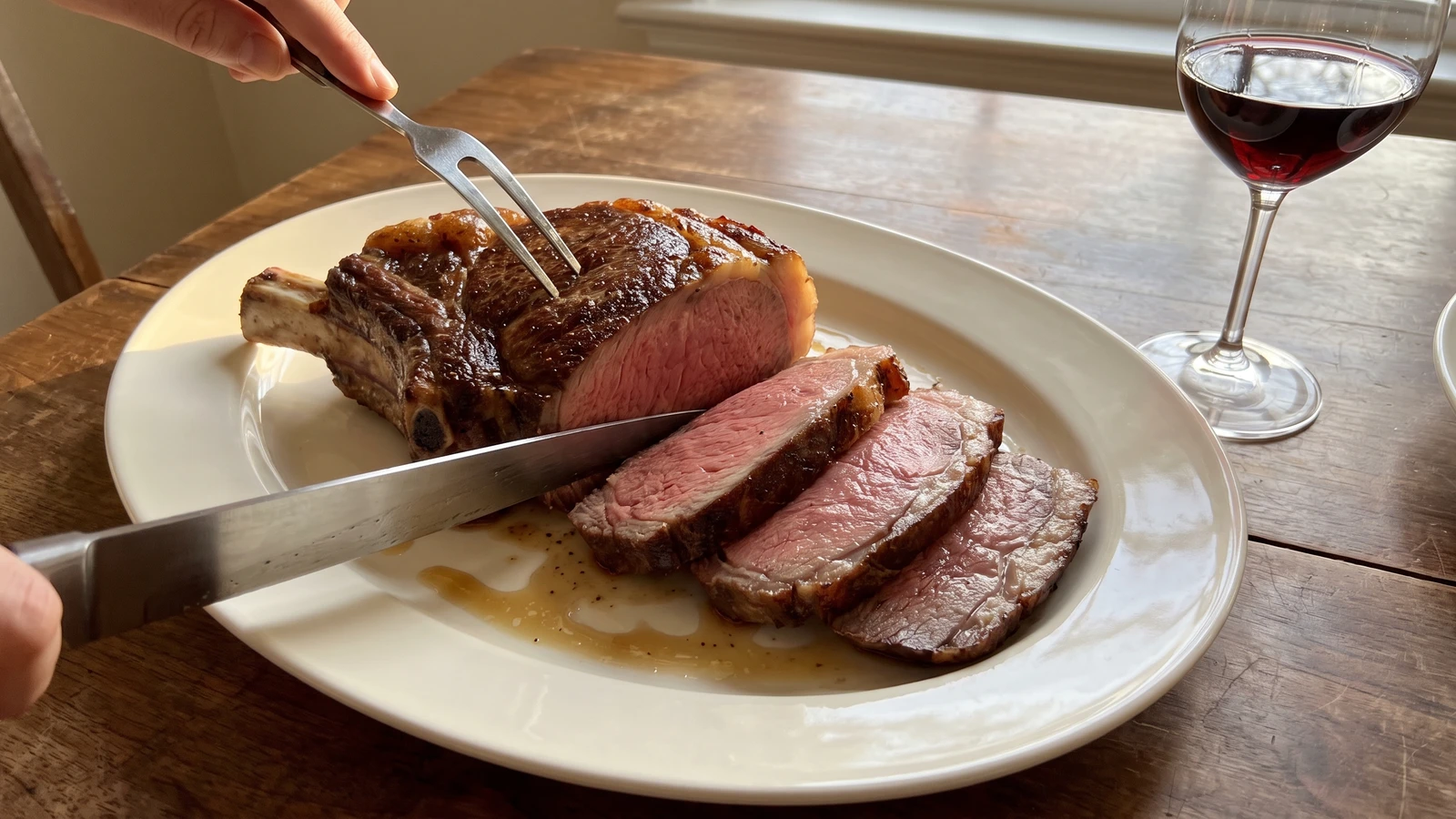
Contre-filet roasted over fierce heat, rested pink, and served with its own butter-glossed jus. Nick the yellow ligament first, and the handsome joint stays straight while its crust bronzes.
Contre-filet rôti (roast upper-fillet) teaches a hard and useful principle: a tender loin joint wants fiercer heat and less time than the ribs. The strong heat builds a deep bronze crust before the lean interior can dry, leaving the slices rosy, succulent, and properly beefy.
The original kitchen received a large bone-in joint with the projecting vertebral bones broken and the yellow ligament severed by the larder staff. For four people, ask the butcher for a 3½-pound joint, with the vertebral projections sawn short, then use a small knife to nick any remaining ligament. The bone work is brigade scaffolding and belongs at the butcher's block; severing the ligament and roasting fiercely are the dish and must stay. Unlike preparations built around a saucier, stock never off the fire, or a salamander, this entry calls for none of them. A thermometer replaces the brigade cook's practiced touch, and the roast makes its own jus from water, pan fond, and real butter. One cook, one stove, one evening.
When it is right, the fat is burnished, the cut face glows an even rose, and the jus pools beneath it with a clear buttery gleam. Before the joint meets the oven, find the tough elastic cord along its spinal edge and cut through that cord at short intervals. Miss it and the contre-filet pulls itself into a bow; sever it cleanly and the roast holds its handsome shape.
Contre-filet belongs to French butchery and the national roast table, not to one regional larder; from the butcher's block it passed into grand-kitchen service and Parisian bourgeois Sunday dinners. Its name identifies the loin lying against, or opposite, the filet across the backbone, which is why English labels such as sirloin and strip loin never map neatly onto it. Preparing the projecting vertebrae and elastic yellow ligament was not ceremony: it kept the bone-in joint true in shape under fierce heat and allowed clean carving at the table.
Quantity
1 joint, about 3½ lb (1.6 kg)
fat cap intact and vertebral projections sawn short
Quantity
2 teaspoons (10 ml / 12 g)
Quantity
1 teaspoon (5 ml / 2 g)
Quantity
2 tablespoons (30 ml / 28 g)
divided; half melted and half cold and cubed
Quantity
½ cup (120 ml / 120 g), plus up to ¼ cup (60 ml / 60 g) as needed
| Ingredient | Quantity |
|---|---|
| bone-in contre-filet or strip-loin roastfat cap intact and vertebral projections sawn short | 1 joint, about 3½ lb (1.6 kg) |
| fine sea salt | 2 teaspoons (10 ml / 12 g) |
| coarsely ground black pepper | 1 teaspoon (5 ml / 2 g) |
| unsalted butterdivided; half melted and half cold and cubed | 2 tablespoons (30 ml / 28 g) |
| hot water | ½ cup (120 ml / 120 g), plus up to ¼ cup (60 ml / 60 g) as needed |
Ask the butcher to leave the contre-filet on its supporting bones but saw the projecting vertebral pieces short so the roast sits steadily and can be carved without a cleaver. Keep a thin, even fat cap. Bone-breaking was sensible work for a professional larder, but it is neither safe nor useful work for a home cutting board.
Take the joint from the cold about 45 minutes before roasting. Set it bone-side down in a shallow metal roasting pan and press every surface dry. Heat the oven to 475°F (245°C), with a rack in the middle. The shallow pan matters because high sides shield the meat from the fierce heat this cut requires.
Find the firm yellow-white elastic band running along the spinal edge beneath the outer covering. With the tip of a sharp knife, cut crosswise through the ligament every 1 to 1¼ inches (2.5 to 3 cm), stopping as soon as the cord releases so you do not slash deeply into the loin. If the joint still springs into a curve when gently flexed, deepen the stubborn nicks before tying it at even intervals. Ça se rattrape now; once the meat is hot, leave the knife alone. Season the entire joint with the salt and pepper.
Roast the contre-filet bone-side down and fat-side up for 15 minutes at 475°F (245°C). Lower the oven to 450°F (230°C) and continue for 20 to 30 minutes, rotating the pan once if your oven colours unevenly. When the centre is within about 18°F (10°C) of its target temperature, brush the exposed meat with the melted half of the butter and return it promptly to the oven. Begin checking early: remove the joint at 122 to 126°F (50 to 52°C) for a medium-rare finish, or 133 to 136°F (56 to 58°C) for medium. Insert the thermometer into the thickest part without touching bone. If the crust darkens too quickly while the centre remains cool, cover only the darkest patch loosely with foil and lower the oven to 425°F (220°C). The fierce beginning has already done its work.
Move the roast to a carving board with a channel and cover it very loosely with foil. Rest it for 25 minutes. Its centre will rise several degrees while the fibres relax and hold their juices; carve immediately and those juices run across the board instead. Keep the covering loose, because a tight foil parcel softens the burnished crust.
While the meat rests, pour the clear roasting fat from the pan into a heatproof bowl, leaving the browned fond behind. Set the roasting pan over medium heat, or scrape its contents into a small saucepan if the pan cannot go on the stove. Add the hot water and scrape until the brown glaze dissolves, then simmer until the jus tastes concentrated and lightly coats a spoon. Add the juices collected on the carving board. Remove from the heat and whisk in the cold cubed butter until the jus gleams. If it looks greasy, skim the excess fat and whisk in a teaspoon of cold water. If the fond has gone black and tastes bitter, leave those patches behind and use only the clear roasting juices, water, and butter. Ça se rattrape.
Remove the twine and run the carving knife closely along the bones to release the loin in one piece. Turn it cut-side down and slice across the grain about ½ inch (12 mm) thick. Arrange the slices on a warm platter, spoon over enough jus to make them gleam, and send the remainder to the table in a warm sauceboat. À table!
1 serving (about 280g)
Culinary guides, cultural storytelling, and the editorial depth that makes cooking meaningful.
Discover Culinary ExplorerChef Juliette
John Dory has the delicacy of sole and the firmness of turbot. A light flouring, a quick butter sauté, and nut-brown beurre noisette show exactly why looks never mattered.

Chef Juliette
Fresh haddock proves its delicacy in the meunière pan: a fine flour crust, moist pearly flakes, and beurre noisette sharpened with lemon and parsley, ready from one skillet in half an hour.
Chef Juliette
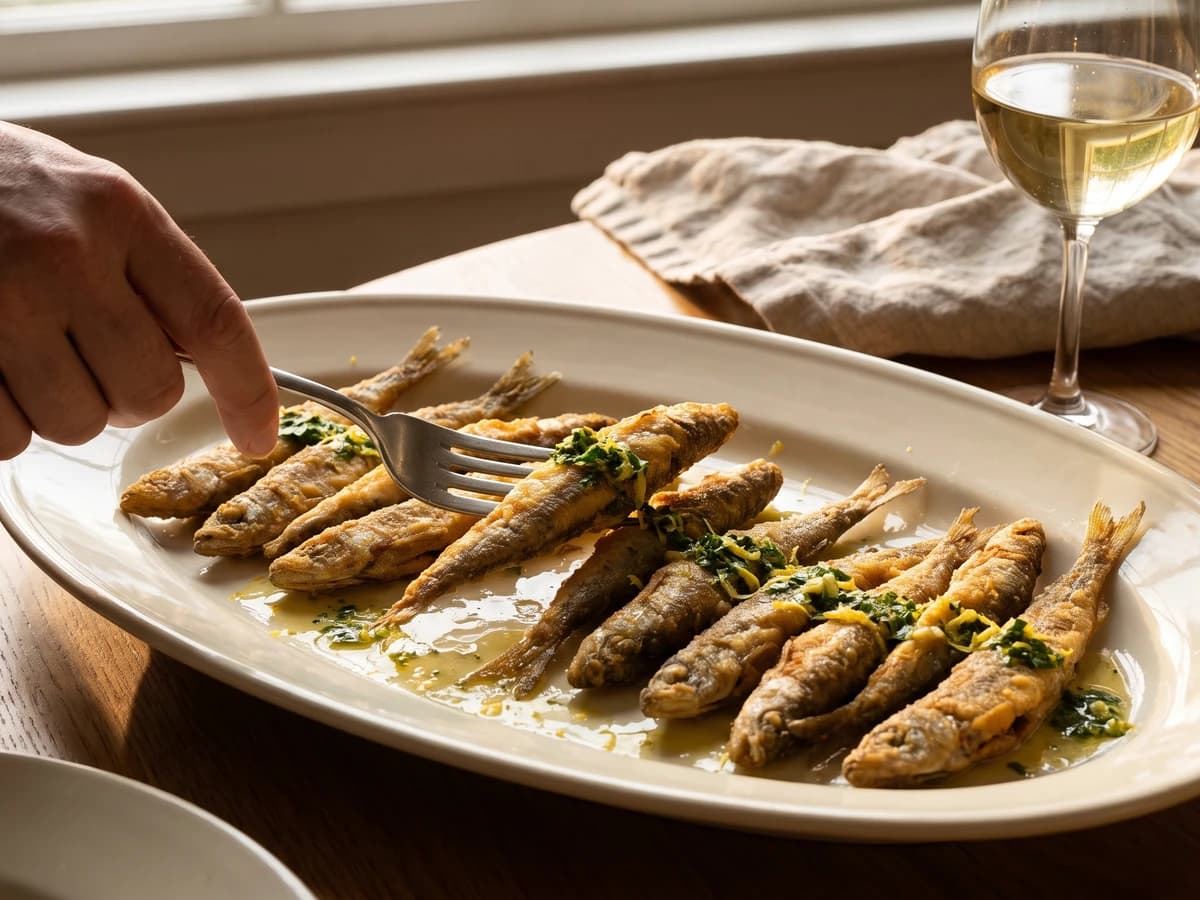
Éperlans à l’Anglaise turns small fish into a lesson in disciplined coating: boned smelts under a close, crisp crumb, pan-fried in clarified butter and finished with bright, half-melted maître d’hôtel butter.

Chef Juliette
Tiny smelts, shallot, mushrooms, white wine, gratin sauce, and fine bread raspings meet a fierce oven, where the fish must turn tender in the same breath the buttered crust bronzes.