
Chef Juliette
John Dory (St. Pierre)
John Dory has the delicacy of sole and the firmness of turbot. A light flouring, a quick butter sauté, and nut-brown beurre noisette show exactly why looks never mattered.
A cooking platform built around craft, culture, and the stories behind what we eat.

Created by Chef Juliette
Based on No. 1929, Mauviettes à la Bonne-Femme, from Le Guide Culinaire (1907) by Auguste Escoffier
Farmed quail stand in for larks done the thrush way: browned quickly in butter with salt bacon, settled on crisp croûtons, and glossed with brandy. Cover the cocotte early, because small birds forgive nothing.
Mauviettes à la Bonne-Femme (larks in the home cook's manner) teaches heat management in miniature. The one true thing to know before touching the pan is this: color a small bird quickly, then lower the heat and cover it before the breast surrenders its moisture. Brown timidly and the pan gives no fond; brown too long and the breast dries before the legs are ready.
The entry is terse, larks prepared exactly as thrushes, and it assumes a game dealer supplying oven-ready birds plus brigade hands frying bread while the birds cook. It needs neither a saucier, stock never off the fire, nor a salamander, and inventing them would bury a wonderfully direct dish. At home, one wide cocotte handles the work in sequence. Farmed quail replaces lark that most cooks cannot lawfully buy; quail is larger and meatier, so eight feed four and require a few extra covered minutes. The separate hands are scaffolding and can go. The butter, lardons (diced salt bacon), croûtons (bread fried crisp in butter), covered cocotte, and brandy reduction are the dish, so they stay. One cook, one stove, one evening.
Done properly, each quail arrives Maillard-bronze and butter-glossed, perched on a croûton that remains crisp underneath while drinking the pan juices at its edges. The step that decides everything is the covered finish: probe early, remove each bird the moment it is ready, and never leave small poultry waiting beneath the lid.
Mauviettes were larks, tiny migratory game birds carried from the grain fields of northern and central France onto Parisian bourgeois and grand-kitchen tables, where the canon directed cooks to treat them exactly as thrushes. Bonne-femme here describes a direct household manner rather than a regional sauce: butter, diced salt bacon, fried croûtons, and the bird's brandy-loosened juices, with no stock or cream to hide the game. Wild larks are protected or tightly regulated in many places, so farmed quail is the honest modern bird; it preserves the small-bird method while tasting fuller and requiring a slightly longer covered finish.
Quantity
8 (about 2 lb / 900 g total)
giblets removed and birds patted dry
Quantity
8 (about 7 oz / 200 g total)
each about 3 by 2 inches and 1/2 inch thick
Quantity
2/3 cup (160 ml / 100 g)
rind removed and cut into 1/4-inch dice
Quantity
7 tablespoons (105 ml / 100 g)
divided
Quantity
1/4 cup (60 ml / 57 g)
Quantity
1/2 teaspoon (2.5 ml / 3 g)
Quantity
1/2 teaspoon (2.5 ml / 1 g)
| Ingredient | Quantity |
|---|---|
| oven-ready farmed quailgiblets removed and birds patted dry | 8 (about 2 lb / 900 g total) |
| crustless country-bread ovalseach about 3 by 2 inches and 1/2 inch thick | 8 (about 7 oz / 200 g total) |
| unsmoked slab bacon or meaty salt porkrind removed and cut into 1/4-inch dice | 2/3 cup (160 ml / 100 g) |
| unsalted butterdivided | 7 tablespoons (105 ml / 100 g) |
| French brandy or Cognac | 1/4 cup (60 ml / 57 g) |
| fine sea salt | 1/2 teaspoon (2.5 ml / 3 g) |
| freshly ground black pepper | 1/2 teaspoon (2.5 ml / 1 g) |
If using salt pork, soak the dice in cold water for 10 minutes, then drain and dry them thoroughly; unsmoked slab bacon needs no soaking. Tuck the quail wing tips beneath the bodies and tie the legs loosely together so the birds brown evenly. Pat every surface dry again, then season inside and out with the pepper and half the salt. Reserve the remaining salt until the lardons have cooked, because cured pork has the final vote.
Melt 3 tablespoons of the butter in a wide cocotte over medium heat. When it foams, lay in the bread ovals and fry them until deeply golden and crisp on both sides, about 2 minutes per side. Adjust the heat if the butter colors faster than the bread. Transfer the croûtons to a wire rack, uncovered, and brush any loose crumbs from the cocotte so they cannot burn beneath the birds.
Set the cocotte over medium-low heat and add the lardons. Cook slowly for 4 to 5 minutes, stirring often, until their fat turns translucent and their edges take a bronze color. They should be supple and browned, not brittle. Lift them out with a slotted spoon and leave their rendered fat in the cocotte.
Raise the heat to medium-high and add 3 tablespoons of butter to the rendered bacon fat. When the foam subsides, brown the quail in two batches so they never crowd. Begin breast-side down for about 2 minutes, then roll each bird onto both sides until the skin is an even copper-brown, 4 to 5 minutes per batch. If the butter turns black or smells bitter, lift out the birds immediately, wipe away the burned fat without scraping bitter specks into the pan, and continue with the reserved tablespoon of butter. Ça se rattrape.
Return every quail to the cocotte in one snug layer and scatter the lardons around them. Lower the heat, cover tightly, and cook for 5 minutes. Turn the birds, cover again, and begin checking after another 2 minutes. Remove each quail as soon as the thickest part of its inner thigh reaches 165°F (74°C), usually after 7 to 9 covered minutes in total, and let it rest uncovered on a warm plate. If the thighs lag while the pan threatens to scorch, add 1 tablespoon of hot water around the edge and cover for 2 minutes more; the water protects the fond and will disappear into the final reduction.
Transfer the lardons to a small bowl and pour off all but a thin film of fat from the cocotte. Take the pan off the heat, turn off any gas flame, and add the brandy. Return it to medium heat and déglacer, loosen the savory brown fond with the liquid, scraping until every good brown speck dissolves. Add any juices released by the resting quail and reduce for 1 to 2 minutes, until the raw alcoholic edge has softened and the jus is deeply glossy. If it tightens to syrup, loosen it with a spoonful of hot water; if it remains watery, reduce it a little longer. Arrange two croûtons and two quail per serving, scatter over the lardons, and spoon the brandy jus across the birds. Serve immediately. À table!
1 serving (about 225g)
Culinary guides, cultural storytelling, and the editorial depth that makes cooking meaningful.
Discover Culinary ExplorerChef Juliette
John Dory has the delicacy of sole and the firmness of turbot. A light flouring, a quick butter sauté, and nut-brown beurre noisette show exactly why looks never mattered.

Chef Juliette
Fresh haddock proves its delicacy in the meunière pan: a fine flour crust, moist pearly flakes, and beurre noisette sharpened with lemon and parsley, ready from one skillet in half an hour.
Chef Juliette
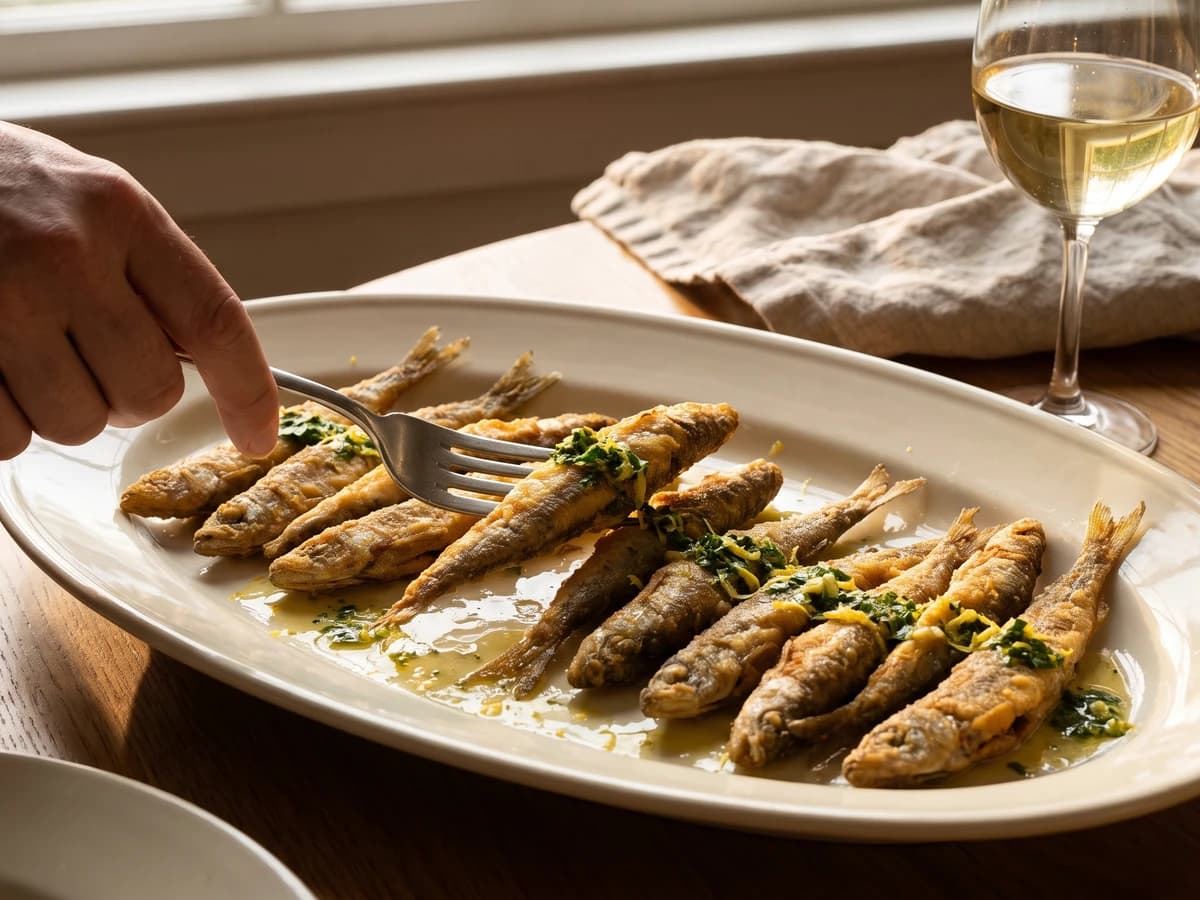
Éperlans à l’Anglaise turns small fish into a lesson in disciplined coating: boned smelts under a close, crisp crumb, pan-fried in clarified butter and finished with bright, half-melted maître d’hôtel butter.

Chef Juliette
Tiny smelts, shallot, mushrooms, white wine, gratin sauce, and fine bread raspings meet a fierce oven, where the fish must turn tender in the same breath the buttered crust bronzes.