
Chef Juliette
John Dory (St. Pierre)
John Dory has the delicacy of sole and the firmness of turbot. A light flouring, a quick butter sauté, and nut-brown beurre noisette show exactly why looks never mattered.
A cooking platform built around craft, culture, and the stories behind what we eat.

Created by Chef Juliette
Based on No. 1927, Grives ou Merles à la Liégeoise, from Le Guide Culinaire (1907) by Auguste Escoffier
Farmed quail stand in honestly for rarely available thrushes or blackbirds, cooked uncovered in butter, finished with two juniper berries per bird, then covered just long enough to perfume crisp round croûtons.
Grives ou Merles à la Liégeoise (thrushes or blackbirds in the Liège manner) teaches the discipline of late seasoning. Juniper belongs near the end, exactly two berries to each bird, so its woodland perfume meets the browned butter without cooking into medicine. That is the one true thing to know before touching the pan.
The source assumed freshly dressed Ardennes songbirds, a flameproof earthenware saucepan, and a cook who judged small game by touch. It called for no saucier, no stock kept on the fire, and no salamander, so none should be invented. Because thrushes and blackbirds are protected or tightly regulated in many places, this home version uses oven-ready farmed quail, eight for four diners. A broad enameled cast-iron braiser replaces earthenware that may crack over direct heat. The quail are larger and milder, so they need a few more minutes, but the sequence and the ratio of juniper to bird remain intact. One cook, one stove, one evening.
The supply of wild birds and the professional flameproof pot are scaffolding we can replace. Cooking uncovered in real butter, adding the juniper only when the birds are nearly done, folding in round croûtons fried in butter, then closing the casserole for the last moment are the dish itself and must stay. Watch the butter while the quail brown. If it blackens, ça se rattrape, and the rescue sits exactly where you'll need it. Most of all, wait on the juniper.
The name places this small-game preparation at Liège in eastern Wallonia, while the source particularly prizes thrushes from the wooded Ardennes to the south. French was the language of the recipe because Liège belongs to French-speaking Belgium and its cooking entered the wider French classical repertoire through professional manuals, not because the dish came from France itself. Its late addition of juniper preserves an Ardennes woodland character while avoiding the harsh resinous taste produced by long cooking.
Quantity
8 birds, about 4½ to 5 ounces each (1.0 to 1.1 kg total)
giblets removed, checked for pinfeathers, and patted dry
Quantity
1½ teaspoons (7.5 ml / 9 g)
Quantity
10 tablespoons (150 ml / 142 g)
divided, with 2 tablespoons held in reserve
Quantity
8 rounds, each 2 inches (5 cm) across and ½ inch (1.25 cm) thick (about 4 ounces / 115 g total)
cut from crustless slices
Quantity
16 berries (about 2 teaspoons / 4 g)
finely chopped just before use
| Ingredient | Quantity |
|---|---|
| oven-ready farmed quailgiblets removed, checked for pinfeathers, and patted dry | 8 birds, about 4½ to 5 ounces each (1.0 to 1.1 kg total) |
| fine sea salt | 1½ teaspoons (7.5 ml / 9 g) |
| unsalted butterdivided, with 2 tablespoons held in reserve | 10 tablespoons (150 ml / 142 g) |
| day-old pain de mie rounds for croûtonscut from crustless slices | 8 rounds, each 2 inches (5 cm) across and ½ inch (1.25 cm) thick (about 4 ounces / 115 g total) |
| juniper berriesfinely chopped just before use | 16 berries (about 2 teaspoons / 4 g) |
Take the quail from the cold twenty minutes before cooking. Check the cavities, remove any remaining pinfeathers, and dry every surface thoroughly. Season inside and out with the salt, working a little beneath the legs and wings. A wet bird cooks pale, while a dry one gives the butter a proper bronze surface to baste.
Melt 3 tablespoons (45 ml / 43 g) of the butter over medium heat in a broad, heavy casserole. Add the bread rounds and fry for about 2 minutes per side, turning once, until evenly butter-gold and crisp at the edges. These are croûtons, butter-fried bread rounds, and they belong inside the finished casserole rather than beside it as decoration. Lift them onto a rack, then wipe away any loose dark crumbs without scrubbing away the golden butter film.
Add 5 tablespoons (75 ml / 71 g) of the butter and let it foam. Arrange the quail breast-side down in one snug layer and brown for 3 minutes, then turn them onto their backs for another 3 minutes. Lower the heat to medium-low and continue cooking uncovered for 8 to 12 minutes, turning the birds onto each side and basting them with the foaming butter every 2 minutes. They are nearly done when deeply bronzed and an instant-read thermometer placed in the thickest thigh without touching bone reads about 155°F (68°C). Keep the butter hazelnut-brown, never black.
Finely chop the juniper now, not earlier, and sprinkle exactly two berries' worth over each nearly cooked bird. Nestle the croûtons around the quail and spoon a little of the aromatic butter over their upper surfaces. Do not fry the juniper separately or leave it bubbling uncovered. Prolonged heat turns its clean woodland scent resinous and medicinal.
Cover the casserole at once and keep it over the lowest heat for 2 to 4 minutes. The closed final moment finishes the quail, perfumes the croûtons, and leaves their tops crisp while their undersides drink the butter. Check that the thickest thigh has reached 165°F (74°C); if not, cover for 1 minute more. Carry the covered casserole directly to the table and uncover it there. Serve two birds and two croûtons to each diner, spooning over every drop of the juniper-scented butter. À table!
1 serving (about 205g)
Culinary guides, cultural storytelling, and the editorial depth that makes cooking meaningful.
Discover Culinary ExplorerChef Juliette
John Dory has the delicacy of sole and the firmness of turbot. A light flouring, a quick butter sauté, and nut-brown beurre noisette show exactly why looks never mattered.

Chef Juliette
Fresh haddock proves its delicacy in the meunière pan: a fine flour crust, moist pearly flakes, and beurre noisette sharpened with lemon and parsley, ready from one skillet in half an hour.
Chef Juliette
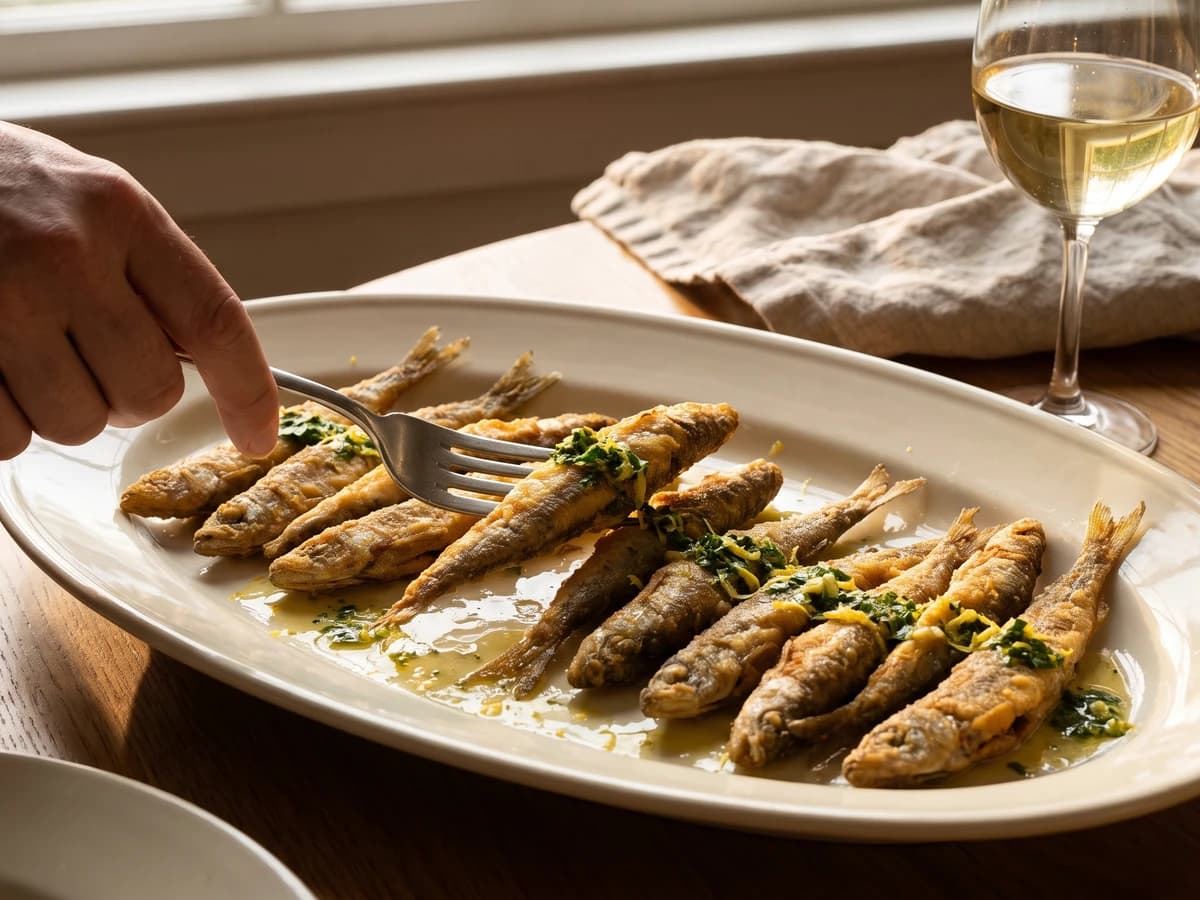
Éperlans à l’Anglaise turns small fish into a lesson in disciplined coating: boned smelts under a close, crisp crumb, pan-fried in clarified butter and finished with bright, half-melted maître d’hôtel butter.

Chef Juliette
Tiny smelts, shallot, mushrooms, white wine, gratin sauce, and fine bread raspings meet a fierce oven, where the fish must turn tender in the same breath the buttered crust bronzes.