
Chef Juliette
John Dory (St. Pierre)
John Dory has the delicacy of sole and the firmness of turbot. A light flouring, a quick butter sauté, and nut-brown beurre noisette show exactly why looks never mattered.
A cooking platform built around craft, culture, and the stories behind what we eat.
Created by Chef Juliette
Based on No. 1914, Cailles Richelieu Froides, from Le Guide Culinaire (1907) by Auguste Escoffier
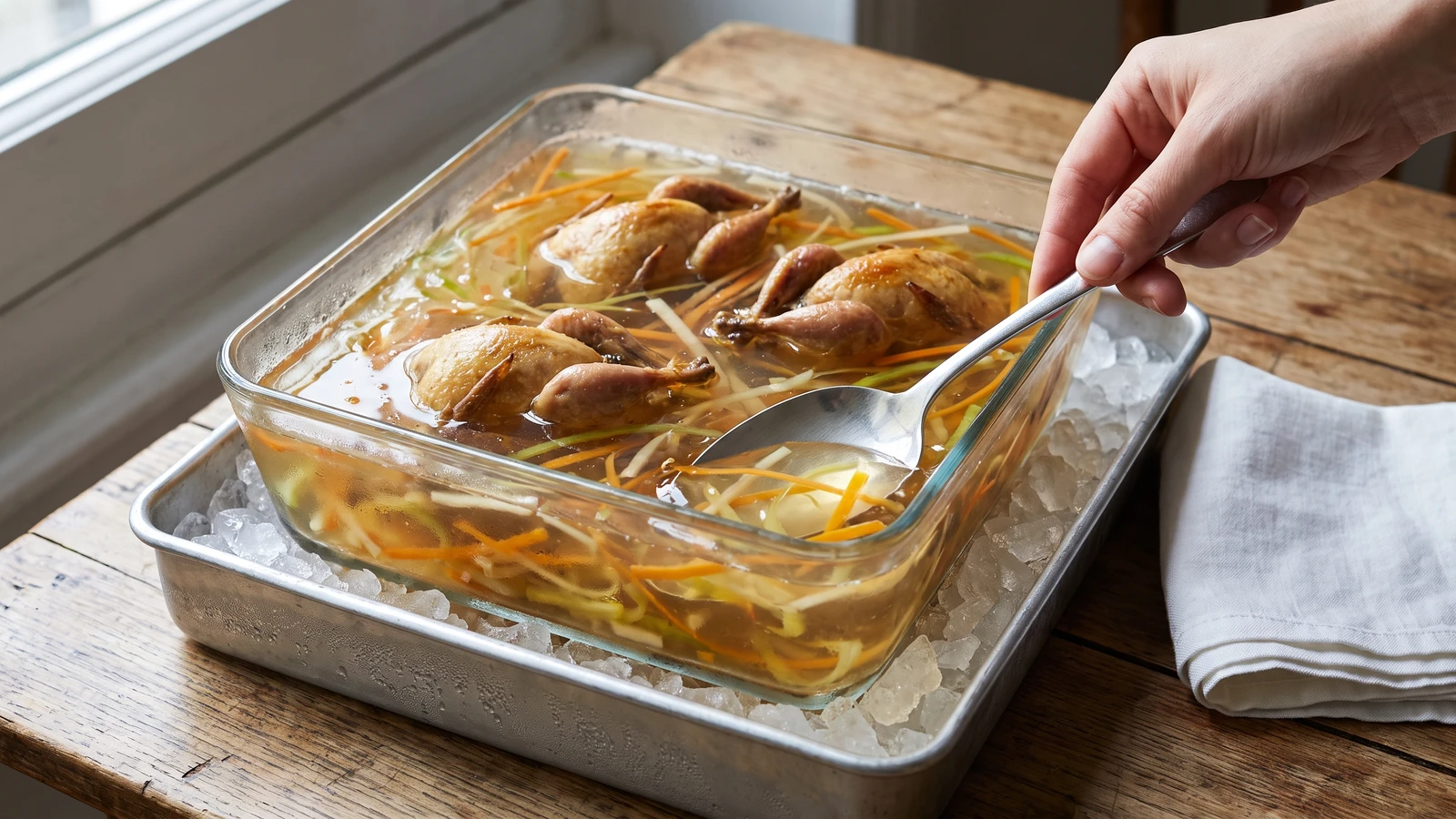
Four browned quails and a precise vegetable julienne rest in their clarified, softly set cooking liquor, a cold Richelieu that turns careful braising and patient chilling into a generous make-ahead centerpiece.
Cailles Richelieu Froides (cold Richelieu quails) teaches that a cold dish is only as good as the liquor surrounding it. The quails must remain tender, but the one true thing to know before touching the pan is this: chilling mutes flavor, so the cooking liquor must taste complete and slightly more seasoned while warm, then set to a tender gelée rather than a rubbery aspic.
The source assumes Hot Cailles Richelieu already prepared, a saucier tending the liquor, gelatin-rich stock never off the fire, and enough hands to present the finished dish on a carved block of ice. No salamander belongs here. For one cook, one stove, one evening, four quails braise with the same fine julienne in one covered pan; a cold-saucer test judges the natural gelatin, powdered gelatin is used only if that stock needs reinforcement, and a low tray of crushed ice replaces the carved block.
Separate clarification and ice carving are brigade scaffolding, so they can go. The dish itself must stay: the hot Richelieu preparation, its vegetable garnish, its own reduced cooking liquor, and the removal of every trace of grease only after chilling. Wait until the gelée is completely firm before lifting that fat, when it will come away almost in one sheet.
The Richelieu name belongs to the Parisian classical table, where named preparations signaled a settled method and garnish rather than a claim to regional farmhouse origins. In this cold version, the hot braise passes intact into buffet service: the birds, vegetable julienne, and their own cooking liquor are chilled together before the risen fat is removed. The block of ice was practical service equipment; the essential inheritance is the cold, cleanly degreased gelée, not the carved pedestal.
Quantity
4 (about 1½ pounds / 680 g total)
patted dry
Quantity
1½ teaspoons (7.5 ml / 9 g), plus more as needed
Quantity
½ teaspoon (2.5 ml / 1 g)
Quantity
2 tablespoons (30 ml / 28 g)
Quantity
4 thin slices (about 3 ounces / 85 g)
Quantity
¾ cup (180 ml / 90 g)
cut into fine julienne
Quantity
½ cup (120 ml / 75 g)
cut into fine julienne
Quantity
½ cup (120 ml / 60 g)
cut into fine julienne
Quantity
½ cup (120 ml / 60 g)
cut into fine julienne and rinsed
Quantity
½ cup (120 ml / 120 g)
Quantity
3 cups (720 ml / 720 g)
Quantity
1
Quantity
Up to 2 teaspoons (10 ml / 6 g)
Quantity
2 tablespoons (30 ml / 30 g)
for blooming gelatin
Quantity
8 cups (1.9 liters / approximately 1.1 kg)
for serving
| Ingredient | Quantity |
|---|---|
| oven-ready whole quailspatted dry | 4 (about 1½ pounds / 680 g total) |
| fine sea salt | 1½ teaspoons (7.5 ml / 9 g), plus more as needed |
| finely ground white pepper | ½ teaspoon (2.5 ml / 1 g) |
| unsalted butter | 2 tablespoons (30 ml / 28 g) |
| unsmoked streaky bacon or fatback | 4 thin slices (about 3 ounces / 85 g) |
| carrotcut into fine julienne | ¾ cup (180 ml / 90 g) |
| turnipcut into fine julienne | ½ cup (120 ml / 75 g) |
| celerycut into fine julienne | ½ cup (120 ml / 60 g) |
| leek whitecut into fine julienne and rinsed | ½ cup (120 ml / 60 g) |
| dry Madeira | ½ cup (120 ml / 120 g) |
| unsalted gelatin-rich brown chicken or veal stock | 3 cups (720 ml / 720 g) |
| bouquet garni of parsley stems, thyme, and bay leaf | 1 |
| unflavored powdered gelatin (optional) | Up to 2 teaspoons (10 ml / 6 g) |
| cold water (optional)for blooming gelatin | 2 tablespoons (30 ml / 30 g) |
| crushed icefor serving | 8 cups (1.9 liters / approximately 1.1 kg) |
Cut the carrot, turnip, celery, and leek into julienne, fine matchsticks about 1½ inches (4 cm) long and no thicker than a match. Uniformity matters because all four vegetables must soften together while remaining visible in the gelée. Rinse the leek thoroughly after cutting, then drain and dry every vegetable; grit has no rescue once sealed beneath clear cooking liquor.
Season the quails inside and out with the salt and white pepper. Melt half the butter in a 12-inch (30 cm) lidded sauté pan over medium heat. When the foam subsides, brown the quails on the breast, back, and both sides, about 6 minutes altogether, turning carefully so the skin stays intact. They need a quiet golden color, not a dark roasting crust. If the butter blackens, lift out the birds, wipe away the burnt specks, and continue with fresh butter. Ça se rattrape.
Transfer the quails to a plate and add the remaining butter to the pan. Cook the carrot, turnip, celery, and leek for 3 minutes, turning them until glossy but not browned. Set the quails breast-side up over the julienne, drape each with a slice of bacon, and tuck in the bouquet garni. Pour the Madeira around the birds and let it reduce by half, then add the stock. The liquid should reach about two-thirds of the way up the quails.
Cover the pan and hold the cooking liquor at the barest tremble for 20 to 25 minutes, turning the quails once, until the thickest part of a thigh reaches 165°F (74°C). Boiling toughens the small birds and clouds the liquor. If the pan begins to boil, pull it off the heat for a minute, then return it over a lower flame. The quails should feel yielding at the leg joint while the breasts remain plump.
Lift away and discard the bacon and bouquet garni. Place the four quails breast-side up in a snug 8-inch (20 cm) square deep dish, arranged as a compact square. Use a slotted spoon to distribute the julienne around and between them without crushing it. The close arrangement is practical: it lets a modest amount of cooking liquor cover the birds completely.
Pass the cooking liquor through a fine sieve into a clean saucepan, without pressing the vegetables left in the sieve, and simmer gently until about 2½ cups (600 ml) remain. Taste it warm. It should be clear in flavor, slightly more seasoned than an ordinary hot sauce, and distinctly savory, because the cold will soften everything. Put a teaspoonful on a cold saucer and chill it for 5 minutes. It should form a delicate wobbling gelée that yields immediately to a spoon.
If the saucer test remains liquid, bloom the powdered gelatin in the cold water for 5 minutes. Use 1 teaspoon if the liquor has begun to thicken, or the full 2 teaspoons if it shows no sign of setting. Whisk the bloomed gelatin into the hot liquor off the heat until dissolved, then repeat the test. Do not boil after adding it, or the gelée may weaken. Ça se rattrape: unreliable stock needs reinforcement, not a new sauce.
Let the liquor cool for about 10 minutes, until warm but still completely fluid, then pour it through the clean sieve over the arranged quails and julienne, covering the birds. If a quail floats or shifts, pour in only half the liquor, chill the dish until that layer becomes tacky, reposition the bird, and add the remainder. Refrigerate uncovered once the dish has stopped radiating strong heat, cover when cold, and chill for at least 6 hours, preferably overnight.
When the gelée is completely firm, loosen the opaque fat at one corner with the tip of a small knife and lift it away in sheets. This is the step the dish teaches: do not chase warm grease around the surface. Cold gathers it into something you can remove cleanly. Pick up remaining beads with a spoon dipped in hot water and wiped dry; if the gelée is nicked, smooth the mark with the warmed back of that spoon.
Fill a low tray with the crushed ice and nestle the square dish securely into it, keeping the rim above the melting water. This replaces the original block of ice without changing its purpose. Serve one quail per person with a generous spoonful of julienne and gelée, and keep the dish over ice throughout service. À table!
1 serving (about 280g)
Culinary guides, cultural storytelling, and the editorial depth that makes cooking meaningful.
Discover Culinary ExplorerChef Juliette
John Dory has the delicacy of sole and the firmness of turbot. A light flouring, a quick butter sauté, and nut-brown beurre noisette show exactly why looks never mattered.

Chef Juliette
Fresh haddock proves its delicacy in the meunière pan: a fine flour crust, moist pearly flakes, and beurre noisette sharpened with lemon and parsley, ready from one skillet in half an hour.

Chef Juliette
Éperlans à l’Anglaise turns small fish into a lesson in disciplined coating: boned smelts under a close, crisp crumb, pan-fried in clarified butter and finished with bright, half-melted maître d’hôtel butter.

Chef Juliette
Tiny smelts, shallot, mushrooms, white wine, gratin sauce, and fine bread raspings meet a fierce oven, where the fish must turn tender in the same breath the buttered crust bronzes.