
Chef Juliette
John Dory (St. Pierre)
John Dory has the delicacy of sole and the firmness of turbot. A light flouring, a quick butter sauté, and nut-brown beurre noisette show exactly why looks never mattered.
A cooking platform built around craft, culture, and the stories behind what we eat.
Created by Chef Juliette
Based on No. 1901, Chaud-froid de Cailles en Belle-vue, from Le Guide Culinaire (1907) by Auguste Escoffier
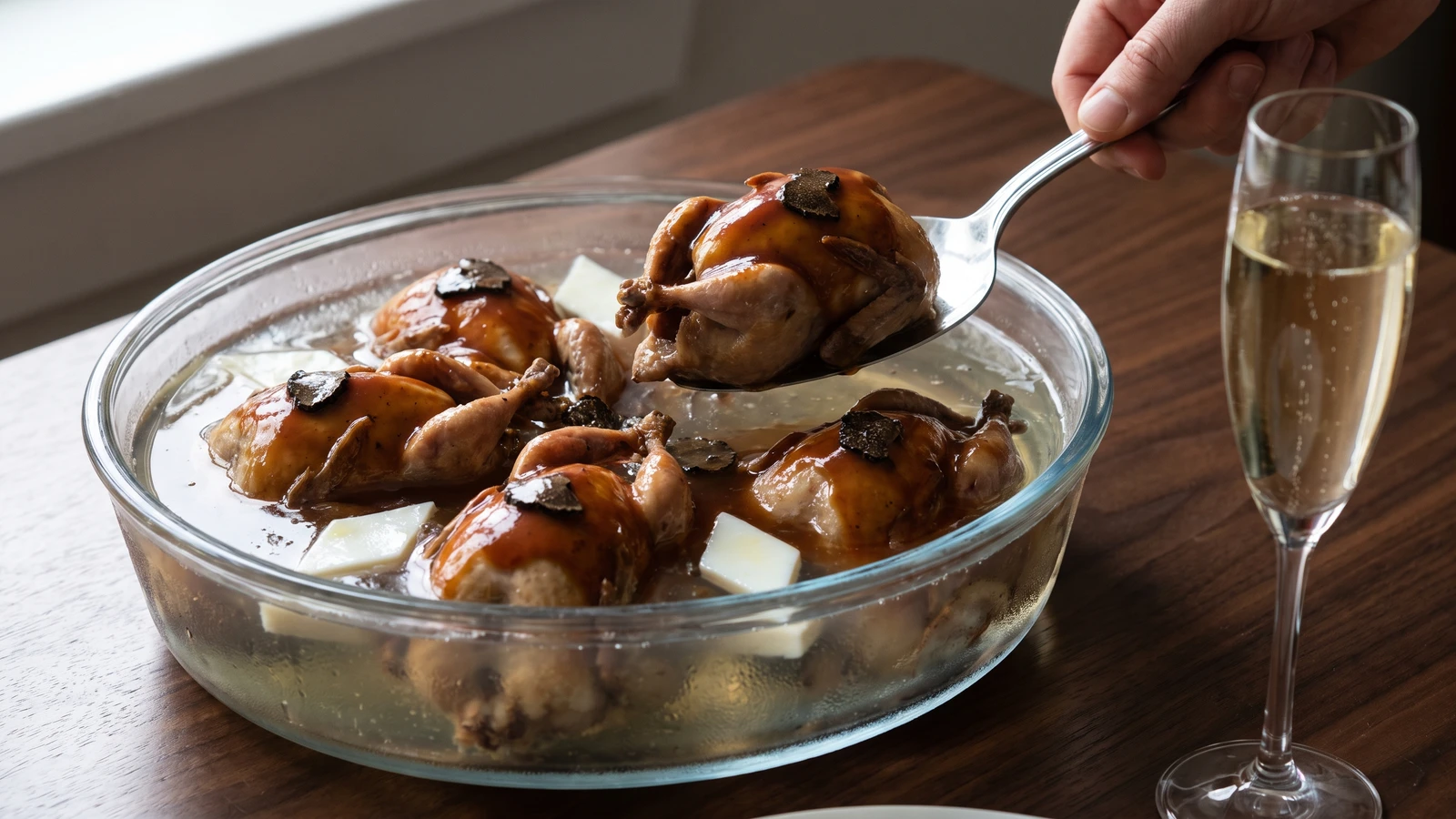
Four boned quails hide game forcemeat, foie gras, and truffle beneath a glassy brown chaud-froid glaze, then rest in clear savoury jelly: a cold centerpiece governed entirely by temperature.
Chaud-froid de Cailles en Belle-vue (boned, stuffed quails glazed and set in clear savoury jelly) teaches one exacting truth: temperature is not a finishing detail here, it is the technique. The quails must be cold and dry, while the brown chaud-froid sauce must be fluid enough to flow yet cool enough to cling. A degree too warm and it slides away. Too cold and it sets in ridges.
The original formula assumed a saucier on staff, a stock never off the fire, a game larder ready with quail fumet, a concentrated quail essence, and brigade quantities of sauce and jelly. A salamander, useful to much grand-kitchen finishing, has no work in this cold dish. Four butcher-boned quails, the completed Gratins (No. 268) and Brown Chaud-froid Sauce (No. 34), a narrow pot, an ice bath, and your refrigerator are the honest home equivalents. The repeated reheating, holding pans, and great surplus of sauce were brigade scaffolding, so they go. Boning, restuffing, muslin poaching, cooling in stock, coating at the exact set, and encasing in clear jelly are the dish, so they stay. One cook, one stove, one evening of work, then the refrigerator takes the night watch.
At the table, each quail should appear suspended beneath clear jelly, its brown glaze glossy, its breast marked with black truffle and ivory egg white. Cut through and the centre reveals game forcemeat wrapped around foie gras and truffle. Before you meet the sauce, set out a chilled spoon, an ice bath, and a thermometer. Catching that coating point is the one step that decides everything.
Chaud-froid belongs to the Parisian grand-kitchen cold buffet, where cooked poultry and game were masked with gelatin-bound sauce and protected beneath limpid savoury jelly before service. The belle-vue treatment made display part of the method, arranging a decorated bird beneath clear jelly so the workmanship remained visible rather than hidden. Despite the name, chaud-froid is not a sauce served both warm and cold; the bird is cooked hot, finished cold, and brought to the table fully set.
Quantity
4, about 6 oz (170 g) each
fully boned through the back with the skin intact
Quantity
¼ cup (60 ml / 60 g)
cut into four narrow rods
Quantity
¼ cup (60 ml / 30 g)
divided between four narrow rods and small decorative pieces
Quantity
6 cups (1.4 L / 1.4 kg)
Quantity
2 cups (475 ml / 500 g)
prepared with quail fumet and chilled
Quantity
2
Quantity
4 cups (950 ml / 950 g)
melted and cooled until barely fluid, divided
| Ingredient | Quantity |
|---|---|
| whole quailsfully boned through the back with the skin intact | 4, about 6 oz (170 g) each |
| Gratins (No. 268), game forcemeat formprepared and thoroughly chilled | 1 cup (240 ml / 225 g) |
| foie grascut into four narrow rods | ¼ cup (60 ml / 60 g) |
| black truffledivided between four narrow rods and small decorative pieces | ¼ cup (60 ml / 30 g) |
| gelatin-rich veal stock | 6 cups (1.4 L / 1.4 kg) |
| Brown Chaud-froid Sauce (No. 34)prepared with quail fumet and chilled | 2 cups (475 ml / 500 g) |
| large egg whites | 2 |
| very clear savoury jellymelted and cooled until barely fluid, divided | 4 cups (950 ml / 950 g) |
Have the game forcemeat form of Gratins (No. 268), the Brown Chaud-froid Sauce (No. 34), the veal stock, and the savoury jelly finished before you begin. These are complete preparations in their own right, so this formula reaches for them ready rather than rebuilding them inline. Keep the forcemeat thoroughly cold, reserve the sauce in the refrigerator, and hold the melted jelly just cool enough to remain fluid.
Lay each boned quail skin-side down and spread one quarter of the chilled Gratins (No. 268) along its centre, leaving a clear border around the skin. Set one rod of foie gras and one rod of truffle lengthwise through the middle. Fold the flesh and skin neatly around the filling, then reshape the bird into its original plump form with the breast skin smooth and unbroken. If the seam gapes, remove a spoonful of forcemeat rather than stretching the skin. Overfilling looks generous now and becomes a split quail in the stock.
Place each reshaped quail seam-side down on a square of washed muslin. Roll it snugly, twist the ends, and tie them with kitchen string, adding one loose tie around the middle to hold the breast shape. The muslin is not decoration. It replaces the steady hands of a brigade by keeping the boneless bird compact while its filling sets.
Bring the veal stock to a bare tremble, about 180 to 190°F (82 to 88°C), in the narrowest pot that will hold the four bundles without crowding. Lower in the quails and keep them submerged with a small heatproof plate if necessary. Poach for 20 minutes without boiling, then check that the centre of the filling has reached 165°F (74°C); if it has not, continue in 2-minute intervals. Set the whole pot in a deep ice bath without removing the quails, and cool them in their stock, turning the bundles once, until thoroughly cold. This preserves their moisture while bringing them quickly through the unsafe temperature range. Never leave the stockpot cooling on the counter.
Lift the cold quails from the stock and unwrap them carefully. If the stock has gelled around the muslin, stand the pot briefly in tepid water until the bundles release; pulling will tear the skin. Pat every bird completely dry and set them on a rack in the refrigerator. A damp quail rejects its sauce. Meanwhile, slip the egg whites separately into barely trembling water and poach until opaque and firm, about 3 minutes. Drain, chill, and cut them into small diamonds or leaves with some of the reserved truffle.
Warm the Brown Chaud-froid Sauce (No. 34), prepared with quail fumet, over barely warm water only until smooth and fluid. Quail fumet is the concentrated essence drawn from the bird, and it is what keeps this glaze tied to its filling. Set the bowl over ice and stir continuously as the sauce cools. Test it on a chilled spoon: it is ready when it blankets the metal in an even, glossy film within seconds, without running bare or setting in ridges, usually near 79 to 82°F (26 to 28°C). Dip one cold, dry quail completely, lift it, let the excess fall away, and set it on the rack. If the sauce slides off, it is too warm, so stir it over ice and test again. If it gathers in heavy ridges, warm it gently over lukewarm water. Ça se rattrape. Once the coating sets, patch any bare place with a second thin dip.
Arrange the truffle and poached egg-white pieces neatly across each breast, keeping the pattern restrained enough that the brown glaze remains visible. Spoon a very thin film of the barely fluid savoury jelly over the decoration to fasten it, then chill until set. If the pieces drift, the jelly is too warm. Lift them off, chill the bird again, reseat them, and fix each piece first with two or three cold droplets before adding the final film.
Use the tip of a fine paring knife to trim the skirts of set sauce from around each quail. Arrange the birds breast-side up in a two-by-two square inside the deep square serving dish. Cool the remaining savoury jelly until it is fluid but close to setting, then pour it slowly down the side of the dish until the quails are covered. Never pour directly onto the decoration. If a brown streak bleeds into the jelly, stop immediately, chill the dish for 10 minutes, skim away the marked jelly, and resume with the remainder slightly colder. Limpid jelly is the belle-vue, the beautiful view, and clarity is part of the dish.
Refrigerate the dish for at least 4 hours, preferably overnight, until the jelly is firm and bright. Bring it from the refrigerator about 10 minutes before serving and place it directly on the table, still in its deep dish, with a broad spoon for lifting one quail per guest. The original serves it this way; unmolding adds risk and no pleasure. À table!
1 serving (about 480g)
Culinary guides, cultural storytelling, and the editorial depth that makes cooking meaningful.
Discover Culinary ExplorerChef Juliette
John Dory has the delicacy of sole and the firmness of turbot. A light flouring, a quick butter sauté, and nut-brown beurre noisette show exactly why looks never mattered.

Chef Juliette
Fresh haddock proves its delicacy in the meunière pan: a fine flour crust, moist pearly flakes, and beurre noisette sharpened with lemon and parsley, ready from one skillet in half an hour.

Chef Juliette
Éperlans à l’Anglaise turns small fish into a lesson in disciplined coating: boned smelts under a close, crisp crumb, pan-fried in clarified butter and finished with bright, half-melted maître d’hôtel butter.

Chef Juliette
Tiny smelts, shallot, mushrooms, white wine, gratin sauce, and fine bread raspings meet a fierce oven, where the fish must turn tender in the same breath the buttered crust bronzes.