
Chef Juliette
John Dory (St. Pierre)
John Dory has the delicacy of sole and the firmness of turbot. A light flouring, a quick butter sauté, and nut-brown beurre noisette show exactly why looks never mattered.
A cooking platform built around craft, culture, and the stories behind what we eat.

Created by Chef Juliette
Based on No. 1895, Cailles Richelieu, from Le Guide Culinaire (1907) by Auguste Escoffier
Eight plump quails, perfumed from within with Cognac and truffle, poached beneath buttered julienne in amber veal stock, then finished with more raw truffle for two fragrant minutes.
Cailles Richelieu (quails poached beneath buttered vegetable matchsticks and black truffle) teaches restraint inside luxury. The birds sit tightly together under their julienne, with only enough amber veal stock to cover them, and the liquor must barely tremble after its first boil. The one true thing is timing: most of the truffle belongs to the final two minutes, when it perfumes the stock without surrendering its character.
The original assumed a saucier on staff to guard a stockpot that never went cold, another pair of hands to cut two precise juliennes, and a warmed timbale waiting for service. A salamander has no work in this preparation. At home, concentrated unsalted veal stock, one lidded sauté pan, and a deep warm serving bowl do the same job. The separate labor is brigade scaffolding and can go; the snug packing, butter-softened coarse julienne, twelve-minute poach, and two-minute truffle finish are the dish and must stay.
The brigade quantity becomes eight quails for four, because two small birds make a generous celebratory main beside pilaf rice. When they reach the table, the skins should gleam under clear amber liquor, with carrot, onion, celery, and black truffle lying over them in distinct ribbons. Have every cut made and the stock hot before the quails enter the pan. The final two minutes decide everything.
Cailles Richelieu belongs to the ceremonial Parisian grand-kitchen repertory, where small birds, concentrated stock, and black truffle displayed a saucier's control without relying on a heavy sauce. Richelieu is a dedicatory name, not a claim that the preparation belongs to the town of Richelieu or to Touraine; the dish traveled from formal dining rooms to prosperous home tables because it could be presented handsomely in one timbale. Its signature remains exact: the vegetable julienne cooks first, while the truffle julienne enters only at the finish so its perfume reaches the table intact.
Quantity
8, about 4 to 5 ounces each (115 to 140 g each; 920 g to 1.12 kg total)
gizzards removed
Quantity
5¼ ounces (150 g)
divided into eight 1/8-ounce (3 g) pieces and about 1 cup (240 ml / 125 g) coarse julienne
Quantity
1 teaspoon (5 ml / 5 g)
Quantity
1½ teaspoons (7.5 ml / 9 g)
divided
Quantity
¾ cup (180 ml / 90 g)
cut into coarse julienne
Quantity
¾ cup (180 ml / 90 g)
cut into coarse julienne
Quantity
½ cup (120 ml / 55 g)
cut into coarse julienne
Quantity
3 tablespoons (45 ml / 42 g)
Quantity
6 to 7 cups (1.4 to 1.65 L / 1.4 to 1.65 kg)
unsalted, gelatinous when chilled and heated before use
Quantity
4 cups (960 ml / 720 g)
for serving
| Ingredient | Quantity |
|---|---|
| fresh, plump quailsgizzards removed | 8, about 4 to 5 ounces each (115 to 140 g each; 920 g to 1.12 kg total) |
| fresh black truffledivided into eight 1/8-ounce (3 g) pieces and about 1 cup (240 ml / 125 g) coarse julienne | 5¼ ounces (150 g) |
| Cognac or good French brandy | 1 teaspoon (5 ml / 5 g) |
| fine sea saltdivided | 1½ teaspoons (7.5 ml / 9 g) |
| carrotcut into coarse julienne | ¾ cup (180 ml / 90 g) |
| yellow onioncut into coarse julienne | ¾ cup (180 ml / 90 g) |
| inner celery stalkscut into coarse julienne | ½ cup (120 ml / 55 g) |
| unsalted butter | 3 tablespoons (45 ml / 42 g) |
| rich amber veal stockunsalted, gelatinous when chilled and heated before use | 6 to 7 cups (1.4 to 1.65 L / 1.4 to 1.65 kg) |
| prepared pilaf rice (optional)for serving | 4 cups (960 ml / 720 g) |
Julienne-fashion means cutting the vegetables into match-shaped rods. Cut the carrot, onion, and celery into coarse rods about 1½ inches (4 cm) long and 1/8 inch (3 mm) thick, keeping the cuts as even as your knife permits. Cut eight small pieces from the truffle for the cavities, then cut the remainder into the same coarse julienne. The truffle julienne should measure 1 cup, exactly half the 2 cups of vegetable julienne. Cover the truffle closely and keep it cool.
Check each quail cavity and remove any remaining gizzard. Pat the birds dry. Put a small grain of salt and a few drops of Cognac inside each one, followed by a piece of raw truffle. Tuck the wings behind the backs, draw the legs neatly against the breasts, and tie each bird compactly with kitchen twine. This entrée truss is practical, not decorative: it helps the quails cook evenly and lets eight birds fit tightly in one pan.
Melt the butter in the sauté pan over medium-low heat. Add the carrot, onion, celery, and a small pinch of the measured salt. Cook for 6 to 8 minutes, turning gently, until the rods are supple and glossy but still distinct, with no browning. Lift the vegetables into a bowl, leaving the butter in the pan. If the pan begins to color, lower the heat and add a spoonful of the hot stock; the glaze will dissolve and the julienne can continue without bitterness.
Arrange the quails breast-side up in the buttered pan, pressed snugly against one another so they cannot drift or roll. Season their surfaces with the remaining salt and spread the cooked vegetable julienne evenly over them. Pour in enough hot amber veal stock to cover the birds and vegetables, using no more than the pan requires. Cover, bring the liquor to one clear boil, then immediately lower the heat and poach at the barest tremble for exactly 12 minutes.
Scatter the raw truffle julienne evenly over the vegetable julienne, cover again, and poach for 2 minutes, no longer. Check a quail at the thickest part of the thigh without touching bone; it should register 165°F (74°C). If the birds need another minute, lift the truffle julienne out with a slotted spoon and keep it covered while the quails finish, then return it at service. This preserves the book's intent: cooked quail, warm truffle, full perfume.
Lift the quails into a warmed deep serving bowl or timbale and remove the twine. Skim every visible bead of fat from the cooking liquor, but do not strain away the julienne. Taste the liquor for salt, then spoon the vegetable and truffle juliennes over the birds and pour over enough clear amber liquor to pool generously around them. Serve the remaining liquor at the table, with pilaf rice alongside if using. À table!
1 serving (about 525g)
Culinary guides, cultural storytelling, and the editorial depth that makes cooking meaningful.
Discover Culinary ExplorerChef Juliette
John Dory has the delicacy of sole and the firmness of turbot. A light flouring, a quick butter sauté, and nut-brown beurre noisette show exactly why looks never mattered.

Chef Juliette
Fresh haddock proves its delicacy in the meunière pan: a fine flour crust, moist pearly flakes, and beurre noisette sharpened with lemon and parsley, ready from one skillet in half an hour.
Chef Juliette
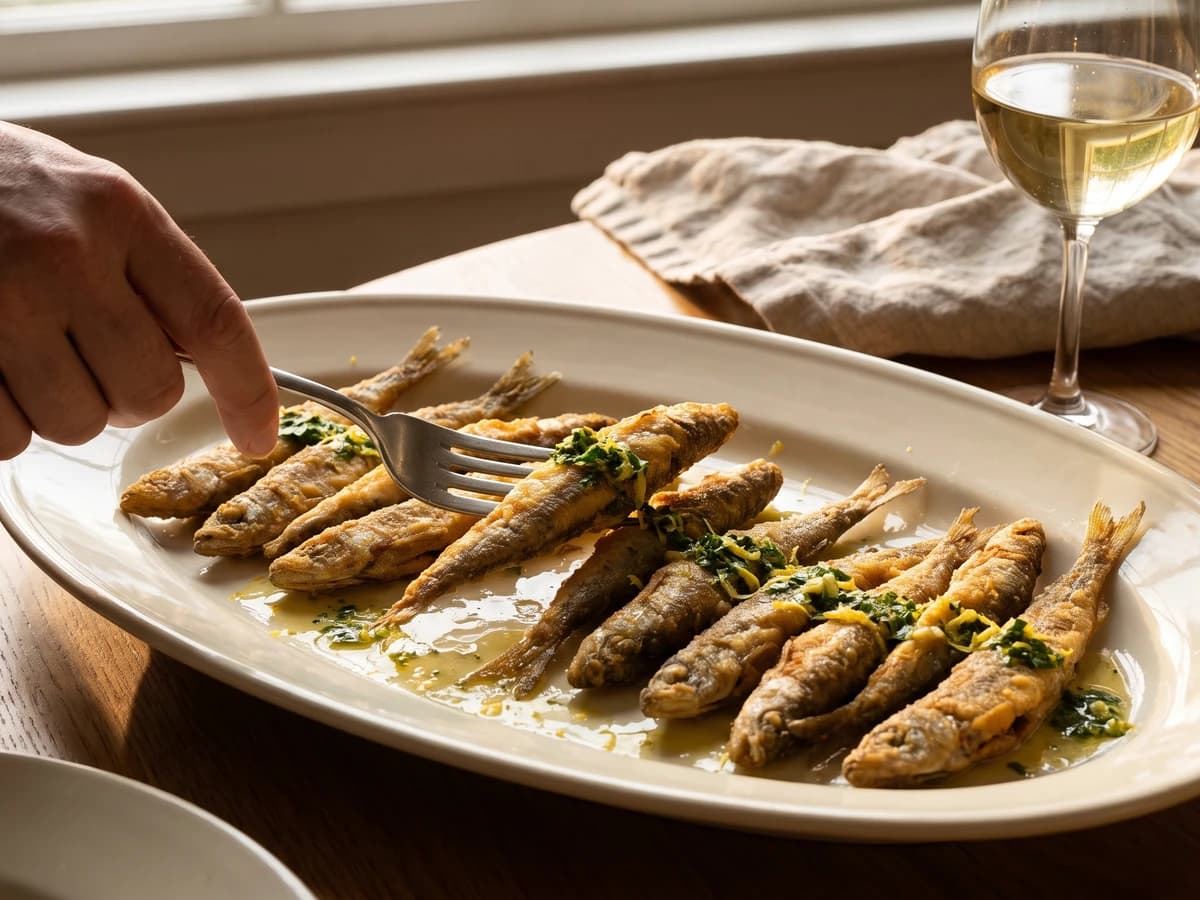
Éperlans à l’Anglaise turns small fish into a lesson in disciplined coating: boned smelts under a close, crisp crumb, pan-fried in clarified butter and finished with bright, half-melted maître d’hôtel butter.

Chef Juliette
Tiny smelts, shallot, mushrooms, white wine, gratin sauce, and fine bread raspings meet a fierce oven, where the fish must turn tender in the same breath the buttered crust bronzes.