
Chef Juliette
John Dory (St. Pierre)
John Dory has the delicacy of sole and the firmness of turbot. A light flouring, a quick butter sauté, and nut-brown beurre noisette show exactly why looks never mattered.
A cooking platform built around craft, culture, and the stories behind what we eat.
Created by Chef Juliette
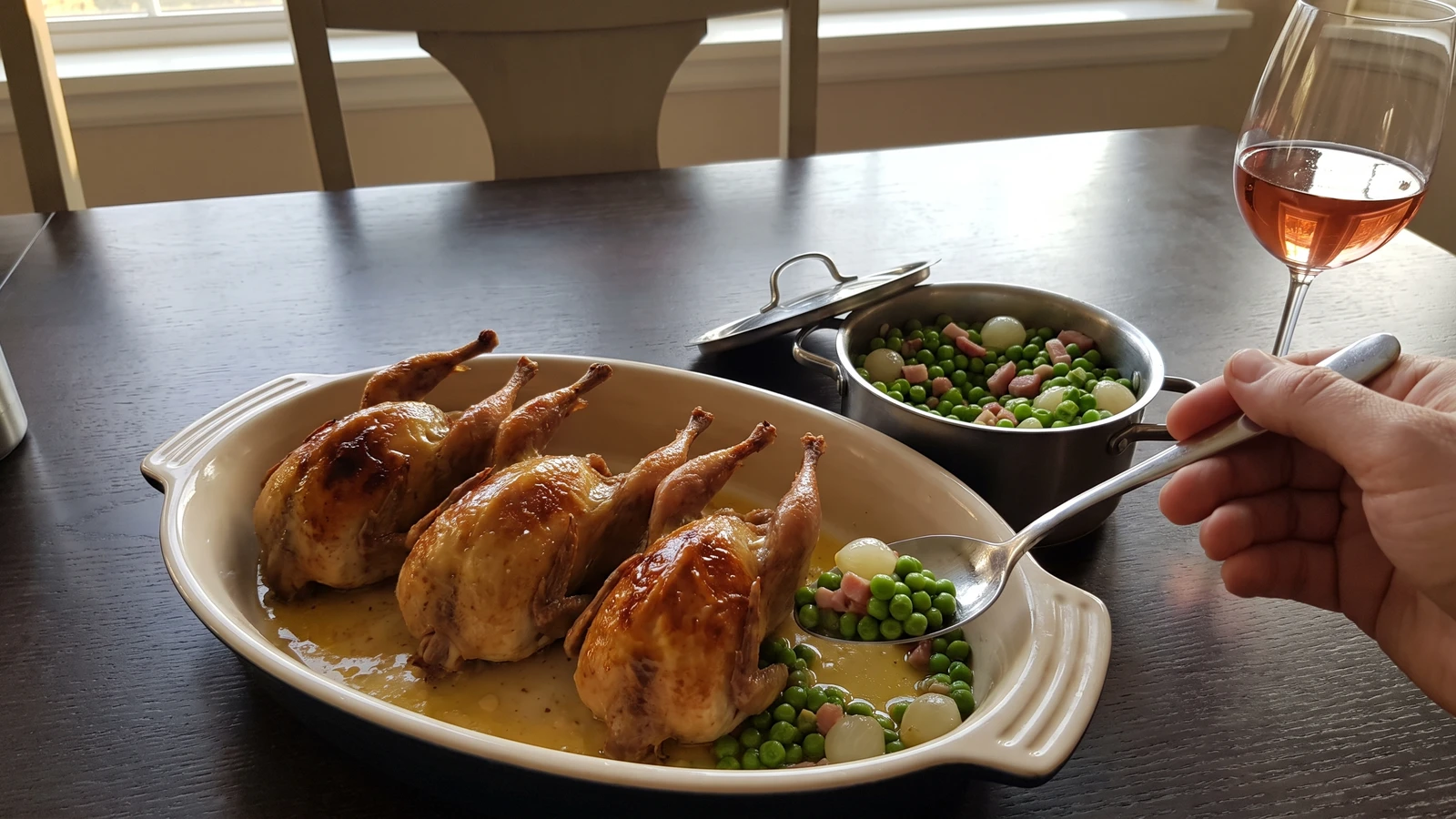
Based on No. 1893, Cailles aux Petits Pois à la Romaine, from Le Guide Culinaire (1907) by Auguste Escoffier
Four butter-bronzed quails and a covered pan of sweet peas, new onion, and raw ham arrive separately, then meet on the plate, a lesson in timing and concentrated flavor without added liquid.
Cailles aux Petits Pois à la Romaine (quails with Roman-style peas) teaches sealed-pan cooking: fresh peas, raw ham, and new onion carry enough moisture to cook themselves, so the one true thing to know before touching a pan is that no stock and no water belong with the peas. The lid traps what the ingredients release; a gentle flame concentrates it. Add liquid and the peas become soupier, duller, and no longer this dish.
The old entry assumed a brigade that could keep quails and peas moving in separate pans, finish them at the same instant, and send each in little closed timbales. It assumed no saucier, simmering stockpot, or salamander because none belongs here. For four people, two lidded skillets and two warmed covered serving dishes are the honest equivalents. The home version keeps the exact proportion of one small new onion and two-thirds of an ounce of raw ham for each quail; only the individual timbales go, because they are service scaffolding. Serving the birds and peas separately, still hot, is the dish and stays.
The quails are poêlées (browned and gently finished in butter in a covered pan) until their skins are deep bronze, while the peas soften beside them in their own juices. The step that decides everything is heat control under the pea lid: listen for a quiet buttery sizzle, never a hard fry. If the bottom catches, ça se rattrape, and the rescue is waiting in the method.
Cailles aux Petits Pois à la Romaine sits at the meeting point of Roman pea cookery and the French classical dining room: à la Romaine names the garnish of fresh peas, new onion, and raw ham, not the origin of the quails. French service sent the butter-cooked birds and covered peas to the table in separate timbales so each guest made the final mixture, a formal presentation built around the practical spring-kitchen principle that newly shelled peas can cook in their own moisture.
Quantity
4, about 5 to 6 oz (140 to 170 g) each
cleaned and patted dry
Quantity
8 tablespoons (1/2 cup / 113 g)
divided
Quantity
4, about 3/4 cup (180 ml / 100 g)
finely chopped
Quantity
about 1/2 cup (120 ml / 75 g), exactly 2/3 oz per quail
finely chopped
Quantity
4 cups (950 ml / 600 g)
shelled at the last moment
Quantity
1 teaspoon (5 ml / 6 g)
divided
| Ingredient | Quantity |
|---|---|
| whole quailscleaned and patted dry | 4, about 5 to 6 oz (140 to 170 g) each |
| unsalted butterdivided | 8 tablespoons (1/2 cup / 113 g) |
| small new onionsfinely chopped | 4, about 3/4 cup (180 ml / 100 g) |
| jambon cru, an unsmoked dry-cured raw hamfinely chopped | about 1/2 cup (120 ml / 75 g), exactly 2/3 oz per quail |
| freshly shelled young peasshelled at the last moment | 4 cups (950 ml / 600 g) |
| fine sea saltdivided | 1 teaspoon (5 ml / 6 g) |
Bring the quails from the cold about 20 minutes before cooking. Pat them thoroughly dry inside and out, tie the legs together if they splay, and season with 1/2 teaspoon of the measured salt. Chop the onions and ham, then shell the peas only now. Set a 12-inch (30 cm) lidded skillet and a 10-inch (25 cm) lidded sauté pan on adjacent burners, with two covered serving dishes ready for warming.
Melt 3 tablespoons of the butter in the larger skillet over medium heat. When it foams and smells nutty but remains golden, lay in the quails breast-side down. Brown for about 2 minutes, then turn them onto each side and finally onto their backs, allowing 6 to 8 minutes in all. Leave space between the birds so they brown rather than stew. If the butter turns black or smells acrid, lift out the quails, pour away only the burnt butter, wipe the pan, and return the birds with the reserved tablespoon of quail butter. Keep any bronze fond that tastes toasted rather than bitter. Ça se rattrape.
Lower the quail pan to medium-low, add 1 more tablespoon butter, and cover. Cook for 8 to 10 minutes, turning the birds once, while you begin the peas immediately. Check the thickest part of a thigh without touching bone; each quail must reach 165°F (74°C). If the skin softens beneath the lid, uncover for the final minute and turn the birds through the bronzed butter until they gleam again.
As soon as the quails are covered, melt 3 tablespoons of the remaining butter in the second pan over medium-low heat. Add the chopped new onions and ham together, exactly as the entry directs, and fry gently for 3 to 4 minutes, stirring, until the onion softens and the ham releases its aroma without becoming crisp. Fold in the freshly shelled peas and 1/4 teaspoon salt, then cover at once. Cook over low heat for 8 to 12 minutes, shaking the closed pan every 2 minutes. Add no water, stock, or wine whatsoever; the sealed pan keeps the moisture from the peas, onion, and ham where it belongs.
Listen to the pea pan. A soft sizzle is right; a sharp frying sound means the heat is too high. Lift the pan from the burner, add the final tablespoon of butter, shake it closed, and leave it off the heat for 1 minute before returning it to the lowest flame. If black specks appear, transfer the unscorched peas to a bowl without scraping the bottom, wipe the pan clean, then return the peas and finish them gently. Ça se rattrape. The peas are ready when tender but still round, with a spoonful of concentrated buttery juice beneath them. If they finish first, hold them covered off the heat. If the quails finish first, rest them in their covered serving dish. Taste the peas only after the ham has cooked through, then use the final 1/4 teaspoon salt only if needed.
Warm both covered serving dishes with hot water, then empty and dry them well. Place the quails in one and spoon over their clean bronzed butter and fond. Put the peas, onion, ham, and every drop of their juices in the other. Cover both and carry them to the table together. Each diner takes a quail, spoons the peas alongside, and makes the final mixture on the plate. No added sauce and no decorative garnish. À table!
1 serving (about 330g)
Culinary guides, cultural storytelling, and the editorial depth that makes cooking meaningful.
Discover Culinary ExplorerChef Juliette
John Dory has the delicacy of sole and the firmness of turbot. A light flouring, a quick butter sauté, and nut-brown beurre noisette show exactly why looks never mattered.

Chef Juliette
Fresh haddock proves its delicacy in the meunière pan: a fine flour crust, moist pearly flakes, and beurre noisette sharpened with lemon and parsley, ready from one skillet in half an hour.
Chef Juliette
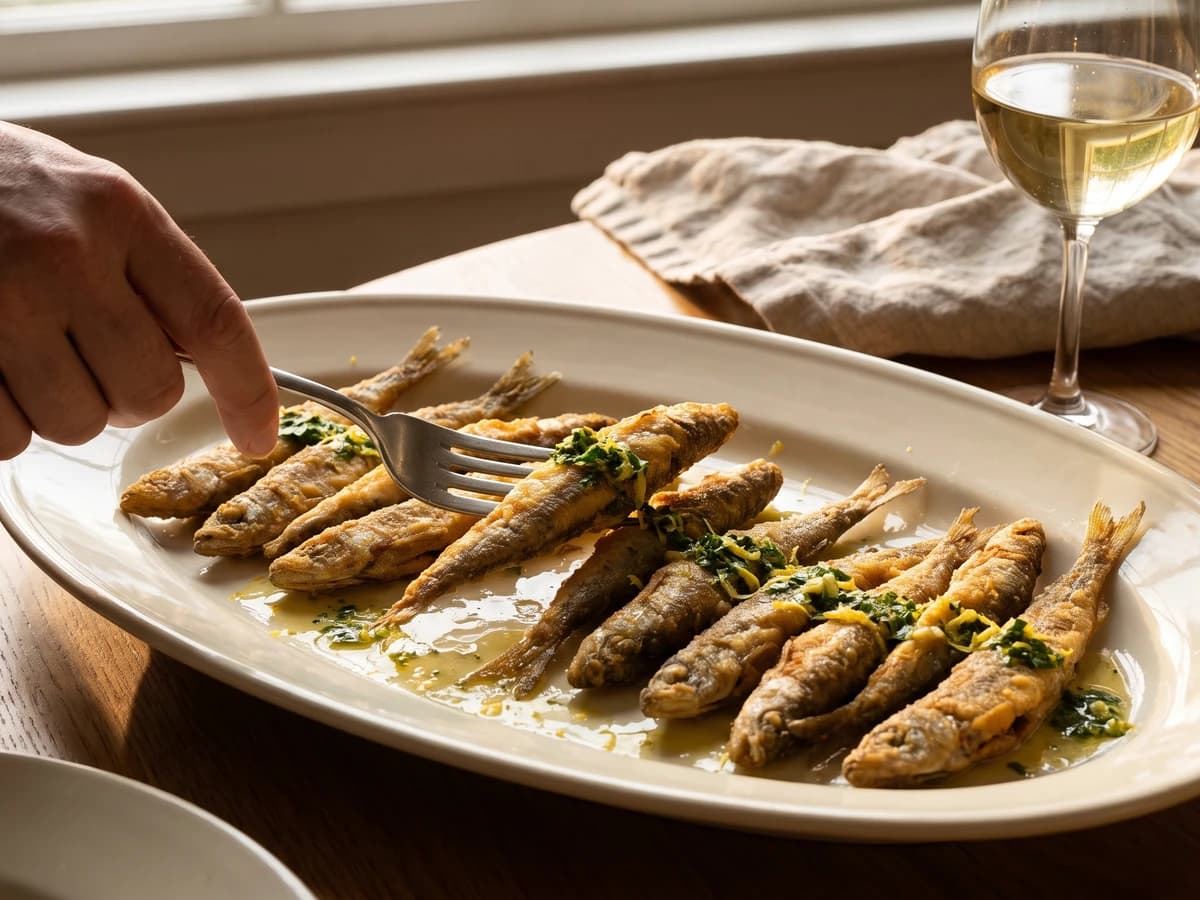
Éperlans à l’Anglaise turns small fish into a lesson in disciplined coating: boned smelts under a close, crisp crumb, pan-fried in clarified butter and finished with bright, half-melted maître d’hôtel butter.

Chef Juliette
Tiny smelts, shallot, mushrooms, white wine, gratin sauce, and fine bread raspings meet a fierce oven, where the fish must turn tender in the same breath the buttered crust bronzes.