
Chef Juliette
John Dory (St. Pierre)
John Dory has the delicacy of sole and the firmness of turbot. A light flouring, a quick butter sauté, and nut-brown beurre noisette show exactly why looks never mattered.
A cooking platform built around craft, culture, and the stories behind what we eat.
Created by Chef Juliette
Based on No. 1889, Cailles Juliette, from Le Guide Culinaire (1907) by Auguste Escoffier
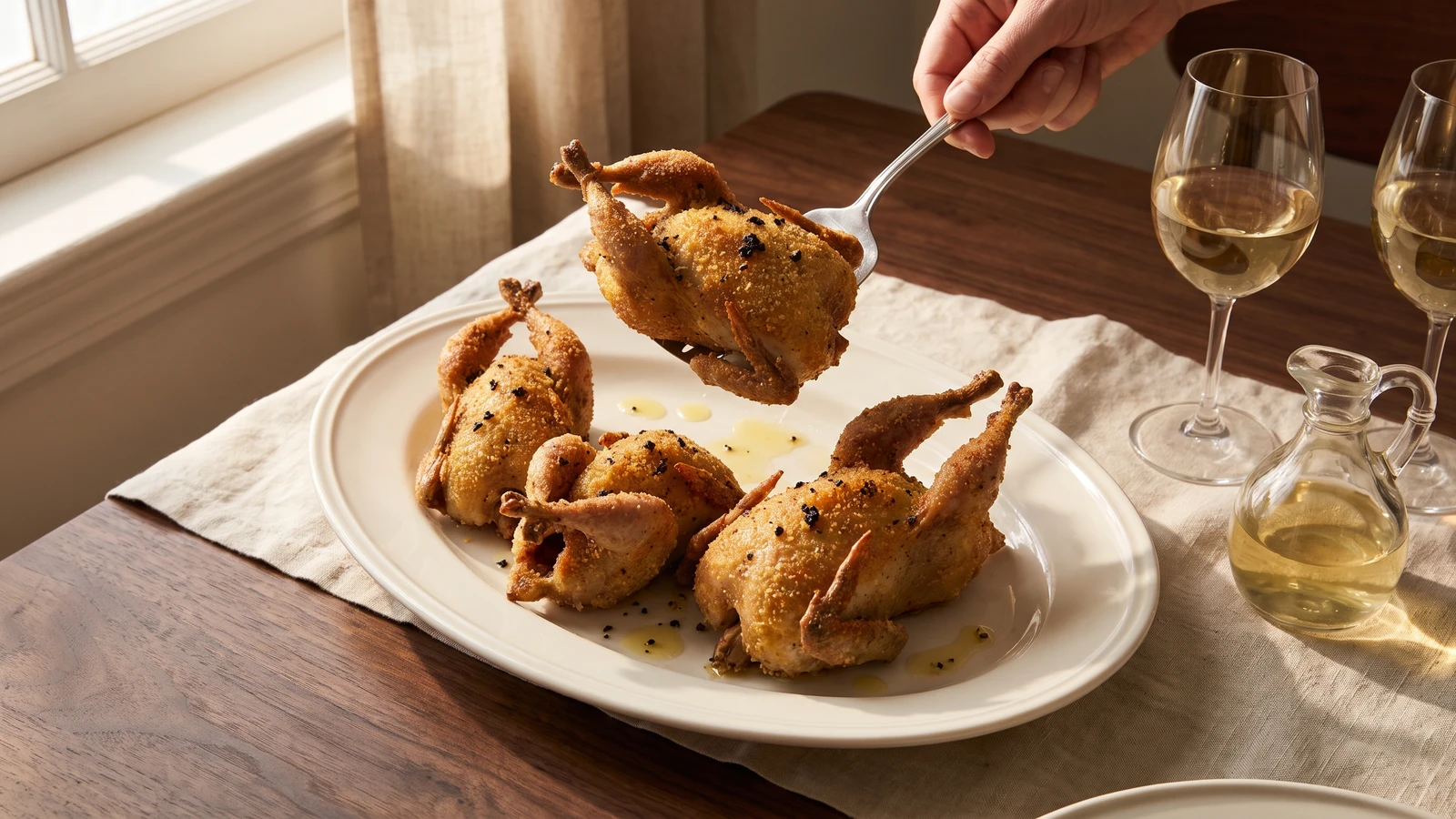
Truffled quails held in melting caul fat, buttered, lightly crumbed, and gently grilled, then woken with verjuice: a small bird that teaches precise heat and restraint.
Cailles Juliette (Juliette-style quails) teaches the discipline of gentle grilling. The caul must have time to melt into the birds before the fine crumbs darken; rush the heat and you scorch the coat while the quail stays raw beneath it. When it is right, the caul has nearly disappeared, the surface is butter-gold and crisp under the teeth, and black truffle perfumes the first cut rather than shouting over it.
The classical entry assumed a grillardin tending a mild charcoal fire, with pig’s caul and truffle ready from the larder. Unlike a sauced preparation, it asks nothing of a saucier, a stockpot, or a salamander. For one cook, four small quails sit on a wire rack beneath a low home broiler, moved nearer or farther from the heat as needed. The brigade’s fire-tending and large service platter are scaffolding, so they go; the back-split bird, truffle, caul, butter, fine crumbs, and final green acidity are the dish, so every one stays.
Verjuice is not an optional flourish. Its few drops cut butter and caul without bringing lemon’s perfume, which would rewrite the finish. Watch the birds’ distance from the element rather than trusting the clock: letting the caul render before the crumbs become too dark is the one step that decides Cailles Juliette.
Cailles Juliette belongs to the classical Parisian dining-room repertoire rather than to a regional farmhouse canon, a named quail preparation joining the larder’s caul and truffle to the grill station’s precise fire. Wrapping small game birds in crépine, pig’s caul fat, carried a charcutier’s technique from household and market cooking into the grand kitchen, where the web basted lean flesh and then nearly disappeared. Its most revealing detail is the last one: verjuice rather than lemon or a composed sauce, preserving the green taste of unripe grape while keeping the truffle clear.
Quantity
4, each 5 to 6 ounces / 140 to 170 g
Quantity
1¼ teaspoons (6 ml / 7 g)
Quantity
½ teaspoon (2.5 ml / 1 g)
Quantity
4 tablespoons (60 ml / 57 g)
melted and divided
Quantity
2 tablespoons (30 ml / 20 g)
very finely chopped
Quantity
4 pieces, each about 10 inches / 25 cm square (about 4¼ ounces / 120 g total)
Quantity
½ cup (120 ml / 45 g)
sifted
Quantity
2 teaspoons (10 ml / 10 g)
for finishing
| Ingredient | Quantity |
|---|---|
| whole oven-ready quails, skin on | 4, each 5 to 6 ounces / 140 to 170 g |
| fine sea salt | 1¼ teaspoons (6 ml / 7 g) |
| freshly ground black pepper | ½ teaspoon (2.5 ml / 1 g) |
| unsalted buttermelted and divided | 4 tablespoons (60 ml / 57 g) |
| fresh black truffle or drained whole preserved black trufflevery finely chopped | 2 tablespoons (30 ml / 20 g) |
| pig’s caul fat | 4 pieces, each about 10 inches / 25 cm square (about 4¼ ounces / 120 g total) |
| fine dry breadcrumbs made from crustless white breadsifted | ½ cup (120 ml / 45 g) |
| white verjuicefor finishing | 2 teaspoons (10 ml / 10 g) |
Soak the caul fat in a bowl of very cold water for 20 minutes, which relaxes the web and makes it easier to unfold without tearing. Rinse it, gently squeeze out the water, and spread the pieces between clean towels. Set a broiler-safe wire rack over a rimmed baking sheet. Position an oven rack 8 inches / 20 cm below a low broiler; if your broiler has only one fierce setting, increase that distance to 10 inches / 25 cm. Heat the broiler for 10 minutes. Divide the melted butter equally between two bowls so the butter used after wrapping never meets the raw birds.
Set each quail breast-side down. With sturdy kitchen shears, cut lengthwise through the back from tail to neck, then open the bird like a book without cutting through the breastbone that joins the two halves. Press each half gently until the quail lies flat. Remove any pinfeathers or loose fragments of bone, then dry every surface thoroughly. Season the birds evenly with the salt and pepper, including the opened backs. A wet bird turns its crumb coating to paste, so take the drying seriously.
Brush the quails on both sides with the first half of the melted butter. Divide the chopped truffle among them, pressing it chiefly over the exposed inner surfaces and into the joints between breast and leg. Keep every fragment on the bird. The caul will protect the truffle from direct heat while its fat carries the perfume through the flesh.
Spread one piece of caul flat and place a quail in its center. Fold the caul snugly around the bird in a single thin layer, overlapping the edges underneath and trimming away heavy excess. If the web tears, patch it with a damp scrap and overlap the edges firmly; the fat melts into itself as it cooks. Brush the wrapped birds with the remaining melted butter, then sprinkle them evenly with the fine breadcrumbs. Shake off anything loose. This should be a delicate coat, not armor, because a thick layer will burn before the caul renders.
Arrange the quails breast-side down on the prepared rack, leaving space around each one. Broil gently for 6 to 8 minutes, until the caul looks translucent at the edges and the crumbs are pale gold. Turn each bird carefully with a wide spatula and tongs, then broil breast-side up for another 5 to 7 minutes. They are ready when the caul has nearly disappeared, the coating is deep butter-gold, and an instant-read thermometer inserted into the thickest part of a thigh without touching bone registers 165°F / 74°C. If the crumbs darken while the caul still looks white, ça se rattrape: lower the sheet one rack, cover only the dark patches loosely with small pieces of foil, and continue cooking. Never walk away from rendered caul fat beneath a broiler.
Transfer the quails to a warm serving platter and let them settle for 3 minutes. Sprinkle the verjuice over them drop by drop, using about ½ teaspoon per bird and keeping the crisp coating intact. Do not pour it in a stream. The finish should taste green and sharply vinous against the butter and truffle, not wet or lemony. Serve at once. À table!
1 serving (about 165g)
Culinary guides, cultural storytelling, and the editorial depth that makes cooking meaningful.
Discover Culinary ExplorerChef Juliette
John Dory has the delicacy of sole and the firmness of turbot. A light flouring, a quick butter sauté, and nut-brown beurre noisette show exactly why looks never mattered.

Chef Juliette
Fresh haddock proves its delicacy in the meunière pan: a fine flour crust, moist pearly flakes, and beurre noisette sharpened with lemon and parsley, ready from one skillet in half an hour.
Chef Juliette
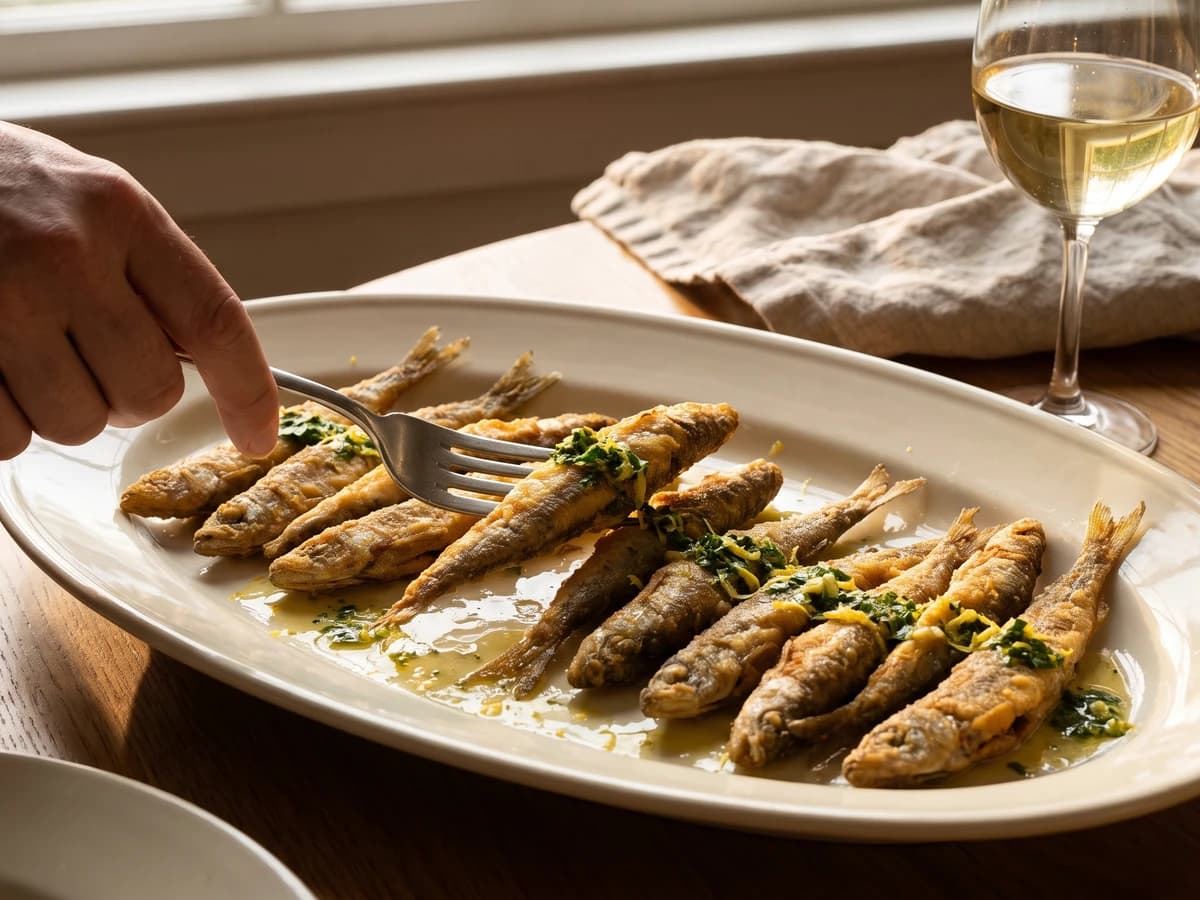
Éperlans à l’Anglaise turns small fish into a lesson in disciplined coating: boned smelts under a close, crisp crumb, pan-fried in clarified butter and finished with bright, half-melted maître d’hôtel butter.

Chef Juliette
Tiny smelts, shallot, mushrooms, white wine, gratin sauce, and fine bread raspings meet a fierce oven, where the fish must turn tender in the same breath the buttered crust bronzes.