
Chef Juliette
John Dory (St. Pierre)
John Dory has the delicacy of sole and the firmness of turbot. A light flouring, a quick butter sauté, and nut-brown beurre noisette show exactly why looks never mattered.
A cooking platform built around craft, culture, and the stories behind what we eat.

Created by Chef Juliette
Based on No. 1881, Timbale de Bécasse Nesselrode, from Le Guide Culinaire (1907) by Auguste Escoffier
A pastry mould holding chilled game forcemeat, underdone woodcock suprêmes, foie gras, and truffles, baked until burnished and opened at the table with a glossy fumet-enriched sauce.
Timbale de Bécasse Nesselrode (woodcock timbale with foie gras and truffles) teaches construction: every layer must be properly seasoned, chilled, and only partly cooked before the whole goes into the oven. The crust here is the mould, not the meal. It must stand straight and release cleanly, but the feast is inside: dark game, supple suprêmes, the breast fillets, black truffle, and a sauce deepened with fumet, a concentrated game essence.
The original assumed a saucier, brown stock never off the fire, several hands for boning and pounding, and a tamis through which the game paste was worked patiently. At home, a food processor followed by a fine sieve replaces the pounding, a metal Charlotte mould provides the architecture, and prepared Espagnole and demi-glace join the fresh fumet in one saucepan. I have scaled the brigade timbale to four without changing its governing ratios: one-quarter raw foie gras to the cooked carcass meat, followed by an equal weight of panada-and-butter game forcemeat. Repeated sauce work was brigade scaffolding and has been consolidated; the underdone poëling, forcemeat ratio, truffle centre, and sealed short-paste mould are the dish, so they stay.
The one true thing to know before touching a pan is this: warm filling melts the pastry butter and loosens the forcemeat. Cool every component before assembly. If the mixture softens while you work, stop and chill it for fifteen minutes. Ça se rattrape.
Timbale de Bécasse Nesselrode belongs to the ceremonial table of Parisian grand cuisine, where feathered game was combined with foie gras, truffles, reduced sauces, and pastry architecture. The Nesselrode title reflects that kitchen's habit of naming elaborate preparations for the cosmopolitan diplomatic table, rather than a regional tradition of cooking woodcock. The canon permits the same method for pheasant, partridge, or hazel-hen, but insists that the chosen bird replace bécasse in the menu name.
Quantity
2½ cups (600 ml / 300 g)
Quantity
¾ cup (180 ml / 170 g)
diced
Quantity
1 teaspoon (5 ml / 6 g)
Quantity
⅓ cup plus 1 tablespoon (95 ml / 95 g)
Quantity
1 tablespoon (15 ml / 14 g)
for the mould
Quantity
1
beaten for glazing
Quantity
4 small birds, about 8 to 10 oz (225 to 285 g) each
Quantity
1 setup, scaled for 4 woodcocks and 1½ cups (360 ml / 360 g) finished liquor, Poëlings (No. 250)
Quantity
1 cup (240 ml / 140 g)
diced and kept ice-cold
Quantity
¾ cup loosely packed (180 ml / 35 g)
torn
Quantity
3 tablespoons (45 ml / 46 g)
Quantity
3 tablespoons (45 ml / 43 g)
diced
Quantity
¾ teaspoon (3.75 ml / 4.5 g)
Quantity
¼ teaspoon (1.25 ml / 0.5 g)
Quantity
Up to ¼ cup (60 ml / 55 g), using exactly one-quarter the weight of the cooked carcass meat
diced and chilled
Quantity
¼ cup (60 ml / 56 g)
Quantity
About 1 cup (240 ml / 140 g)
cut into olive shapes
Quantity
½ cup (120 ml / 120 g)
Quantity
1 cup (240 ml / 240 g)
| Ingredient | Quantity |
|---|---|
| plain flour | 2½ cups (600 ml / 300 g) |
| cold unsalted butterdiced | ¾ cup (180 ml / 170 g) |
| fine salt for the pastry | 1 teaspoon (5 ml / 6 g) |
| ice-cold water | ⅓ cup plus 1 tablespoon (95 ml / 95 g) |
| softened unsalted butterfor the mould | 1 tablespoon (15 ml / 14 g) |
| large eggbeaten for glazing | 1 |
| legally sourced, oven-ready woodcocks | 4 small birds, about 8 to 10 oz (225 to 285 g) each |
| prepared Poëlings setup | 1 setup, scaled for 4 woodcocks and 1½ cups (360 ml / 360 g) finished liquor, Poëlings (No. 250) |
| raw game meat, preferably pheasant or partridge thighdiced and kept ice-cold | 1 cup (240 ml / 140 g) |
| crustless white breadtorn | ¾ cup loosely packed (180 ml / 35 g) |
| whole milk | 3 tablespoons (45 ml / 46 g) |
| cold unsalted butter for the forcemeatdiced | 3 tablespoons (45 ml / 43 g) |
| fine salt for the forcemeat | ¾ teaspoon (3.75 ml / 4.5 g) |
| ground white pepper | ¼ teaspoon (1.25 ml / 0.5 g) |
| raw foie grasdiced and chilled | Up to ¼ cup (60 ml / 55 g), using exactly one-quarter the weight of the cooked carcass meat |
| Cognac or fine liqueur brandy | ¼ cup (60 ml / 56 g) |
| fresh or well-drained preserved black trufflecut into olive shapes | About 1 cup (240 ml / 140 g) |
| prepared Sauce Espagnole | ½ cup (120 ml / 120 g) |
| prepared demi-glace (half-glaze sauce) | 1 cup (240 ml / 240 g) |
Rub the cold butter into the flour and salt until the mixture resembles coarse crumbs with a few pea-sized flakes remaining. Add the ice-cold water gradually, stopping as soon as the pâte brisée, the savory short paste, holds together when pressed. Flatten it into a disc, wrap, and chill for at least thirty minutes. If it remains crumbly, add cold water one teaspoon at a time; if it turns sticky, chill it rather than burying it in more flour.
Soak the bread in the milk for ten minutes, then squeeze it lightly to make the panada. Process the ice-cold raw game meat with the salt and white pepper until it becomes tacky, add the panada, then work in the cold butter a piece at a time. Fry a teaspoonful and taste for seasoning. The forcemeat must remain cold and close-textured; if it becomes shiny or greasy, the butter is warming. Stop, spread it on a chilled plate, and refrigerate for fifteen minutes before pulsing it briefly again. Ça se rattrape. Cover and keep cold.
Cook the woodcocks using Poëlings (No. 250), keeping the vessel snug and retaining every drop of its finished liquor. Take the birds out while the breasts remain distinctly underdone, since they will cook again inside the timbale. Let them stand only until they can be handled, then begin dismantling them; leaving the cooked birds whole traps heat and carries the suprêmes too far.
Raise the suprêmes cleanly from the breasts and slice them across into neat collops about ⅜ inch (1 cm) thick. Refrigerate them at once. Remove every usable morsel of meat from the legs and frames, weigh it, then weigh raw foie gras equal to exactly one-quarter of that amount. Process the cooked meat and foie gras to a paste, press it through a fine sieve, and weigh the result. Fold in precisely the same weight of the cold game forcemeat. This equal-weight ratio gives the lining both the savor of roasted woodcock and the structure to hold the collops. Cover and chill.
Chop the stripped carcasses into small pieces and return them to the liquor from Poëlings (No. 250). Take the pan off the heat, add the Cognac, then return it to a gentle simmer and cook for eight minutes, crushing the bones once or twice with a spoon. Strain through a fine sieve and remove the surface fat. Bring the fumet to the barest simmer, add the olive-shaped truffles, and poach fresh truffles for four minutes or preserved truffles for one minute. Lift them out and chill them. Reserve all the fumet.
Combine the Sauce Espagnole with ½ cup (120 ml) of the fumet and simmer until reduced to about ⅓ cup (80 ml), glossy and thick enough to coat a spoon without running like broth. Cool it completely. If it tightens too far, loosen it with a spoonful of reserved fumet; if it remains thin, keep reducing. Thin sauce soaks the pastry, and no amount of hopeful baking corrects it.
Butter a 1½-quart (1.5-liter) metal Charlotte mould thoroughly. Reserve one-third of the pastry for the lid, then roll the rest to about ⅛ inch (3 mm) thick and line the mould in one piece, pressing it gently into the bottom angle and leaving ¾ inch (2 cm) overhanging. Avoid stretching, which makes the pastry retreat in the oven. If it tears, patch it from inside with a thin scrap brushed with water, press the seam flat, and chill the lined mould for fifteen minutes.
Spread the chilled woodcock forcemeat about ½ inch (1.25 cm) thick over the bottom and sides of the pastry. Set the woodcock suprême collops against this lining in overlapping rows, keeping their cut faces visible. Pack the poached truffles into the centre and spoon the cold Espagnole reduction over them. Roll out the reserved pastry, brush the exposed rim with beaten egg, and set the lid in place. Crimp firmly, trim the excess, cut a small central vent, and glaze the top. If the forcemeat softens or the pastry begins to shine, refrigerate the entire mould before continuing. Cold assembly is the step that decides the dish.
Heat the oven to 375°F (190°C). Set the mould on a rimmed baking sheet and bake for about forty-five minutes, keeping the source recipe's good, moderate heat, until the pastry is deeply golden and the centre of the forcemeat reaches 165°F (74°C). If the top colors before the filling is ready, cover it loosely with foil without blocking the vent. If the centre has not reached temperature at forty-five minutes, continue in five-minute intervals. Rest the baked timbale in its mould for fifteen minutes.
While the timbale rests, combine the demi-glace with the remaining fumet and simmer until the sauce coats the back of a spoon while still pouring freely. If reduction makes it too strong or salty, restore the balance with hot water a tablespoon at a time. Loosen the pastry edge, invert the timbale onto a warm serving dish, and lift the mould straight upward. If it clings, wrap the mould for thirty seconds in a towel wrung out in hot water, then try again. Spoon a little sauce around the base and serve the remainder in a sauceboat. If a corner cracks, set that side toward the carver and carry on with confidence. Never apologize at your own table. À table!
1 serving (about 420g)
Culinary guides, cultural storytelling, and the editorial depth that makes cooking meaningful.
Discover Culinary ExplorerChef Juliette
John Dory has the delicacy of sole and the firmness of turbot. A light flouring, a quick butter sauté, and nut-brown beurre noisette show exactly why looks never mattered.

Chef Juliette
Fresh haddock proves its delicacy in the meunière pan: a fine flour crust, moist pearly flakes, and beurre noisette sharpened with lemon and parsley, ready from one skillet in half an hour.
Chef Juliette
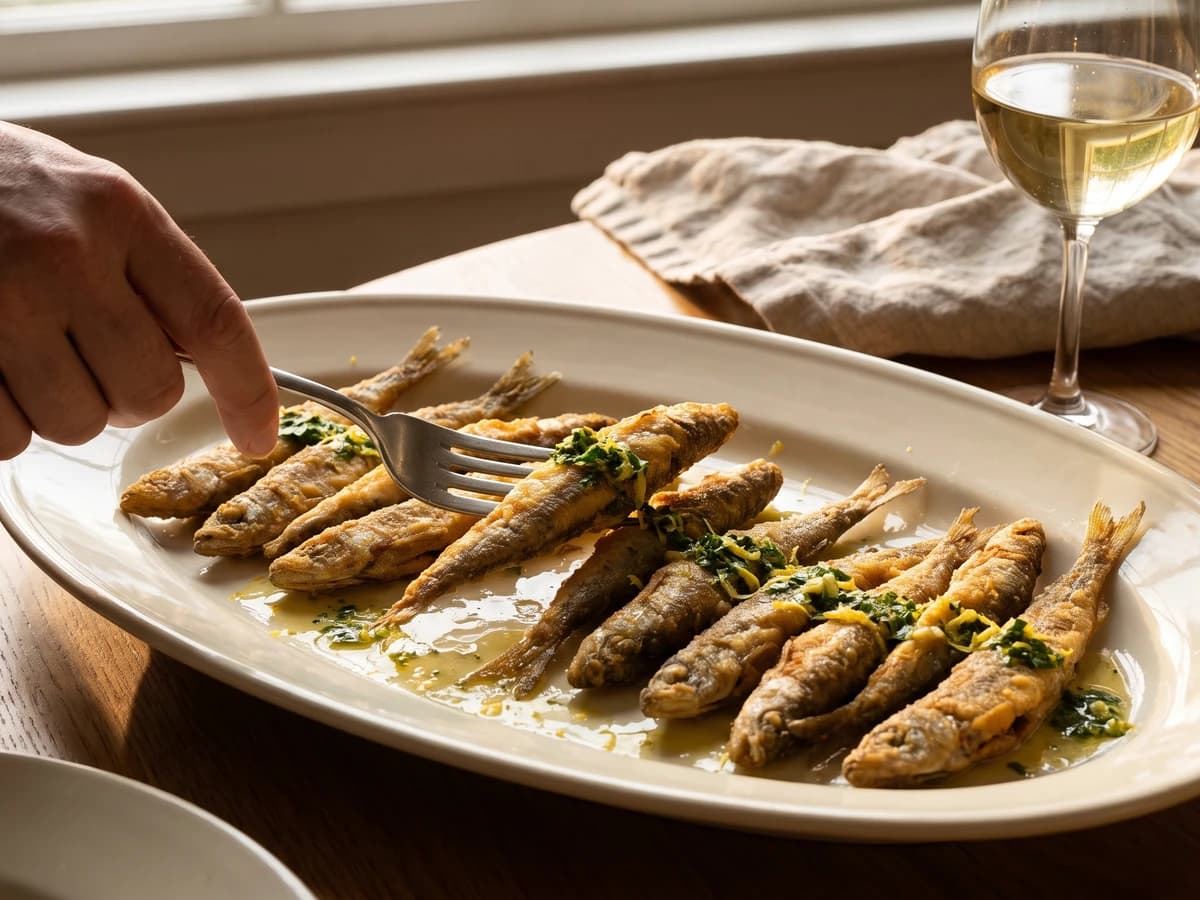
Éperlans à l’Anglaise turns small fish into a lesson in disciplined coating: boned smelts under a close, crisp crumb, pan-fried in clarified butter and finished with bright, half-melted maître d’hôtel butter.

Chef Juliette
Tiny smelts, shallot, mushrooms, white wine, gratin sauce, and fine bread raspings meet a fierce oven, where the fish must turn tender in the same breath the buttered crust bronzes.