
Chef Juliette
John Dory (St. Pierre)
John Dory has the delicacy of sole and the firmness of turbot. A light flouring, a quick butter sauté, and nut-brown beurre noisette show exactly why looks never mattered.
A cooking platform built around craft, culture, and the stories behind what we eat.

Created by Chef Juliette
Based on No. 1869, Perdreau aux Choux, from Le Guide Culinaire (1907) by Auguste Escoffier
Two partridges do two jobs: the mature bird perfumes the cabbage, the young bird crowns it underdone, and a narrow ribbon of game-scented demi-glace binds the plate.
Perdreau aux Choux (young partridge with braised cabbage) teaches division of labor. The mature bird gives depth, the young bird gives tenderness, and the cabbage carries both. Know one thing before you touch a pan: the cabbage must be drained until it sheds no loose liquor, or the demi-glace thins into soup.
The grand-kitchen entry assumed a saucier on staff, game stock never off the fire, Braised Cabbage ready from another station, and spare hands to poële the young bird while someone built an ornamental Chartreuse. At home, one cocotte holds the cabbage, one small covered casserole handles the bird, and a saucepan reduces prepared demi-glace with game fumet, a concentrated game essence. One cook, one stove, one evening.
We keep the two-bird architecture because it is the dish. We leave out the optional Chartreuse mold because it is brigade scaffolding, handsome but flavorless work that makes the cabbage harder to drain. The home platter loses none of the intent: glossy cabbage underneath, burnished young partridge above, soft rectangles of lean bacon around it, and just enough mahogany sauce to join them.
The young bird must leave the oven just before final doneness so its covered rest finishes it gently, but that timing can be corrected. Watery cabbage cannot hide. Drain the cabbage hard before you dish it.
Perdreau aux Choux belongs to the Parisian cuisine bourgeoise, where game from the northern hunting country met braised cabbage and the sauce work of the classical kitchen. The French name is exact: perdreau means a young partridge, while the mature perdrix works unseen in the cabbage, and the formula uses both ages deliberately. Its optional vegetable-lined Chartreuse shows how a country hunting dish traveled to the grand kitchen without changing its essential pairing.
Quantity
1 bird (about 1½ lb / 680 g)
thoroughly thawed if frozen
Quantity
2 tablespoons (30 ml / 28 g)
Quantity
1 teaspoon (5 ml / 6 g)
Quantity
½ teaspoon (2.5 ml / 1 g)
Quantity
1 batch Braised Cabbage (No. 2100), about 5 cups (1.2 L / 900 g)
Quantity
1 cup (240 ml / 150 g)
cut into small rectangles
Quantity
1 bird (1¼ to 1½ lb / 570 to 680 g), cooked as Poëlings (No. 250)
kept just under final doneness
Quantity
¾ cup (180 ml / 190 g)
ready to use, not concentrated paste
Quantity
½ cup (120 ml / 120 g)
| Ingredient | Quantity |
|---|---|
| mature partridgethoroughly thawed if frozen | 1 bird (about 1½ lb / 680 g) |
| unsalted butter | 2 tablespoons (30 ml / 28 g) |
| fine sea salt | 1 teaspoon (5 ml / 6 g) |
| freshly ground black pepper | ½ teaspoon (2.5 ml / 1 g) |
| Braised Cabbage | 1 batch Braised Cabbage (No. 2100), about 5 cups (1.2 L / 900 g) |
| very lean unsmoked slab baconcut into small rectangles | 1 cup (240 ml / 150 g) |
| very tender young partridgekept just under final doneness | 1 bird (1¼ to 1½ lb / 570 to 680 g), cooked as Poëlings (No. 250) |
| prepared sauce demi-glaceready to use, not concentrated paste | ¾ cup (180 ml / 190 g) |
| unsalted game fumet | ½ cup (120 ml / 120 g) |
Pat the mature partridge completely dry and season it with the salt and pepper. Melt the butter in the cocotte over medium-high heat, wait until its foam subsides, then brown the bird deeply on every side, including the back and the ends. Give it eight to ten minutes and real chestnut color. Pale skin contributes little to the cabbage, while a well-browned carcass carries roasted game flavor through the whole braise.
Prepare the Braised Cabbage (No. 2100) exactly as its own formula directs, using the home-scale batch listed here. When the cabbage is ready for its covered braise, bury the browned mature partridge in its center and distribute the bacon rectangles through it, in addition to the bacon required by the referenced preparation. Complete the braise as directed. The mature bird is seasoning, not centerpiece; slow contact with the cabbage is the part that must stay.
When the cabbage has about thirty-five minutes left, prepare the young partridge by Poëlings (No. 250), the butter-rich covered-roasting method, and follow that formula without adding water to the cooking vessel. Remove the bird when the thickest part of the breast reaches 160°F (71°C), then rest it covered for ten minutes and verify that it reaches 165°F (74°C) before serving. This is underdone only when it leaves the oven; the covered rest finishes it without sacrificing tenderness. If it remains below 165°F (74°C), ça se rattrape: return it to the covered casserole for three to five minutes, then check again.
Lift the mature bird from the finished Braised Cabbage (No. 2100) and reserve any useful meat for another meal; its work here is complete. Retrieve the bacon rectangles, then tip the cabbage into a large colander set over a bowl. Press gently with the back of a spoon and leave it for ten minutes. If liquid still collects when you press, ça se rattrape: spread the cabbage in a wide pan and turn it over medium heat until the loose moisture cooks away. Keep it succulent, but leave no puddle to dilute the sauce.
Combine the prepared sauce demi-glace, the classical half-glaze sauce, with the game fumet in a small saucepan. Simmer gently until reduced to about ¾ cup (180 ml) and glossy enough to nap the back of a spoon. If it tightens too far, loosen it with another spoonful of fumet; if it runs like broth, reduce it a little longer. Taste before adding salt, since prepared demi-glace can be assertive.
Warm an oval platter and arrange the drained cabbage in a low, compact mound. Set the rested young partridge breast-up on top and surround it with the bacon rectangles. Spoon a narrow thread of the game-scented demi-glace around the cabbage, not over the burnished skin. Present the bird whole, then carve it into two breast portions and two leg portions at the table. Give each plate plenty of cabbage and a spoonful of sauce. À table!
1 serving (about 500g)
Culinary guides, cultural storytelling, and the editorial depth that makes cooking meaningful.
Discover Culinary ExplorerChef Juliette
John Dory has the delicacy of sole and the firmness of turbot. A light flouring, a quick butter sauté, and nut-brown beurre noisette show exactly why looks never mattered.

Chef Juliette
Fresh haddock proves its delicacy in the meunière pan: a fine flour crust, moist pearly flakes, and beurre noisette sharpened with lemon and parsley, ready from one skillet in half an hour.
Chef Juliette
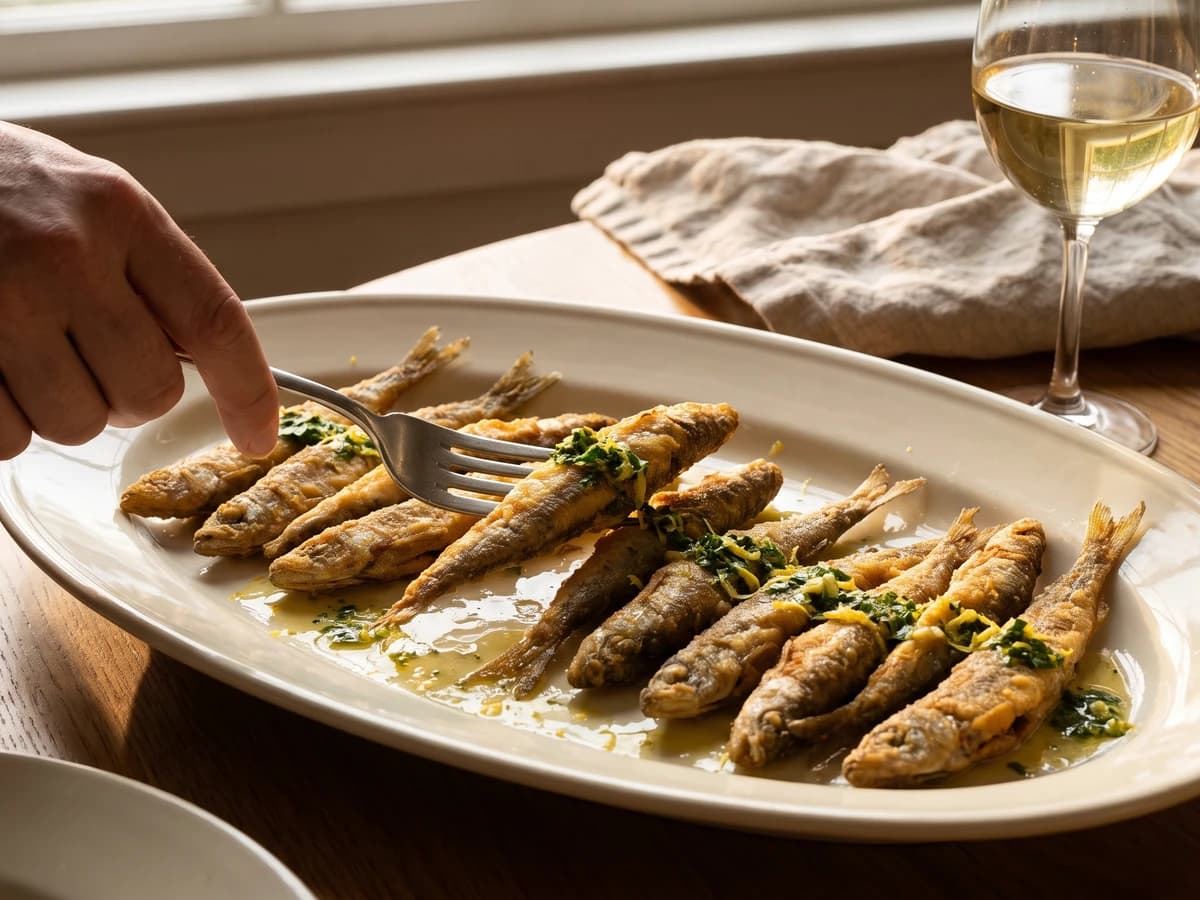
Éperlans à l’Anglaise turns small fish into a lesson in disciplined coating: boned smelts under a close, crisp crumb, pan-fried in clarified butter and finished with bright, half-melted maître d’hôtel butter.

Chef Juliette
Tiny smelts, shallot, mushrooms, white wine, gratin sauce, and fine bread raspings meet a fierce oven, where the fish must turn tender in the same breath the buttered crust bronzes.