
Chef Juliette
John Dory (St. Pierre)
John Dory has the delicacy of sole and the firmness of turbot. A light flouring, a quick butter sauté, and nut-brown beurre noisette show exactly why looks never mattered.
A cooking platform built around craft, culture, and the stories behind what we eat.

Created by Chef Juliette
Based on No. 1868, Perdreau Lady Clifford, from Le Guide Culinaire (1907) by Auguste Escoffier
Butter-basted partridge turns bronze before raw truffle, burnt Cognac, and meat glaze enter for the final quarter, preserving their perfume while warm Sauce Soubise waits in its own boat.
Perdreau Lady Clifford (partridge with truffle, burnt brandy, and Sauce Soubise, an onion purée sauce) teaches one clean principle: perfume enters last. Raw truffle and burnt brandy can survive a little heat, but they cannot survive neglect. Put them in early and you buy perfume only to boil it away. Before touching a pan, know this one true thing: brown and nearly cook the birds first, then give the truffle and brandy only the final quarter.
The original recipe assumed a saucier keeping Sauce Soubise ready, a stock never off the fire to furnish glace de viande, and enough hands to time garnish and bird together. It called for no salamander; the saucepan is the whole stage. At home, make the finished Sauce Soubise ahead, use a sound prepared meat glaze, and warm the sauce while the birds rest. The brigade's simultaneous service is scaffolding and can go. Four small partridges preserve the entry's proportions for four diners, one bird apiece. One cook, one stove, one evening.
The butter cookery, two ounces of raw truffle per bird, burnt brandy and meat glaze added three-quarters of the way through, and Sauce Soubise served apart are the dish itself. Those stay. The decisive moment comes when the measured brandy meets the hot pan: keep the bottle away, ignite calmly, then finish the birds before the truffle loses its haunting woodland scent.
Perdreau Lady Clifford belongs to the Parisian grand-kitchen repertory of named game-bird preparations, while partridge itself came in from hunting tables across many French regions. Lady Clifford is an eponymous title, not a regional one, and the canon preserves the method more clearly than the identity behind the name. Its distinction lies in sequence: raw truffle and burnt brandy enter only for the final quarter, while Sauce Soubise remains separate so its sweet onion softness does not bury the bird's buttered glaze.
Quantity
4 (12 to 14 oz / 340 to 400 g each)
brought to cool room temperature and thoroughly dried
Quantity
1/2 cup (120 ml / 113 g)
divided
Quantity
2 teaspoons (10 ml / 12 g)
Quantity
1 teaspoon (5 ml / 2 g)
freshly ground
Quantity
about 2 cups loosely packed (475 ml / 225 g), 2 oz per bird
cut into very fine slices
Quantity
1/2 cup (120 ml / 114 g), 2 tablespoons per bird
Quantity
1/4 cup (60 ml / 70 g), 1 tablespoon per bird
melted
Quantity
2 cups (475 ml / 500 g)
served separately
Quantity
2 tablespoons (30 ml / 30 g)
| Ingredient | Quantity |
|---|---|
| young oven-ready partridgesbrought to cool room temperature and thoroughly dried | 4 (12 to 14 oz / 340 to 400 g each) |
| unsalted butterdivided | 1/2 cup (120 ml / 113 g) |
| fine sea salt | 2 teaspoons (10 ml / 12 g) |
| black pepperfreshly ground | 1 teaspoon (5 ml / 2 g) |
| fresh raw black trufflecut into very fine slices | about 2 cups loosely packed (475 ml / 225 g), 2 oz per bird |
| French brandy, preferably Cognac | 1/2 cup (120 ml / 114 g), 2 tablespoons per bird |
| glace de viande (clear melted meat glaze)melted | 1/4 cup (60 ml / 70 g), 1 tablespoon per bird |
| finished Sauce Soubiseserved separately | 2 cups (475 ml / 500 g) |
| cold water (optional) | 2 tablespoons (30 ml / 30 g) |
Remove the partridges from the cold about thirty minutes before cooking. Pat every surface and the cavities dry, season inside and out with the salt and pepper, then tie the legs neatly against the bodies. Measure the brandy into a heatproof cup and cap the bottle before it comes near the stove. Melt the glace de viande gently if it is firm. Slice the truffles paper-thin only now and keep them covered; every exposed minute costs fragrance.
Melt 6 tablespoons (90 ml / 85 g) of the butter in a wide, heavy lidded sauté pan over medium heat. When the foam subsides, add the partridges breast-side down and brown them methodically on every side, about eight to ten minutes in all. Work in two batches if the birds cannot sit without touching, then return them all to the pan. You want an even hazelnut bronze, not black milk solids. If the butter scorches, lift out the birds, wipe the pan clean, add the reserved butter, and continue. Ça se rattrape.
Lower the heat, cover the pan with the lid slightly askew, and cook the birds for ten to twelve minutes. Turn them every few minutes and spoon the foaming butter over the breasts and legs. Three-quarters cooked means the flesh has firmed while the juices remain rosy, with an instant-read thermometer registering about 140 to 145°F (60 to 63°C) in the thickest part of a thigh. Do not push farther yet. The final ingredients still need their minutes.
Scatter the fine raw truffle slices around the birds, keeping them in the butter rather than piled on the breasts. Take the pan off the burner and switch off the overhead fan. Pour in the measured brandy from the cup, stand back, and touch a long match or wand lighter to the vapour at the pan's edge. Let the flame subside on its own, then swirl in the glace de viande. If the brandy does not ignite, do not keep trying: return the pan to low heat and simmer for about ninety seconds, until its sharp alcoholic smell softens. The burnt-brandy effect is preserved, and the dish is safe.
Cover again and cook gently for another six to eight minutes, turning and basting twice, until the thighs reach 165°F (74°C). Transfer the birds and truffle slices to a warm platter and rest them for eight minutes. Simmer the pan juices briefly until they form a light, glossy glaze, then remove the pan from the heat. If the glaze looks oily rather than united, whisk in the cold water one teaspoon at a time until the butter and meat glaze come together. Spoon the truffles and glaze over and around the birds.
While the partridges rest, warm the finished Sauce Soubise in a small saucepan over low heat, stirring often so the onion purée does not catch. If it has tightened in the cold, loosen it with a teaspoon or two of water until it falls softly from the spoon. Transfer it to a warmed sauceboat. Do not pour it over the partridges; serving it apart preserves the contrast between the ivory onion sauce, the bronzed skin, and the truffle-dark glaze.
Give each diner one partridge, with its share of truffle slices and butter glaze. Pass the Sauce Soubise separately so everyone can spoon it beside the bird rather than over the crispest skin. The truffle is at its fullest now, and waiting gains nothing. À table!
1 serving (about 400g)
Culinary guides, cultural storytelling, and the editorial depth that makes cooking meaningful.
Discover Culinary ExplorerChef Juliette
John Dory has the delicacy of sole and the firmness of turbot. A light flouring, a quick butter sauté, and nut-brown beurre noisette show exactly why looks never mattered.

Chef Juliette
Fresh haddock proves its delicacy in the meunière pan: a fine flour crust, moist pearly flakes, and beurre noisette sharpened with lemon and parsley, ready from one skillet in half an hour.
Chef Juliette
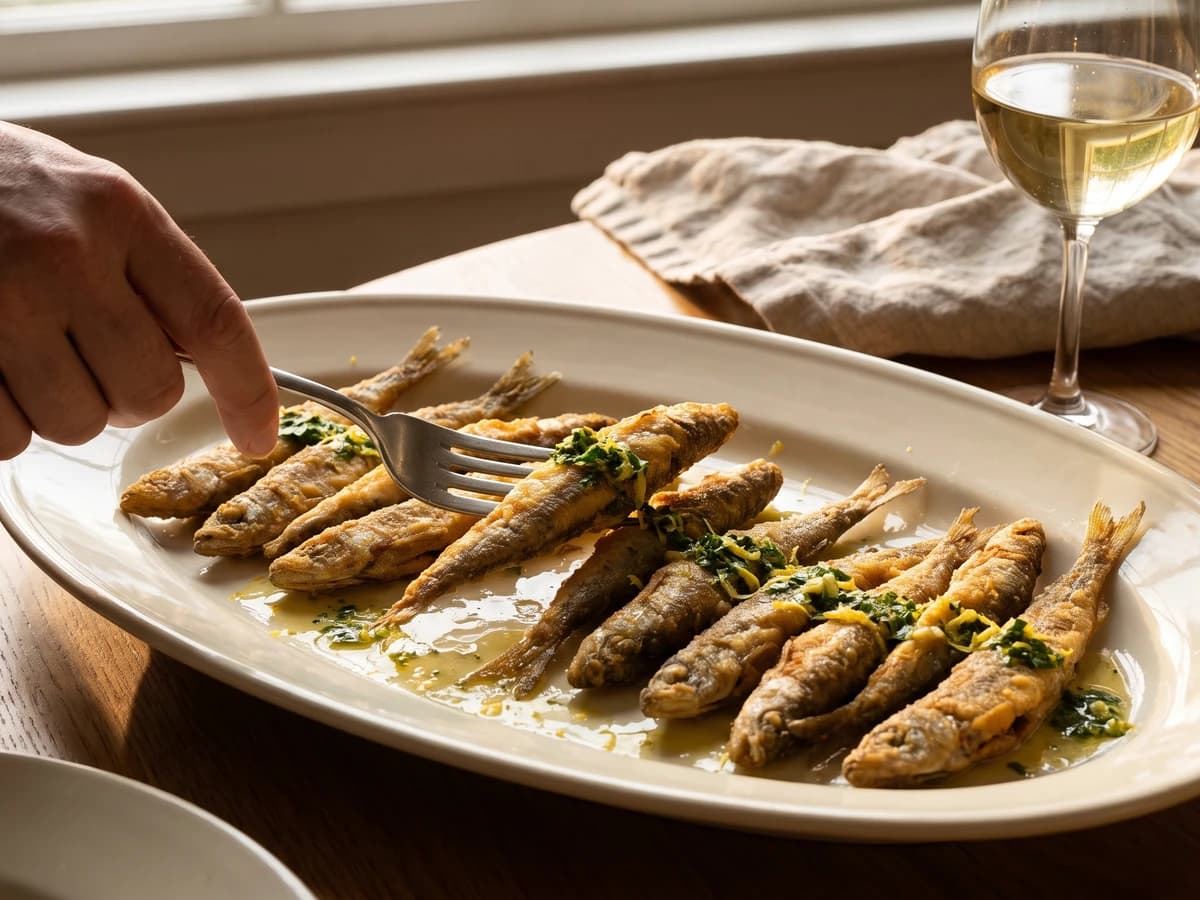
Éperlans à l’Anglaise turns small fish into a lesson in disciplined coating: boned smelts under a close, crisp crumb, pan-fried in clarified butter and finished with bright, half-melted maître d’hôtel butter.

Chef Juliette
Tiny smelts, shallot, mushrooms, white wine, gratin sauce, and fine bread raspings meet a fierce oven, where the fish must turn tender in the same breath the buttered crust bronzes.