
Chef Juliette
John Dory (St. Pierre)
John Dory has the delicacy of sole and the firmness of turbot. A light flouring, a quick butter sauté, and nut-brown beurre noisette show exactly why looks never mattered.
A cooking platform built around craft, culture, and the stories behind what we eat.

Created by Chef Juliette
Based on No. 1846, Suprêmes, Côtelettes et Filets de Faisan, from Le Guide Culinaire (1907) by Auguste Escoffier
The decisive rule for pheasant breast: poêle the birds just underdone, keep the meat on the bone until the plates are ready, then raise the suprêmes and serve immediately with glossy jus.
Suprêmes, Côtelettes et Filets de Faisan (pheasant breasts, cutlets, and fillets) teaches one true thing: lean pheasant breast must remain protected by the whole bird until the moment it is served. Lift it raw and poach it as one might a fowl suprême, and the meat can dry during the few seconds service takes to gather itself. Poêle the bird just underdone, let the rest finish the cooking, then raise the suprêmes when the sauce and plates are waiting.
The original service assumed a saucier attending the cooking liquor, brown stock never off the fire, and a carver ready at the pass. A salamander stood nearby for other preparations, but this natural service has no need of it. The home equivalents are honest ones: a heavy lidded casserole for the poêling, an instant-read thermometer for the old cook's practiced touch, and one small saucepan for the jus. Two modest pheasants give four generous portions. One cook, one stove, one evening.
Separate holding pans and another pair of hands were brigade scaffolding, so they go. The butter-rich poêling and the last-minute raising of the breasts are the dish, so they stay. Have every plate warm and every guest seated before the knife touches the first suprême.
Suprêmes, côtelettes et filets de faisan belong to the classical Paris game table, where pheasants from the autumn shoot entered the broad family of garnishes already used for fowl but demanded gentler handling. The crucial correction is technical rather than ornamental: pheasant breasts are not lifted raw and poached like chicken, since their lean flesh dries rapidly once separated from the carcass. The method passes neatly from the grand kitchen to the home table because its governing rule needs no brigade, only a whole bird, careful poêling, and carving at the last moment.
Quantity
2 birds, 2¼ to 2½ pounds (1 to 1.15 kg) each, for Poëlings (No. 250)
Quantity
1 cup (240 ml / about 240 g) from Poëlings (No. 250)
strained and degreased
Quantity
as needed
Quantity
as needed
Warm an oval platter and four dinner plates in a 150°F (65°C) oven. Set out a sharp flexible knife, a board with a groove, and a small saucepan before the birds finish. The Poëlings (No. 250) must meet a table ready to receive it, because guests may wait for pheasant, but carved pheasant must never wait for guests.
Cook the pheasants according to Poëlings (No. 250), keeping the birds whole and following that preparation through its butter-rich cooking. Begin checking early. Remove the birds when the thickest part of each breast registers 158 to 160°F (70 to 71°C) and the inner thigh has reached at least 165°F (74°C); carryover during the rest should bring the breasts to 165°F (74°C). If a thigh lags, shield the breasts loosely with foil and continue cooking in two-minute intervals. If a breast reaches 165°F (74°C) sooner than planned, take the bird out at once and do not return it to the oven. Hot jus and warm plates will serve it more kindly than further cooking.
Transfer the pheasants to the warmed platter and cover them loosely for 8 to 12 minutes, leaving every breast attached. Check that the breast has reached 165°F (74°C) before carving. If dinner is delayed, keep the birds whole rather than parking carved meat in a warm pan; a loose cover and an extra five minutes are tolerable, while a sliced suprême dries almost at once.
While the birds rest, place the finished cooking liquor from Poëlings (No. 250) in the small saucepan and bring it to a bare simmer. Skim away any remaining surface fat, then reduce only until the jus tastes concentrated and lightly coats a spoon. If it remains watery, give it another minute; if it becomes salty or sticky, loosen it a tablespoon at a time with hot water. Ça se rattrape. Keep the jus hot without boiling it hard.
Place one pheasant breast-side up. Cut down one side of the breastbone, then turn the knife nearly flat and follow the rib cage with short, clean strokes, lifting the breast in one piece. Repeat on the other side and with the second bird. If the meat clings, stop and move the blade closer to the ribs rather than pulling; a small tear disappears beneath the jus, but tugging squeezes out the juices. Taste a drop of the carving juices and add them to the saucepan if they are clear and well flavored.
For suprêmes, leave each breast whole. For côtelettes, keep the first wing bone attached as you raise the breast, scrape the bone clean, and trim the flesh into a neat oval without pounding it. For filets, remove the wing bone and divide the breast along its natural length. These are forms for service, not invitations to cook the meat again.
Season the carved pheasant lightly with salt and white pepper only if needed, then place one portion on each warmed plate. Spoon the glossy jus over and around the meat, enough to keep it succulent without drowning its browned surface. Carry the plates directly to the table. No holding pan, no second heating, no delay. À table!
1 serving (about 300g)
Culinary guides, cultural storytelling, and the editorial depth that makes cooking meaningful.
Discover Culinary ExplorerChef Juliette
John Dory has the delicacy of sole and the firmness of turbot. A light flouring, a quick butter sauté, and nut-brown beurre noisette show exactly why looks never mattered.

Chef Juliette
Fresh haddock proves its delicacy in the meunière pan: a fine flour crust, moist pearly flakes, and beurre noisette sharpened with lemon and parsley, ready from one skillet in half an hour.
Chef Juliette
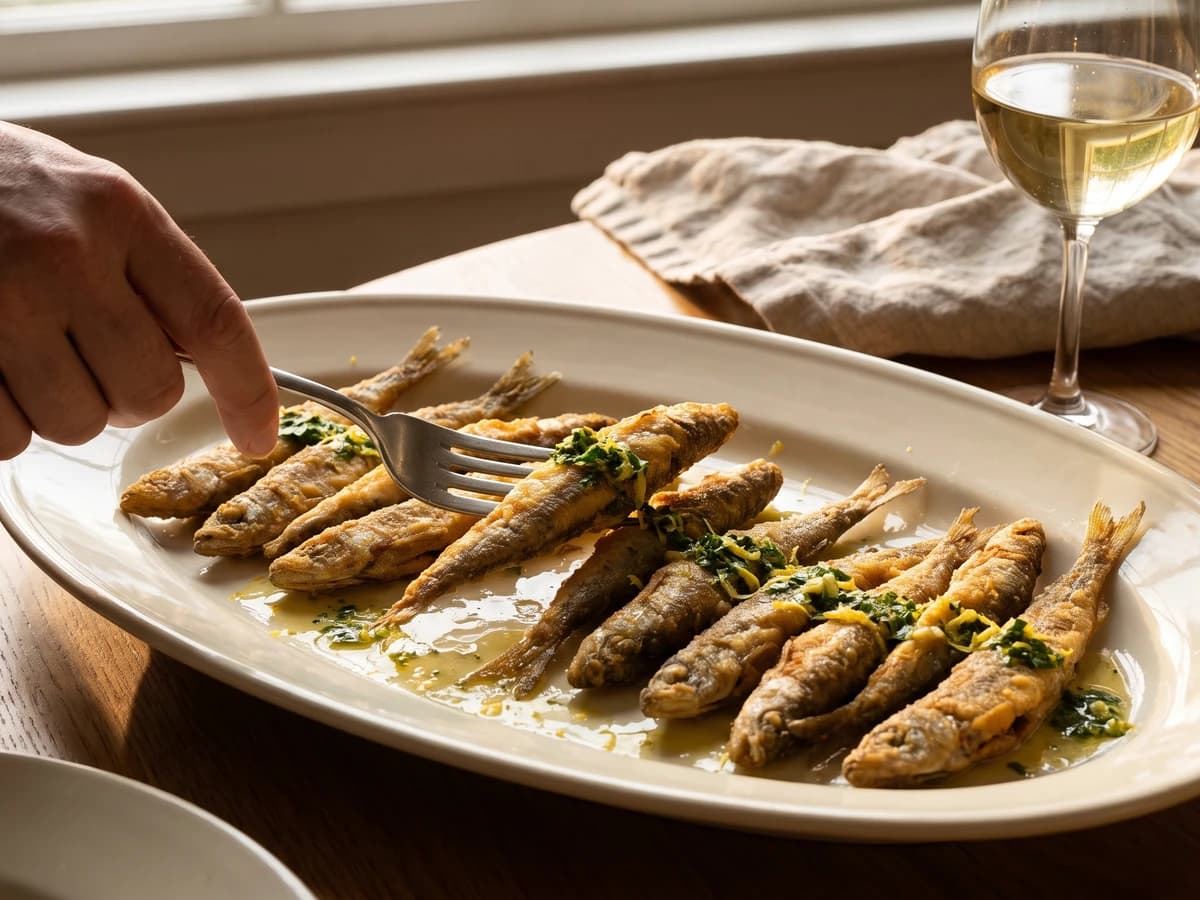
Éperlans à l’Anglaise turns small fish into a lesson in disciplined coating: boned smelts under a close, crisp crumb, pan-fried in clarified butter and finished with bright, half-melted maître d’hôtel butter.

Chef Juliette
Tiny smelts, shallot, mushrooms, white wine, gratin sauce, and fine bread raspings meet a fierce oven, where the fish must turn tender in the same breath the buttered crust bronzes.