
Chef Juliette
John Dory (St. Pierre)
John Dory has the delicacy of sole and the firmness of turbot. A light flouring, a quick butter sauté, and nut-brown beurre noisette show exactly why looks never mattered.
A cooking platform built around craft, culture, and the stories behind what we eat.
Created by Chef Juliette
Based on No. 1845, Faisan Souvaroff, from Le Guide Culinaire (1907) by Auguste Escoffier
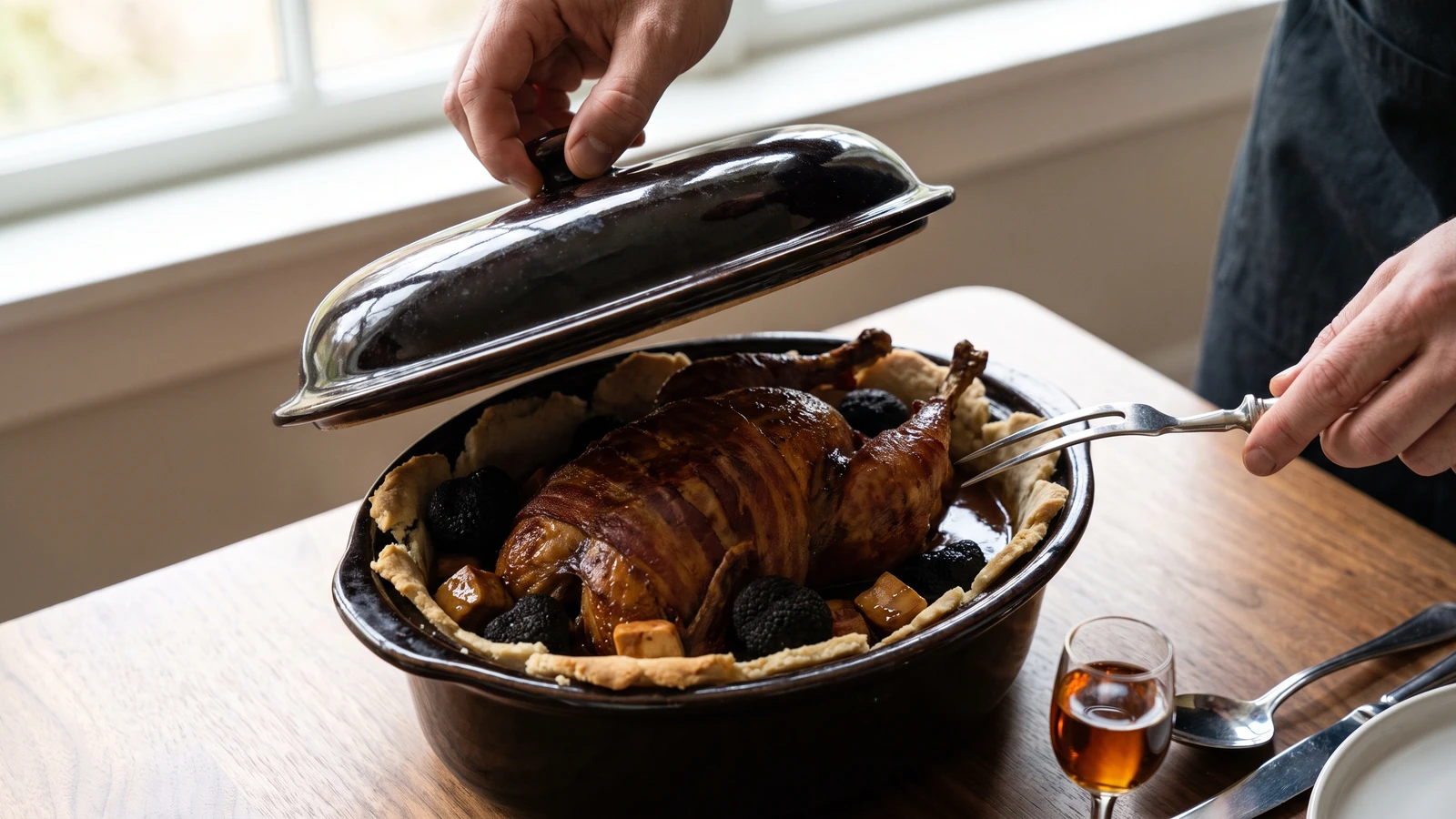
Butter-poêlé pheasant, a lavish foie gras stuffing, six whole truffles, and Madeira finish beneath a flour-sealed terrine lid, where the captured juices become the sauce and the table gets the first scent.
Faisan Souvaroff (pheasant with foie gras, truffles, and Madeira sealed in a terrine) teaches the discipline of captured aroma. The bird is poêlé (butter-roasted) only two-thirds of the way, then enclosed with its richest companions so the final cooking happens in their shared perfume. Stop the first cooking early. That is the one true thing to understand before the pheasant meets the pan.
The classical formula assumed a saucier on staff, a stock never off the fire, and a salamander waiting, though this dish asks no finishing blast from it. Your honest equivalents are prepared light meat glaze, prepared game gravy, and a heavy lidded terrine closed with pâte à luter, a plain flour-and-water sealing dough. The separate stockpots are brigade scaffolding and can go; the two-stage cooking and hermetic seal are the dish itself and must stay. The formula is already built around one pheasant, enough for four, so its six truffles and half-pound of foie gras remain. This is extravagance by intent, not excess from careless scaling.
When the flour seal is cracked at the table, the bacon is burnished, the Madeira juices gleam around the bird, and the truffles have given their scent to everything beneath the lid. One cook, one stove, one evening. Press the pâte à luter firmly around every inch of the rim, because an absolute seal decides the dish.
Faisan Souvaroff belongs to the grand Parisian table, where roast game, foie gras, black truffles, and Madeira were assembled into named preparations for formal service. Souvaroff is the French form of Suvorov, and the title follows the Paris kitchen custom of naming elaborate dishes for celebrated foreign figures; the method is French, not a Russian regional recipe. Its flour-luted lid is more than ceremony: it traps the pheasant's juices and the volatile perfume of the truffles until the terrine is opened at the table.
Quantity
1 bird, 2 3/4 to 3 1/4 lb (1.25 to 1.5 kg)
giblets removed
Quantity
6 fair-sized truffles, about 6 oz (170 g)
gently brushed clean
Quantity
1 1/4 cups (225 g / 8 oz)
cut into 1-inch (2.5 cm) dice and kept very cold
Quantity
3/4 cup (180 ml / 180 g)
divided
Quantity
1/2 cup (120 ml / 130 g)
Quantity
1/4 cup (60 ml / 65 g)
Quantity
10 to 12 slices, about 8 oz (225 g)
Quantity
2 teaspoons (10 ml / 12 g)
Quantity
1 teaspoon (5 ml / 2 g)
Quantity
1 quantity Poëlings (No. 250), scaled for 1 pheasant
Quantity
all liquor produced by Poëlings (No. 250)
Quantity
1 cup (240 ml / 125 g)
for the pâte à luter
Quantity
1/4 cup (60 ml / 60 g), plus up to 1 tablespoon (15 ml / 15 g) if needed
for the pâte à luter
| Ingredient | Quantity |
|---|---|
| oven-ready pheasantgiblets removed | 1 bird, 2 3/4 to 3 1/4 lb (1.25 to 1.5 kg) |
| fresh black trufflesgently brushed clean | 6 fair-sized truffles, about 6 oz (170 g) |
| fresh foie grascut into 1-inch (2.5 cm) dice and kept very cold | 1 1/4 cups (225 g / 8 oz) |
| medium-dry Madeiradivided | 3/4 cup (180 ml / 180 g) |
| prepared light meat glaze | 1/2 cup (120 ml / 130 g) |
| prepared game gravy | 1/4 cup (60 ml / 65 g) |
| thin unsmoked streaky bacon | 10 to 12 slices, about 8 oz (225 g) |
| fine sea salt | 2 teaspoons (10 ml / 12 g) |
| freshly ground black pepper | 1 teaspoon (5 ml / 2 g) |
| referenced poëling preparation | 1 quantity Poëlings (No. 250), scaled for 1 pheasant |
| reserved poëling liquor | all liquor produced by Poëlings (No. 250) |
| plain flourfor the pâte à luter | 1 cup (240 ml / 125 g) |
| cool waterfor the pâte à luter | 1/4 cup (60 ml / 60 g), plus up to 1 tablespoon (15 ml / 15 g) if needed |
Set an oven rack in the middle and heat the oven to 350°F (180°C). Pat the pheasant completely dry, then season it inside and out with the salt and pepper. Mix the flour with the 1/4 cup water until a firm, smooth pâte à luter forms, adding the extra water only if dry crumbs remain. Knead it briefly, cover it, and leave it supple at room temperature. It should roll into a rope without sticking or cracking.
Combine 1/2 cup (120 ml) of the Madeira with the light meat glaze in the smallest saucepan that will hold the truffles closely. Bring it to a gentle simmer, add the truffles, and turn them through the liquor for exactly 5 minutes. Lift the truffles into the terrine in which the pheasant will finish. Keep the cooking liquor over low heat; it should coat a spoon lightly. If it is watery, reduce it briefly. If it has tightened into paste, loosen it with a spoonful of Madeira.
Lower the truffle liquor to the barest tremble and add the cold foie gras dice. Turn them gently for 45 to 60 seconds, just until their surfaces firm while their centers remain cool, then lift them immediately to a plate. If their corners begin to soften and render, stop the cooking and chill the dice for 5 minutes. Ça se rattrape: leave the released foie fat in the liquor, where it enriches the sauce instead of disappearing down the drain.
Spoon the foie gras and enough of its clinging truffle liquor to coat it into the pheasant cavity. Do not ram it tight; a loose filling heats more evenly and leaves room for the juices to circulate. Close the opening with a poultry skewer, truss the bird compactly, and wrap the breast and legs with overlapping bacon slices. Tie the bacon in place with kitchen twine.
Cook the wrapped pheasant according to Poëlings (No. 250), stopping at two-thirds doneness rather than completing the preparation. Begin checking after about 25 minutes: the bacon should be lightly bronzed, the breast should register 125 to 130°F (52 to 54°C), and the thigh about 135 to 140°F (57 to 60°C). Reserve every spoonful of poëling liquor. If the breast has already passed 140°F (60°C), assemble the terrine at once and begin checking the sealed finish after 8 minutes; the bird is not lost, but it has no more time to spare.
Set the hot pheasant over the truffles in the terrine. Pour in any remaining truffle and foie liquor, all the reserved poëling liquor from Poëlings (No. 250), the remaining 1/4 cup (60 ml) Madeira, and the game gravy. Insert a leave-in thermometer probe into the center of the foie stuffing. Roll the pâte à luter into a rope, lay it around the terrine rim, fit the lid, and press the dough firmly over the entire seam, including the thermometer cable. The seal must be continuous. If it splits before entering the oven, patch it with a dab of wet dough and press again.
Bake the sealed terrine for about 15 minutes, or until the center of the stuffing reaches 165°F (74°C). If it needs longer, leave the lute intact and continue in 5-minute intervals. Rest the terrine for 8 minutes, still sealed, then carry it to the table as it stands. Crack the pâte à luter, lift the lid, and remove the twine and skewer. Carve the pheasant, giving each guest foie gras, truffle, and a generous spoonful of the glossy Madeira juices. If excess butter pools on top, spoon off only the heavy slick and leave the sauce's proper sheen. À table!
1 serving (about 400g)
Culinary guides, cultural storytelling, and the editorial depth that makes cooking meaningful.
Discover Culinary ExplorerChef Juliette
John Dory has the delicacy of sole and the firmness of turbot. A light flouring, a quick butter sauté, and nut-brown beurre noisette show exactly why looks never mattered.

Chef Juliette
Fresh haddock proves its delicacy in the meunière pan: a fine flour crust, moist pearly flakes, and beurre noisette sharpened with lemon and parsley, ready from one skillet in half an hour.
Chef Juliette
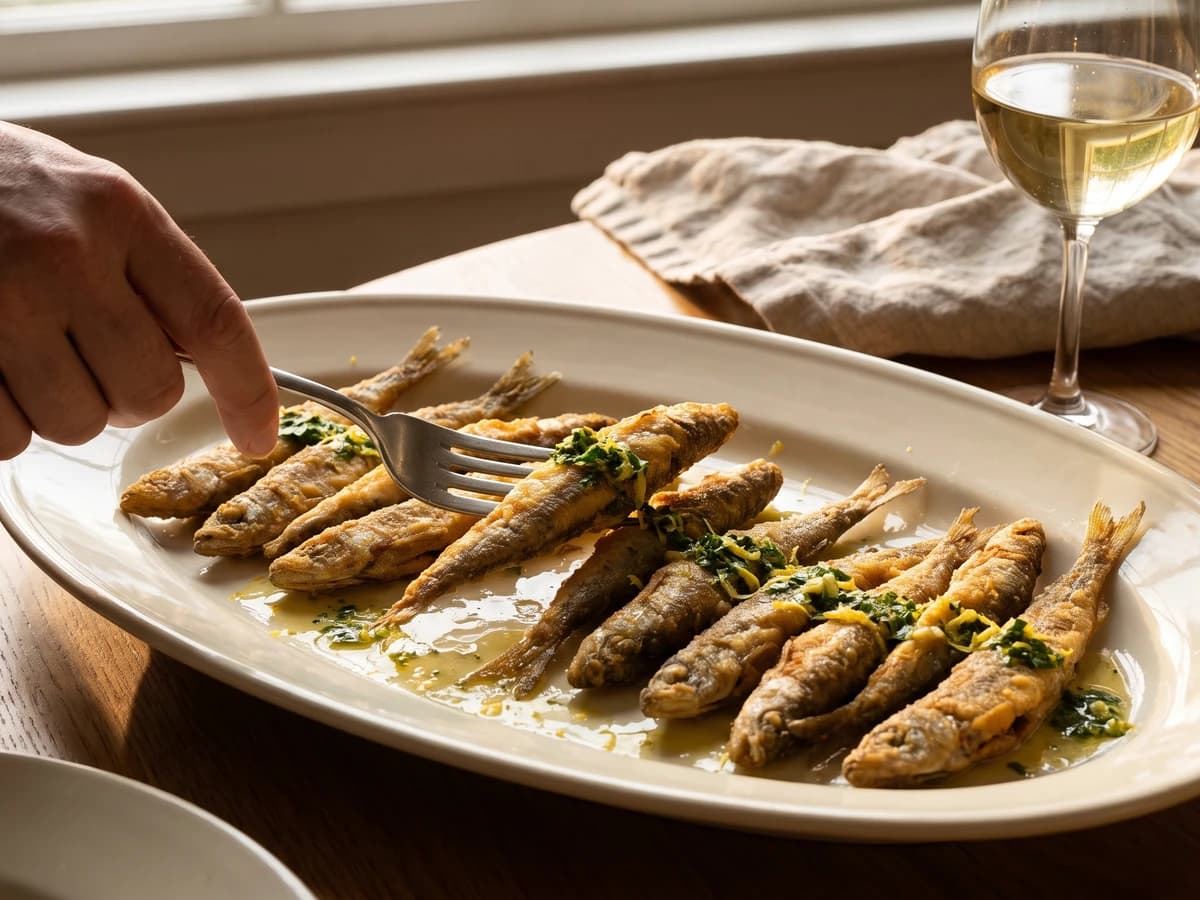
Éperlans à l’Anglaise turns small fish into a lesson in disciplined coating: boned smelts under a close, crisp crumb, pan-fried in clarified butter and finished with bright, half-melted maître d’hôtel butter.

Chef Juliette
Tiny smelts, shallot, mushrooms, white wine, gratin sauce, and fine bread raspings meet a fierce oven, where the fish must turn tender in the same breath the buttered crust bronzes.