
Chef Juliette
John Dory (St. Pierre)
John Dory has the delicacy of sole and the firmness of turbot. A light flouring, a quick butter sauté, and nut-brown beurre noisette show exactly why looks never mattered.
A cooking platform built around craft, culture, and the stories behind what we eat.
Created by Chef Juliette
Based on No. 1844, Faisan à la Sainte-Alliance, from Le Guide Culinaire (1907) by Auguste Escoffier
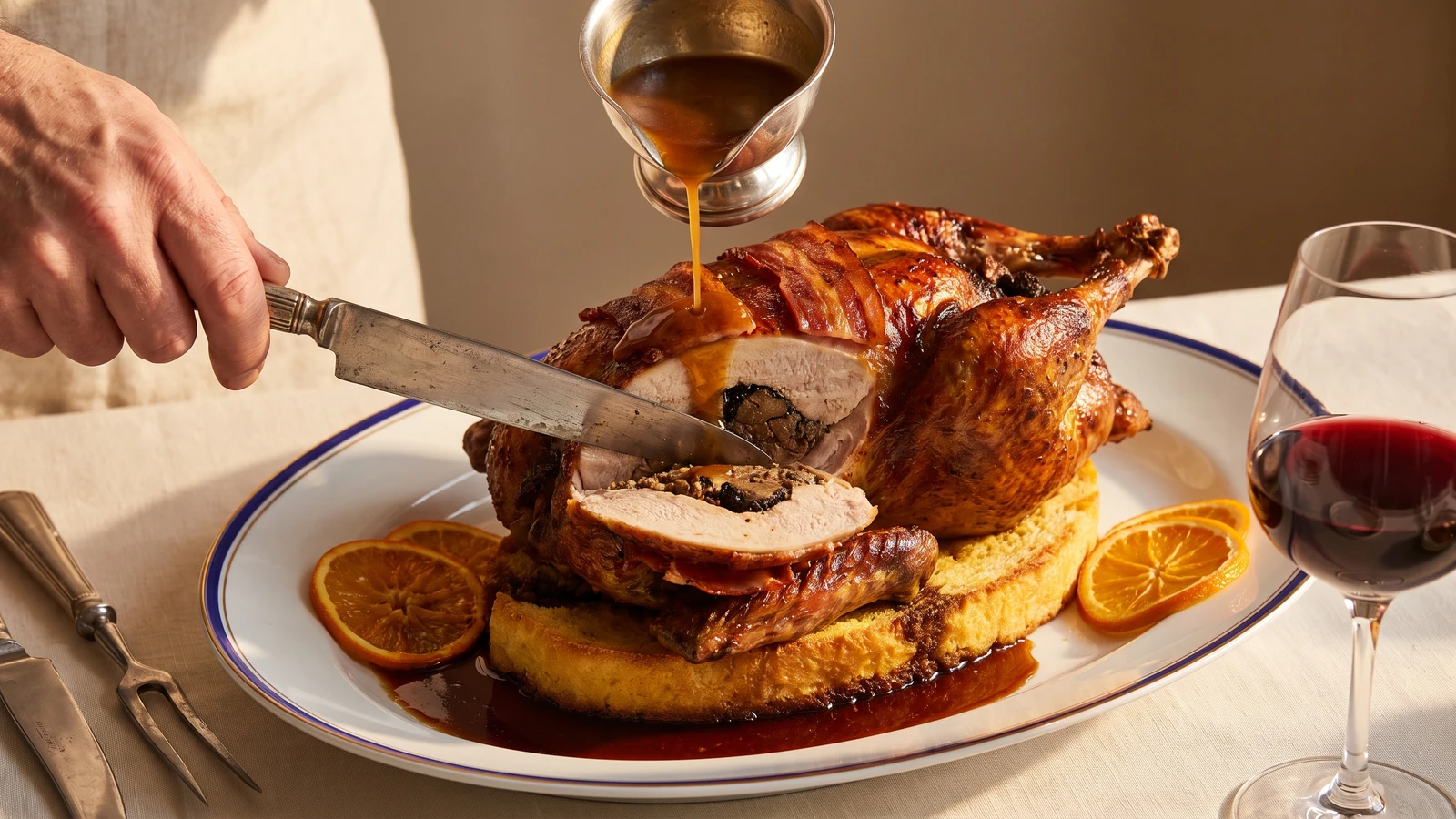
The croûton is the dish: woodcock offal, fatback, anchovy, and truffle beneath a barded pheasant, drinking every roasting drop before bitter orange cuts through the richness.
Faisan à la Sainte-Alliance (pheasant with woodcock, truffle, and its juice-soaked croûton) teaches one uncompromising thing: the croûton is the dish. The pheasant may be handsome, but the butter-fried bread, spread with pounded woodcock livers and clean edible intestines, then placed beneath the bird to drink every drop, is the bite that explains the whole construction.
The grand kitchen assumed a game butcher to bone the woodcocks, a turning spit, a cool larder, and a saucier with stock never off the fire. At home, have the dealer separate the tiny birds, roast the pheasant high on a V-rack, chill it in the refrigerator, and reduce the jus in a small saucepan while the bird finishes. Boning for appearance and tending the spit are brigade scaffolding, so they can go; the one-quarter weights of marrow and fresh fatback, the six ounces of truffle, the 24-hour rest, and the dripping croûton stay. The active work fits one cook and one stove, but the truffle rest begins the day before.
When the pheasant is two-thirds cooked, spread the croûton and put it directly under the bird. Too early, the paste darkens before the filling is safe; too late, the bread misses the juices. Watch that handoff. It is the one step that matters most before you touch the pan.
Faisan à la Sainte-Alliance belongs to the Parisian grand-kitchen repertoire rather than a regional farmhouse table, and its title borrows diplomatic language for an alliance of pheasant, woodcock, truffle, fatback, and bitter orange. Its ancestry is practical game cookery: birds roasted over bread so no juice was lost, while the prized woodcock trail, the edible liver and intestines, was pounded into the croûton rather than discarded. As the preparation traveled from turning spit to domestic oven, the raised roasting rack replaced the open fire, but the croûton remained its measure of fidelity.
Quantity
1 bird (3½ to 4 lb / 1.6 to 1.8 kg)
giblets removed
Quantity
2 birds (about 1 to 1¼ lb / 450 to 550 g total)
boned to yield about 1⅓ cups (320 ml / 200 g) meat, with livers and dealer-cleaned edible intestines reserved separately
Quantity
3 tablespoons (45 ml / 50 g), exactly one-quarter the weight of the boned woodcock meat
poached and chilled
Quantity
⅓ cup (80 ml / 50 g), exactly one-quarter the weight of the boned woodcock meat
finely diced
Quantity
1 cup (240 ml / 170 g)
peeled and quartered
Quantity
1 tablespoon (15 ml / 14 g)
Quantity
1 tablespoon (15 ml / 4 g)
finely chopped
Quantity
2 teaspoons (10 ml / 12 g)
divided
Quantity
1 teaspoon (5 ml / 2 g)
divided
Quantity
12 thin slices (about 8 oz / 225 g)
Quantity
1 slab (about 10 by 5 by 1¼ inches / 25 by 13 by 3 cm, weighing 7 oz / 200 g)
crusts removed
Quantity
⅓ cup (80 ml / 75 g)
Quantity
about ¼ cup (60 ml / 40 g)
Quantity
¼ cup (60 ml / 40 g), equal in weight to the reserved woodcock offal
finely grated
Quantity
1 anchovy (about 2 teaspoons / 8 g)
filleted and thoroughly rinsed
Quantity
2 tablespoons (30 ml / 28 g)
softened
Quantity
2 tablespoons (30 ml / 14 g)
finely grated
Quantity
1½ cups (360 ml / 360 g)
Quantity
2 oranges (about 12 oz / 340 g total)
thinly sliced
| Ingredient | Quantity |
|---|---|
| oven-ready pheasantgiblets removed | 1 bird (3½ to 4 lb / 1.6 to 1.8 kg) |
| legally sourced whole woodcocksboned to yield about 1⅓ cups (320 ml / 200 g) meat, with livers and dealer-cleaned edible intestines reserved separately | 2 birds (about 1 to 1¼ lb / 450 to 550 g total) |
| beef marrowpoached and chilled | 3 tablespoons (45 ml / 50 g), exactly one-quarter the weight of the boned woodcock meat |
| fresh unsmoked fatback for the stuffingfinely diced | ⅓ cup (80 ml / 50 g), exactly one-quarter the weight of the boned woodcock meat |
| fresh black truffles for the stuffingpeeled and quartered | 1 cup (240 ml / 170 g) |
| unsalted butter for the truffles | 1 tablespoon (15 ml / 14 g) |
| flat-leaf parsley and thyme leavesfinely chopped | 1 tablespoon (15 ml / 4 g) |
| fine sea saltdivided | 2 teaspoons (10 ml / 12 g) |
| freshly ground black pepperdivided | 1 teaspoon (5 ml / 2 g) |
| fresh unsmoked fatback for barding | 12 thin slices (about 8 oz / 225 g) |
| firm sandwich loafcrusts removed | 1 slab (about 10 by 5 by 1¼ inches / 25 by 13 by 3 cm, weighing 7 oz / 200 g) |
| clarified butter | ⅓ cup (80 ml / 75 g) |
| reserved woodcock livers and dealer-cleaned edible intestines | about ¼ cup (60 ml / 40 g) |
| fresh unsmoked fatback for the croûtonfinely grated | ¼ cup (60 ml / 40 g), equal in weight to the reserved woodcock offal |
| salt-cured anchovyfilleted and thoroughly rinsed | 1 anchovy (about 2 teaspoons / 8 g) |
| unsalted butter for the croûton pastesoftened | 2 tablespoons (30 ml / 28 g) |
| raw black truffle for the croûton pastefinely grated | 2 tablespoons (30 ml / 14 g) |
| unsalted brown poultry or game stock | 1½ cups (360 ml / 360 g) |
| bitter oranges, such as Seville orangesthinly sliced | 2 oranges (about 12 oz / 340 g total) |
Ask the game dealer to bone the woodcocks and pack the meat, livers, and cleaned edible intestines separately. This is brigade scaffolding, not the soul of the dish. If you must do it yourself, keep the birds very cold and scrape the flesh from the tiny bones in pieces; it will be chopped, so perfect boning is unnecessary. Use only intact, fresh offal certified fit for eating, with the gall, grit, and shot-damaged tissue removed. Weigh the meat, then weigh out one-quarter as much marrow and one-quarter as much fatback. If the marrow is raw, poach it at a bare simmer for 3 minutes, chill it immediately, and dry it well.
Melt 1 tablespoon butter over gentle heat, add the 6 ounces of quartered truffles, and turn them for 2 minutes without allowing them to brown. Cool completely. Chop the woodcock meat with the chilled marrow and diced fatback until you have a cohesive, coarse hash, not a smooth paste. Mix in the herbs, half the salt, half the pepper, and the cooled truffles with their butter. Fry a teaspoonful and taste it; correct the seasoning now, because once it is inside the pheasant, the argument is over.
Dry the pheasant inside and out, then season it with the remaining salt and pepper. Pack the woodcock stuffing into the cavity without crushing it tight, close the opening with a skewer or kitchen twine, and truss the legs against the body. Barder means to wrap a lean bird in fat: overlap the thin fatback slices across the breast and thighs, then tie them securely. Cover and refrigerate at 40°F / 4°C or colder for 24 hours. That rest concentrates the truffle through the bird, and it is part of the dish, not idle ceremony.
Take the pheasant from the refrigerator 30 minutes before roasting. Heat the oven to 425°F / 220°C with a rack in the lower-middle position. Set a high V-rack, with at least 2 inches / 5 cm of clearance beneath it, inside a shallow roasting pan. Place the bird breast-side up on the rack. The raised rack is the honest home equivalent of the spit: the bird roasts in open heat, and later its juices can fall directly onto the croûton.
Roast the pheasant at 425°F / 220°C for 15 minutes, then reduce the oven to 375°F / 190°C and continue for 35 minutes. Turn the pan once if your oven browns unevenly, but do not baste; the barde is already doing that work. At this point the bird will be about two-thirds through its cooking, which is precisely when the croûton must go underneath.
While the pheasant roasts, heat the clarified butter in a 12-inch / 30 cm skillet. Fry the bread slab until deep gold and crisp on both faces, about 3 minutes per side, then drain it on a rack. Process or pound the reserved woodcock livers and cleaned intestines with an equal weight of grated fatback, the rinsed anchovy, softened butter, and raw grated truffle until perfectly smooth. If the mixture turns greasy because it became warm, stop and chill it for 10 minutes, then process again. Ça se rattrape. Spread the paste evenly over one face of the fried croûton, carrying it nearly to the edges.
After the pheasant has roasted for about 50 minutes, lift the rack and bird carefully onto a board. Pour the early pan drippings into a small saucepan, then set the coated croûton paste-side up on the floor of the roasting pan. Replace the rack so the croûton sits directly beneath the bird, and return everything to the oven. Roast for another 20 to 35 minutes, until the centre of the stuffing, the thickest part of the thigh, and the croûton paste each reach 165°F / 74°C. If the croûton darkens before the bird is safe, slide it onto a lower oven shelf and cover its edges loosely with foil. If the bird finishes first, remove it and give the croûton another few minutes alone. Ça se rattrape, and neither component need be sacrificed.
While the final roasting finishes, add the stock to the reserved drippings and bring it to a lively simmer. Scrape in any sound browned sediment, skim away excess fat, and reduce to about ¾ cup / 180 ml, until the jus de rôti, the roasting gravy, runs glossy and lightly coats a spoon. If it becomes too salty from the fatback, dilute it with a spoonful of unsalted stock and reduce only enough to restore its body. Keep the jus warm without boiling it dry.
Rest the pheasant for 20 minutes, loosely covered, while the croûton remains warm. Transfer the croûton to a heated oval platter and set the pheasant directly upon it, removing any loose or pale barding. Surround the bird with thin bitter-orange slices and send the jus separately. Carve the pheasant into four portions, giving each person stuffing, one bitter-orange slice, and a small piece of the coated croûton soaked with the roasting juices. The orange is not decoration; its bitterness clears the palate for the next buttery bite. À table!
1 serving (about 480g)
Culinary guides, cultural storytelling, and the editorial depth that makes cooking meaningful.
Discover Culinary ExplorerChef Juliette
John Dory has the delicacy of sole and the firmness of turbot. A light flouring, a quick butter sauté, and nut-brown beurre noisette show exactly why looks never mattered.

Chef Juliette
Fresh haddock proves its delicacy in the meunière pan: a fine flour crust, moist pearly flakes, and beurre noisette sharpened with lemon and parsley, ready from one skillet in half an hour.
Chef Juliette
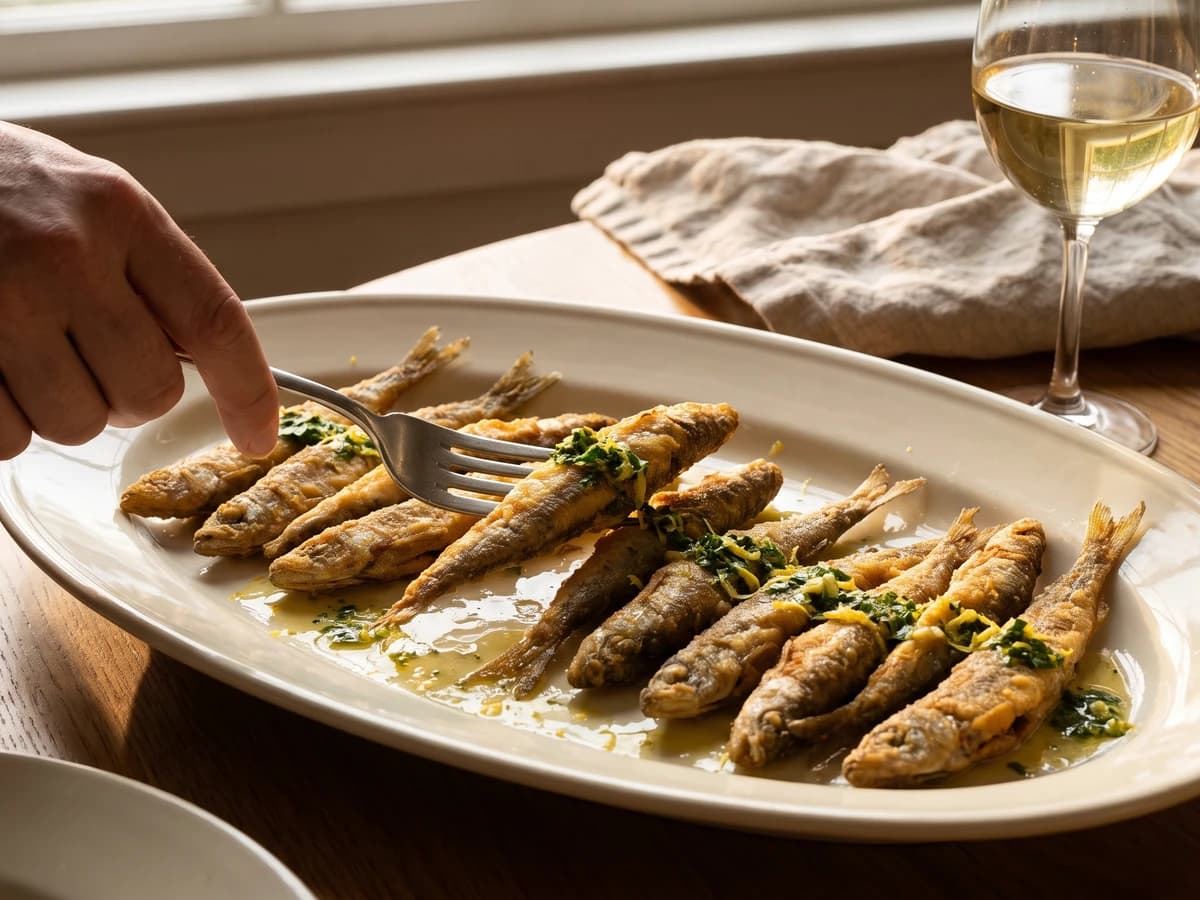
Éperlans à l’Anglaise turns small fish into a lesson in disciplined coating: boned smelts under a close, crisp crumb, pan-fried in clarified butter and finished with bright, half-melted maître d’hôtel butter.

Chef Juliette
Tiny smelts, shallot, mushrooms, white wine, gratin sauce, and fine bread raspings meet a fierce oven, where the fish must turn tender in the same breath the buttered crust bronzes.