
Chef Juliette
John Dory (St. Pierre)
John Dory has the delicacy of sole and the firmness of turbot. A light flouring, a quick butter sauté, and nut-brown beurre noisette show exactly why looks never mattered.
A cooking platform built around craft, culture, and the stories behind what we eat.

Created by Chef Juliette
Based on No. 1841, Faisan à la Normande, from Le Guide Culinaire (1907) by Auguste Escoffier
Pheasant bronzed in butter, nestled among six softened apples, and finished under a veil of cream: Normandy’s lesson in protecting lean game while letting fruit become its sauce.
Faisan à la Normande (Normandy-style pheasant) teaches the protection of lean game: brown the bird decisively, then let buttered apples and fresh cream shield it in the oven. The one true thing to know before you touch the pan is that colour must come first and doneness must arrive only once. A pale pheasant tastes timid; an overcooked one cannot be talked back into juiciness.
The original entry needs neither a saucier on staff nor a stockpot kept perpetually hot, and it never goes under a salamander. Its brigade luxury is simpler: one cook browns the pheasant while another peels, quarters, minces, and tosses six apples in butter. At home, those jobs happen in sequence, and a heavy lidded casserole stands in honestly for the terrine. The simultaneous hands are scaffolding and can go; the browned bird, lightly tossed apples, cream, covered bake, and service in the cooking dish must stay. One cook, one stove, one evening.
When it is right, the pheasant comes out deep bronze, surrounded by apples softened into a buttery rough compote, with ivory cream gathering the bird’s juices beneath it. Begin checking at twenty minutes. The thermometer, not ceremony, protects the bird.
Faisan à la Normande belongs to Normandy’s game table, where orchard apples and rich cream soften the leanness of a roasted bird. The preparation traveled from hunting-house and bourgeois tables into the grand-kitchen repertoire without losing its plain regional logic: fruit beneath and around the pheasant, cream over all, then service in the terrine. Despite a common assumption, an à la Normande preparation need not contain cider or Calvados; in this form, apples and cream carry Normandy by themselves.
Quantity
1 bird (2 to 2½ lb / 900 g to 1.1 kg)
Quantity
6 medium (about 7 cups / 1.65 L / 900 g prepared)
peeled, quartered, cored, and minced
Quantity
6 tablespoons (90 ml / 85 g)
divided
Quantity
¼ cup (60 ml / 60 g)
Quantity
1½ teaspoons (7.5 ml / 9 g)
Quantity
½ teaspoon (2.5 ml / 1 g)
| Ingredient | Quantity |
|---|---|
| young oven-ready pheasant | 1 bird (2 to 2½ lb / 900 g to 1.1 kg) |
| firm cooking applespeeled, quartered, cored, and minced | 6 medium (about 7 cups / 1.65 L / 900 g prepared) |
| unsalted butterdivided | 6 tablespoons (90 ml / 85 g) |
| fresh heavy cream | ¼ cup (60 ml / 60 g) |
| fine salt | 1½ teaspoons (7.5 ml / 9 g) |
| freshly ground black pepper | ½ teaspoon (2.5 ml / 1 g) |
Heat the oven to 425°F (220°C). Pat the pheasant completely dry, including inside the cavity, then season it all over with the salt and pepper. Tuck the wing tips beneath the bird and tie the legs together if it is not already trussed. Mince the peeled and cored apple quarters into roughly ¼-inch (6 mm) pieces; even pieces soften together, which matters more than making them dainty.
Melt half the butter in a heavy skillet over medium-high heat. When the foam subsides, lay in the pheasant and brown it deeply on the breast, back, and both sides, turning with tongs and supporting it with a wooden spoon when necessary, about 10 to 12 minutes altogether. Let each surface become a confident bronze before moving it. If the butter turns black before the bird colours, lift out the pheasant, wipe away the burnt solids, and begin again with a spoonful of the measured butter. Ça se rattrape. Transfer the browned bird to a plate.
Add the remaining butter to the skillet, followed by the minced apples. Toss over medium heat for 5 to 7 minutes, just until the pieces gleam, lose their raw stiffness, and begin to soften at the edges. Do not cook them into compote now; the covered oven finishes that work. Scrape up any nut-brown pheasant residue as you toss, but discard anything black or bitter.
Spread half the buttered apples across the bottom of a 3½ to 4-quart (3.3 to 3.8 L) lidded casserole. Set the pheasant breast-side up on this bed, then surround and partially bury it with the remaining apples. Spoon the fresh cream evenly over the bird and fruit. Add no stock, cider, herbs, or spirits; the entry’s flavour is deliberately narrow, and the apples supply all the moisture the covered dish requires.
Cover the casserole tightly and bake for 20 to 28 minutes. Begin checking at 20 minutes: the thickest part of the breast should reach 160 to 162°F (71 to 72°C), while the inner thigh should reach at least 165°F (74°C); the breast finishes safely as the bird rests. If the breast reaches its mark before the apples are tender, lift the pheasant to a warm board, leave the covered apples in the oven for 5 minutes, then reunite them. Do not sacrifice the bird to the fruit.
Lift the pheasant from the casserole and rest it loosely covered for 10 minutes. Stir the apples and cream gently. They should be soft and lightly bound by glossy juices; if the mixture looks watery or separated, set the casserole over medium-low heat and toss for 2 to 3 minutes until the excess moisture cooks away and the cream gathers again. Ça se rattrape. Return the whole pheasant to its apple bed, carry the casserole directly to the table, and carve there. À table!
1 serving (about 355g)
Culinary guides, cultural storytelling, and the editorial depth that makes cooking meaningful.
Discover Culinary ExplorerChef Juliette
John Dory has the delicacy of sole and the firmness of turbot. A light flouring, a quick butter sauté, and nut-brown beurre noisette show exactly why looks never mattered.

Chef Juliette
Fresh haddock proves its delicacy in the meunière pan: a fine flour crust, moist pearly flakes, and beurre noisette sharpened with lemon and parsley, ready from one skillet in half an hour.
Chef Juliette
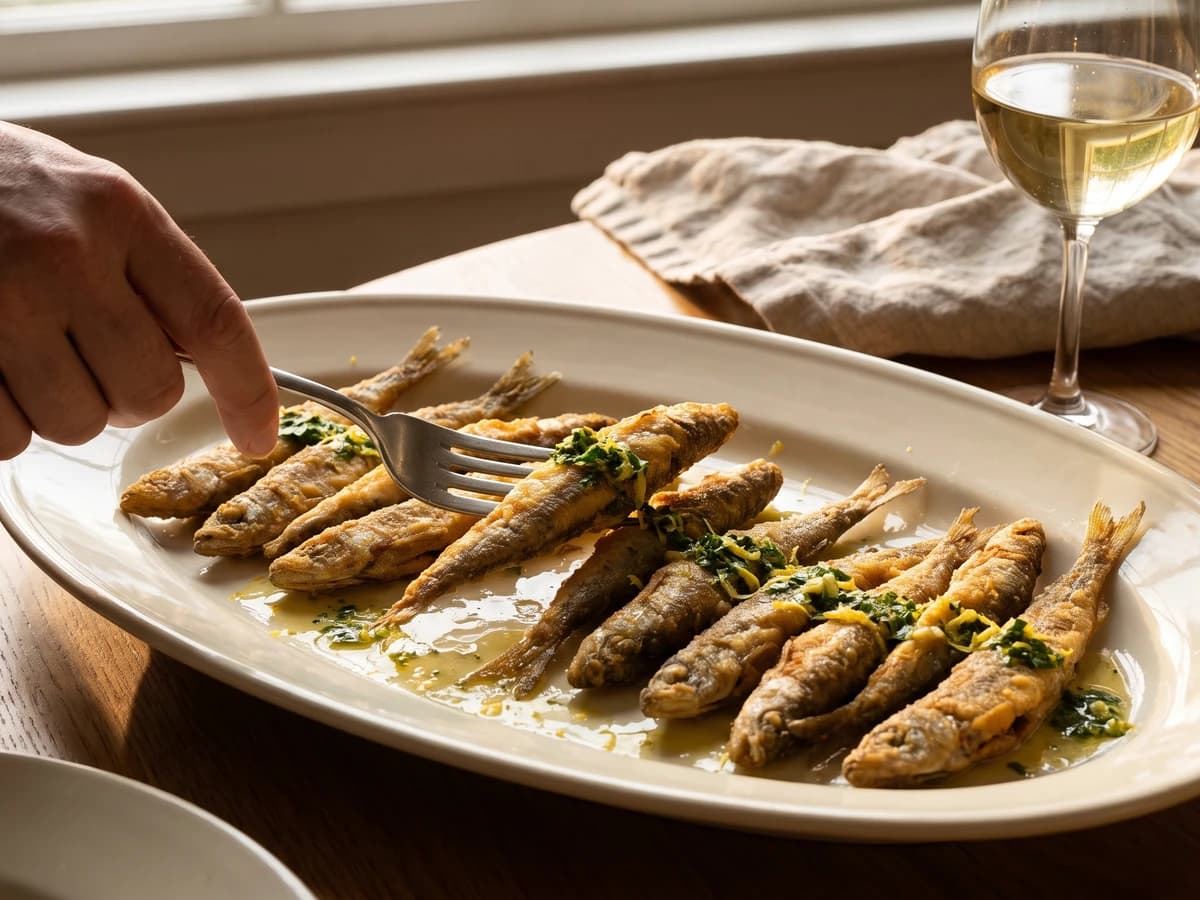
Éperlans à l’Anglaise turns small fish into a lesson in disciplined coating: boned smelts under a close, crisp crumb, pan-fried in clarified butter and finished with bright, half-melted maître d’hôtel butter.

Chef Juliette
Tiny smelts, shallot, mushrooms, white wine, gratin sauce, and fine bread raspings meet a fierce oven, where the fish must turn tender in the same breath the buttered crust bronzes.