
Chef Juliette
John Dory (St. Pierre)
John Dory has the delicacy of sole and the firmness of turbot. A light flouring, a quick butter sauté, and nut-brown beurre noisette show exactly why looks never mattered.
A cooking platform built around craft, culture, and the stories behind what we eat.

Created by Chef Juliette
Based on No. 1811, Lièvre Farci à la Perigourdine, from Le Guide Culinaire (1907) by Auguste Escoffier
Whole hare, larded and filled with its own offal, blood, bacon, bread, and Périgord truffle, braised gently in white wine and glazed at the last moment with a glossy truffle game sauce.
Lièvre farci à la périgourdine (Périgord-style stuffed hare) teaches the discipline of protecting lean game. A hare has almost no fat to forgive you, so its saddle and legs must be larded before the wine ever warms. The blood-and-offal stuffing seasons it from within, the white-wine braise tenderizes it, and the last-minute glaze gives the pale braised surface its burnished finish.
The original kitchen assumed a larding needle, a saucier with half-glaze game sauce ready, a broad braisière (braising pan) attended by spare hands, and a salamander for the final glaze. At home, a narrow skewer threads chilled fatback through the meat, a close-fitting oval cocotte keeps one bottle of wine around the hare, prepared half-glaze game sauce replaces the perpetual sauce station, and the hottest oven does the salamander's work. Four fowls' livers become four chicken livers because that is the same ingredient named precisely for the modern market. Where local law prevents the sale of hare lungs or blood, equal-weight chicken liver and food-safe pig's blood preserve the stuffing's body, though the hare's own blood gives the finer flavor.
Parade-ground trussing and a separate cook for the sauce were brigade scaffolding, so they can go. Larding the lean meat, keeping the book's proportions of offal, bacon, bread, onion, blood, and truffle, braising in white wine, basting often, reducing the liquor, and glazing at the last moment are the dish itself. Those stay. One cook, one stove, one evening.
The finished hare should be mahogany-bronze outside, tender enough to carve without collapsing, with a dark, moist stuffing and truffle-rich sauce that coats rather than floods the platter. Before touching the pan, have the hare, blood, offal, and half-glaze game sauce cold and ready. Lard the saddle and legs carefully; that is the step deciding whether the hare arrives succulent or merely impressive.
Lièvre farci à la périgourdine belongs to Périgord, especially the black-truffle larder around Sarlat in Périgord Noir, where hare, poultry liver, blood, and Tuber melanosporum meet in the same cold-season kitchen. The grand kitchen refined a country practice by larding a naturally lean animal, returning its offal as stuffing, and finishing the braise with a reduced game sauce. It should not be collapsed into lièvre à la royale: this preparation keeps the hare whole and is defined by its offal-and-blood stuffing, white-wine braise, and Périgord truffle finish.
Quantity
1 whole, 4 to 5 lb (1.8 to 2.3 kg)
skinned and dressed with its blood and offal reserved, leg bones cleanly cracked by the butcher, and leg and saddle tendons removed
Quantity
All reserved, usually ⅓ to ½ cup (80 to 120 ml / 85 to 125 g)
Quantity
1 set, about 7 oz (200 g)
cleaned and trimmed; replace unavailable lungs by equal-weight chicken liver
Quantity
4, about 4½ oz (125 g)
trimmed
Quantity
1 cup (240 ml / 140 g)
finely diced
Quantity
¾ cup (180 ml / 115 g)
chilled and cut into narrow strips
Quantity
1 packed cup (240 ml / 140 g)
measured after soaking in cold water and pressing firmly
Quantity
½ cup (120 ml / 55 g)
finely chopped
Quantity
1 tablespoon (15 ml / 14 g)
Quantity
1 teaspoon (5 ml / 1 g)
finely chopped
Quantity
¼ teaspoon (1.25 ml / 1 g)
crushed to a paste
Quantity
½ cup (120 ml / 85 g)
finely chopped
Quantity
2¼ teaspoons (11 ml / 14 g)
Quantity
1 teaspoon (5 ml / 2 g)
Quantity
3⅛ cups (750 ml / 750 g)
Quantity
⅔ imperial pint, about 1⅔ cups (400 ml / 400 g)
Quantity
½ cup (120 ml / 85 g)
chopped
| Ingredient | Quantity |
|---|---|
| whole hareskinned and dressed with its blood and offal reserved, leg bones cleanly cracked by the butcher, and leg and saddle tendons removed | 1 whole, 4 to 5 lb (1.8 to 2.3 kg) |
| reserved hare blood, or food-safe pig's blood only if necessary | All reserved, usually ⅓ to ½ cup (80 to 120 ml / 85 to 125 g) |
| hare liver, heart, and lungscleaned and trimmed; replace unavailable lungs by equal-weight chicken liver | 1 set, about 7 oz (200 g) |
| chicken liverstrimmed | 4, about 4½ oz (125 g) |
| unsmoked fat bacon or fatty pork bellyfinely diced | 1 cup (240 ml / 140 g) |
| pork fatback for lardingchilled and cut into narrow strips | ¾ cup (180 ml / 115 g) |
| fresh white breadcrumbsmeasured after soaking in cold water and pressing firmly | 1 packed cup (240 ml / 140 g) |
| onionfinely chopped | ½ cup (120 ml / 55 g) |
| unsalted butter | 1 tablespoon (15 ml / 14 g) |
| flat-leaf parsleyfinely chopped | 1 teaspoon (5 ml / 1 g) |
| garliccrushed to a paste | ¼ teaspoon (1.25 ml / 1 g) |
| raw Périgord black truffle paringsfinely chopped | ½ cup (120 ml / 85 g) |
| fine salt | 2¼ teaspoons (11 ml / 14 g) |
| freshly ground black pepper | 1 teaspoon (5 ml / 2 g) |
| dry white wine, preferably Bergerac Sec | 3⅛ cups (750 ml / 750 g) |
| prepared half-glaze game sauce | ⅔ imperial pint, about 1⅔ cups (400 ml / 400 g) |
| Périgord black truffle for the saucechopped | ½ cup (120 ml / 85 g) |
Keep the hare, blood, and offal below 40°F (4°C) while you work. Inspect the cavity and flesh carefully, removing stray bone fragments and, if the hare was field-shot, every trace of shot and damaged tissue. Ask the butcher to crack the leg bones cleanly without cutting through the skin; don't strike them at home, where splintered bone is more likely than elegant trussing. Whisk the blood until smooth and pass it through a fine sieve if small clots remain. Use blood and offal only from an inspected animal handled under continuous refrigeration.
Melt the butter over gentle heat and cook the onion until completely tender and translucent, about 8 minutes, without letting it color. Spread it on a plate and cool it fully. Soak the breadcrumbs briefly in cold water, then squeeze them very firmly in a clean cloth and weigh out 5 oz (140 g). The onion and bread must be cold before they meet the blood and offal; warmth loosens the stuffing before it has any chance to bind.
Chill the fatback until firm. Working along the grain of each saddle fillet and leg muscle, make narrow channels with a larding needle or long metal skewer, then pull or guide the fatback strips through so small veins of fat run inside the meat every inch or so. Don't carve wide pockets, which let the juices escape. If a strip breaks, insert two shorter pieces from opposite ends; the protection matters, not an uninterrupted ribbon.
Chop the hare liver, heart, lungs, chicken livers, and fat bacon together with a knife until they form a close, slightly textured mince, not a smooth paste. Mix in the pressed breadcrumbs, blood, cooled onion, parsley, garlic, truffle parings, 1¾ teaspoons of the salt, and ¾ teaspoon of the pepper. Work only until the mixture becomes cohesive. Fry a teaspoonful in a dry pan until cooked through, taste, and correct it with some of the reserved seasoning. If the stuffing slumps like batter, don't add extra bread and disturb the book's ratio. Chill it for 15 minutes; ça se rattrape.
Lay the hare belly-up and fill the cavity evenly, pressing the stuffing into the shoulders and pelvis without packing it hard. Draw the belly skin together and sew it with a trussing needle and kitchen twine, using close stitches. If the skin tears, bridge the opening with two short metal skewers and lace the twine around them in a figure eight. Fold the legs into a compact natural crouch, then truss the body firmly enough to hold its long shape. Season the outside with the remaining salt and pepper.
Heat the oven to 325°F (165°C). Set the hare seam-side up in a close-fitting oval cocotte or deep covered roasting pan and pour the white wine around it; the liquid should reach roughly one-third of the way up the animal. Bring the wine only to a tremble on the stove, cover with parchment and the lid, then braise for about 2½ hours. Baste every 20 minutes, spooning the wine over the saddle and legs before covering the pot again. That frequent basting is not brigade fussing, it is the dish's defense against dry game. Keep the liquor at a bare simmer. If it begins boiling hard, lower the oven by 25°F (15°C); if the level falls below the pot floor, add ¼ cup (60 ml / 60 g) hot water at a time. The hare is ready when a skewer enters the hind leg without resistance and the center of the stuffing reaches at least 165°F (74°C).
Lift the hare carefully onto a rimmed tray and cover it loosely. Pour the braising liquor into a saucepan, add the prepared half-glaze game sauce, and boil steadily until the sauce is nappant, thick enough to coat the back of a spoon while still running freely. Clear it of grease as it reduces, using a shallow spoon or fat separator, then pass it through a fine sieve. Reserve 3 tablespoons (45 ml) of the clear reduction for glazing. If the sauce becomes too salty before it coats, add ¼ cup (60 ml / 60 g) hot water and reduce more gently; if it tightens too far, loosen it one spoonful at a time.
Raise the oven to 450°F (230°C). Brush the hare with the reserved reduction and return it uncovered for 6 to 10 minutes, brushing once or twice more, until the surface is evenly glossy and mahogany-bronze. Watch closely because a reduced glaze moves from lacquered to scorched quickly. While the hare glazes, stir the chopped Périgord truffle into the remaining sauce over low heat and warm it for 2 minutes without a hard boil; the truffle belongs in the finished sauce, not cooked into silence.
Remove the twine and set the whole hare on a warmed long platter. Spoon only enough truffle sauce around it to gloss the platter without concealing the hare, then pour the rest into a warmed sauceboat. Present it whole, carve the legs and saddle at the table, and serve each portion with a generous spoonful of the dark stuffing and more sauce. Never apologize at your own table. À table!
1 serving (about 560g)
Culinary guides, cultural storytelling, and the editorial depth that makes cooking meaningful.
Discover Culinary ExplorerChef Juliette
John Dory has the delicacy of sole and the firmness of turbot. A light flouring, a quick butter sauté, and nut-brown beurre noisette show exactly why looks never mattered.

Chef Juliette
Fresh haddock proves its delicacy in the meunière pan: a fine flour crust, moist pearly flakes, and beurre noisette sharpened with lemon and parsley, ready from one skillet in half an hour.
Chef Juliette
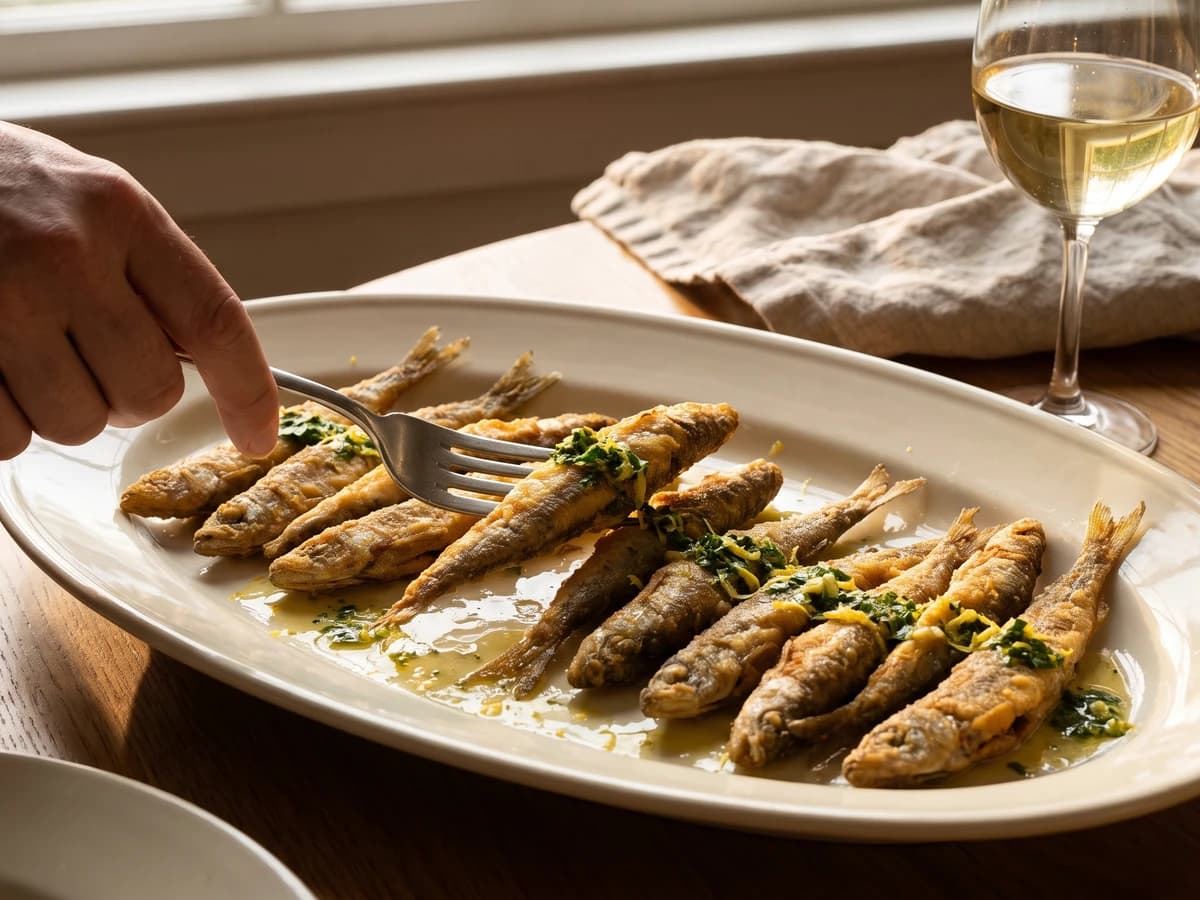
Éperlans à l’Anglaise turns small fish into a lesson in disciplined coating: boned smelts under a close, crisp crumb, pan-fried in clarified butter and finished with bright, half-melted maître d’hôtel butter.

Chef Juliette
Tiny smelts, shallot, mushrooms, white wine, gratin sauce, and fine bread raspings meet a fierce oven, where the fish must turn tender in the same breath the buttered crust bronzes.