
Chef Juliette
John Dory (St. Pierre)
John Dory has the delicacy of sole and the firmness of turbot. A light flouring, a quick butter sauté, and nut-brown beurre noisette show exactly why looks never mattered.
A cooking platform built around craft, culture, and the stories behind what we eat.
Created by Chef Juliette
Based on No. 1798, Selle de Chevreuil au Genièvre, from Le Guide Culinaire (1907) by Auguste Escoffier
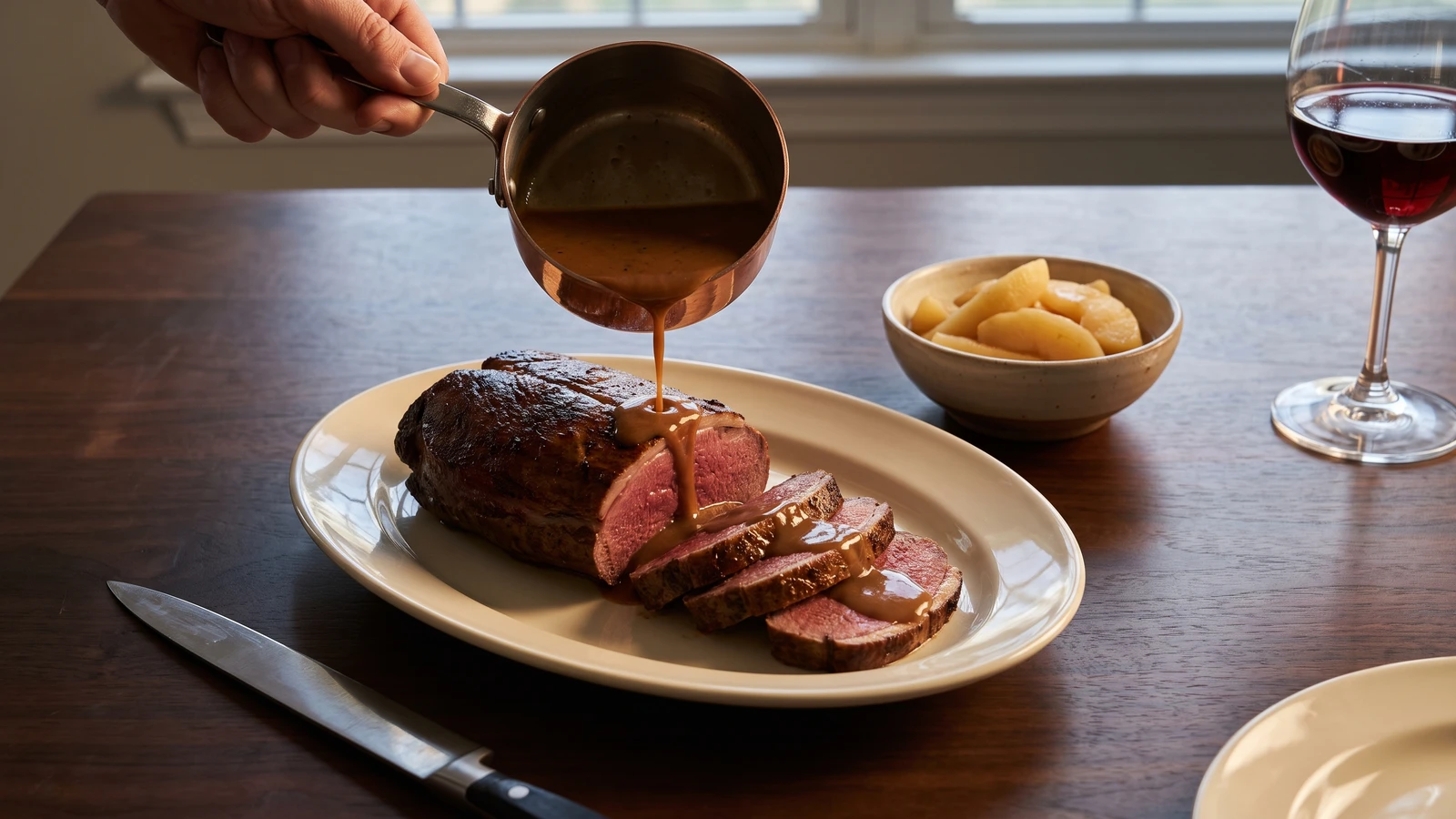
A lean venison saddle, carefully larded and roasted pink, meets gin burned clean in the tray, one juniper berry, reduced cream, and poivrade, with barely sweet apples keeping the dark sauce bright.
Selle de Chevreuil au Genièvre (roast saddle of venison with juniper) teaches the discipline lean game demands: add fat before heat, then stop roasting while the centre is still rosy. Venison has no marbling to forgive a distracted cook. The reward is clean, dark meat under a sauce that carries gin and juniper as perfume, not noise, with tart apples making each rich spoonful ready for the next.
The entry assumed a large bone-in saddle, a larding needle, and a saucier with poivrade ready from a stockpot that never went cold. At home, a 900-gram boneless saddle serves four, a narrow knife and slim skewer make honest channels for chilled fatback, and prepared poivrade sauce supplies the finished component without asking you to run a second kitchen. The brigade portion and specialized needle are scaffolding; they can go. Larding the meat, burning the gin in the tray, using exactly one juniper berry, reducing the cream by half, and finishing with poivrade and lemon are the dish. One cook, one stove, one evening.
Take the venison from the oven by thermometer, not hope. The finishing temperature is the one step that decides the whole saddle.
Selle de chevreuil belongs to France's cuisine de chasse, particularly the forested tables of Alsace and Lorraine, where juniper has long accompanied game, while poivrade came through the national grand-kitchen sauce canon. The saddle is the prized double loin lying over the backbone, tender enough to roast rather than braise, with tart apples traditionally providing relief from its rich sauce. In this formulation, gin is burned off and only one berry is used, correcting the common mistake of making juniper louder than the venison.
Quantity
1 roast, about 2 lb (900 g)
silverskin removed and rolled evenly
Quantity
⅓ cup loosely packed (80 ml / 60 g)
cut into 12 slender batons
Quantity
1½ teaspoons (7.5 ml / 9 g)
Quantity
¼ cup (60 ml / 57 g)
Quantity
1
crushed to a powder immediately before use
Quantity
6 tablespoons plus 1 teaspoon (95 ml / 95 g)
Quantity
3 tablespoons (45 ml / 45 g)
Quantity
8 drops (about ⅛ teaspoon / 0.6 ml / 0.6 g)
Quantity
4 medium, about 4 cups sliced (950 ml / 750 g)
peeled, cored, and cut into wedges
Quantity
¼ cup (60 ml / 60 g)
Quantity
2 teaspoons (10 ml / 8 g)
| Ingredient | Quantity |
|---|---|
| boneless venison saddlesilverskin removed and rolled evenly | 1 roast, about 2 lb (900 g) |
| chilled unsmoked pork fatbackcut into 12 slender batons | ⅓ cup loosely packed (80 ml / 60 g) |
| fine sea salt | 1½ teaspoons (7.5 ml / 9 g) |
| dry gin | ¼ cup (60 ml / 57 g) |
| juniper berrycrushed to a powder immediately before use | 1 |
| double cream | 6 tablespoons plus 1 teaspoon (95 ml / 95 g) |
| prepared poivrade sauce | 3 tablespoons (45 ml / 45 g) |
| fresh lemon juice | 8 drops (about ⅛ teaspoon / 0.6 ml / 0.6 g) |
| firm-tart applespeeled, cored, and cut into wedges | 4 medium, about 4 cups sliced (950 ml / 750 g) |
| water | ¼ cup (60 ml / 60 g) |
| granulated sugar | 2 teaspoons (10 ml / 8 g) |
Put the apple wedges, water, and sugar in a small heavy saucepan. Cover and cook over gentle heat for 8 to 12 minutes, turning the fruit once, until the wedges are tender at their edges but still hold their shape. The apples must taste of apple, not pudding; two teaspoons of sugar are enough. Set them aside covered. If they soften into a rough compote, serve them confidently in the same separate bowl and stir as little as possible.
Heat the oven to 450°F (230°C). Chill the fatback batons until firm but not frozen solid. Make 12 narrow channels through the venison, running with the grain and distributed evenly through the roast, using a slim skewer followed carefully by the tip of a narrow knife. Push one fatback baton into each channel until it is buried. Tie the saddle at 1-inch (2.5 cm) intervals and season it evenly with the salt.
Set the saddle directly in the smallest heavy metal roasting tray that holds it comfortably. Roast for 10 minutes, then lower the oven to 400°F (200°C) without opening the door. Continue for 10 to 18 minutes, checking from the side with an instant-read thermometer. Remove the saddle when the centre reaches 136°F (58°C); during its rest it should settle near 142 to 145°F (61 to 63°C), still pink and moist. If it remains under the target after resting, return the whole roast to the oven for 3 to 5 minutes. If it has gone farther, carve it thinly and keep the sauce generous.
Transfer the venison to a warm platter and cover it loosely with foil for 15 minutes. Don't wrap it tightly; trapped heat pushes the centre past its mark. Keep every drop that gathers on the platter, and leave the roasting tray with its fond, the brown glaze stuck to the metal, intact for the sauce.
Spoon excess clear fat from the roasting tray, leaving the fond and a thin sheen of fat. Turn off the extractor fan, move the gin bottle well away, and set a fitted lid nearby. Take the tray off the heat, pour in the measured gin, then return it to medium heat. Keeping your face and sleeves back, ignite the gin with a long match and let the flame die naturally while you scrape the tray. If it refuses to ignite, boil it briskly for 60 to 90 seconds, until the raw alcohol smell disappears. The destination is the same.
Add the powdered juniper berry and double cream to the roasting tray. Tip the tray slightly so the liquid gathers, then simmer steadily while scraping up the last of the fond. Reduce the cream by half, about 4 to 6 minutes, until the bubbles broaden and the liquid begins to coat a spoon. Lower the heat and whisk in the prepared poivrade sauce, one tablespoon at a time. Simmer for 1 minute, then remove from the heat and add exactly 8 drops of lemon juice. If the sauce tightens too far or looks greasy, whisk in the saddle's resting juices a teaspoon at a time until the gloss returns. Ça se rattrape.
Warm the apples gently over low heat. Remove the string from the saddle and carve across the grain into slices about ½ inch (1.25 cm) thick. Arrange them in order on the warm platter, spoon enough sauce over the meat to make it gleam, and send the remaining sauce alongside. Serve the hot stewed apples separately, exactly as the dish intends. À table!
1 serving (about 410g)
Culinary guides, cultural storytelling, and the editorial depth that makes cooking meaningful.
Discover Culinary ExplorerChef Juliette
John Dory has the delicacy of sole and the firmness of turbot. A light flouring, a quick butter sauté, and nut-brown beurre noisette show exactly why looks never mattered.

Chef Juliette
Fresh haddock proves its delicacy in the meunière pan: a fine flour crust, moist pearly flakes, and beurre noisette sharpened with lemon and parsley, ready from one skillet in half an hour.

Chef Juliette
Éperlans à l’Anglaise turns small fish into a lesson in disciplined coating: boned smelts under a close, crisp crumb, pan-fried in clarified butter and finished with bright, half-melted maître d’hôtel butter.

Chef Juliette
Tiny smelts, shallot, mushrooms, white wine, gratin sauce, and fine bread raspings meet a fierce oven, where the fish must turn tender in the same breath the buttered crust bronzes.