
Chef Juliette
John Dory (St. Pierre)
John Dory has the delicacy of sole and the firmness of turbot. A light flouring, a quick butter sauté, and nut-brown beurre noisette show exactly why looks never mattered.
A cooking platform built around craft, culture, and the stories behind what we eat.
Created by Chef Juliette
Based on No. 1796, Selle de Chevreuil à la Créole, from Le Guide Culinaire (1907) by Auguste Escoffier
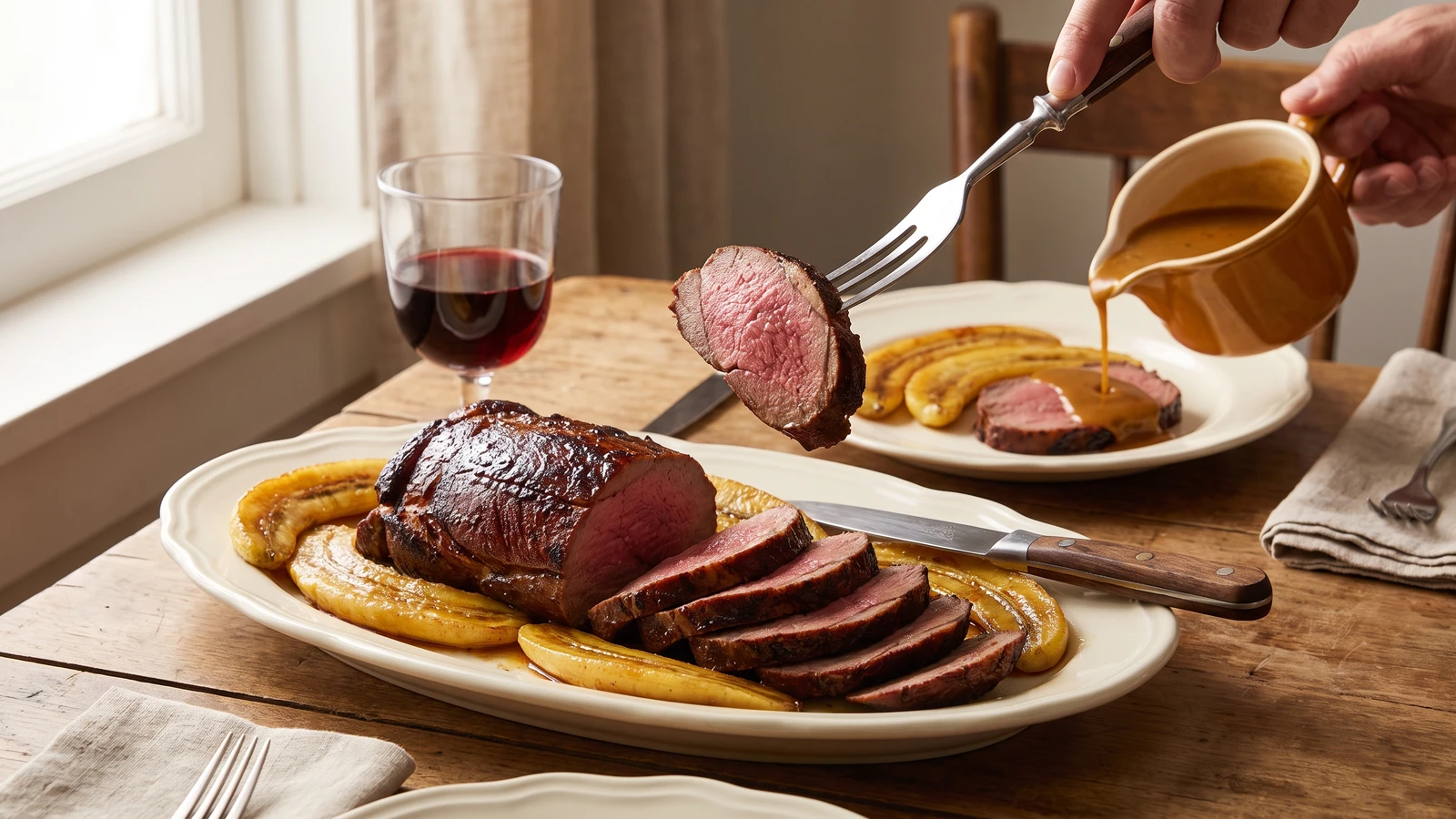
A brief aromatic marinade, a hot spit-style roast kept pink at the center, buttery bananas, and Robert sauce sharpened with one-third poivrade: a grand saddle translated for four without losing its nerve.
Selle de Chevreuil à la Créole (venison saddle with buttered bananas and a sharp game sauce) teaches restraint with lean game. The one true thing is this: the saddle must brown handsomely without surrendering its pink center. Its cooked marinade perfumes the meat for a few hours, never overnight, because acid should season venison rather than begin cooking its surface.
The original assumes a turning spit, a saucier beside it, a stockpot never cold, and a whole saddle destined for a long dining-room platter. At home, a butcher-trimmed, boned, and tied saddle portion serves four; a rack in a hot oven supplies the spit’s circulating heat, and a thermometer replaces the spit-master’s practiced thumb. Sauce Robert (a mustard-shallot brown sauce) and sauce poivrade (a pepper-sharpened game sauce) arrive finished from their own preparations. One cook, one stove, one evening.
The spit, the saucier, and five quarts of marinade were brigade scaffolding, so they can go. The brief marinade, repeated basting, buttered bananas, three-to-one marriage of the sauces, and final fresh butter are the dish itself, so they stay. Roast by temperature and pull before the saddle’s final rise during resting, because its pink center is the one thing no sauce can give back.
Selle de Chevreuil à la Créole belongs to the French grand-kitchen table rather than the home repertory of Lyon, Burgundy, Normandy, or another single region; the venison saddle was treated as a formal game centerpiece, and in this preparation the Créole label is carried by the banana garnish. That name reflects the canon’s habit of describing tropical ingredients through French colonial vocabulary, not a faithful portrait of any one Creole cuisine. The cooked marinade and compound sauce move the saddle from the hunt table into formal service, while the buttered fruit provides the sweet contrast that distinguishes this entry.
Quantity
1 roast (2½ to 3 lb / 1.1 to 1.35 kg)
Quantity
2 cups (475 ml / about 490 g) Cooked Marinade for Venison (No. 168)
fully chilled and divided before contact with raw meat
Quantity
½ teaspoon (2.5 ml / 3 g)
Quantity
½ teaspoon (2.5 ml / 1 g)
Quantity
1½ cups (360 ml / about 375 g)
Quantity
½ cup (120 ml / about 125 g)
Quantity
1 tablespoon plus 2 teaspoons (25 ml / 24 g)
diced
Quantity
4 medium (about 14 oz / 400 g peeled)
peeled and halved lengthwise
Quantity
2 tablespoons (30 ml / 28 g)
| Ingredient | Quantity |
|---|---|
| butcher-trimmed, boned, and tied venison saddle loin roast | 1 roast (2½ to 3 lb / 1.1 to 1.35 kg) |
| Cooked Marinade for Venisonfully chilled and divided before contact with raw meat | 2 cups (475 ml / about 490 g) Cooked Marinade for Venison (No. 168) |
| fine sea salt | ½ teaspoon (2.5 ml / 3 g) |
| freshly ground black pepper | ½ teaspoon (2.5 ml / 1 g) |
| finished Sauce Robert | 1½ cups (360 ml / about 375 g) |
| finished Sauce Poivrade | ½ cup (120 ml / about 125 g) |
| cold unsalted butter for finishing the saucediced | 1 tablespoon plus 2 teaspoons (25 ml / 24 g) |
| firm-ripe bananaspeeled and halved lengthwise | 4 medium (about 14 oz / 400 g peeled) |
| unsalted butter for the bananas | 2 tablespoons (30 ml / 28 g) |
Place the venison in a snug nonreactive dish or sealable bag. Pour over 1½ cups of the fully chilled Cooked Marinade for Venison (No. 168), turning the roast so every surface is coated. Reserve the remaining ½ cup separately in the refrigerator before anything touches the raw meat. Refrigerate the saddle for 3 hours, turning it once; do not leave it overnight, because the vinegar will tighten the exterior before the center has taken much flavor.
Remove the saddle from the marinade 30 minutes before roasting and discard the liquid that held the raw meat. Pat the roast thoroughly dry, particularly between any folds made by the butcher’s tying; a wet surface will pale instead of brown. Season lightly with the salt and pepper. Heat the oven to 450°F (230°C) with a rack set over a shallow roasting pan. Meanwhile, bring the reserved ½ cup Cooked Marinade for Venison (No. 168) to a full boil in a small saucepan, boil for 2 minutes, then keep it hot for basting.
Set the saddle on the rack and roast for 10 minutes at 450°F (230°C). Lower the oven to 400°F (200°C), then spoon a little hot marinade over the roast every 7 to 8 minutes without flooding the pan. Continue until the thickest center registers 138 to 140°F (58 to 60°C), usually 25 to 35 minutes in total; resting should carry it toward 145°F (63°C) while leaving the meat pink. If the sugared marinade darkens before the center is ready, lower the oven to 375°F (190°C) and shield the roast loosely with foil. Ça se rattrape. The thermometer governs, not the clock.
Transfer the roast to a warm board, cover it loosely with foil, and rest it for 12 to 15 minutes. Do not wrap it tightly, or the crust softens. Resting lets the temperature settle and the juices redistribute; carving immediately would leave those juices on the board instead of inside the venison.
While the saddle rests, combine the 1½ cups Sauce Robert and ½ cup Sauce Poivrade in a small saucier. This is the book’s exact relation: three parts Robert to one part poivrade. Bring the mixture only to a bare simmer, stirring until completely smooth, then remove it from the heat. Monter au beurre, finish by whisking in cold butter, one piece at a time, until the sauce gleams and lightly coats a spoon. If it turns oily, stop adding butter and whisk in 1 teaspoon of cold water off the heat; ça se rattrape. Taste before adding any salt, because both finished sauces should already carry their seasoning.
Melt the 2 tablespoons butter in a broad skillet over medium heat until it foams and smells nutty but remains golden. Lay in the banana halves cut-side down and cook for 1 to 2 minutes, then turn them carefully and cook the second side just until butter-gold at the edges. They should be warmed through and glazed, not collapsing. If one begins to slump, lift it out at once and hold it on the serving platter while the others finish.
Remove the strings and carve the saddle across the grain into slices about ½ inch (1.25 cm) thick. Overlap them down the center of a warmed long platter and arrange the buttered bananas around the meat, keeping the fruit whole and generous rather than fussing over it. Pour the Robert-poivrade sauce into a warmed sauce boat and serve it at the same moment, allowing each guest to spoon it beside the venison. À table!
1 serving (about 465g)
Culinary guides, cultural storytelling, and the editorial depth that makes cooking meaningful.
Discover Culinary ExplorerChef Juliette
John Dory has the delicacy of sole and the firmness of turbot. A light flouring, a quick butter sauté, and nut-brown beurre noisette show exactly why looks never mattered.

Chef Juliette
Fresh haddock proves its delicacy in the meunière pan: a fine flour crust, moist pearly flakes, and beurre noisette sharpened with lemon and parsley, ready from one skillet in half an hour.

Chef Juliette
Éperlans à l’Anglaise turns small fish into a lesson in disciplined coating: boned smelts under a close, crisp crumb, pan-fried in clarified butter and finished with bright, half-melted maître d’hôtel butter.

Chef Juliette
Tiny smelts, shallot, mushrooms, white wine, gratin sauce, and fine bread raspings meet a fierce oven, where the fish must turn tender in the same breath the buttered crust bronzes.