
Chef Juliette
John Dory (St. Pierre)
John Dory has the delicacy of sole and the firmness of turbot. A light flouring, a quick butter sauté, and nut-brown beurre noisette show exactly why looks never mattered.
A cooking platform built around craft, culture, and the stories behind what we eat.

Created by Chef Juliette
Based on No. 1789, Suprêmes de Pigeonneaux aux Truffes, from Le Guide Culinaire (1907) by Auguste Escoffier
Eight tender pigeon suprêmes rest on a softly poached forcemeat border, lacquered with Madeira meat glaze and thirty-two warm truffle slices, an exacting lesson in timing, reduction, and emulsion.
Suprêmes de Pigeonneaux aux Truffes (young pigeon breast fillets with truffles) teaches that luxury depends on sequence, not fuss. The pigeon cooks in minutes, while its ivory farce mousseline, reduced glaze, sliced truffle, and cold finishing butter must already be waiting. Once the suprêmes meet the pan, there is no useful moment for catching up.
The original service assumed a garde-manger, the cold-station cook, ready to pipe smooth forcemeat, a saucier with pale meat glaze beside stock never off the fire, brigade portions, and an oven station to poach the border. A salamander stood nearby, but this dish never asks it to brown a thing. At home, a food processor makes one small farce mousseline, one cup of stock becomes the glaze, and a low oven with a shallow water bath poaches the border. The separate hands and great quantities were scaffolding, so they go. The piped border, clarified butter, Madeira deglazing, four truffle slices for every suprême, and final butter emulsion are the dish, so every one stays. One cook, one stove, one evening.
When it is right, the farce is tender and ivory, the pigeon carries a light bronze surface and a faint blush within, and the sauce glazes rather than floods. Prepare the entire landing place before touching the sauté pan. The border must be poached, the glaze reduced, the truffle sliced, and the butter cold; that sequence is the one true thing.
Suprêmes de Pigeonneaux aux Truffes belongs to the Parisian classical dining room, where cooks separated the quick-cooking breasts of young pigeons while sending the legs and carcasses to other preparations. Suprême here is not a boast but the precise name of the cut, and its place on a piped forcemeat border shows how a bird from the bourgeois roasting table traveled into composed service. The four truffle slices allotted to each suprême are not garnish by whim; they are part of the sauce and preserve the preparation's measured generosity.
Quantity
4, 14 to 16 oz / 400 to 450 g each
well chilled, with breasts intact
Quantity
8 oz / 225 g
cut into 1-inch / 2.5 cm cubes and thoroughly chilled
Quantity
1 (about 2 tbsp / 30 ml / 30 g)
chilled
Quantity
1/2 cup (120 ml / 120 g)
cold
Quantity
2 tsp (10 ml / 12 g)
divided
Quantity
1/4 tsp (1.25 ml / 0.5 g)
divided
Quantity
3 tbsp (45 ml / 42 g)
divided
Quantity
1 cup (240 ml / 240 g)
Quantity
1/2 cup (120 ml / 120 g)
Quantity
1 1/2 oz / 40 g
cut into 32 thin slices just before finishing
Quantity
3 tbsp (45 ml / 42 g)
cold and cut into small cubes
| Ingredient | Quantity |
|---|---|
| whole dressed squab (pigeonneaux)well chilled, with breasts intact | 4, 14 to 16 oz / 400 to 450 g each |
| skinless boneless chicken breastcut into 1-inch / 2.5 cm cubes and thoroughly chilled | 8 oz / 225 g |
| large egg whitechilled | 1 (about 2 tbsp / 30 ml / 30 g) |
| heavy creamcold | 1/2 cup (120 ml / 120 g) |
| fine sea saltdivided | 2 tsp (10 ml / 12 g) |
| ground white pepperdivided | 1/4 tsp (1.25 ml / 0.5 g) |
| clarified butterdivided | 3 tbsp (45 ml / 42 g) |
| unsalted gelatin-rich chicken stock, for the pale meat glaze | 1 cup (240 ml / 240 g) |
| dry or medium-dry Madeira | 1/2 cup (120 ml / 120 g) |
| black truffle, fresh or whole preservedcut into 32 thin slices just before finishing | 1 1/2 oz / 40 g |
| unsalted buttercold and cut into small cubes | 3 tbsp (45 ml / 42 g) |
Pour the chicken stock into a small wide saucepan and boil it briskly until only 3 tablespoons (45 ml / 45 g) remain, about 15 to 20 minutes. It should be pale amber, gelatinous, and able to coat a spoon without tasting scorched or aggressively salty. This is the home equivalent of the pale meat glaze once kept ready by the saucier. If it reduces into a stiff syrup, whisk in a spoonful of water until it flows again. Ça se rattrape. Set it beside the stove, and heat the oven to 300°F / 150°C.
Place one squab breast-side up. With a narrow sharp knife, cut beside the keel bone and follow the ribs closely, lifting away each breast fillet in one clean piece while leaving its skin attached. Repeat to produce eight suprêmes. Save the legs and carcasses for another meal or stock. Lay each suprême between sheets of parchment and press the thick end gently with the flat base of a small saucepan until the fillet is an even 5/8 inch / 1.5 cm thick. This is flattening, not pounding; torn pigeon dries quickly. Cover and return the suprêmes to the cold.
Chill the bowl and blade of a food processor for 10 minutes. Process the cold chicken with 1 teaspoon (5 ml / 6 g) of the salt and half the white pepper until it becomes smooth and tacky. Add the egg white and process just until absorbed, then pour in the cold cream in three additions, pulsing briefly after each. The farce mousseline should be satin-smooth and hold a soft ridge. If it turns loose or greasy, stop, set the bowl over ice for 10 minutes, and pulse once or twice when thoroughly cold. Ça se rattrape. Press the farce through a fine-mesh sieve, then poach a teaspoonful in barely simmering water until it reaches 165°F / 74°C. Taste that cooked sample and correct the seasoning without tasting the raw mixture.
Brush an ovenproof oval platter lightly with 1 tablespoon (15 ml / 14 g) of the clarified butter. Transfer the farce to a piping bag fitted with a 3/4-inch / 2 cm plain tube. Pipe two close, continuous ropes into an oval band about 1 1/2 inches / 4 cm wide, leaving the center open, and smooth the joining seam with a wet fingertip. If the band begins to slump, chill the entire platter for 10 minutes before cooking. Set the platter inside a roasting pan and pour just-boiled water around it to a depth of 1/2 inch / 1 cm. Tent loosely with buttered parchment and oven-poach for 14 to 18 minutes, until the border is ivory, gently firm, and 165°F / 74°C at its thickest point. Lift out the platter and dry its underside.
Lower the oven to 200°F / 95°C and hold the poached border there for no more than 10 minutes. Slice the truffle into 32 fine slices, exactly four for each suprême, and keep them covered. Place the Madeira, pale meat glaze, and cold butter cubes beside the stove. The sauce will wait for none of them once the pigeon leaves the pan.
Pat the suprêmes dry and season them with 3/4 teaspoon (3.75 ml / 4.5 g) salt and the remaining white pepper. Heat the remaining 2 tablespoons (30 ml / 28 g) clarified butter in a wide sauté pan over medium-high heat. When it shimmers, add the suprêmes in one uncrowded layer, presentation-side down. Rock the pan so the clarified butter washes around them, cooking for about 90 seconds until lightly bronzed, then turn and cook for another 60 to 90 seconds. Remove each as its center reaches 155°F / 68°C, place it directly on the warm forcemeat border, and rest it there for at least one minute. For pregnant, elderly, very young, or immunocompromised guests, cook the pigeon to 165°F / 74°C.
Pour off any excess clarified butter without disturbing the browned fond. Return the pan to medium-high heat, add the Madeira, and scrape the pan clean as it bubbles. Reduce it to about 3 tablespoons (45 ml / 45 g), then add the pale meat glaze and bring the mixture to a gentle simmer. Add all 32 truffle slices and turn them through the sauce for 20 to 30 seconds, just long enough to warm and perfume the glaze. Do not boil them into exhaustion.
Take the pan completely off the heat. Monter au beurre (finish by whisking in cold butter), adding the cubes one at a time until the sauce is glossy, cohesive, and thick enough to veil a spoon. Never boil it after the butter goes in. If oily beads appear, whisk 1 teaspoon of cold water in a clean bowl, then add the broken sauce back a spoonful at a time until smooth. Ça se rattrape. Taste before adding the reserved 1/4 teaspoon (1.25 ml / 1.5 g) salt. Coat each suprême with sauce, then lift exactly four truffle slices onto each one. Spoon the remaining glaze inside the forcemeat border and serve immediately. À table!
1 serving (about 270g)
Culinary guides, cultural storytelling, and the editorial depth that makes cooking meaningful.
Discover Culinary ExplorerChef Juliette
John Dory has the delicacy of sole and the firmness of turbot. A light flouring, a quick butter sauté, and nut-brown beurre noisette show exactly why looks never mattered.

Chef Juliette
Fresh haddock proves its delicacy in the meunière pan: a fine flour crust, moist pearly flakes, and beurre noisette sharpened with lemon and parsley, ready from one skillet in half an hour.
Chef Juliette
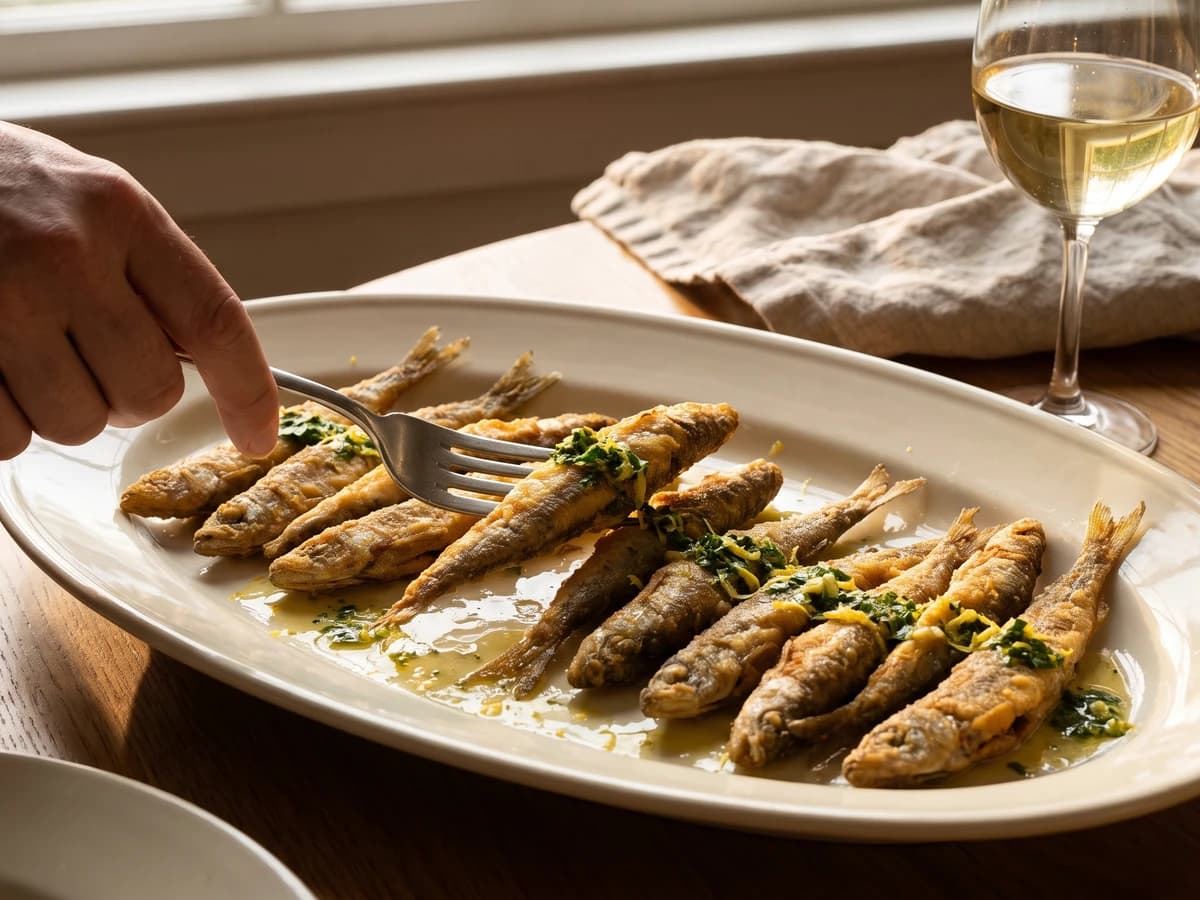
Éperlans à l’Anglaise turns small fish into a lesson in disciplined coating: boned smelts under a close, crisp crumb, pan-fried in clarified butter and finished with bright, half-melted maître d’hôtel butter.

Chef Juliette
Tiny smelts, shallot, mushrooms, white wine, gratin sauce, and fine bread raspings meet a fierce oven, where the fish must turn tender in the same breath the buttered crust bronzes.