
Chef Juliette
John Dory (St. Pierre)
John Dory has the delicacy of sole and the firmness of turbot. A light flouring, a quick butter sauté, and nut-brown beurre noisette show exactly why looks never mattered.
A cooking platform built around craft, culture, and the stories behind what we eat.

Created by Chef Juliette
Based on No. 1782, Vol au Vent de Pigeonneaux, from Le Guide Culinaire (1907) by Auguste Escoffier
A burnished vol-au-vent filled at the last minute with squab poêlé only just done, truffle-rich Financière garnish, and glossy poëling liquor: a lesson in timing pastry against sauce.
Vol-au-Vent de Pigeonneaux (puff-pastry case filled with young pigeon) teaches one uncompromising principle: a crisp shell and a sauced filling may meet only at the last minute. The squabs are poêlés (cooked gently with butter under cover) until barely done, quartered, and folded into a rich Financière garnish sharpened by their own cooking liquor. Fill too early and the pastry drinks the sauce. Nothing restores that lost crispness.
The grand kitchen divided this work among a pâtissier, a saucier with stock never off the fire, and a cook attending the birds, with a salamander waiting to refresh the crust before service. One cook has a good all-butter puff pastry, the two finished preparations preserved by their cross-references, and an ordinary oven for the final crisping. The pastry station and folded napkin beneath the platter are brigade scaffolding, so they go. Four small squabs, one generous shell, one stove, one evening.
What remains is the dish and must stay: real butter in the linked preparations, squab cooked only just through, the poëling liquor worked back into the garnish, and assembly while everyone is taking their seats. Have the filling glossy, the shell hot, and the platter waiting before those two ever meet.
The vol-au-vent belongs to the formal Parisian table, where pastry cooks turned laminated dough into tall communal cases whose name, a flight in the wind, boasts of their lightness. It was never one fixed filling; poultry, sweetbreads, seafood, quenelles, truffles, and rich garnitures moved through the shell according to the menu. Unlike the smaller individual bouchée à la reine, the vol-au-vent traditionally arrives as a centerpiece to be opened and served at the table.
Quantity
1¾ pounds (800 g)
chilled and divided into 3 equal pieces
Quantity
2 tablespoons (30 ml / 16 g)
for rolling
Quantity
1
beaten
Quantity
1 tablespoon (15 ml / 15 g)
Quantity
4, about 12 to 14 ounces (340 to 400 g) each, for Poëlings (No. 250)
feet and wing tips removed
Quantity
½ teaspoon (2.5 ml / 3 g)
Quantity
¼ teaspoon (1.25 ml / 0.6 g)
Quantity
2½ cups (600 ml / 650 g), Poularde à la Financière (No. 1474)
kept hot
Quantity
¾ cup (180 ml / 180 g), from Poëlings (No. 250)
hot and carefully skimmed
| Ingredient | Quantity |
|---|---|
| all-butter puff pastrychilled and divided into 3 equal pieces | 1¾ pounds (800 g) |
| all-purpose flourfor rolling | 2 tablespoons (30 ml / 16 g) |
| large eggbeaten | 1 |
| cold water | 1 tablespoon (15 ml / 15 g) |
| oven-ready young squabsfeet and wing tips removed | 4, about 12 to 14 ounces (340 to 400 g) each, for Poëlings (No. 250) |
| fine sea salt | ½ teaspoon (2.5 ml / 3 g) |
| freshly ground black pepper | ¼ teaspoon (1.25 ml / 0.6 g) |
| prepared garnish from Poularde à la Financièrekept hot | 2½ cups (600 ml / 650 g), Poularde à la Financière (No. 1474) |
| strained poëling liquorhot and carefully skimmed | ¾ cup (180 ml / 180 g), from Poëlings (No. 250) |
Line a heavy baking sheet with parchment. On a lightly floured surface, roll each piece of pastry into a 12-inch (30 cm) round about ⅛ inch (3 mm) thick. Leave one round whole for the base and dock its exposed center with a fork. Cut an 8½-inch (22 cm) opening from each of the other rounds, reserving one neat center disc as the lid. Dampen the rim of the base lightly with the cold water, stack the two rings on top, and press only enough to join them. Brush the upper surface and lid with beaten egg, keeping egg away from the cut edges where it would seal the layers. Chill for 20 minutes. If the pastry softens and drags under the knife, stop and chill it for 10 minutes before recutting cleanly. Ça se rattrape.
Heat the oven to 425°F (220°C). Bake the case and lid for 15 minutes without opening the door, then lower the heat to 375°F (190°C) and continue for 20 to 25 minutes, until the walls stand tall and the pastry is deeply butter-gold. Lift away any soft pastry from inside the case without cutting into the base, lower the oven to 350°F (175°C), and dry the case and lid for another 8 to 10 minutes. Let them cool uncovered. A pale shell will soften quickly under sauce, so give it full color now.
Season the squabs with the salt and pepper, then prepare them according to Poëlings (No. 250). Begin checking the thickest part of the breast after about 18 minutes and stop cooking at 160°F (71°C); rest the birds covered for 5 to 8 minutes so carryover heat brings them to 165°F (74°C). Complete, strain, and carefully skim the poëling liquor as directed, reserving ¾ cup (180 ml). The breast must remain moist because it receives one final warming in the sauce.
Raise the oven to 375°F (190°C) and return the empty pastry case and lid for 6 to 8 minutes. Meanwhile, remove each squab leg neatly at the hip, then split the remaining crown lengthwise to make two breast portions, giving four pieces from each bird as the original service requires. Set the pieces aside under a loose cover. Warm the prepared garnish from Poularde à la Financière (No. 1474) over the gentlest heat, stirring carefully so the quenelles and mushroom heads remain intact. It must be hot but never boiling.
Stir ½ cup (120 ml) of the hot poëling liquor from Poëlings (No. 250) into the garnish from Poularde à la Financière (No. 1474), then add more liquor a spoonful at a time until the sauce coats the garnish and pools slowly rather than running like broth. If it is too loose, lift out the solid garnish and reduce the liquid alone for 2 to 4 minutes before returning everything to the pan. Do not reach for flour. Ça se rattrape. Fold in the squab quarters and warm them for 1 to 2 minutes without simmering, checking that each piece reaches 165°F (74°C).
Set the hot pastry case on a warm serving platter. Spoon in the squab and Financière garnish, distributing the quarters through the shell and pouring the glossy sauce over them. Set the pastry lid slightly askew so the filling remains visible. Carry it directly to the table. Filling the shell at the last minute is not ceremony, it is the dish. À table!
1 serving (about 550g)
Culinary guides, cultural storytelling, and the editorial depth that makes cooking meaningful.
Discover Culinary ExplorerChef Juliette
John Dory has the delicacy of sole and the firmness of turbot. A light flouring, a quick butter sauté, and nut-brown beurre noisette show exactly why looks never mattered.

Chef Juliette
Fresh haddock proves its delicacy in the meunière pan: a fine flour crust, moist pearly flakes, and beurre noisette sharpened with lemon and parsley, ready from one skillet in half an hour.
Chef Juliette
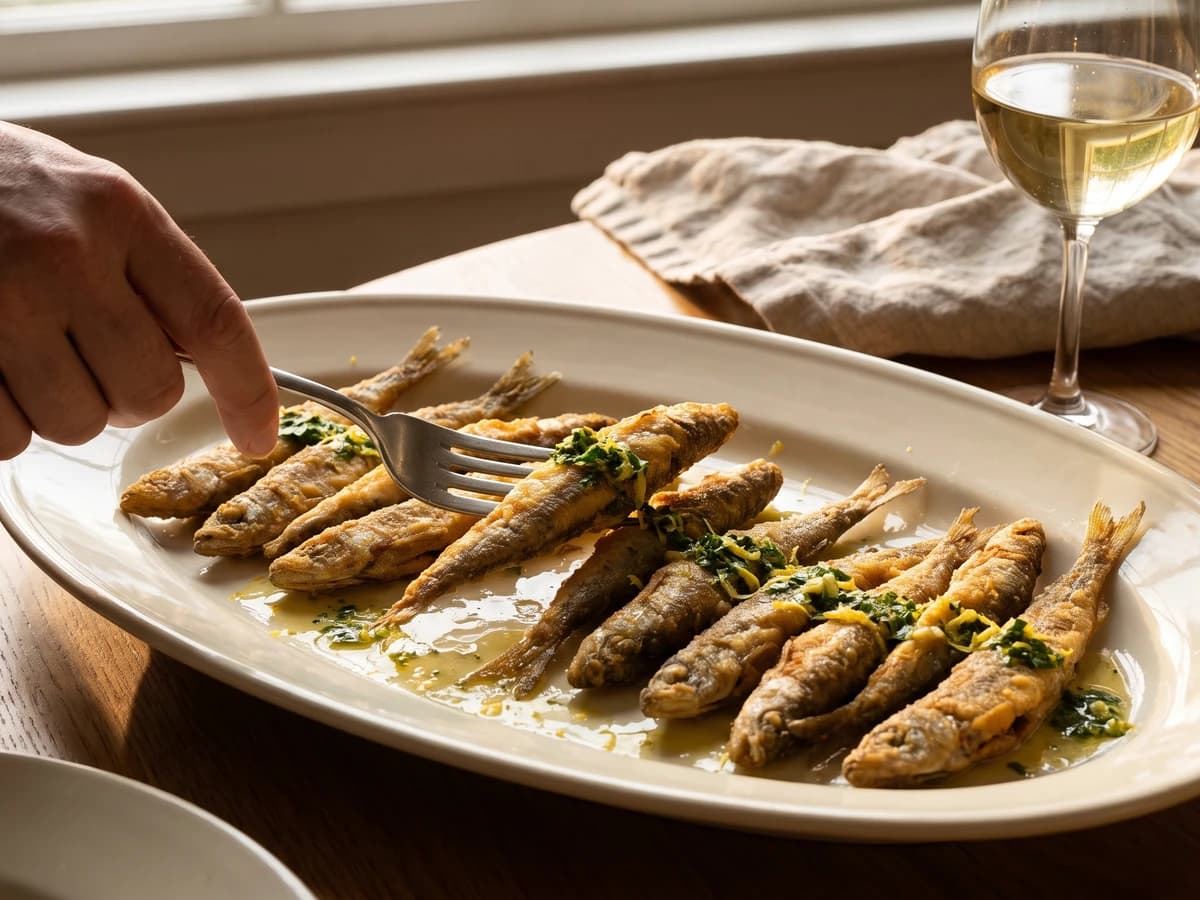
Éperlans à l’Anglaise turns small fish into a lesson in disciplined coating: boned smelts under a close, crisp crumb, pan-fried in clarified butter and finished with bright, half-melted maître d’hôtel butter.

Chef Juliette
Tiny smelts, shallot, mushrooms, white wine, gratin sauce, and fine bread raspings meet a fierce oven, where the fish must turn tender in the same breath the buttered crust bronzes.