
Chef Juliette
John Dory (St. Pierre)
John Dory has the delicacy of sole and the firmness of turbot. A light flouring, a quick butter sauté, and nut-brown beurre noisette show exactly why looks never mattered.
A cooking platform built around craft, culture, and the stories behind what we eat.

Created by Chef Juliette
Based on No. 1779, Pigeonneaux en Crapaudine, from Le Guide Culinaire (1907) by Auguste Escoffier
Four young pigeons, opened crapaudine, brushed with real butter and cloaked in fine crumbs, then grilled over gentle heat until bronze, with a bright, peppery Sauce Diable at the table.
Pigeonneaux en crapaudine (young pigeons split and flattened like toads) teaches one true thing: breaded poultry needs measured heat. The butter must bronze the fine crumbs while the tender flesh cooks through beside the bone. Rush it under a fierce flame and the coating burns before the bird is ready.
The professional kitchen assumed a charcoal gridiron or salamander whose heat could be moderated, a saucier on staff, and brown stock never off the fire for Sauce Diable (devilled sauce). Here, brigade portions become four individual squab, the grill becomes a low broiler over a wire rack, and the ready brown sauce becomes a compact wine-and-stock reduction made in one saucepan. That prepared sauce was brigade scaffolding and can go. Splitting the birds, coating them with real butter and fine crumbs, and grilling them gently are the dish itself, and they stay. One cook, one stove, one evening.
The reward is wonderfully direct: dark, tender pigeon under a crisp butter-gold coat, with a glossy sauce sharp from wine, vinegar, and cayenne. Moderate the heat before the first bird goes beneath it. That is the step that decides everything.
Pigeonneaux en crapaudine belongs to the national French classical grill repertory, particularly the dining rooms of Paris, rather than to one regional larder. Crapaudine comes from crapaud, meaning toad: the name describes the flattened silhouette, with wings and legs splayed, not a sauce or garnish. Young pigeon suited the treatment because its tender flesh cooked quickly over a moderated gridiron, and the method traveled from grand grill stations to bourgeoise tables with little more than a household grill and a saucepan for Sauce Diable.
Quantity
4 birds, 12 to 16 ounces (340 to 450 g) each
Quantity
2 teaspoons (10 ml / 12 g)
divided
Quantity
1 teaspoon (5 ml / 2 g)
divided
Quantity
8 tablespoons (120 ml / 113 g)
divided, 6 tablespoons melted and 2 tablespoons cold and cubed
Quantity
1½ cups (360 ml / 90 g)
Quantity
¼ cup (60 ml / 45 g)
finely chopped
Quantity
½ cup (120 ml / 120 g)
Quantity
¼ cup (60 ml / 60 g)
Quantity
1 tablespoon (15 ml / 16 g)
Quantity
2¼ cups (540 ml / 540 g)
divided
Quantity
¼ teaspoon (1.25 ml / 0.5 g)
| Ingredient | Quantity |
|---|---|
| oven-ready young squab (pigeonneaux) | 4 birds, 12 to 16 ounces (340 to 450 g) each |
| fine sea saltdivided | 2 teaspoons (10 ml / 12 g) |
| freshly ground black pepperdivided | 1 teaspoon (5 ml / 2 g) |
| unsalted butterdivided, 6 tablespoons melted and 2 tablespoons cold and cubed | 8 tablespoons (120 ml / 113 g) |
| fine fresh white breadcrumbs | 1½ cups (360 ml / 90 g) |
| shallotsfinely chopped | ¼ cup (60 ml / 45 g) |
| dry white wine | ½ cup (120 ml / 120 g) |
| white wine vinegar | ¼ cup (60 ml / 60 g) |
| tomato paste | 1 tablespoon (15 ml / 16 g) |
| rich unsalted chicken stockdivided | 2¼ cups (540 ml / 540 g) |
| cayenne pepper | ¼ teaspoon (1.25 ml / 0.5 g) |
Combine the shallots, white wine, and vinegar in a small heavy saucepan. Bring them to a lively simmer and reduce until about 2 tablespoons remain, 8 to 10 minutes; the acidity should smell rounded rather than raw. Whisk in the tomato paste and 2 cups (480 ml / 480 g) of the stock, then simmer uncovered for 20 to 25 minutes, until reduced to about 1 cup and able to coat a spoon lightly. Strain into a clean saucepan and reserve. If it tightens while it waits, loosen it spoonful by spoonful with the reserved stock.
Set a squab breast-side up on a steady cutting board, with the cavity toward you. Starting at the pointed lower end of the breastbone, guide a sharp boning knife almost horizontally through the fine ribs toward one wing joint, then repeat toward the other wing. Leave the upper back and skin connected as a hinge rather than separating the bird into two pieces. Open it wide, turn it skin-side up, and press gently until the breast, wings, and legs lie in one flattened crapaudine shape. Repeat with the remaining birds, pat them dry, and season every surface with 1½ teaspoons of the salt and ¾ teaspoon of the pepper.
Melt 6 tablespoons of the butter and let it cool until warm. Use a little to grease a wire rack set over a rimmed sheet pan, then brush or dip each squab generously on both sides with the remaining melted butter. Press the birds into the breadcrumbs, coating every surface evenly without building a thick shell. Set them on the rack and rest the coating for 10 minutes so the butter and crumbs bind; if bare patches appear, dab them with butter and press on more crumbs.
Heat the broiler on low and position the oven rack about 8 inches (20 cm) below it. If your broiler has only one fierce setting, move the rack to 10 inches (25 cm). Arrange the squab inner-side up and grill for 8 to 10 minutes, then turn them carefully with a wide spatula and grill skin-side up for another 8 to 12 minutes. Rotate the pan whenever the colour develops unevenly. The crumbs should become deep butter-gold while the thickest parts of both breast and inner thigh reach 165°F (74°C), away from the bone. If the crumbs darken before the flesh is ready, lower the rack and shield only the darkest patches with small pieces of foil. Ça se rattrape. Rest the birds for 5 minutes while the sauce is finished.
Return the strained sauce base to a gentle simmer. Whisk in the cayenne, then taste and add the reserved salt and pepper as needed; Sauce Diable should be sharp and warming, never bluntly hot. If it is too loose, reduce it before adding the butter. Remove the pan from the heat and monter au beurre, whisking in the 2 tablespoons of cold cubed butter one piece at a time until the sauce gleams and naps the spoon. If the butter separates, place 1 teaspoon of cold water in a clean warm bowl and whisk the sauce into it gradually until smooth again.
Arrange the pigeonneaux on a warmed oval platter with their wings and legs opened so the crapaudine shape remains clear. Bring the Sauce Diable to the table in a warmed sauce boat and spoon it beside each bird, not over the crisp crumbs. One bird makes a generous serving. À table!
1 serving (about 290g)
Culinary guides, cultural storytelling, and the editorial depth that makes cooking meaningful.
Discover Culinary ExplorerChef Juliette
John Dory has the delicacy of sole and the firmness of turbot. A light flouring, a quick butter sauté, and nut-brown beurre noisette show exactly why looks never mattered.

Chef Juliette
Fresh haddock proves its delicacy in the meunière pan: a fine flour crust, moist pearly flakes, and beurre noisette sharpened with lemon and parsley, ready from one skillet in half an hour.
Chef Juliette
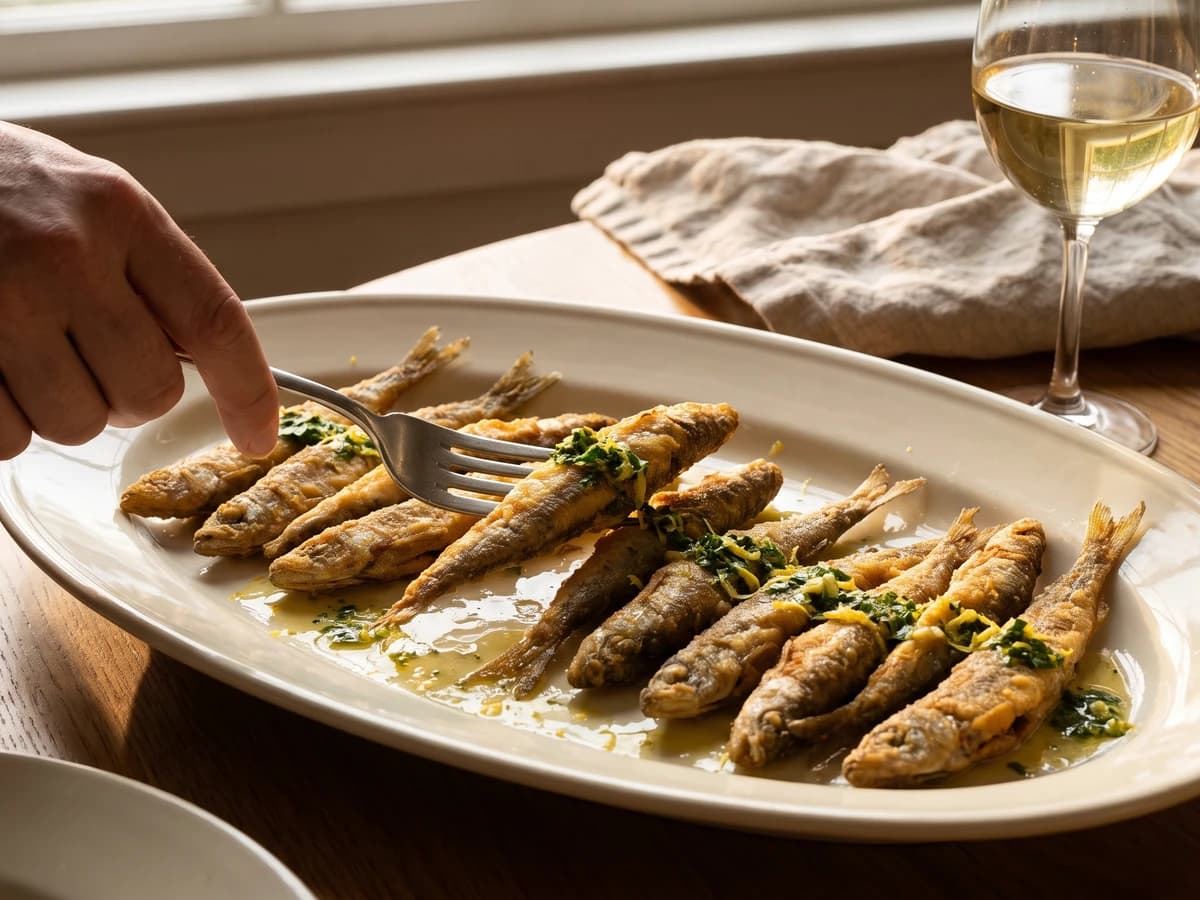
Éperlans à l’Anglaise turns small fish into a lesson in disciplined coating: boned smelts under a close, crisp crumb, pan-fried in clarified butter and finished with bright, half-melted maître d’hôtel butter.

Chef Juliette
Tiny smelts, shallot, mushrooms, white wine, gratin sauce, and fine bread raspings meet a fierce oven, where the fish must turn tender in the same breath the buttered crust bronzes.