
Chef Juliette
John Dory (St. Pierre)
John Dory has the delicacy of sole and the firmness of turbot. A light flouring, a quick butter sauté, and nut-brown beurre noisette show exactly why looks never mattered.
A cooking platform built around craft, culture, and the stories behind what we eat.

Created by Chef Juliette
Based on No. 1768, Aiguillettes de Canetons à l’Écarlate, from Le Guide Culinaire (1907) by Auguste Escoffier
Cold duckling aiguillettes lacquered with brown chaud-froid, scarlet tongue, truffle, and clear aspic, laid in strict alternation over a silken duck mousse that must set firm before the pattern begins.
Aiguillettes de Canetons à l’Écarlate (thin duckling breast slices with scarlet tongue) teaches the architecture of a cold composed dish: each layer must be properly set before the next can rest upon it. The one true thing to know before touching a pan is this: the leg-meat mousse must be cold and firm before you arrange the aiguillettes. If it is merely cool, the pattern sinks and the aspic turns muddled.
The original assumed a saucier on staff, brown stock never off the fire, and a cold room lined with silver trays. At home, a covered Dutch oven handles the poêling, a blender replaces the pounding and sieving of a brigade, and a shallow oval metal dish serves four. The separate sauce station and ranks of waiting platters were scaffolding, so they can go. The poêling, the equal cuts of duck and tongue, the brown chaud-froid, the firm mousse, and the clear aspic are the dish itself, so they stay. The salamander can remain dark; this is cold work.
The finished platter is striking without theater: brown-glazed duck, scarlet cured tongue, black truffle, and clear aspic arranged over pale mousse. One cook, one stove, one evening of work, then the refrigerator completes the service. Set that mousse until it resists a light fingertip before laying a single aiguillette.
Aiguillettes de Canetons à l’Écarlate belongs to the Parisian grand-kitchen repertoire of cold decorated poultry, while its specified Rouen duckling ties the platter to Normandy’s celebrated duck raising. Écarlate names the scarlet cured tongue, not a red sauce: the colour comes from alternating it with brown-glazed duck beneath clear aspic. Such preparations carried poêled poultry into cold buffet and formal bourgeois service, where precise carving and preservation mattered as much as roasting.
Quantity
1 bird (about 4 lb / 1.8 kg), prepared by Poëlings (No. 250), with Aiguillettes de Rouennais à la Bigarrade (No. 1755) as the lengthwise carving reference
Quantity
16 thin slices (about 7 oz / 200 g)
Quantity
1½ cups (360 ml / 360 g)
Quantity
2¼ cups (540 ml / 540 g)
Quantity
⅓ cup (80 ml / 80 g)
divided
Quantity
2 tablespoons (30 ml / 28 g)
Quantity
2 tablespoons (30 ml / 16 g)
Quantity
8 teaspoons (40 ml / 24 g)
divided
Quantity
½ cup (120 ml / 120 g)
divided
Quantity
¾ cup (180 ml / 180 g)
thoroughly chilled
Quantity
1 small truffle (about ¾ oz / 20 g)
cut into small lozenges
Quantity
Up to 1 teaspoon (5 ml / 6 g)
as needed
Quantity
½ teaspoon (2.5 ml / 1 g)
| Ingredient | Quantity |
|---|---|
| Rouen duckling or small Pekin duckling | 1 bird (about 4 lb / 1.8 kg), prepared by Poëlings (No. 250), with Aiguillettes de Rouennais à la Bigarrade (No. 1755) as the lengthwise carving reference |
| cooked cured beef tongue | 16 thin slices (about 7 oz / 200 g) |
| unsalted brown veal stock | 1½ cups (360 ml / 360 g) |
| clear unsalted chicken consommé or light veal stock | 2¼ cups (540 ml / 540 g) |
| Madeiradivided | ⅓ cup (80 ml / 80 g) |
| unsalted butter | 2 tablespoons (30 ml / 28 g) |
| plain flour | 2 tablespoons (30 ml / 16 g) |
| powdered gelatindivided | 8 teaspoons (40 ml / 24 g) |
| cold waterdivided | ½ cup (120 ml / 120 g) |
| heavy creamthoroughly chilled | ¾ cup (180 ml / 180 g) |
| black trufflecut into small lozenges | 1 small truffle (about ¾ oz / 20 g) |
| fine saltas needed | Up to 1 teaspoon (5 ml / 6 g) |
| ground white pepper | ½ teaspoon (2.5 ml / 1 g) |
Prepare the duckling by Poëlings (No. 250), keeping that linked preparation whole rather than rebuilding it here. Cook the bird only until done, with the thickest part of the thigh just reaching 165°F / 74°C. Strain the poêling liquor, set the duckling in a close-fitting vessel, and pour the liquor around it. Cool the vessel promptly over ice, then cover and refrigerate until the bird is cold throughout, about 2 hours. Lift off the set fat and reserve 1 cup (240 ml / 240 g) of the clear liquor; if the bird yielded less, make up the difference with brown veal stock.
Raise the two breasts whole and remove their skin. Aiguillettes de Rouennais à la Bigarrade (No. 1755) supplies the canonical lengthwise handling of the breast; follow that linked carving reference, then cut each breast into 8 long, thin aiguillettes of even size. Remove all usable meat from the legs and carcass and weigh out 10½ ounces (300 g) for the mousse. Trim the cured tongue into 16 slices matching the duck in length, width, and thickness. This equality is not decoration for its own sake: it makes every serving carry the intended alternation of duck and tongue.
Sprinkle 4½ teaspoons (22 ml / 14 g) of the gelatin over ¼ cup plus 1 tablespoon (70 ml / 70 g) of the cold water and leave it to bloom for 5 minutes. Bring the clear consommé and 2 tablespoons plus 1 teaspoon (35 ml / 35 g) of the Madeira just below a simmer, remove from the heat, and stir in the bloomed gelatin until completely dissolved. Strain without pressing, then spoon a teaspoon onto a cold saucer. It should set into a clear, tender gel within several minutes. If it remains weak, rewarm it and add a little of the reserved gelatin bloomed in an equal weight of cold water; if it sets rubbery, thin it with clear stock. Reserve ¾ cup (180 ml / 180 g) of liquid aspic for the mousse and keep the remainder cool but fluid.
Melt the butter in a small heavy saucepan, add the flour, and cook the roux over medium-low heat until it reaches the brown of a hazelnut and smells toasted, stirring steadily. Whisk in the reserved poêling liquor a little at a time, followed by 1 cup (240 ml / 240 g) of the brown veal stock and the remaining 3 tablespoons (45 ml / 45 g) Madeira. Simmer gently, skimming as needed, until reduced to about 1¼ cups (300 ml / 300 g) and glossy enough to coat a spoon. Bloom 2¼ teaspoons (11 ml / 7 g) gelatin in 2 tablespoons plus 1 teaspoon (35 ml / 35 g) cold water, dissolve it in the hot sauce off the heat, then strain. Cool the chaud-froid over ice, stirring, until it reaches nappant, a coating consistency that clings without running. If it sets too quickly, warm it for a few seconds; if it slides off the cold duck, return it to the ice and stir until thicker. Ça se rattrape.
Lay the chilled aiguillettes on a rack over a tray. Spoon or brush each with an even layer of brown chaud-froid, carrying the coating neatly to the edges, then chill until set. Place one small truffle lozenge on each piece and fix it with a dab of fluid aspic. On a second tray, brush the matching tongue slices with clear aspic and chill them until glossy and set. Keep the two sets separate and cold so their colours remain distinct.
Purée the 10½ ounces (300 g) cooked leg and trimming meat with the reserved ¾ cup (180 ml / 180 g) liquid aspic until completely smooth. Pass the mixture through a fine sieve, season cautiously with salt and white pepper, and chill it until cool but still fluid. Whip the cold cream to soft folds, not stiff peaks, then fold it through the duck base in three additions. The base must be cold before the cream enters; warmth melts the whipped structure and leaves the mousse loose. If that happens, set the bowl over ice and fold gently until it thickens again. Do not beat it harder.
Spread the mousse evenly in a shallow 1½-quart oval or square serving dish, making a level layer about 1 inch (2.5 cm) deep. Tap the dish lightly to settle hidden air pockets, smooth the surface, cover, and refrigerate for at least 3 hours. It is ready only when a light fingertip leaves no dent. This setting is the step the dish cannot surrender; if the centre still yields, give it more time rather than trying to freeze the surface around a soft middle.
Arrange the coated duck aiguillettes and aspic-glazed tongue over the firm mousse, alternating one brown duck slice with one scarlet tongue slice. Work in two close rows or a single overlapping fan, depending on the shape of the dish, but preserve the sequence. Spoon a very thin veil of syrupy aspic over the exposed mousse and the arranged slices, then chill for 10 minutes before adding a second thin coat. If a piece shifts or floats, the aspic was too warm: lift the piece, blot the spot, rechill the mousse, and set it back in place.
Cover the finished dish without touching its surface and refrigerate for at least 2 hours, or overnight, until the aspic is clear and firmly set. Remove it from the cold 15 minutes before serving so the duck and mousse lose their refrigerator hardness while remaining properly chilled. Use a broad serving spoon to cut through both aiguillettes and mousse, preserving the brown-and-scarlet alternation in each portion. À table!
1 serving (about 530g)
Culinary guides, cultural storytelling, and the editorial depth that makes cooking meaningful.
Discover Culinary ExplorerChef Juliette
John Dory has the delicacy of sole and the firmness of turbot. A light flouring, a quick butter sauté, and nut-brown beurre noisette show exactly why looks never mattered.

Chef Juliette
Fresh haddock proves its delicacy in the meunière pan: a fine flour crust, moist pearly flakes, and beurre noisette sharpened with lemon and parsley, ready from one skillet in half an hour.
Chef Juliette
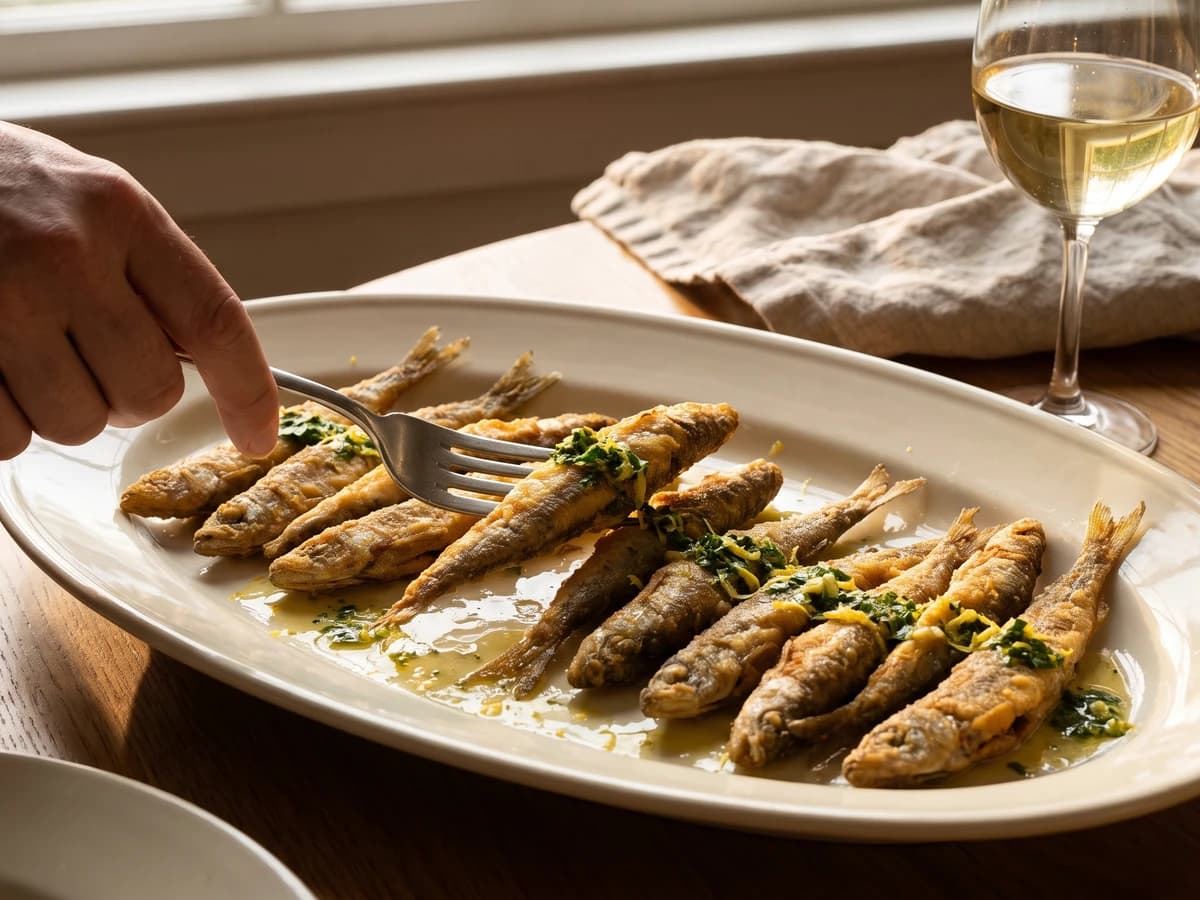
Éperlans à l’Anglaise turns small fish into a lesson in disciplined coating: boned smelts under a close, crisp crumb, pan-fried in clarified butter and finished with bright, half-melted maître d’hôtel butter.

Chef Juliette
Tiny smelts, shallot, mushrooms, white wine, gratin sauce, and fine bread raspings meet a fierce oven, where the fish must turn tender in the same breath the buttered crust bronzes.