
Chef Juliette
John Dory (St. Pierre)
John Dory has the delicacy of sole and the firmness of turbot. A light flouring, a quick butter sauté, and nut-brown beurre noisette show exactly why looks never mattered.
A cooking platform built around craft, culture, and the stories behind what we eat.

Created by Chef Juliette
Based on No. 1747, Caneton Molière, from Le Guide Culinaire (1907) by Auguste Escoffier
Caneton Molière rebuilds a boned duckling around foie gras, pork, and two truffle rows, then poaches it in carcass stock before a glossy Madeira finish. The lesson is cold filling, even shaping, and gentle heat.
Caneton Molière (boned duckling with foie gras, truffle, and Madeira) teaches reconstruction: once a bird is boned, its evenness becomes its cooking method. The one true thing to know before touching a pan is that a cold, evenly packed duck cooks safely from edge to center; a loose bulge gives you dry breast around an underdone middle.
The entry assumed a practiced boning hand, a stockpot never off the fire, a saucier to clear and reduce the cooking stock, and a salamander for glazing. Here, a butcher can bone the bird, its chopped carcass makes the poaching stock, a fat separator replaces repeated clarification, and the broiler supplies fierce overhead heat. The separate stations are brigade scaffolding. The three-to-two forcemeat ratio, two truffle rows, carcass-stock poach, glaze, and Madeira sauce are the dish, so every one stays.
For four plates, the original pound of foie-gras forcemeat and two-thirds pound of sausage meat become eight ounces and five and one-third ounces, preserving the ratio exactly. Its two-ounce allotment of sliced sauce truffle becomes one ounce, while one additional ounce supplies the two rows whose weight the entry leaves unstated. One cook, one stove, one evening. The step that decides everything is the stitching: keep the filling cold, distribute it evenly, and close the skin without strangling it.
Caneton Molière belongs to the Parisian grand-kitchen repertoire, where elaborate poultry preparations were often named for celebrated figures and recorded as distinct formulas within the classical canon. Its title does not claim a recipe from Molière's own table; its character lies in the method, a boned bird reconstructed around foie gras and truffle, poached like a galantine, then returned hot beneath Madeira sauce. Carving revealed the two deliberate truffle rows, turning careful kitchen geometry into part of the dining-room pleasure.
Quantity
1 duckling, 4 to 4½ pounds (1.8 to 2 kg)
boned through the back with skin and meat kept in one piece; carcass, neck, and wing bones reserved
Quantity
8 ounces (about 1 cup / 225 g) gratin foie-gras forcemeat prepared according to Gratins (No. 268)
Quantity
5⅓ ounces (about ⅔ cup / 150 g)
unsmoked and without herbs
Quantity
2 ounces (about ½ cup when thinly sliced / 56 g)
divide one ounce into long pieces for the filling and thinly slice the remaining ounce
Quantity
8 cups (1.9 liters / 1.9 kg)
Quantity
¾ cup (180 ml / 180 g)
Quantity
2 tablespoons (30 ml / 28 g)
diced
Quantity
1 teaspoon (5 ml / 6 g)
divided
Quantity
½ teaspoon (2.5 ml / 1 g)
divided
| Ingredient | Quantity |
|---|---|
| whole young ducklingboned through the back with skin and meat kept in one piece; carcass, neck, and wing bones reserved | 1 duckling, 4 to 4½ pounds (1.8 to 2 kg) |
| chilled gratin foie-gras forcemeat | 8 ounces (about 1 cup / 225 g) gratin foie-gras forcemeat prepared according to Gratins (No. 268) |
| plain fresh pork sausage meatunsmoked and without herbs | 5⅓ ounces (about ⅔ cup / 150 g) |
| fresh black trufflesdivide one ounce into long pieces for the filling and thinly slice the remaining ounce | 2 ounces (about ½ cup when thinly sliced / 56 g) |
| cold water | 8 cups (1.9 liters / 1.9 kg) |
| dry or medium-dry Madeira | ¾ cup (180 ml / 180 g) |
| cold unsalted butterdiced | 2 tablespoons (30 ml / 28 g) |
| fine sea saltdivided | 1 teaspoon (5 ml / 6 g) |
| freshly ground black pepperdivided | ½ teaspoon (2.5 ml / 1 g) |
Ask the butcher to bone the duckling through the back while preserving the skin and attached meat as one sheet, and insist that every bone comes home with you. If doing it yourself, cut along the backbone, scrape the meat gradually from the carcass, disjoint the shoulders and hips, then work the leg and wing bones out from inside without piercing the skin. Refrigerate the boned bird at once while you prepare the stock.
Heat the oven to 450°F (230°C). Chop the carcass and larger bones so they fit closely in a roasting pan, then roast them without added fat for 25 to 30 minutes, until deeply browned but never black. Transfer them to a narrow stockpot. Deglaze the roasting pan with some of the measured water, scraping up the fond, then add this and the remaining water to the bones. Bring slowly to a simmer, skim the first foam, and cook uncovered for 50 minutes. This short stock continues extracting while the duck poaches, the honest home equivalent of a stockpot kept permanently on the fire.
Set a mixing bowl over ice. Fold the chilled gratin foie-gras forcemeat prepared according to Gratins (No. 268) together with the sausage meat until the mixture is uniform and just tacky, preserving the source's three-to-two ratio. Fry a teaspoonful and taste it, then adjust with a little of the measured salt and pepper only if needed. If the mixture softens or releases fat, stop mixing and chill it for 20 minutes. Ça se rattrape: cold restores the bind, while more stirring only makes it greasy.
Lay the duck skin-side down and spread the meat into an even rectangle, opening the thickest leg portions slightly if necessary. Season the exposed meat with most of the remaining salt and pepper. Spread half the forcemeat over the center, leaving a 1-inch (2.5 cm) border. Arrange 1 ounce (28 g) of truffle in two straight, parallel rows running from neck to tail through the thickest part, then cover them with the remaining forcemeat. Keep the filling even from end to end; this geometry is what lets the duck cook through without sacrificing its outer meat.
Bring the two long skin edges over the filling so they meet along the back. Tuck in the neck and tail ends, then sew the seam with a trussing needle and strong kitchen twine, using loose stitches about 1 inch (2.5 cm) apart. The skin should contain the filling without compressing it hard, since the forcemeat expands as it cooks. Wrap the reconstructed duck tightly in a clean unbleached muslin cloth, roll it into an even galantine shape, and tie it at five or six intervals. If a seam opens, overlap it, add another stitch, and rewrap. Ça se rattrape.
Strain the carcass stock into the narrowest pot that will hold the wrapped duckling and bring it to 180°F (82°C). Lower in the duck, weighting it with a small heatproof plate if it floats, and hold the stock between 175°F and 180°F (79°C and 82°C). It must barely tremble, never boil. Poach for 85 to 105 minutes, checking through the cloth at the thickest center, until the filling reaches 165°F (74°C). If the stock boils, pull the pot off the heat immediately and let it fall below 180°F before continuing. The duck isn't ruined, but a sustained boil will force out fat and toughen the forcemeat. Lift the duck onto a rack and rest it, still wrapped, for 15 minutes.
Strain the poaching stock through a fine sieve, let it settle for 5 minutes, then remove every visible trace of fat with a separator or careful ladling. Return the defatted stock to a wide saucepan and boil steadily until about 2 cups (475 ml) remain and the liquid lightly coats a spoon. Do not season before reducing, because the stock concentrates fiercely. If it looks greasy or cloudy, let it settle again and separate the fat before continuing; repeated egg-white clarification belonged to a staffed kitchen, while thorough skimming preserves the intent at home.
Heat the broiler and place a rack about 6 inches (15 cm) beneath it. Unwrap the rested duck, snip and remove every stitch, then pat the skin completely dry. Reserve ⅓ cup (80 ml) of the reduced stock and brush a thin coat over the duck. Following the glazing operation within Gratins (No. 268), broil for 1 to 2 minutes, brush again, and repeat until two or three coats form a taut chestnut lacquer. Watch without wandering. If one patch colors too quickly, shield it with foil and continue glazing the pale areas.
Add the Madeira to the remaining reduced duck stock and boil until the sauce reaches nappé, a coating consistency, and about 1¼ cups (300 ml) remain. Add the reserved 1 ounce (28 g) of sliced truffle and simmer gently for 2 minutes. Remove the pan from the heat and whisk in the cold butter a few pieces at a time until the sauce gleams. Taste and use the remaining salt and pepper as needed. If the sauce tightens too far, loosen it with a spoonful of water; if the butter separates, whisk in a teaspoon of cold water off the heat. Ça se rattrape.
Transfer the glazed duckling to a warmed oval platter. Spoon the Madeira sauce over it generously, letting the sliced truffles settle across the lacquered skin and the sauce pool around the base. Carve crosswise into thick slices so each portion reveals duck meat, foie-gras forcemeat, and the two dark truffle rows. Never apologize at your own table. À table!
1 serving (about 375g)
Culinary guides, cultural storytelling, and the editorial depth that makes cooking meaningful.
Discover Culinary ExplorerChef Juliette
John Dory has the delicacy of sole and the firmness of turbot. A light flouring, a quick butter sauté, and nut-brown beurre noisette show exactly why looks never mattered.

Chef Juliette
Fresh haddock proves its delicacy in the meunière pan: a fine flour crust, moist pearly flakes, and beurre noisette sharpened with lemon and parsley, ready from one skillet in half an hour.
Chef Juliette
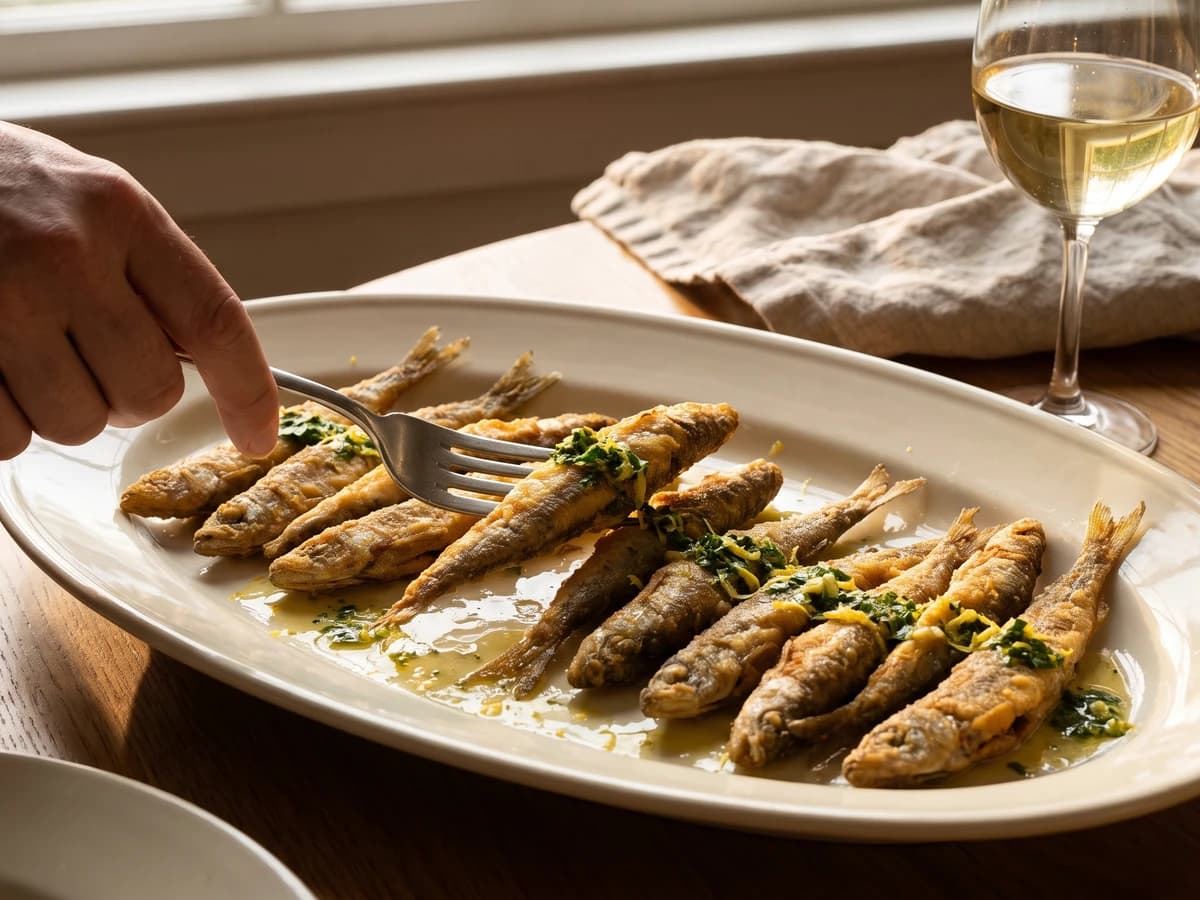
Éperlans à l’Anglaise turns small fish into a lesson in disciplined coating: boned smelts under a close, crisp crumb, pan-fried in clarified butter and finished with bright, half-melted maître d’hôtel butter.

Chef Juliette
Tiny smelts, shallot, mushrooms, white wine, gratin sauce, and fine bread raspings meet a fierce oven, where the fish must turn tender in the same breath the buttered crust bronzes.