
Chef Juliette
John Dory (St. Pierre)
John Dory has the delicacy of sole and the firmness of turbot. A light flouring, a quick butter sauté, and nut-brown beurre noisette show exactly why looks never mattered.
A cooking platform built around craft, culture, and the stories behind what we eat.

Created by Chef Juliette
Based on No. 1741, Pain de Foie Gras, from Le Guide Culinaire (1907) by Auguste Escoffier
Pain de Foie Gras turns Madeira-braised liver into a silken, truffled aspic: a lesson in warm emulsion, gentle folding, and the quiet confidence of a cold dish made entirely ahead.
Pain de Foie Gras (a moulded foie gras loaf) teaches one true thing before you touch a pan: temperature is an ingredient. The Madeira liquor is mounted with yolks and real butter by the Hollandaise method, then joined with sieved foie gras only when both are lukewarm. Too hot and the fat separates. Too cold and the gelatin catches before the mixture turns silken.
The original assumed a Madeira-braised foie already waiting cold, clear aspic from a stockpot never off the fire, and a saucier free to tend the emulsion. Your honest equivalents are a snug saucepan, prepared clear poultry aspic, a bowl over barely simmering water, a fine sieve, and a small mould sized for four. The yolks and butter are reduced in proportion with the foie gras, and the elaborate buffet decoration becomes a few true truffle slices and diamond croûtons of jelly. That decoration is scaffolding. The reduction, warm emulsion, sieve, and restrained folding are the dish itself.
Once unmoulded, the pain should stand pale gold beneath a lucid coat of aspic, with dark truffle and neat collops crossing each slice. It is generous, cold, and entirely make-ahead. The step that matters most is the fold: wait until the emulsion is lukewarm, work gently, and stop the moment it is smooth.
Pain de foie gras belongs to the formal Parisian cold table, where foie gras associated with the distinct traditions of Alsace and Périgord was arranged with Madeira, truffle, and aspic in composed moulds. The word pain describes the loaf-like form rather than bread, while the croûtons surrounding it are cut diamonds of aspic jelly, another piece of the classical kitchen's precise vocabulary. The dish traveled from elaborate cold buffets to private dining rooms because its chief virtue is practical as well as splendid: it can be finished before the guests arrive.
Quantity
1 lobe (about 1 lb / 450 g)
deveined and kept whole
Quantity
¾ teaspoon (3.75 ml / 4.5 g)
Quantity
⅛ teaspoon (0.6 ml / 0.3 g)
Quantity
½ cup (120 ml / 118 g)
Quantity
2 large, plus 1 extra yolk for rescue if needed
Quantity
½ cup (120 ml / 113 g)
cut into small cubes and cool but pliable
Quantity
1 leaf (about 2 g)
soaked in cold water and squeezed dry
Quantity
1 large (about 1.5 g)
toasted, skinned, and finely crushed
Quantity
1 small truffle (about 20 g)
drained, patted dry, and thinly sliced
Quantity
1¾ cups (420 ml / 420 g), for Another Method of Preparing Aspics de Filets de Soles (No. 916) and the croûtons
melted and divided
| Ingredient | Quantity |
|---|---|
| fresh duck or goose foie gras lobedeveined and kept whole | 1 lobe (about 1 lb / 450 g) |
| fine sea salt | ¾ teaspoon (3.75 ml / 4.5 g) |
| ground white pepper | ⅛ teaspoon (0.6 ml / 0.3 g) |
| medium-dry Madeira | ½ cup (120 ml / 118 g) |
| pasteurized egg yolks | 2 large, plus 1 extra yolk for rescue if needed |
| unsalted buttercut into small cubes and cool but pliable | ½ cup (120 ml / 113 g) |
| gold-strength gelatin leafsoaked in cold water and squeezed dry | 1 leaf (about 2 g) |
| hazelnuttoasted, skinned, and finely crushed | 1 large (about 1.5 g) |
| preserved black truffledrained, patted dry, and thinly sliced | 1 small truffle (about 20 g) |
| clear poultry aspic jellymelted and divided | 1¾ cups (420 ml / 420 g), for Another Method of Preparing Aspics de Filets de Soles (No. 916) and the croûtons |
Keep the foie gras cold while you remove any visible veins, disturbing the lobe as little as possible. Season it evenly with the salt and white pepper. Bring the Madeira to a bare tremble in a snug saucepan, lay in the foie gras, and cover. Braise over very gentle heat for 12 to 18 minutes, turning once and spooning Madeira over the exposed surface, until the centre reaches 63°C / 145°F. The liquor must never boil hard, or the liver sheds its fat instead of keeping its silken body. If bubbling becomes vigorous, lift the pan from the heat at once and let it settle before continuing.
Lift the foie gras onto a small tray and let it cool for 20 minutes, then cover and refrigerate until completely cold, about 2 hours. Strain the cooking liquor into a narrow cup and chill it beside the liver so every trace of fat solidifies on top. Lift that fat away cleanly. With a thin knife warmed in hot water and wiped dry, cut six neat collops, meaning thin slices, about 3 to 4 mm thick and 120 g in total. Reserve them cold. If a slice cracks, add it to the portion destined for the sieve; nothing is lost.
Keep the melted aspic barely fluid, around 30°C / 86°F. Pour ½ cup (120 ml) into a shallow dish in a layer about 6 mm thick and refrigerate it for the croûtons. Use the remaining clear poultry aspic jelly with Another Method of Preparing Aspics de Filets de Soles (No. 916): set the mould in a bowl of ice, pour in several spoonfuls of jelly, and rotate it slowly until a thin, even coat clings to every surface. Drain away the excess and chill until firm. Fix three handsome truffle slices to the base with drops of aspic, cover them with another thin layer, and chill again. This is clothing the mould, and the cold metal replaces the broken ice and brigade hands of the original method.
Measure the completely degreased cooking liquor, then simmer it in the smallest saucepan you own until precisely half that volume remains. The reduction should smell round and concentrated, with no harsh breath of alcohol. Let it cool for 3 minutes. Reducing by half is not decorative scaffolding; it concentrates the Madeira and gives the yolks enough flavour without flooding the emulsion.
Whisk the two yolks with the reduced cooking liquor in a heatproof bowl set over barely simmering water, keeping the bowl above the water rather than in it. Whisk until the mixture is pale, creamy, and holds the trace of the whisk. Add the butter a cube at a time, whisking each addition smooth before the next. This is the Hollandaise method, a warm yolk-and-butter emulsion. If the butter begins pooling, take the bowl off the heat and whisk in 1 teaspoon of cool water. If it breaks fully, whisk the spare yolk with 1 teaspoon of water in a clean bowl, then rebuild the sauce by adding the broken emulsion one spoonful at a time. Ça se rattrape. Whisk in the crushed hazelnut and softened gelatin until the gelatin has completely dissolved.
Press the remaining cold foie gras through a fine-mesh sieve with a flexible scraper, leaving any coarse fibres behind. Let the Madeira emulsion cool to 35 to 38°C / 95 to 100°F, distinctly lukewarm but still fluid, then fold the sieved foie gras into it in three additions. Use broad, gentle strokes and stop the moment the mixture is uniform. This is the step that decides the Pain de Foie Gras: hot emulsion melts and separates the liver fat, while cold emulsion catches the gelatin before the mixture is smooth. If beads of fat appear, stop. Whisk the spare yolk with a teaspoon of cool water in a clean bowl over barely warm water, then work the broken mixture into it by spoonfuls and cool it back to lukewarm before proceeding.
Spread a 1 cm layer of foie gras mixture in the clothed mould. Lay on some reserved collops and truffle slices without pressing them into paste, then cover with another layer of the mixture. Repeat until the mould is filled, finishing with the foie gras mixture. If it begins setting before the mould is filled, hold the bowl over the warm bain-marie for five seconds, remove it, and fold once or twice until supple. Cover the final layer with a 5 mm cap of the clear poultry aspic jelly used for Another Method of Preparing Aspics de Filets de Soles (No. 916).
Cover the mould without disturbing the aspic and refrigerate for at least 6 hours, preferably overnight. The butter, foie gras, gelatin, and aspic must set as one structure, so do not hurry it in the freezer. One cook, one stove, one evening of work, then the refrigerator takes the night watch.
Cut the shallow tray of clear poultry aspic jelly associated with Another Method of Preparing Aspics de Filets de Soles (No. 916) into small diamonds. These are the croûtons named by the book, pieces of jelly rather than bread. Dip the mould in lukewarm water for 5 seconds, dry it, invert it onto a chilled platter, and lift. If it resists, repeat for only 2 or 3 seconds; too much warmth melts the clear aspic clothing. Border the Pain de Foie Gras with the croûtons and let it stand for 10 minutes before slicing with a warm, dry knife. À table!
1 serving (about 255g)
Culinary guides, cultural storytelling, and the editorial depth that makes cooking meaningful.
Discover Culinary ExplorerChef Juliette
John Dory has the delicacy of sole and the firmness of turbot. A light flouring, a quick butter sauté, and nut-brown beurre noisette show exactly why looks never mattered.

Chef Juliette
Fresh haddock proves its delicacy in the meunière pan: a fine flour crust, moist pearly flakes, and beurre noisette sharpened with lemon and parsley, ready from one skillet in half an hour.
Chef Juliette
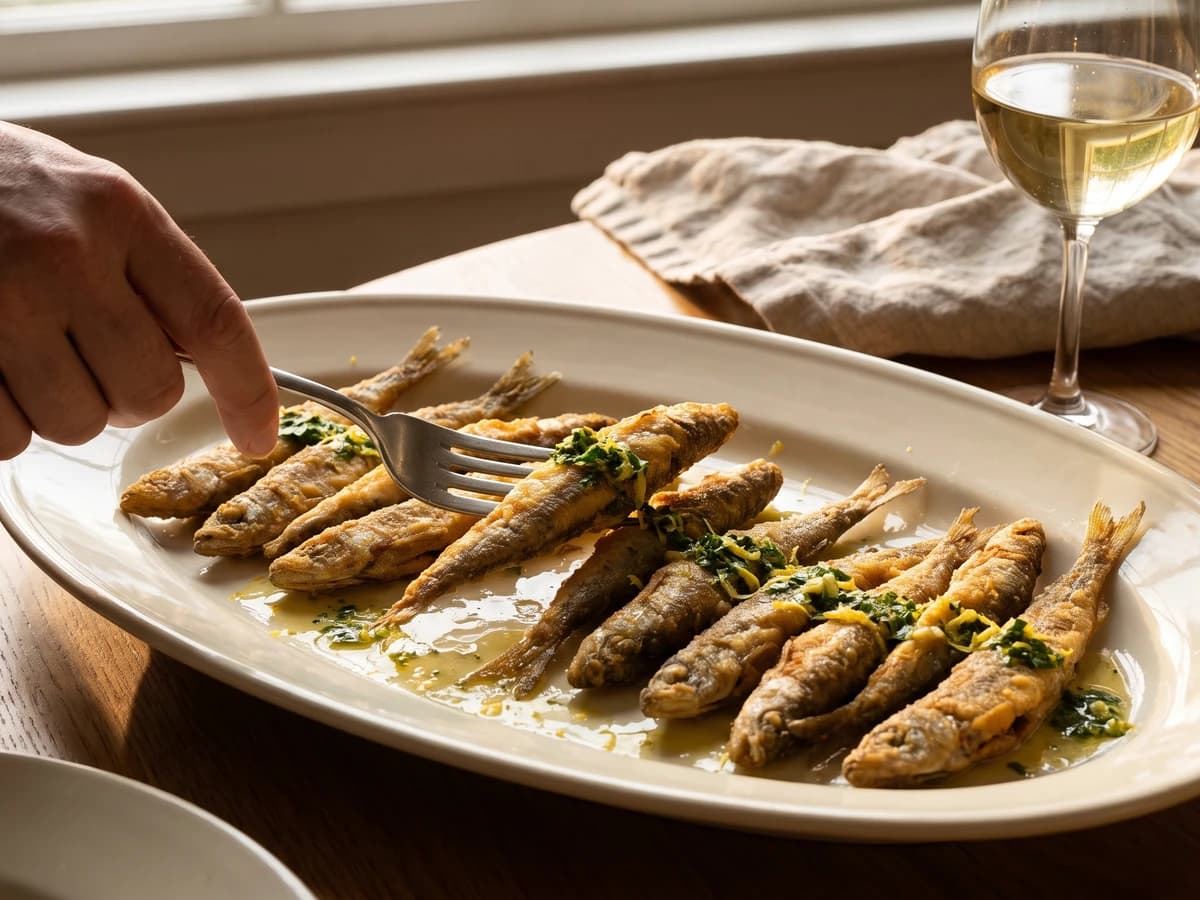
Éperlans à l’Anglaise turns small fish into a lesson in disciplined coating: boned smelts under a close, crisp crumb, pan-fried in clarified butter and finished with bright, half-melted maître d’hôtel butter.

Chef Juliette
Tiny smelts, shallot, mushrooms, white wine, gratin sauce, and fine bread raspings meet a fierce oven, where the fish must turn tender in the same breath the buttered crust bronzes.