
Chef Juliette
John Dory (St. Pierre)
John Dory has the delicacy of sole and the firmness of turbot. A light flouring, a quick butter sauté, and nut-brown beurre noisette show exactly why looks never mattered.
A cooking platform built around craft, culture, and the stories behind what we eat.

Created by Chef Juliette
Based on No. 1719, Dindonneau en Daube, from Le Guide Culinaire (1907) by Auguste Escoffier
A boned turkey breast closes around Cognac-scented forcemeat, truffle, bacon, and a vivid tongue center, then cooks under seal and chills in its own liquor for a generous cold-table centerpiece.
Dindonneau en Daube (young turkey breast cooked and cooled in its terrine) teaches the discipline of enclosure. The one true thing to know before touching a pan is this: the breast must close tightly around the forcemeat and bacon-wrapped red tongue. Empty pockets become grey gaps and loose slices after chilling.
The original assumed a larder cook who could bone, reconstruct, sew, and truss a whole young turkey while a saucier kept brown stock never off the fire. At home, one broad skin-on breast becomes the wrapper, kitchen twine replaces the larding needle, and finished Brown Veal Stock (No. 9) is fortified with turkey trimmings and wine instead of rebuilding a separate veal-and-beef stock beside it. Foil beneath a snug lid does the work of the flour-paste seal. Those are brigade scaffolding changes. The Cognac sausage meat, truffle, central tongue, sealed cooking, and cooling in the terrine are the dish, so they stay. One cook, one stove, one evening, then the refrigerator finishes the set overnight.
Turned out, the daube is cool and firm, with ivory turkey surrounding truffle-flecked forcemeat and a red tongue heart, all held by clear amber cooking jelly. Pack that center tightly and bind the roll before it meets the stock. That one act decides every slice.
Dindonneau en daube belongs to the Parisian classical cold table and the formal household buffet, where poultry was boned, filled, cooked under seal, and presented in clean slices. It shares the grammar of the galantine, but the daube cooks and cools in its closed terrine with concentrated liquor, giving it a particularly moist, close texture. Despite the name, this is not the wine-rich beef daube of Provence; generations of French cooks used daube more broadly for meat enclosed and slowly cooked, sometimes to be served cold.
Quantity
1 breast, about 2¼ pounds (1 kg)
butterflied; trimmings reserved
Quantity
1¼ teaspoons (6 ml / 7 g)
divided
Quantity
¾ teaspoon (4 ml / 1.5 g)
divided
Quantity
8 ounces (225 g)
well chilled
Quantity
1 tablespoon (15 ml / 14 g)
Quantity
1 ounce (30 g)
drained and finely diced
Quantity
1 small piece, about 4 ounces (115 g)
trimmed into a single baton
Quantity
6 slices, about 4 ounces (115 g)
Quantity
3 cups (720 ml / 720 g) Brown Veal Stock (No. 9)
Quantity
¾ cup (180 ml / 180 g)
Quantity
1 onion (about 4 ounces / 115 g)
quartered
Quantity
1 carrot (about 2½ ounces / 70 g)
thickly sliced
Quantity
1 bouquet garni
3 parsley stems, 1 thyme sprig, and 1 bay leaf
| Ingredient | Quantity |
|---|---|
| boneless, skin-on turkey breastbutterflied; trimmings reserved | 1 breast, about 2¼ pounds (1 kg) |
| fine sea saltdivided | 1¼ teaspoons (6 ml / 7 g) |
| freshly ground black pepperdivided | ¾ teaspoon (4 ml / 1.5 g) |
| high-quality plain pork sausage meatwell chilled | 8 ounces (225 g) |
| Cognac | 1 tablespoon (15 ml / 14 g) |
| fresh or preserved black truffledrained and finely diced | 1 ounce (30 g) |
| cooked cured ox or beef tonguetrimmed into a single baton | 1 small piece, about 4 ounces (115 g) |
| thin unsmoked streaky bacon | 6 slices, about 4 ounces (115 g) |
| Brown Veal Stock | 3 cups (720 ml / 720 g) Brown Veal Stock (No. 9) |
| dry white wine | ¾ cup (180 ml / 180 g) |
| small yellow onionquartered | 1 onion (about 4 ounces / 115 g) |
| small carrotthickly sliced | 1 carrot (about 2½ ounces / 70 g) |
| bouquet garni3 parsley stems, 1 thyme sprig, and 1 bay leaf | 1 bouquet garni |
Set the turkey skin-side down. Holding a sharp knife parallel to the board, open the thick lobes like a book, then cover the meat with parchment and pound it gently into a roughly 10 by 12-inch (25 by 30 cm) sheet of even ½-inch (1.25 cm) thickness. Trim ragged edges, reserving one broad flap for patching and the smaller trimmings for the stock. Season the meat with ¾ teaspoon of the salt and half the pepper. If the knife makes a hole, don't panic. Ça se rattrape: cover it with the reserved flap and pound once lightly so the pieces adhere.
Put the small turkey trimmings, onion, carrot, and bouquet garni in a saucepan. Add the white wine and Brown Veal Stock (No. 9), bring them to a bare simmer, and skim away any foam. Simmer gently for 35 minutes, strain without crushing the vegetables, then reduce the liquid until 2 cups (480 ml) remain. It should taste full and lightly wine-scented, not aggressively salty. If it slips below 2 cups, add enough water to restore the measure. Keep the stock warm.
Keep the sausage meat cold while you mix in the Cognac, diced truffle, and remaining pepper. Work it firmly with a wooden spoon until it becomes tacky and holds together, then fry a teaspoonful in a dry pan and taste it. Cold food mutes seasoning, so the sample should taste confidently seasoned while warm. Add the remaining salt only if it needs it. If the Cognac has made the mixture loose, chill it for 15 minutes and mix again. Ça se rattrape. Breadcrumbs would stiffen it, but they would also change the close, juicy slice this daube requires.
Lay three bacon slices lengthwise over the middle of the turkey sheet. Spread the forcemeat evenly over the meat, leaving a 1-inch (2.5 cm) border. Wrap the tongue baton snugly in the remaining three bacon slices and set it along the center. Press the forcemeat firmly around it with your fingertips, expelling every visible pocket of air. Bring the turkey around the filling to form a compact log, skin on the outside, and overlap the edges slightly. Tie it at 1½-inch (4 cm) intervals with kitchen twine. If the seam tries to open, add another tie rather than stretching the breast until it tears.
Heat the oven to 350°F (180°C). Set the turkey roll seam-side down in a snug 2-quart (1.9-liter) lidded terrine. It should fit closely without being crushed. Pour the warm reduced stock around it, nearly covering the roll without making it float. Press a double layer of heavy foil tightly across the rim, then set the lid over it. The old strip of flour paste was a seal, not a ceremony; foil gives the same enclosed cooking on a home stove.
Set the terrine on a rimmed baking sheet and cook for 1 hour 45 minutes before checking the center with an instant-read thermometer. It must reach 165°F (74°C), because the breast surrounds pork forcemeat. If it is not there, reseal the terrine and continue in 10-minute intervals. The liquor should barely quiver when uncovered. If it is boiling hard, lower the oven to 325°F (165°C); the moist seal protects the meat, and the daube can finish gently.
Remove the terrine from the oven and leave it sealed for 30 minutes. Do not turn the daube out warm. Set the terrine in an ice-water bath reaching halfway up its sides for 30 to 45 minutes, then dry the outside and refrigerate it, still covered and undisturbed in its cooking liquor, for at least 8 hours. This cooling in place sets the shape and turns the reduced stock into the clear jelly that holds moisture against the meat.
Remove the lid and foil, then skim away any firm surface fat. Stand the lower two-thirds of the terrine in warm water for 2 to 3 minutes, dry it well, and invert it over a chilled oval platter. If the daube refuses to release, return the terrine to the warm water for 30 seconds at a time. Never tug at the meat; the outside needs only a little more warmth. Remove the twine and cut ½-inch (1.25 cm) slices with a long knife dipped in warm water and wiped dry between cuts. Spoon any clear amber jelly around the slices. À table!
1 serving (about 380g)
Culinary guides, cultural storytelling, and the editorial depth that makes cooking meaningful.
Discover Culinary ExplorerChef Juliette
John Dory has the delicacy of sole and the firmness of turbot. A light flouring, a quick butter sauté, and nut-brown beurre noisette show exactly why looks never mattered.

Chef Juliette
Fresh haddock proves its delicacy in the meunière pan: a fine flour crust, moist pearly flakes, and beurre noisette sharpened with lemon and parsley, ready from one skillet in half an hour.
Chef Juliette
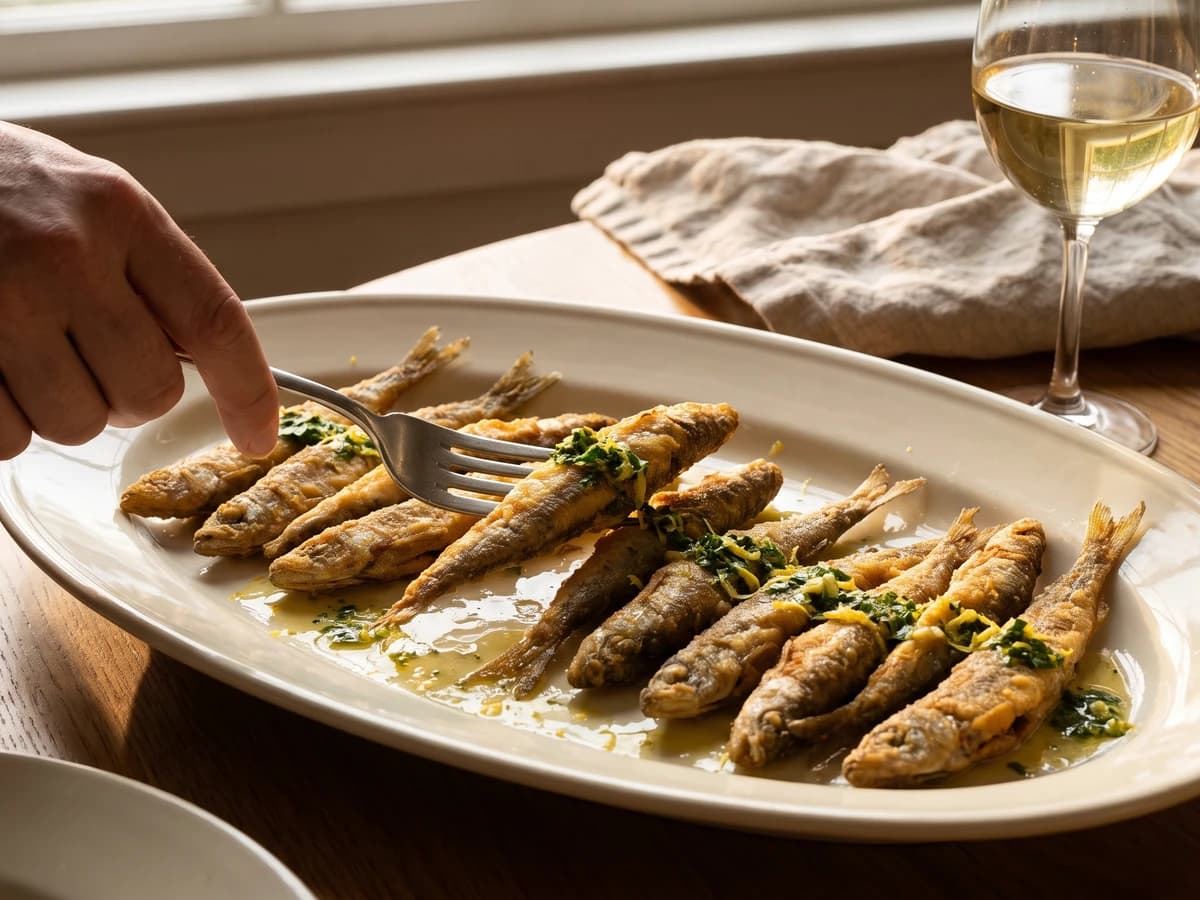
Éperlans à l’Anglaise turns small fish into a lesson in disciplined coating: boned smelts under a close, crisp crumb, pan-fried in clarified butter and finished with bright, half-melted maître d’hôtel butter.

Chef Juliette
Tiny smelts, shallot, mushrooms, white wine, gratin sauce, and fine bread raspings meet a fierce oven, where the fish must turn tender in the same breath the buttered crust bronzes.