
Chef Juliette
John Dory (St. Pierre)
John Dory has the delicacy of sole and the firmness of turbot. A light flouring, a quick butter sauté, and nut-brown beurre noisette show exactly why looks never mattered.
A cooking platform built around craft, culture, and the stories behind what we eat.

Created by Chef Juliette
Based on No. 1705, Aspic de Poulet à l’Italienne, from Le Guide Culinaire (1907) by Auguste Escoffier
A limpid border of chicken jelly holds pale fillet, rose salted tongue, and black truffle in deliberate layers, with bright salade à l’Italienne at its center and mustard-sharp rémoulade alongside.
Aspic de Poulet à l’Italienne (chicken aspic in the Italian manner) teaches the cold side of sauce work: jelly is stock given just enough structure to carry flavor and hold a clean turn. The one true thing to know before touching a pan is this: the aspic must be firm enough to leave the mould intact, but tender enough to melt as you eat it. A rubber ring is no triumph, however symmetrical.
The original entry assumed a saucier, a stockpot never off the fire, broken ice by the bucket, and a border mould sized for brigade service. The salamander used for hot finishes has no work in this cold construction. For four, we poach the chicken in good clear stock, strengthen that liquor with a measured amount of gelatin, and use an ordinary metal ring mould nested in ice water. A full clarification is needed only if the stock clouds; clarity itself is not optional. One cook, one stove, one unhurried evening, then the refrigerator finishes the work.
The banquet quantity and endless ornamental repetitions were scaffolding, so they go. Clothing the mould, fixing broad truffle slices, keeping the chicken, tongue, and truffle in successive layers, and turning everything onto a very cold dish are the dish, so they stay. When it is right, the jelly is pale gold and limpid, the tongue shows rose through it, and the black truffle marks the border like polished stone. The decisive step is clothing the mould with jelly cool enough to cling and fluid enough to run.
Aspic de Poulet à l’Italienne belongs to the Parisian grand-kitchen cold table and the bourgeois buffet, where clear jelly protected cooked meats while displaying the saucier's discipline. The phrase à l’Italienne names the composed salad placed inside the border, not a claim that the mould came from an Italian household kitchen. As aspics moved from large formal displays to smaller home tables, dependable gelatin and modest ring moulds replaced brigade infrastructure, while chicken fillet, salted tongue, truffle, and limpid jelly remained the identifying structure.
Quantity
4 cups (960 ml / 960 g), for the clear jelly required by Aspic de Homard (No. 954)
Quantity
2 large (about 1 lb / 450 g)
Quantity
1 small (about 1/2 cup / 60 g)
sliced
Quantity
1 small (about 1 cup / 90 g)
washed and sliced
Quantity
1
Quantity
1 tablespoon (15 ml / 18 g)
divided between seasoning and cooking water
Quantity
1/2 teaspoon (2.5 ml / 1 g)
divided
Quantity
2 tablespoons (30 ml / 18 g), for the successive setting used in Another Method of Preparing Aspics de Filets de Soles (No. 916)
Quantity
1 teaspoon (5 ml / 3 g)
Quantity
1 large (about 2 tablespoons / 30 ml / 30 g)
Quantity
1 cup (240 ml / 140 g)
cut into coarse julienne
Quantity
2 small (about 1/4 cup / 30 g)
drained if preserved
Quantity
2 medium (about 1 1/4 cups / 200 g)
cut into small dice
Quantity
1 cup (240 ml / 120 g)
trimmed and cut into short lengths
Quantity
1 cup (240 ml / 100 g)
quartered
Quantity
1/3 cup (80 ml / 50 g)
finely diced
Quantity
2 tablespoons (30 ml / 20 g)
drained
Quantity
3 tablespoons (45 ml / 41 g)
Quantity
1 1/2 tablespoons (22 ml / 22 g)
Quantity
1 tablespoon (15 ml / 3 g)
chopped
Quantity
2 teaspoons (10 ml / 2 g)
chopped and divided
Quantity
1
Quantity
1 tablespoon (15 ml / 15 g)
Quantity
3/4 cup (180 ml / 165 g)
Quantity
1 tablespoon (15 ml / 15 g)
Quantity
2 tablespoons (30 ml / 30 g)
finely chopped
Quantity
1 tablespoon (15 ml / 10 g)
drained and finely chopped
Quantity
1 tablespoon (15 ml / 4 g)
finely chopped
| Ingredient | Quantity |
|---|---|
| clear low-sodium chicken stock | 4 cups (960 ml / 960 g), for the clear jelly required by Aspic de Homard (No. 954) |
| boneless, skinless chicken breasts | 2 large (about 1 lb / 450 g) |
| carrot for the poaching liquorsliced | 1 small (about 1/2 cup / 60 g) |
| leek, white part onlywashed and sliced | 1 small (about 1 cup / 90 g) |
| bouquet garni | 1 |
| fine sea saltdivided between seasoning and cooking water | 1 tablespoon (15 ml / 18 g) |
| ground white pepperdivided | 1/2 teaspoon (2.5 ml / 1 g) |
| unflavored powdered gelatin | 2 tablespoons (30 ml / 18 g), for the successive setting used in Another Method of Preparing Aspics de Filets de Soles (No. 916) |
| additional unflavored powdered gelatin (optional) | 1 teaspoon (5 ml / 3 g) |
| egg white for clarification (optional) | 1 large (about 2 tablespoons / 30 ml / 30 g) |
| cooked salted ox tonguecut into coarse julienne | 1 cup (240 ml / 140 g) |
| whole black truffles, fresh or preserveddrained if preserved | 2 small (about 1/4 cup / 30 g) |
| waxy potatoescut into small dice | 2 medium (about 1 1/4 cups / 200 g) |
| haricots vertstrimmed and cut into short lengths | 1 cup (240 ml / 120 g) |
| small button mushroomsquartered | 1 cup (240 ml / 100 g) |
| cornichons for the salade à l’Italiennefinely diced | 1/3 cup (80 ml / 50 g) |
| capers for the salade à l’Italiennedrained | 2 tablespoons (30 ml / 20 g) |
| extra-virgin olive oil | 3 tablespoons (45 ml / 41 g) |
| white wine vinegar for the salade à l’Italienne | 1 1/2 tablespoons (22 ml / 22 g) |
| fresh chervilchopped | 1 tablespoon (15 ml / 3 g) |
| fresh tarragonchopped and divided | 2 teaspoons (10 ml / 2 g) |
| pasteurized large egg yolk | 1 |
| Dijon mustard | 1 tablespoon (15 ml / 15 g) |
| neutral oil | 3/4 cup (180 ml / 165 g) |
| white wine vinegar for the rémoulade | 1 tablespoon (15 ml / 15 g) |
| cornichons for the rémouladefinely chopped | 2 tablespoons (30 ml / 30 g) |
| capers for the rémouladedrained and finely chopped | 1 tablespoon (15 ml / 10 g) |
| flat-leaf parsleyfinely chopped | 1 tablespoon (15 ml / 4 g) |
Reserve 1/2 cup of the stock in the cold for blooming the gelatin. Put the remaining stock in a saucepan with the sliced carrot, leek, bouquet garni, 1 teaspoon of the salt, and half the white pepper. Bring it to a bare simmer, slip in the chicken breasts, and hold the liquid at the gentlest tremble until the thickest part reaches 165°F or 74°C, about 15 to 18 minutes. Lift out the chicken, cover it loosely, and let it cool completely. Hard boiling tightens the fillets and clouds the stock, two injuries from one impatient flame.
Strain the poaching liquor through a damp cloth without pressing the vegetables, skim away every trace of fat, and reduce it gently to 2 1/2 cups. The limpid, succulent standard required by Aspic de Homard (No. 954) remains the point. If the liquor is cloudy, cool it to lukewarm, whisk in the optional egg white, and bring it slowly to a bare simmer without further stirring. Let the raft gather the cloudiness for 10 minutes, then strain again through a freshly dampened cloth and restore the volume to 2 1/2 cups with water if necessary. Bloom the gelatin in the reserved cold stock for 10 minutes, then stir it into the hot clarified liquor off the heat. Do not boil it. Taste and season firmly, since cold mutes salt and pepper.
Spoon a teaspoon of jelly onto a chilled saucer and refrigerate it for 5 minutes. It should hold a clean edge when pushed, yet soften immediately on the tongue. If it remains loose, rewarm the jelly gently and add the optional teaspoon of gelatin after blooming it in a tablespoon of cold water. If it sets like rubber, rewarm it and loosen it with 2 tablespoons of water. Never let the corrected jelly boil. This small test protects the whole mould.
Reserve 8 to 10 broad, thin truffle rounds for decorating the mould. Cut the remaining truffle, the cooled chicken, and the salted tongue julienne-fashion, into coarse match-shaped rods roughly 1 1/2 inches long. Keep the three fillings separate and return them to the cold. Warm filling would melt the jelly around it and blur the layers, so patience here is part of the construction.
Chill a 4-cup ring mould and the serving platter for 30 minutes. Set the mould level in a bowl of ice water, then pour in about 1/2 cup of cool, still-fluid jelly. Rock and turn the mould until a thin, even skin covers its base and walls, then pour the excess back into the bowl and chill the mould until firm. This is clothing the mould, the procedure carried by Aspic de Homard (No. 954), and it creates the clear outer shell. If the jelly slides away and leaves bare patches, it is too warm. Pour it out, chill both mould and jelly for 5 minutes, and try again. Ça se rattrape.
Arrange the reserved truffle rounds against the base and outer wall of the clothed mould. Fix each one with two or three drops of jelly and chill briefly, then spoon over enough jelly to cover the decoration by about 1/4 inch. Chill again until firm. If a truffle slice floats or slips, lift it out before the layer sets, re-chill the mould, and fix it with colder jelly. A regular pattern is handsome, but the firm fixing matters more than geometry.
Following the successive-layer construction of Another Method of Preparing Aspics de Filets de Soles (No. 916), spread a loose layer of chicken julienne over the set jelly, sprinkle it with cool fluid jelly, and chill just until tacky. Add a layer of tongue, more jelly, then a sparse layer of truffle. Repeat in that order until the mould is filled to within 1/4 inch of the rim. Pass a thin skewer gently through each fresh layer to release trapped bubbles, then seal the top with jelly. Do not stir the fillings together and pour once. The separate layers are the dish; the brigade's enormous quantities were scaffolding. Cover without touching the surface and chill for at least 6 hours.
Cook the diced potatoes in well-salted water until tender but still square at the edges, then drain them carefully. Blanch the haricots verts in the same water until bright and just tender, about 3 minutes, and cool them promptly in cold water before draining well. Cook the mushrooms gently in 1 tablespoon of the olive oil with a pinch of salt until their released liquid evaporates, without browning them. Once everything is cool, fold together the potatoes, beans, mushrooms, salad cornichons, salad capers, chervil, 1 teaspoon of the tarragon, the remaining olive oil, and the salad vinegar. Season with salt and white pepper, then chill the salade à l’Italienne separately so its dressing cannot cloud the aspic.
Anchor a bowl on a folded towel and whisk the pasteurized yolk with the Dijon mustard, 1 teaspoon of the rémoulade vinegar, and a pinch each of salt and white pepper. Add the neutral oil first by drops, then in a thin thread once the emulsion gains body, whisking without pause. Thin it with the remaining vinegar, then fold in the rémoulade cornichons, rémoulade capers, parsley, and remaining tarragon. If the emulsion splits, put a teaspoon of cold water in a clean bowl and whisk the broken sauce into it one spoonful at a time. Ça se rattrape. Cover and keep cold.
Dip the mould in hot, not boiling, water for 5 seconds, dry it thoroughly, and invert it onto the very cold platter. Lift the mould straight up. If the aspic refuses to release, give it another 2 seconds in the water rather than shaking it into ruin. Return the turned-out aspic to the cold for 10 minutes if its surface has softened. Drain any loose dressing from the salade à l’Italienne, mound it generously in the center, and serve the rémoulade separately in a small sauceboat. À table!
1 serving (about 595g)
Culinary guides, cultural storytelling, and the editorial depth that makes cooking meaningful.
Discover Culinary ExplorerChef Juliette
John Dory has the delicacy of sole and the firmness of turbot. A light flouring, a quick butter sauté, and nut-brown beurre noisette show exactly why looks never mattered.

Chef Juliette
Fresh haddock proves its delicacy in the meunière pan: a fine flour crust, moist pearly flakes, and beurre noisette sharpened with lemon and parsley, ready from one skillet in half an hour.
Chef Juliette
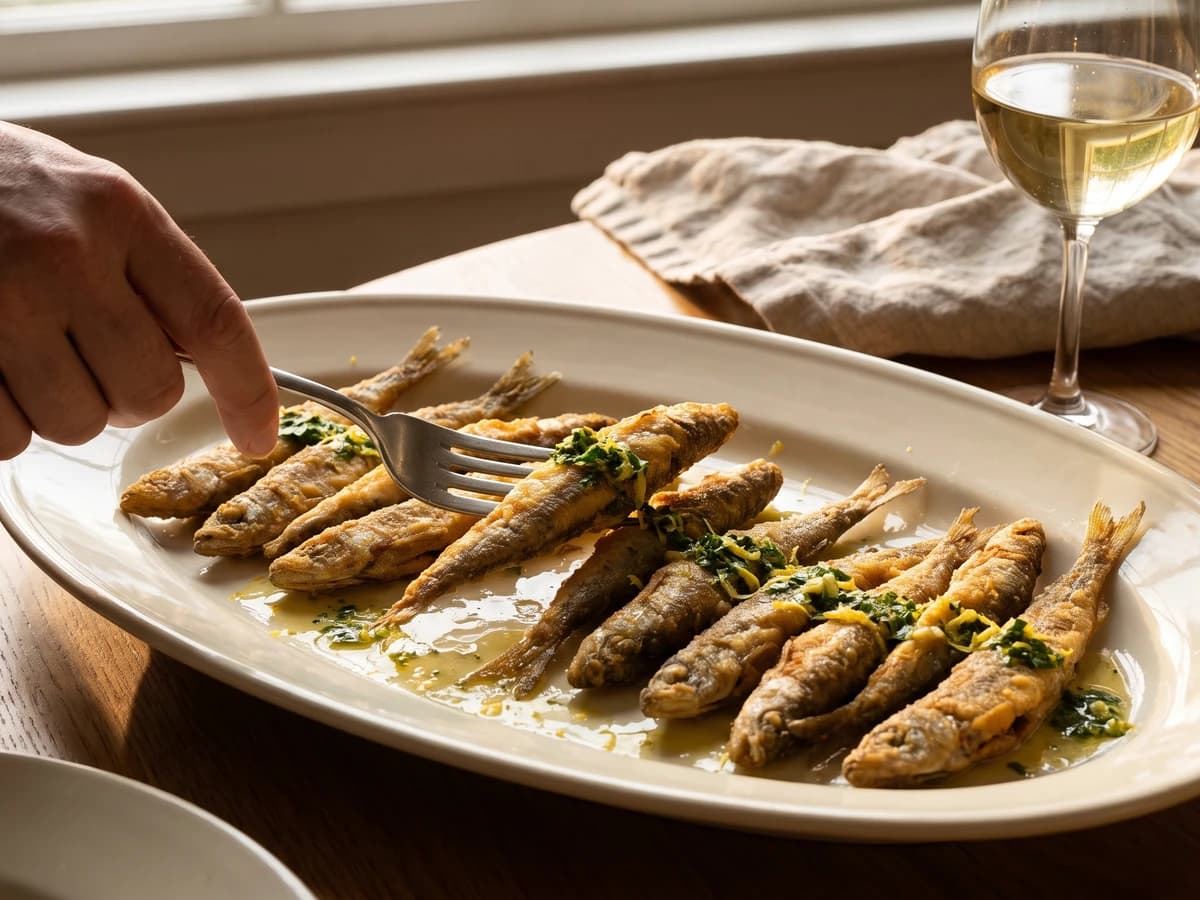
Éperlans à l’Anglaise turns small fish into a lesson in disciplined coating: boned smelts under a close, crisp crumb, pan-fried in clarified butter and finished with bright, half-melted maître d’hôtel butter.

Chef Juliette
Tiny smelts, shallot, mushrooms, white wine, gratin sauce, and fine bread raspings meet a fierce oven, where the fish must turn tender in the same breath the buttered crust bronzes.