
Chef Juliette
John Dory (St. Pierre)
John Dory has the delicacy of sole and the firmness of turbot. A light flouring, a quick butter sauté, and nut-brown beurre noisette show exactly why looks never mattered.
A cooking platform built around craft, culture, and the stories behind what we eat.

Created by Chef Juliette
Based on No. 1693, Chaud-froid de Poularde à la Rossini, from Le Guide Culinaire (1907) by Auguste Escoffier
A cool ivory coat enriched with one-quarter smooth foie gras purée, black truffle cut into lyres, and clear chicken jelly turn tender poularde into the disciplined splendor of the French cold table.
Chaud-froid de Poularde à la Rossini (chilled poularde in foie gras chaud-froid and chicken jelly) teaches one exact lesson: a cold coating exposes every grain. The foie gras must be pressed through a fine sieve before it meets the sauce, because no amount of careful decoration can disguise a lumpy mask. Get that smoothness right and the finished dish is magnificent, tender poultry under an ivory coating, four black truffle lyres, and clear jelly trembling around it.
The original entry assumed a saucier on staff, stock never off the fire, a cold-larder hand to coat each piece, and a special cutter waiting for the truffle. A salamander has no work in this cold dish. Your honest equivalents are a snug stockpot, finished ordinary chaud-froid sauce and chicken jelly prepared ahead, a fine sieve, a refrigerator, and a paper lyre template cut with a sharp knife. The brigade's repeated tray handling is scaffolding and can go; the exact one-quarter proportion of foie gras purée, the smooth coating, the truffle lyre, and the clear jelly are the dish and must stay. One cook, one stove, one evening of work, with the refrigerator doing the waiting.
The moment that decides the chaud-froid comes when sauce meets cold poultry. It must flow like thick cream, neither warm enough to melt its richness nor cold enough to set in ridges. Watch that consistency before you coat the first piece, and the rest becomes calm, deliberate assembly.
Chaud-froid belongs to the formal cold tables of Parisian grand cuisine, where poultry cooked hot was chilled, masked with a sauce strengthened by jelly, decorated, and presented beneath clear aspic. Its name describes that passage from hot cooking to cold service, not a sauce intended to alternate between the two temperatures. In the classical vocabulary, à la Rossini signals the opulent pairing of foie gras and black truffle, while the lyre turns that familiar combination into a musical emblem.
Quantity
1, about 4 lb (1.8 kg)
Quantity
2 qt (1.9 L / 1.9 kg)
Quantity
1 (150 g)
peeled and quartered
Quantity
1 (100 g)
peeled and thickly sliced
Quantity
1 (50 g)
thickly sliced
Quantity
1
Quantity
2 tsp (10 ml / 12 g), plus more if needed
Quantity
2 cups (480 ml / 500 g)
Quantity
1/2 cup (120 ml / 115 g)
pressed through a fine sieve and measured afterward
Quantity
1 (25 g)
wiped clean
Quantity
4 cups (960 ml / 960 g)
melted and cooled until fluid
| Ingredient | Quantity |
|---|---|
| small poularde or plump roasting chicken | 1, about 4 lb (1.8 kg) |
| light unsalted chicken stock | 2 qt (1.9 L / 1.9 kg) |
| medium onionpeeled and quartered | 1 (150 g) |
| medium carrotpeeled and thickly sliced | 1 (100 g) |
| celery stalkthickly sliced | 1 (50 g) |
| bouquet garni | 1 |
| fine sea salt | 2 tsp (10 ml / 12 g), plus more if needed |
| prepared ordinary chaud-froid sauce | 2 cups (480 ml / 500 g) |
| very smooth cooked foie gras puréepressed through a fine sieve and measured afterward | 1/2 cup (120 ml / 115 g) |
| small firm black trufflewiped clean | 1 (25 g) |
| prepared chicken jellymelted and cooled until fluid | 4 cups (960 ml / 960 g) |
Put the stock, onion, carrot, celery, bouquet garni, and salt in a snug stockpot and bring them to a bare simmer. Lower in the poularde, breast downward, adding just enough water to cover if your pot demands it. Hold the liquid between 180 and 185°F (82 and 85°C), with only an occasional bubble, and poach for 45 to 55 minutes. The thickest part of the thigh must reach 165°F (74°C). A boil tightens the flesh and clouds the stock, so lower the heat at once if the surface becomes lively.
Lift the poularde onto a tray and let it drain for 10 minutes. While it is still manageable, divide it into four handsome portions: two leg quarters and two suprêmes, each breast with its first wing joint if possible. Remove the skin without tearing the flesh, trim away ragged edges, and set the pieces on a rack so every surface can cool. Refrigerate uncovered until completely cold and dry, about 1 hour, then cover. A damp piece makes the coating slide, so blot away any beads of moisture before proceeding.
Warm the ordinary chaud-froid sauce only until it becomes fluid, then let it settle near 86°F (30°C). Press the foie gras through a fine sieve, measure 1/2 cup, and whisk it into the 2 cups of sauce. That is one-quarter of the sauce's bulk, exactly as the entry requires. Pass the combined sauce through the sieve once more. If it looks grainy or greasy, don't discard it. Ça se rattrape: set the bowl over ice and whisk gently until it comes together, then sieve it again. If it has set too firmly, warm it over barely warm water, never direct heat.
Set the cold, dry poultry pieces on a rack over a tray. Spoon the foie gras chaud-froid over each piece from the center outward, letting it fall naturally over the sides until the flesh is completely hidden beneath a smooth ivory coat. If the sauce runs off translucent, chill it for 5 minutes; if it leaves ridges, warm it by a degree or two. Do not brush it back and forth. Chill the coated pieces for 15 to 20 minutes, until the surface is set but still faintly tacky.
Cut four broad truffle slices about 1/16 inch (1.5 mm) thick. Draw a simple lyre about 1 1/4 inches (3 cm) tall on parchment, cut it out, and use it as a guide with the point of a very sharp paring knife. The special lyre cutter was brigade equipment, not sacred technique; the clear silhouette is what matters. Set one truffle lyre on each tacky portion and dab it with a little cooled liquid chicken jelly to secure it.
Pour about 1/2 cup (120 ml) chicken jelly into a deep 8-inch (20 cm) square serving dish and chill it until just set. Arrange the four coated pieces neatly on this base. Pour a shallow ribbon of jelly around their feet and chill for 10 minutes to anchor them, then add the remaining jelly slowly down the inside wall of the dish until the pieces are covered. The jelly must be cool yet fluid. If it forms strings, warm it gently; if it feels warm against your wrist, wait, because warm jelly will dissolve the foie gras coating.
Refrigerate the dish uncovered until the jelly is fully set, about 4 hours, then cover it without touching the surface. Bring it from the cold 15 minutes before serving so the foie gras loses its refrigerator hardness while the jelly remains firm. Cut through the aspic with a thin knife dipped in hot water and wiped dry, and serve directly from the square dish. The lyres need no parsley, flowers, or further fuss. Cooking well is not cooking fancy. À table!
1 serving (about 640g)
Culinary guides, cultural storytelling, and the editorial depth that makes cooking meaningful.
Discover Culinary ExplorerChef Juliette
John Dory has the delicacy of sole and the firmness of turbot. A light flouring, a quick butter sauté, and nut-brown beurre noisette show exactly why looks never mattered.

Chef Juliette
Fresh haddock proves its delicacy in the meunière pan: a fine flour crust, moist pearly flakes, and beurre noisette sharpened with lemon and parsley, ready from one skillet in half an hour.
Chef Juliette
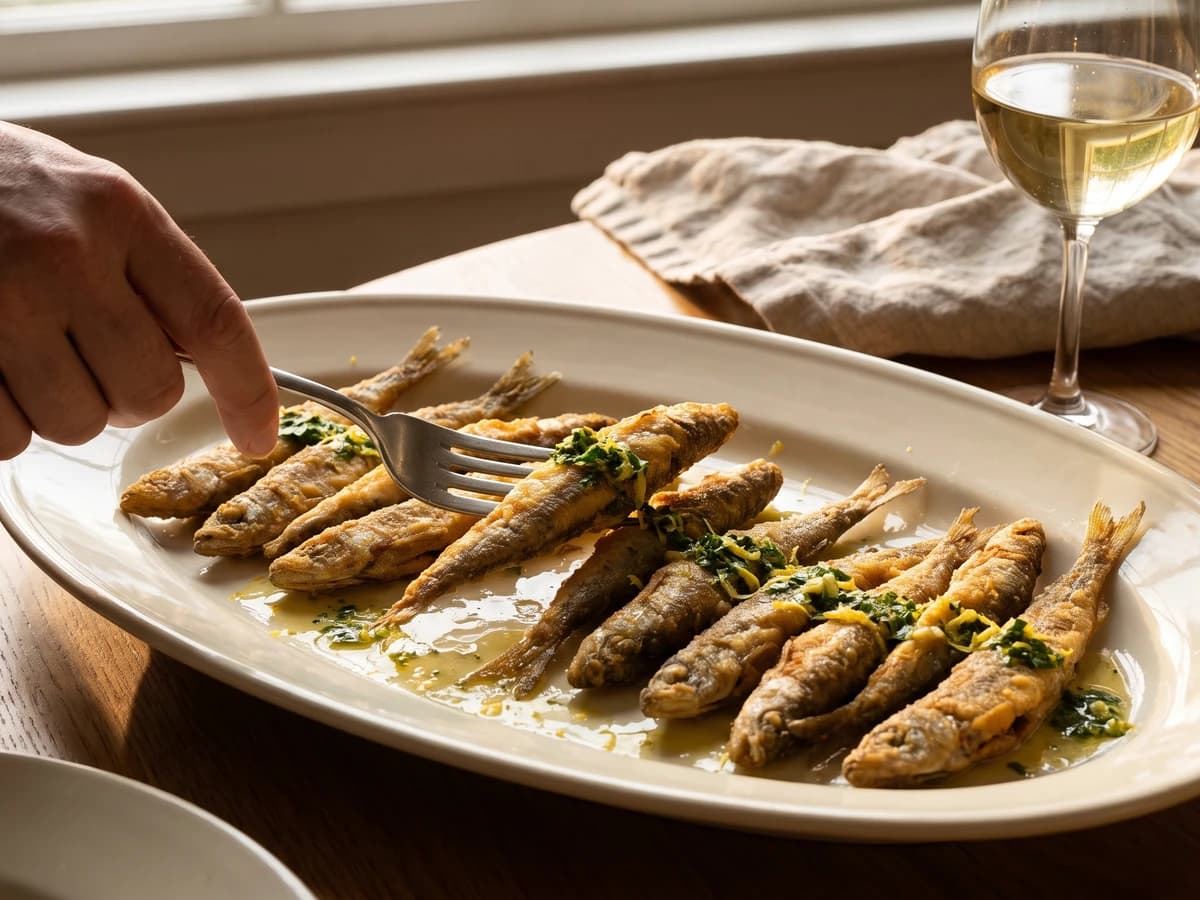
Éperlans à l’Anglaise turns small fish into a lesson in disciplined coating: boned smelts under a close, crisp crumb, pan-fried in clarified butter and finished with bright, half-melted maître d’hôtel butter.

Chef Juliette
Tiny smelts, shallot, mushrooms, white wine, gratin sauce, and fine bread raspings meet a fierce oven, where the fish must turn tender in the same breath the buttered crust bronzes.