
Chef Juliette
John Dory (St. Pierre)
John Dory has the delicacy of sole and the firmness of turbot. A light flouring, a quick butter sauté, and nut-brown beurre noisette show exactly why looks never mattered.
A cooking platform built around craft, culture, and the stories behind what we eat.

Created by Chef Juliette
Based on No. 1683, Soufflés de Volaille, from Le Guide Culinaire (1907) by Auguste Escoffier
Soufflés de Volaille rise by disciplined heat, not mystery: cooked chicken folded through a butter-bound base and whisked whites, then baked steadily until the bronze cap stands proud and the centre is fully set.
Soufflés de Volaille (chicken soufflés) teach the cleanest law of the soufflé family: lift comes from whisked whites, but structure comes from a properly cooked base and a complete bake. Here is the one true thing to know before touching the pan. A soufflé made with cooked chicken moves slowly in the oven, so give it steady heat and err a little long rather than pulling it at the first dramatic rise.
The brigade surrounding this dish once had a saucier on staff, stock never off the fire, a salamander ready for anything needing last colour, and enough hands to pound raw chicken through a mortar and tamis for a banquet. For four people, cooked chicken is the sound road the old formula itself allows. A food processor replaces the mortar, a saucepan builds the roux, and an ordinary oven supplies all the colour required. Stock and salamander can go because they are brigade scaffolding here; the roux, carefully folded whites, and unhurried bake are the dish. One cook, one stove, one evening.
When it is right, the crown stands butter-gold above the dish, the edges are bronzed, and the centre is pale, savoury, and tender rather than wet. Fold only until the broad white streaks disappear, then leave the mixture alone. The bake decides everything after that.
Soufflés de Volaille belong less to a single French province than to the Parisian classical and bourgeois table, where the soufflé moved easily between grand dining rooms and disciplined home kitchens in the same deep-sided timbale. The name describes a structure, not sweetness: in classical vocabulary, hot soufflés could carry poultry, fish, meat, or game, with whisked egg whites providing their rise. Poultry preserved two practical roads, raw breast for large service and cooked meat for a small one, where an unhurried bake made splendid use of the bird already at hand.
Quantity
4 tbsp (60 ml / 56 g)
softened and divided
Quantity
2 tbsp (30 ml / 12 g)
Quantity
1½ packed cups (360 ml / 225 g)
chilled and roughly chopped
Quantity
¼ cup (60 ml / 60 g)
cold
Quantity
¼ cup (60 ml / 30 g)
Quantity
1 cup (240 ml / 240 g)
warmed
Quantity
5
separated
Quantity
2 tbsp (30 ml / 8 g)
finely chopped
Quantity
¾ tsp (3.75 ml / 4 g)
Quantity
¼ tsp (1.25 ml / 0.6 g)
Quantity
⅛ tsp (0.6 ml / 0.3 g)
Quantity
1
unbeaten, for rescuing overwhipped whites
| Ingredient | Quantity |
|---|---|
| unsalted buttersoftened and divided | 4 tbsp (60 ml / 56 g) |
| fine dry breadcrumbs | 2 tbsp (30 ml / 12 g) |
| cooked skinless chicken breastchilled and roughly chopped | 1½ packed cups (360 ml / 225 g) |
| heavy creamcold | ¼ cup (60 ml / 60 g) |
| all-purpose flour | ¼ cup (60 ml / 30 g) |
| whole milkwarmed | 1 cup (240 ml / 240 g) |
| large eggsseparated | 5 |
| flat-leaf parsleyfinely chopped | 2 tbsp (30 ml / 8 g) |
| fine sea salt | ¾ tsp (3.75 ml / 4 g) |
| ground white pepper | ¼ tsp (1.25 ml / 0.6 g) |
| freshly grated nutmeg | ⅛ tsp (0.6 ml / 0.3 g) |
| large egg white (optional)unbeaten, for rescuing overwhipped whites | 1 |
Set a rack in the lower third of the oven and heat it to 375°F (190°C), or 350°F (175°C) with a fan. Brush a 1½-quart (1.4-litre) straight-sided soufflé dish with 1 tablespoon of the softened butter, working upward from base to rim, then coat it evenly with the breadcrumbs and tap out the excess. Chill the prepared dish while making the base.
Put the chilled cooked chicken and cold cream in a food processor. Pulse in short bursts until the chicken is very fine and cohesive but still tender, scraping the bowl once or twice. Stop before it turns rubbery or slick. This replaces the brigade's mortar and tamis without changing the purpose, which is an even texture light enough to rise with the base.
Melt the remaining 3 tablespoons butter in a medium saucepan over moderate heat. Add the flour and stir for 2 minutes, keeping the roux pale while its raw smell gives way to warm biscuit. Add the warm milk gradually, whisking each addition smooth before pouring the next. Cook for 3 to 4 minutes, stirring firmly into the corners, until the mixture heaves in slow bubbles and leaves a clean path behind the spoon. If lumps appear, don't begin again. Ça se rattrape: press the base through a fine sieve while it is hot, return it to the pan, and continue.
Fold the processed chicken and cream into the roux and cook over gentle heat for 2 minutes, stirring, until the panade (the thick, starch-bound base) pulls cleanly from the pan. Remove it from the heat and stir in the parsley, salt, white pepper, and nutmeg. Spread the panade in a broad bowl and cool it for about 10 minutes, until warm rather than hot, then beat in the yolks one at a time. Hot panade cooks yolks into threads; if the bowl still feels hot against your palm, wait.
Whisk the 5 egg whites in a perfectly clean bowl until they hold supple medium peaks: firm enough to stand, still glossy enough to bend at the tip. If they become dry and grainy, whisk in the optional unbeaten white a little at a time until the mass turns smooth again. Fold one-quarter briskly into the chicken base to loosen it, then add the remainder in two portions, cutting down through the centre and turning the bowl as the spatula rises. Stop when no broad white streaks remain; repeated stirring spends the air you have just made.
Spoon the mixture into the chilled dish, filling it no more than two-thirds full. Level the top lightly, then run a clean thumb around the inside rim to make a shallow channel. Bake at once for 30 to 35 minutes without opening the door during the first 25. The crown should be deeply golden, the sides set, and the centre at least 160°F (71°C); a slender skewer should emerge hot with moist crumbs but no liquid egg. Cooked chicken soufflé runs slower than the raw-meat road, so err two or three minutes long rather than short. If the crown browns before the centre sets, lay foil loosely over it and finish the bake. No salamander and no broiler; steady oven heat gives the centre time to follow the crown.
Carry the Soufflés de Volaille directly to the table. Break through the bronze crown with a broad serving spoon and reach to the bottom so every portion receives both the savoury crust and the tender centre. A little settling is natural and changes nothing worth eating. Serve with a sharply dressed green salad. À table!
1 serving (about 195g)
Culinary guides, cultural storytelling, and the editorial depth that makes cooking meaningful.
Discover Culinary ExplorerChef Juliette
John Dory has the delicacy of sole and the firmness of turbot. A light flouring, a quick butter sauté, and nut-brown beurre noisette show exactly why looks never mattered.

Chef Juliette
Fresh haddock proves its delicacy in the meunière pan: a fine flour crust, moist pearly flakes, and beurre noisette sharpened with lemon and parsley, ready from one skillet in half an hour.
Chef Juliette
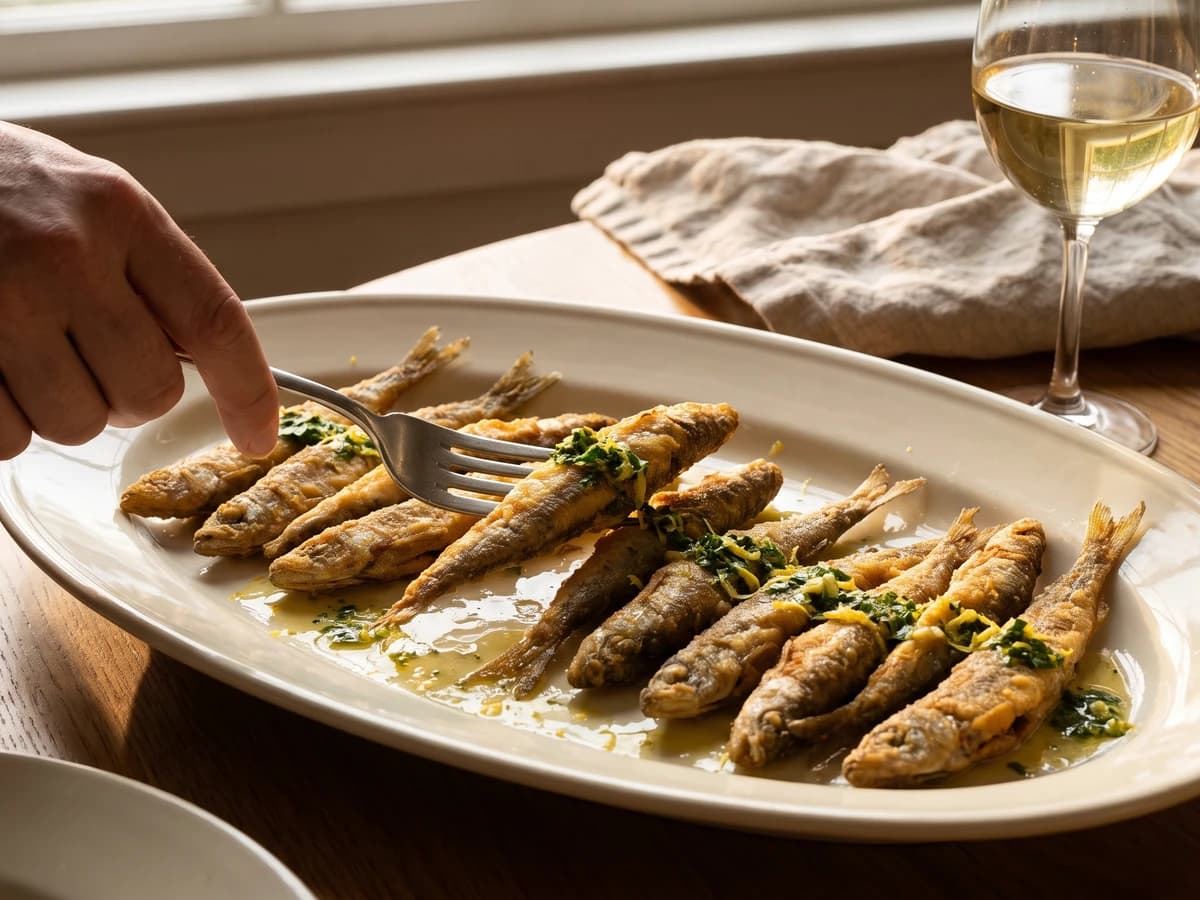
Éperlans à l’Anglaise turns small fish into a lesson in disciplined coating: boned smelts under a close, crisp crumb, pan-fried in clarified butter and finished with bright, half-melted maître d’hôtel butter.

Chef Juliette
Tiny smelts, shallot, mushrooms, white wine, gratin sauce, and fine bread raspings meet a fierce oven, where the fish must turn tender in the same breath the buttered crust bronzes.