
Chef Juliette
John Dory (St. Pierre)
John Dory has the delicacy of sole and the firmness of turbot. A light flouring, a quick butter sauté, and nut-brown beurre noisette show exactly why looks never mattered.
A cooking platform built around craft, culture, and the stories behind what we eat.

Created by Chef Juliette
Based on No. 1671, Mousselines de Volaille Alexandra, from Le Guide Culinaire (1907) by Auguste Escoffier
Four silken chicken mousselines, each under a fine slice of fowl, black truffle, and glossy Mornay, glazed in a breath and gathered around buttered asparagus: the grand canon made workable at home.
Mousselines de Volaille Alexandra (individual poached chicken mousses) teach one uncompromising lesson: the forcemeat must stay cold. Cold chicken, cold bowl, cold cream. Keep that chain intact and the mousselines poach into fine, tender ovals; let it warm while the cream goes in and the emulsion loosens before it ever reaches the water.
The original entry assumed Mousselines ready from the cold larder, cooked fowl from service, a saucier holding sauce Mornay (cheese-enriched béchamel), a stockpot never off the fire, shaped molds, and a salamander, the fierce overhead grill used for glazing. Tonight, a food processor and fine sieve replace the mortar and tamis, the drum sieve; four buttered ramekins replace the batterie of molds; a small pan of stock poaches the cap; a saucepan builds the Mornay; and the household broiler supplies the brief glaze. These are changes of equipment and scale, not intent. The brigade's parallel labor is scaffolding and can go; the cold emulsion, gentle poach, fowl-and-truffle cap, Mornay, and instant glaze are the dish and stay.
The platter should arrive as a ring of ivory mousselines under a barely bronzed, glossy coat, with green asparagus lifted in butter at the center and black truffle hidden just beneath the sauce. Glaze it, do not bake it. The step that decides everything comes earlier: add the cream while the forcemeat is truly cold, and stop the instant the paste loses its tight satin sheen.
Mousselines de Volaille Alexandra belong to Parisian grand cuisine, where fine poultry forcemeat was shaped as an individual portion and a named garnish told the kitchen how to finish it. In this preparation, Alexandra is not a separate sauce but the complete arrangement: cooked fowl and truffle over each mousseline, Mornay glazed above, then asparagus tips or small peas centered on the platter. The dish passed to formal home tables because its components could be prepared in sequence, with only the final glazing reserved for the moment of service.
Quantity
1 lb 2 oz (510 g)
divide into 14 oz (400 g) cold cubes and one 4 oz (110 g) whole piece
Quantity
2 cups (480 ml / 490 g)
Quantity
1¼ teaspoons (6.25 ml / 7.5 g)
divided, plus more for blanching water
Quantity
¼ teaspoon (1.25 ml / 0.6 g)
divided
Quantity
⅛ teaspoon (0.6 ml / 0.25 g)
divided
Quantity
2 large (about ¼ cup / 60 ml / 60 g)
ice-cold
Quantity
1¼ cups (300 ml / 300 g)
ice-cold
Quantity
6 tablespoons (90 ml / 84 g)
divided
Quantity
3 tablespoons plus 1 teaspoon (50 ml / 28 g)
Quantity
1⅓ cups (320 ml / 330 g)
warmed and divided
Quantity
½ cup (120 ml / 60 g)
finely grated
Quantity
¼ cup (60 ml / 20 g)
finely grated
Quantity
4 paper-thin slices (about 0.3 oz / 8 g)
fresh or preserved, drained and patted dry
Quantity
12 oz (340 g)
trimmed to about 3 inches (7.5 cm)
| Ingredient | Quantity |
|---|---|
| boneless, skinless chicken breastdivide into 14 oz (400 g) cold cubes and one 4 oz (110 g) whole piece | 1 lb 2 oz (510 g) |
| low-sodium chicken stock | 2 cups (480 ml / 490 g) |
| fine sea saltdivided, plus more for blanching water | 1¼ teaspoons (6.25 ml / 7.5 g) |
| ground white pepperdivided | ¼ teaspoon (1.25 ml / 0.6 g) |
| freshly grated nutmegdivided | ⅛ teaspoon (0.6 ml / 0.25 g) |
| large egg whitesice-cold | 2 large (about ¼ cup / 60 ml / 60 g) |
| heavy creamice-cold | 1¼ cups (300 ml / 300 g) |
| unsalted butterdivided | 6 tablespoons (90 ml / 84 g) |
| all-purpose flour | 3 tablespoons plus 1 teaspoon (50 ml / 28 g) |
| whole milkwarmed and divided | 1⅓ cups (320 ml / 330 g) |
| Gruyèrefinely grated | ½ cup (120 ml / 60 g) |
| Parmesanfinely grated | ¼ cup (60 ml / 20 g) |
| black trufflefresh or preserved, drained and patted dry | 4 paper-thin slices (about 0.3 oz / 8 g) |
| slender asparagus tipstrimmed to about 3 inches (7.5 cm) | 12 oz (340 g) |
Place the food processor bowl and blade, a metal mixing bowl, the cubed chicken, egg whites, and cream in the freezer for 15 minutes. Nothing should freeze; everything should become thoroughly cold. Meanwhile, bring the chicken stock to the barest tremble in a small saucepan. Add the whole 4 oz (110 g) piece of chicken, cover, and poach gently for 8 to 12 minutes, until its center reaches 165°F (74°C). Lift it out, cover it, and let it cool until firm enough to slice. Cut it across the grain into four fine ovals, no thicker than ⅛ inch (3 mm), and keep them covered. Hold the stock hot for testing the forcemeat.
Melt 2 tablespoons (30 ml / 28 g) of the butter in a saucepan over medium-low heat. Whisk in the flour and cook this roux, butter and flour cooked together, for 2 minutes without letting it color. Gradually whisk in 1¼ cups (300 ml / 309 g) of the warm milk, reserving the rest, then simmer gently for about 5 minutes, whisking along the bottom, until the sauce coats the back of a spoon. Remove it from the heat and stir in the Gruyère, Parmesan, 1 tablespoon (15 ml / 14 g) butter, ¼ teaspoon of the measured salt, and half the white pepper and nutmeg. If the Mornay is lumpy, strain it. If the cheese makes it oily, take the pan completely off the heat and whisk in the reserved warm milk a teaspoon at a time until the sauce comes together. Cover its surface directly and keep it warm.
Put the chilled cubed chicken in the cold processor with the remaining 1 teaspoon salt, white pepper, and nutmeg. Process in short pulses until the meat becomes smooth and tacky, scraping the bowl once. Add the cold egg whites and pulse only until absorbed. Reserve 1 tablespoon (15 ml / 15 g) of the cream, then add the rest in four small pours, pulsing briefly after each. The paste must remain cold, close-textured, and satin-smooth. If it turns grainy or throws a wet ring around the blade, stop. Set the processor bowl over ice for 10 minutes, then pulse in the reserved cream. Ça se rattrape. If the mixture stays smooth, fold that reserved cream in after sieving. Press the forcemeat through a fine-mesh sieve into the chilled metal bowl, then poach a teaspoonful in the hot stock until cooked through. Taste it for seasoning and chill the finished forcemeat while the oven heats.
Heat the oven to 325°F (165°C). Soften 1 tablespoon (15 ml / 14 g) butter and use it to coat four 6 oz (180 ml) oval molds or ramekins thoroughly. Divide the forcemeat among them, press it into the corners to remove air pockets, and smooth the tops. Set the molds in a deep roasting pan and pour hot water around them to reach halfway up their sides. This bain-marie, a water bath, is the home poacher. Cover the pan loosely with foil and cook for 22 to 28 minutes, until the mousselines feel softly resilient and their centers reach 165°F (74°C). The water should remain calm. If the mousselines swell or crack, add a cup of cool water to the bath and lower the oven to 300°F (150°C). Rest them for 3 minutes, loosen the edges with a thin knife, turn them onto a clean towel, and drain them well.
Bring a wide saucepan of well-salted water to a boil. Add the asparagus tips and cook for 2 to 3 minutes, until vivid green and tender enough for a knife to enter without the tips collapsing. Drain them thoroughly. Melt the final 2 tablespoons (30 ml / 28 g) butter in the dry pan, return the asparagus, and roll the tips gently until the butter clings and gives them a clear sheen. Keep them warm without browning them.
Heat the broiler fully and warm a round, broiler-safe serving platter. Arrange the four drained mousselines in a circle. Place one fine slice of cooked fowl on each, then a slice of black truffle. Spoon the warm Mornay over each mousseline, covering the cap without flooding the platter. If the sauce slips away, the mousselines are wet or the Mornay is too thin: blot the surfaces, simmer the sauce for 30 seconds, and coat them again. Set the platter 4 to 5 inches (10 to 13 cm) beneath the broiler for 45 to 90 seconds, just until the sauce takes a few butter-gold freckles. Glaze it, do not bake it. Pull the platter the instant the color appears, heap the buttered asparagus tips in the center, and serve at once. À table!
1 serving (about 390g)
Culinary guides, cultural storytelling, and the editorial depth that makes cooking meaningful.
Discover Culinary ExplorerChef Juliette
John Dory has the delicacy of sole and the firmness of turbot. A light flouring, a quick butter sauté, and nut-brown beurre noisette show exactly why looks never mattered.

Chef Juliette
Fresh haddock proves its delicacy in the meunière pan: a fine flour crust, moist pearly flakes, and beurre noisette sharpened with lemon and parsley, ready from one skillet in half an hour.
Chef Juliette
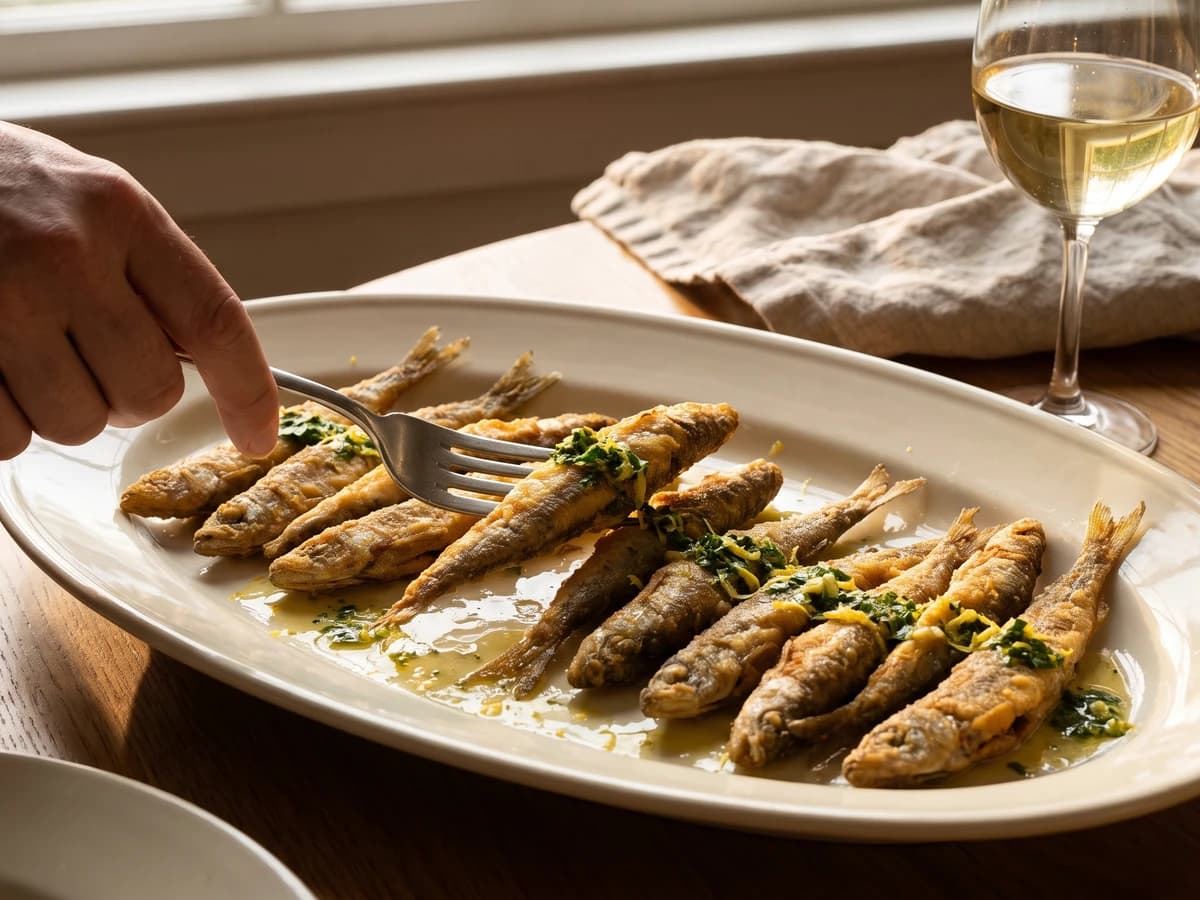
Éperlans à l’Anglaise turns small fish into a lesson in disciplined coating: boned smelts under a close, crisp crumb, pan-fried in clarified butter and finished with bright, half-melted maître d’hôtel butter.

Chef Juliette
Tiny smelts, shallot, mushrooms, white wine, gratin sauce, and fine bread raspings meet a fierce oven, where the fish must turn tender in the same breath the buttered crust bronzes.